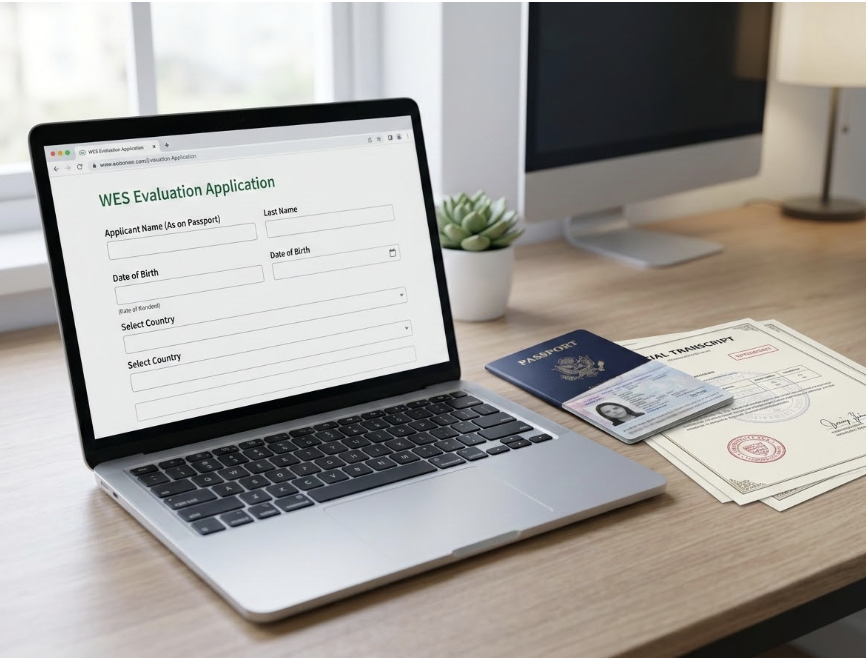
WES evaluations do not usually fail. They stall. The application sits at "documents required" for weeks while you refresh the portal, and by the time you find out what went wrong, the university deadline or licensing board cutoff is a lot closer than it was.
Almost all of it is avoidable. The delays below come from the same handful of misunderstandings about how the process works, and none of them require insider knowledge to sidestep. They just require knowing before you submit instead of after.
This is the single most common reason a file goes nowhere.
For most countries, WES will not accept transcripts and degree certificates that you mail in yourself, no matter how official they look. They have to come directly from the issuing institution or through an approved sender listed for your country. A scan you uploaded, a copy your university gave you in a sealed envelope that you then opened, a notarized photocopy: none of these satisfy the requirement.
Before you do anything else, open the Required Documents page for your specific country on the WES site. The rules genuinely differ. What India requires is not what Nigeria requires is not what Brazil requires. Read your country's page, not a generic checklist someone posted on Reddit in 2021.
Your WES account, your passport, and your academic records need to show the same name.
This sounds trivial until you realize how many transcripts list a maiden name, drop a middle name, use initials, or transliterate a name differently than the passport office did. Any of those mismatches can hold the file.
The fix is usually an affidavit or a name-change document explaining the discrepancy, notarized and submitted alongside everything else. Prepare it in advance if you already know your documents disagree with each other. Waiting for WES to ask costs you a full cycle.

Document-by-document and course-by-course are not interchangeable, and the cheaper one is not the safe default.
Document-by-document gives a general statement of your credential's US equivalence. It works for immigration and some employment purposes. Course-by-course lists every course, credit, and grade, and calculates a GPA. Graduate school admissions and most professional licensing boards require it.
Confirm what your receiving institution wants before ordering. Upgrading later is possible but means paying again and waiting again, and the second wait is not shorter than the first.
WES does not accept translations completed by the applicant. That extends to family members, friends, and anything run through a machine like Curipod translation tool and tidied up. It does not matter how fluent the person is or whether the English is flawless.
The translation has to be completed by a professional translator, which can be someone affiliated with a university, a certified translation agency, or another professional translation service.
Two useful details that people miss. First, translations do not need to arrive in a sealed envelope, unlike most other official documents in your file. That routing rule applies to your academic records, not to the translation. Second, if your documents are not in English, budget for WES translation at the same time you request records from your university, rather than treating it as a step you handle later. Running the two in sequence adds weeks for no reason.
Even a professionally produced translation gets rejected if it takes liberties with the format.
WES asks for translations that are exact and word-for-word, with all text in the original language accurately rendered into English or French, and clear enough that an evaluator can read every course title and grade along with the institutional and applicant details. A translator who condenses a course list, converts a grading scale into US letter grades, or explains what a credential is equivalent to has produced something WES cannot use.
That last one catches good translators who are trying to be helpful. Equivalence is WES's job. The translator's job is to reproduce what the document says, including the parts that look redundant: the stamps, the seals, the signature blocks, the grading legend printed on the back of the transcript, the handwritten note in the margin. Those get marked in the translation rather than dropped.
Formatting matters too. The translation should mirror the layout of the original closely enough that an evaluator can lay them side by side and match line to line.
A subtle one that produces confusing rejections.
Unofficial documents and student copies may not match the official versions exactly, so WES advises making sure your translator is working from official documents. Their own suggestion is to ask your institution for two sets: one to send to WES, and one for the translation service.
If your translator worked from the copy in your desk drawer and your university sent WES a version with a different course code or an extra line, the two documents disagree. The evaluator now has a discrepancy to resolve, and resolving it means writing to you and waiting.
Request the second set at the same time as the first. It costs a little more and saves the entire round trip.
Universities are slow to release records. Some charge fees, some require an in-person request, some take a month in the summer because the registrar's office is half staffed.
None of that is under your control, which is exactly why the timeline has to start earlier than feels necessary. Work backward from the date your evaluation report needs to be in someone else's hands, then add buffer for the one document that goes missing. Something usually does.
 AI tools to find & convert leads.
  Send emails at scale