
Web analytics software records how visitors reach a website and what they do once they arrive. Many teams started on Google's free suite and then ran into sampled reports and consent banners that hide part of their traffic.
GDPR also made the hosting location of visitor data a buying criterion, especially for European companies. The available options fall into two groups. The first is lightweight cookieless tools with a one-page dashboard. The second is product analytics platforms built around event tracking and funnels, often with experimentation features.
Several tools are free to self-host, while others charge by pageviews or by monthly tracked users. Some can also import historical Google data, so your existing trend lines carry over after the switch.
| # | Tool | Key Takeaway |
| 1 | Matomo | Free self-hosted edition or Cloud from €22 per month, with unsampled data and a CNIL-approved consent-exempt tracking option. |
| 2 | Plausible Analytics | Open-source cookieless analytics processed on EU servers, with a one-page dashboard and more than 22,000 paying customers. |
| 3 | Fathom Analytics | Cookieless analytics from $15 per month, with unlimited data retention and European infrastructure for EU traffic. |
| 4 | Piwik PRO | Privacy-focused analytics suite with an interface close to Google Analytics and consent management built into the platform. |
| 5 | Mixpanel | Product analytics used by 29,000 customers, with a free plan and reports that require no SQL knowledge. |
| 6 | Amplitude Analytics | Product analytics with a free plan up to 50,000 monthly tracked users and AI agents that detect anomalies. |
| 7 | Simple Analytics | Cookieless collection layer that runs alongside GA4 and measures visitors who decline consent, with data hosted in Europe. |
| 8 | Adobe Analytics | Enterprise platform connecting web and mobile analytics with product data, including built-in attribution modeling and governance controls. |
| 9 | Umami | Open-source, cookie-free analytics available self-hosted or in the cloud, with session replays and revenue tracking. |
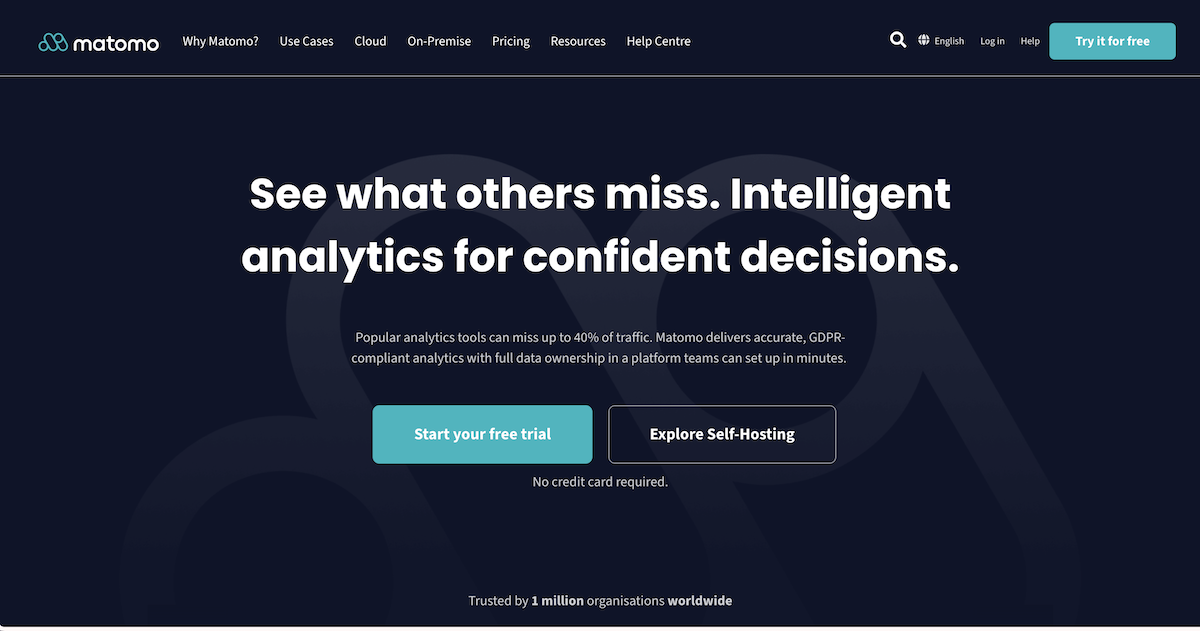
Matomo is an analytics platform for teams that want to own their data. The On-Premise edition is a free self-hosted edition. The Cloud version starts at €22 per month for 50,000 hits on servers in Germany, with a 21-day trial that needs no credit card. More than one million websites in over 190 countries use Matomo.
Its main asset is unsampled data: reports are built from every tracked visit. With consent-exempt tracking enabled, they also include visitors who would decline a banner. You own the data, whether you self-host Matomo or use the Cloud plan.
Matomo supports GDPR and CCPA compliance. It can be configured for consent-exempt tracking under CNIL requirements, which removes the need for a banner in that configuration. A built-in GDPR Manager handles user requests such as the right to be forgotten. The platform is ISO 27001:2022 certified and is used by the European Commission.
Matomo includes heatmaps and session recordings alongside A/B testing, form analytics and tracking of traffic from AI assistants, so you can study on-page behavior without adding a separate tool. The tracking code is a JavaScript snippet, and Matomo has more than 100 integrations, including WordPress and Google Tag Manager. On-Premise users can add over 75 plugins from the Marketplace. Teams leaving Google Analytics can import their GA history to keep long-term trends.
Running the On-Premise edition requires server administration skills on your side. Teams without that capacity can use the Cloud plan and still keep ownership of their data.
Matomo is well suited to organizations that need unsampled analytics data and control over where it is hosted.


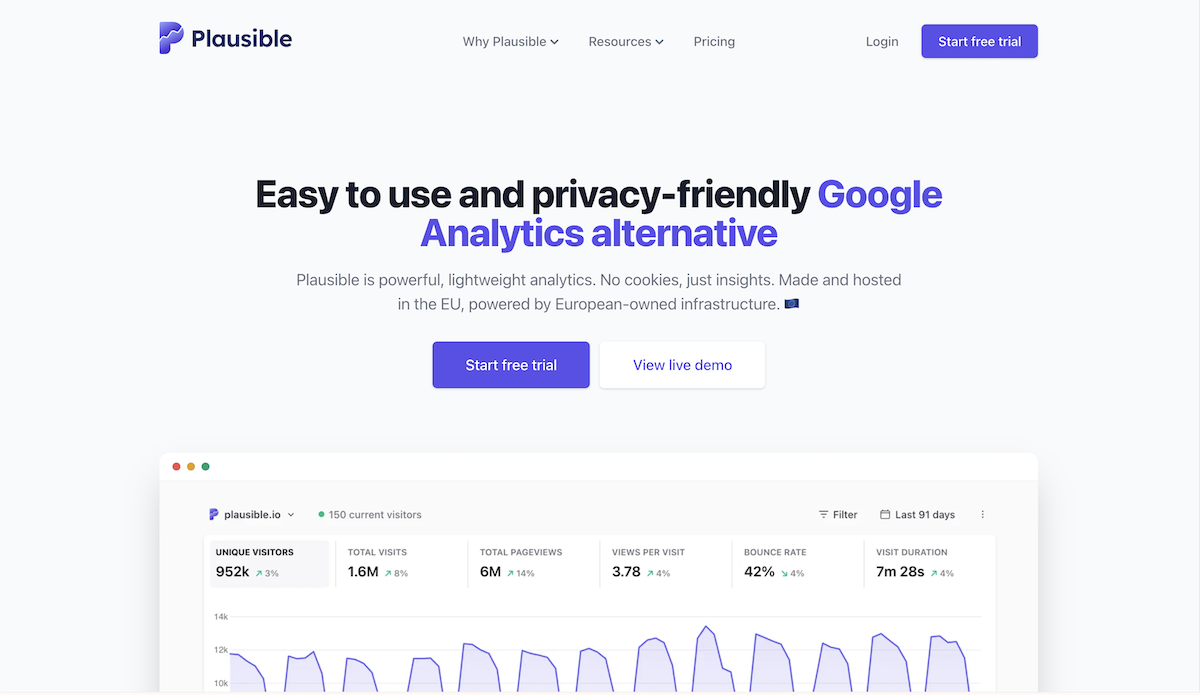
Plausible Analytics is an open-source, cookieless tool that shows every essential metric on a single page, with no nested menus or custom reports to build. Pricing increases with traffic, and the entry plan covers up to 10,000 monthly pageviews. A 30-day free trial requires no credit card.
Plausible sets no cookies or persistent identifiers and does not track visitors across sites or devices, so no consent banner is required. It processes visitor data on European servers only, and the data never leaves the EU.
The script is 54 times lighter than Google Analytics, which means 135 KB less JavaScript per visitor. You can also import Google Analytics data to keep your history.
Plausible has more than 22,000 paying customers, including Stripe, Mozilla, MongoDB and Harvard University. The 10-person company is self-funded.
Plausible is a good fit for content and marketing sites that need core traffic metrics without consent banners.
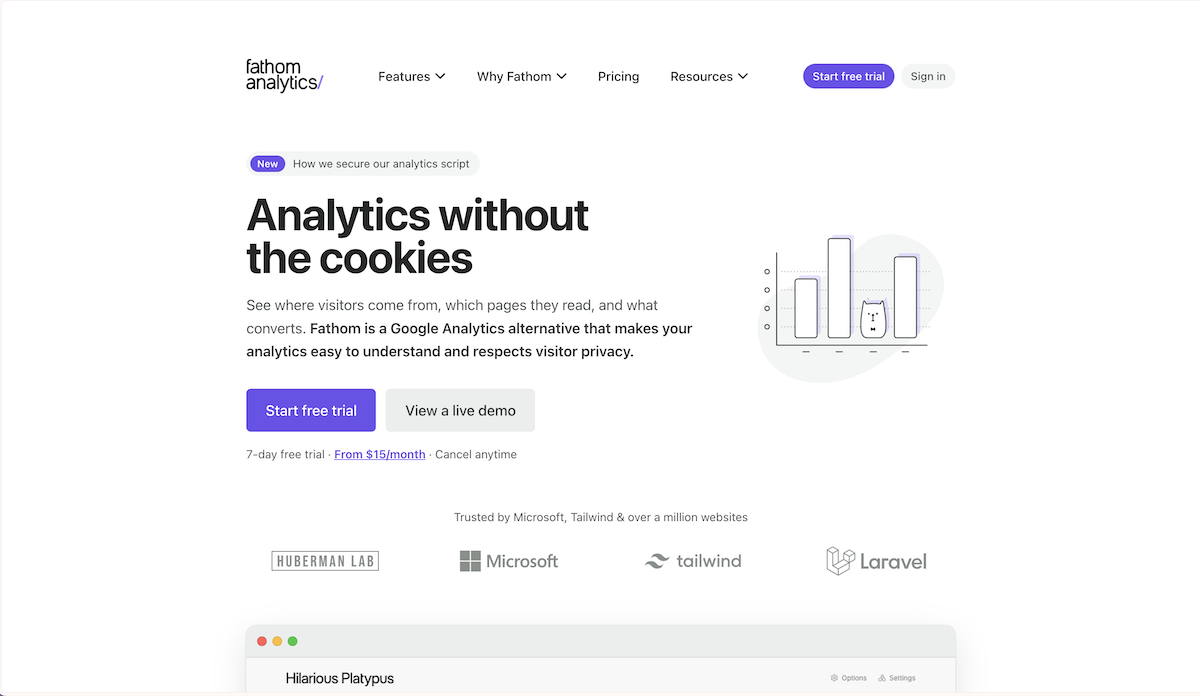
Fathom Analytics is a cookieless analytics tool priced from $15 per month. A 7-day free trial is available, and you can cancel at any time. More than one million sites use Fathom, including Microsoft, Premier League clubs, banks and government bodies.
Fathom supports compliance with GDPR, CCPA, ePrivacy and PECR, and because it uses no cookies, no consent banner is needed. It processes EU traffic on European infrastructure, and as a Canadian company it is covered by the Canada-EU adequacy decision.
The dashboard shows real-time data within minutes of installation, which takes one line of code on any website or CMS. It handles UTM campaigns and custom events, with unlimited data retention.
Teams moving from GA4 can import their GA4 history. Fathom is bootstrapped and earns its revenue from software subscriptions, with no resale of data.
Fathom is well suited to businesses with EU visitors that want banner-free tracking with long-term history.
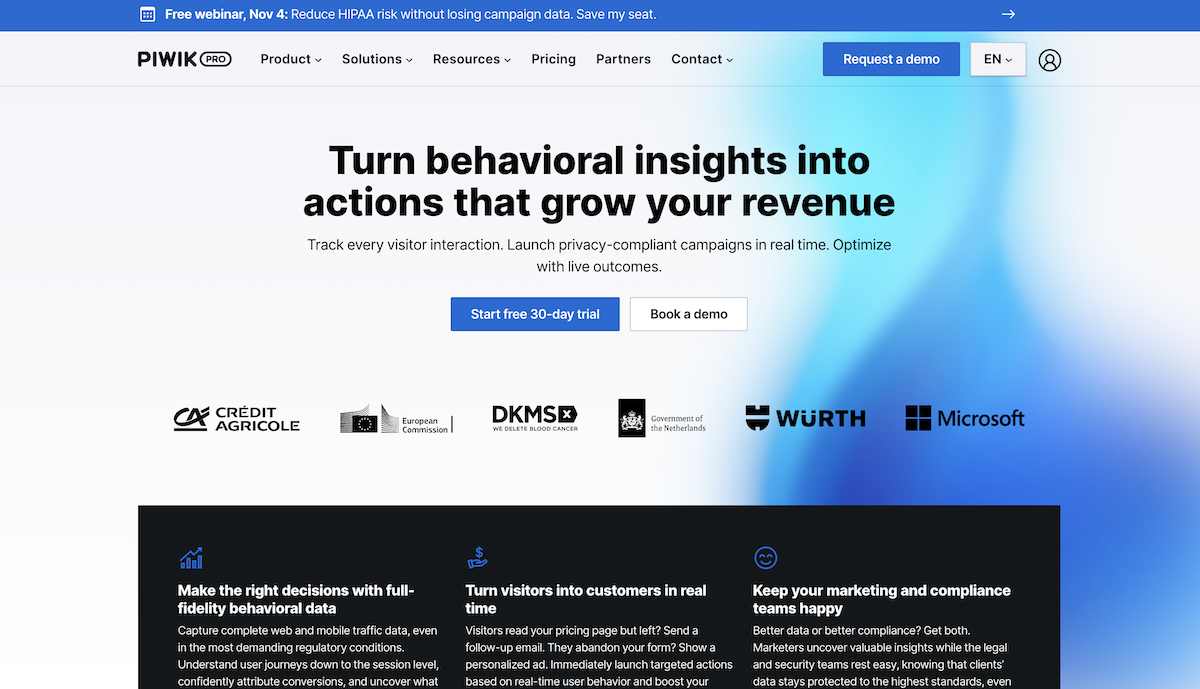
Piwik PRO is a privacy-focused analytics suite whose interface stays close to Google Analytics, so former GA users recognize the layout. It bundles a Tag Manager and a Consent Manager with detailed reports. Training and support are included on every plan.
Piwik PRO includes built-in consent management and supports GDPR along with more than 140 other regulations. It also supports HIPAA compliance, so healthcare organizations can use it.
Piwik PRO uses behavioral data for conversion attribution, and a data activation module applies it to real-time segmentation and targeted campaigns. You can export structured data through the API or send it directly to BI tools.
Piwik PRO is a strong option for regulated organizations, healthcare in particular, that want Google Analytics-style reporting under strict consent rules.
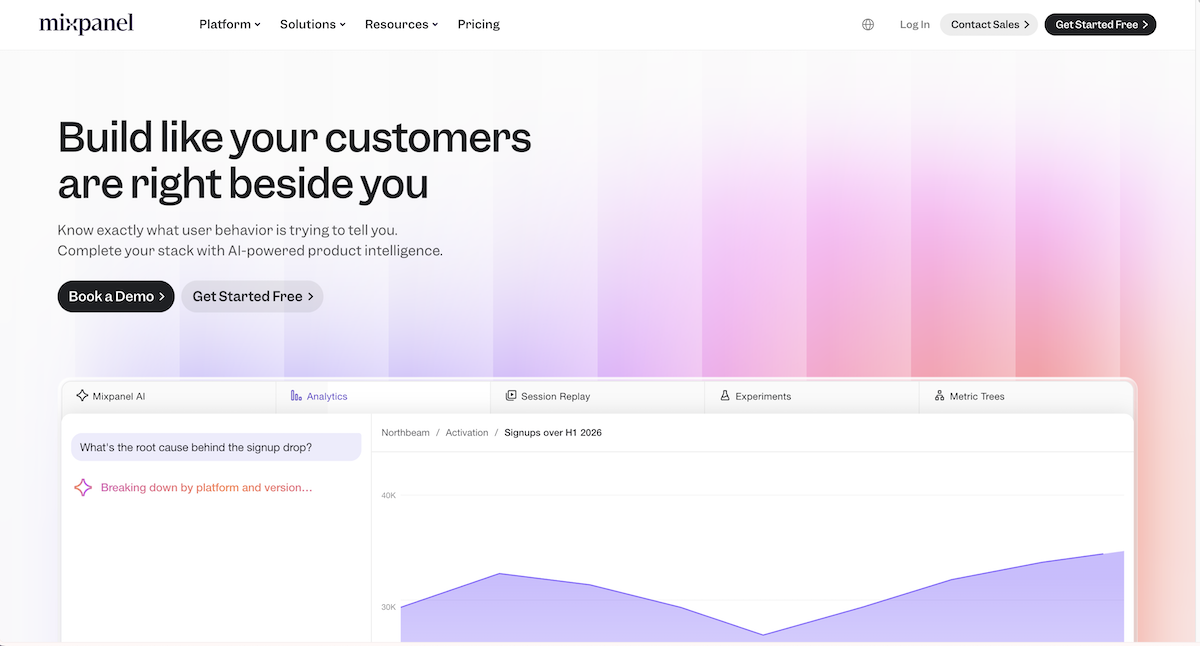
Mixpanel is a product analytics platform that combines event analytics with session replay, experiments, feature flags and AI insights. A free plan is available, and 29,000 customers use the product worldwide.
Mixpanel supports GDPR and CCPA compliance and signs Business Associate Agreements for HIPAA. It stores data on US servers by default, and its European Data Residency Program moves it to an EU cloud.
Reports need no SQL knowledge, so product managers and designers can query data without waiting for engineers. AI agents monitor product metrics continuously, and an MCP integration brings Mixpanel into assistants such as Claude and ChatGPT.
Mixpanel connects to 100+ marketing tools, including CRMs, data warehouses, CDPs and ad platforms such as Google Ads. A Forrester study found a 354% ROI with a six-month payback, and the product has a 4.5/5 average rating from more than 1,300 reviews.
Mixpanel is particularly well suited to product teams that track in-app user behavior more than website traffic.
Amplitude Analytics is a product analytics platform focused on real-time user behavior, with AI features for anomaly detection. Its free plan covers up to 50,000 monthly tracked users, and Plus starts at $49 per month billed annually. Growth and Enterprise pricing is available on request.
Amplitude holds SOC 2 Type 2 certification and several ISO 27000-series standards. It supports GDPR and HIPAA compliance, so teams handling health data can use it.
AI agents watch for anomalies around the clock, and session replay flags errors and user frustration. Server-side experimentation supports A/B/n tests on features.
Amplitude offers 139 integrations, including CDPs such as Segment and Tealium and warehouses such as BigQuery and Amazon Redshift. Forrester named it a Leader, with top scores on 21 criteria.
The interface is visually busy, so expect a learning curve before teams work independently. Amplitude Academy offers training courses.
Amplitude is best suited to data-mature product teams that run frequent experiments at scale.
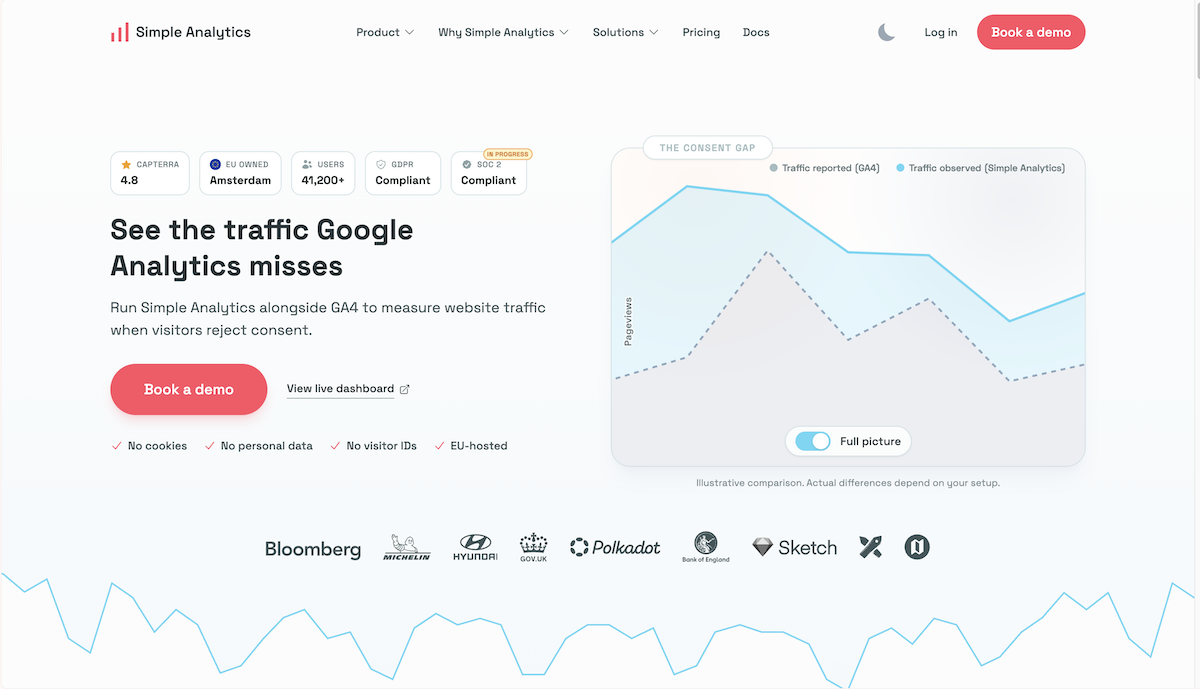
Simple Analytics is a cookieless analytics tool that can run alongside GA4 without changing your existing configuration. It measures traffic independently, including visitors who decline consent in your banner. A 30-day free trial is available.
The tool calculates sessions without creating visitor identities, so it needs no cookies and no banner. Simple Analytics has more than 31,300 users. The company is based in Amsterdam, and all data is hosted in Europe.
An export API covers pageviews, events, referrers and campaign data. You can send that data to BI tools such as Looker Studio and Power BI, or to a data warehouse.
Simple Analytics is a good fit for GA4 users who want a consent-free traffic count next to their current setup.
Adobe Analytics is an enterprise analytics platform that brings web and mobile analytics together with product interaction data. Its AI tools identify trends in audience and content performance across channels.
Administrators can set granular permissions by team, and data processing rules apply in the same way across platforms. A persistent customer identity links each person's interactions over the full lifecycle, so a mobile visit and a later desktop purchase can be tied to the same customer.
Built-in attribution modeling shows which channels drive conversions, which helps you adjust campaign spend. Business teams can build reports in Analysis Workspace without writing queries.
Adobe Analytics is a strong option for large enterprises that need cross-channel attribution under strict data governance.
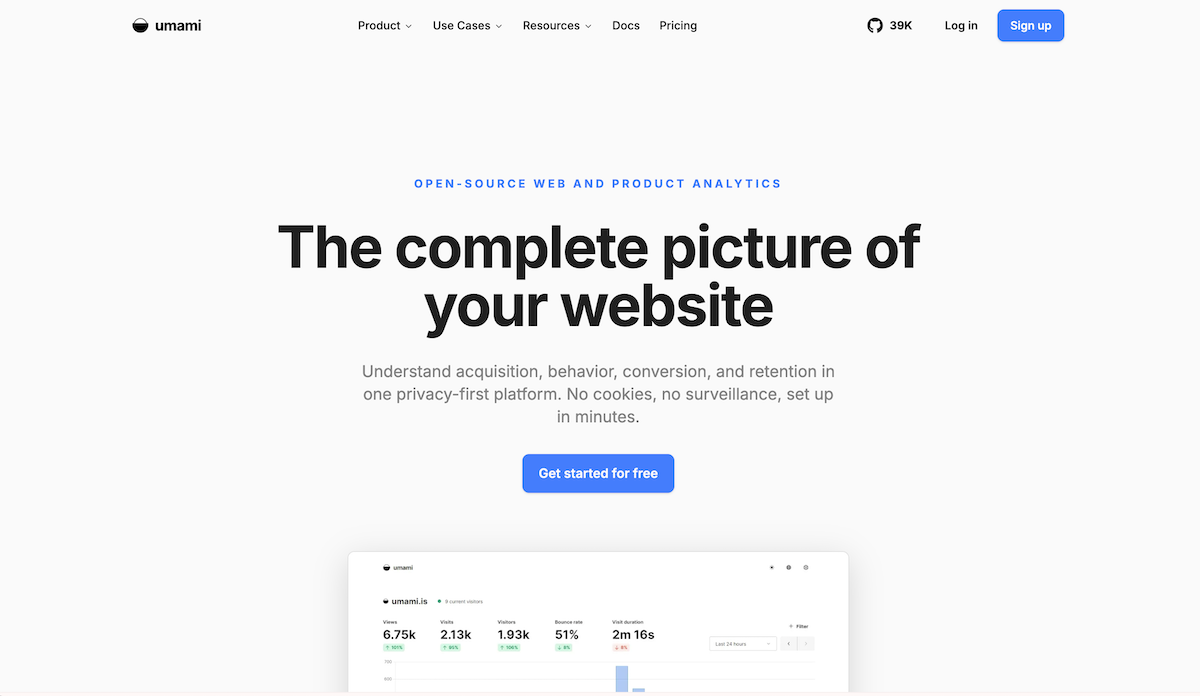
Umami is an open-source analytics tool available self-hosted or as Umami Cloud. It runs without cookies and does not track visitors across sites.
The dashboard shows visitors, pageviews, referrers and bounce rate on one screen, and you can filter by date, country, device or browser. Setup uses a tracking script, and custom events can be added with data attributes. UTM campaign tracking is automatic.
Umami also includes session replays and user journeys that show where visitors drop off. Multi-channel attribution and revenue tracking are built in, so you can connect traffic sources to sales.
Umami is a good fit for teams that want self-hostable open-source analytics with product features such as replays and revenue tracking.
 AI tools to find & convert leads.
 Send emails at scale