Most founders don't lose funding because their idea was weak. They lose it because their deck failed to tell the story clearly. Finding the best presentation design agencies for startup pitch decks means cutting through a market full of generalist designers who've never sat across a VC table. After reviewing dozens of agencies, platforms, and tools, the real gap is always the same: visual polish without investor psychology is just expensive wallpaper. This guide covers five standout options that actually understand what moves investors to say yes.
The research approach for this ranking
Public review platforms, verified client testimonials, agency websites, and third-party directories all fed into how each option was assessed. Only agencies and platforms with a documented history in presentation design made the cut. Patterns in client outcomes, pricing transparency, and turnaround reliability were weighted heavily throughout the process.
-> See the full research breakdown
Whitepage Studio - Best for investor pitch decks and fundraising presentations
Storydoc - Best for interactive pitch decks with engagement tracking
Duck Design - Best for rapid pitch deck revisions with unlimited revisions
Superside - Best for enterprise pitch decks with quick turnarounds
Slide Bean - Best for startup founders raising capital
While pitch deck specialists focus on investor presentations, businesses with ongoing creative needs can also benefit from Penji Graphic Design Services for presentation graphics, branded templates, marketing materials, and other custom design projects.
Putting together a pitch deck sounds simple until you're staring at slide seven trying to explain a two-sided marketplace model without losing the room. The challenge isn't just visual. It's compressing a complex business model into 10 to 15 slides while keeping investor credibility intact. Agencies with genuine VC ecosystem knowledge understand that balance. They know which slides investors skip, which charts read as noise, and how narrative flow affects meeting conversion rates.
The right agency doesn't just make things look good. It shapes how your business lands in the room, and that directly affects how many investor meetings your deck generates, how strong your funding success rate looks over time, and how quickly a polished deck gets into investors' hands.
Note: All data in this table is sourced from review platforms and the official websites of the listed companies.
| Company Name | Years Operating | Team Size | Price | Headquartered In |
| Whitepage Studio | 12+ years | 1-10 employees | From $3,000/project | Boston, MA, USA |
| Storydoc | Est. 2019 | 11-50 employees | From $17.40/month | Tel Aviv, Israel |
| Duck Design | Est. 2019 | 11-50 employees | From $1,199/month | London, UK |
| Superside | Est. 2015 | 501-1,000 employees | $5,000-$10,000+/month | Wilmington, DE, USA |
| Slide Bean | Est. 2013 | 33-40 employees | From $8/month | New York, USA |

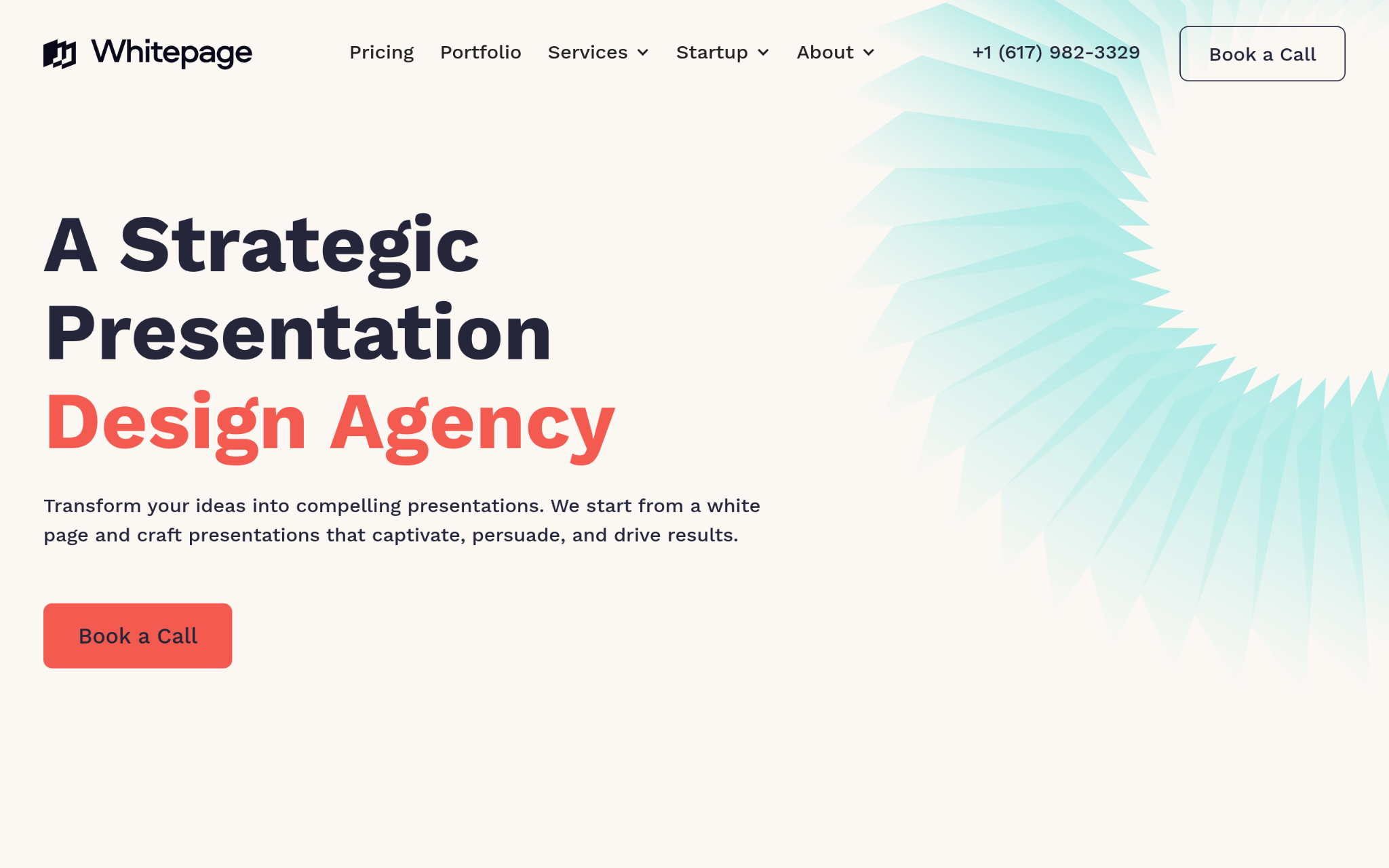
What Does Whitepage Studio Do?
With over 12 years in the presentation design space, the team behind Whitepage has built a reputation for turning difficult business models into investor-ready narratives. They cover technology, finance, healthcare, education, and nonprofit sectors, working across investor pitch decks, sales presentations, and financial modeling. The CEO stays directly involved in every project, which keeps strategic input sharp and consistent. Their 10,000-plus completed projects and reported $1.7B-plus in client acquisitions aren't numbers you see often, and that kind of track record is genuinely hard to match.
Why Whitepage Studio Stands Out for Presentation Design Agencies For Startup Pitch Decks:
Founders dealing with tight fundraising timelines and a complex story to tell need more than a designer. They need someone who understands what investors actually want to see. Whitepage Studio brings exactly that through CEO-led strategy paired with investor-focused storytelling.
Summary of Real User Reviews:
From what the reviews show, clients keep coming back. A 75% repeat client rate and a 9.8 out of 10 satisfaction rating back that up. Reviewers consistently call out the CEO's direct involvement, the responsiveness to feedback, and the team's ability to make complicated information feel clean and clear. And that's not an easy thing to pull off under deadline pressure.
What Does Storydoc Do?
Storydoc takes the traditional slide deck format and replaces it with scroll-based, web-native documents that behave more like interactive experiences than static presentations. Built for pitch decks, proposals, and sales materials, the platform includes assisted content generation, real-time engagement analytics, and CRM connections. Founders can see exactly how long an investor spent on each section, which slides got the most attention, and where interest dropped off. That kind of feedback loop is rare in the pitch deck world and genuinely useful during fundraising rounds.
Why Storydoc Stands Out for Presentation Design Agencies For Startup Pitch Decks:
The platform solves a problem most founders don't even know they have: after you send a deck, you're flying blind. Storydoc's engagement tracking tells you whether investors actually read past slide three, which changes how you follow up and what you adjust next.
Summary of Real User Reviews:
G2 users are generally positive about the interface quality and how professional the final output looks. The most common praise centers on the analytics and how easy mobile responsiveness is to work with. Some reviewers mention that custom branding options feel limited on lower pricing tiers, so teams with strict brand standards may want to factor that in before committing.
What Does Duck Design Do?
Duck Design runs on a subscription model that covers unlimited design requests and revisions at a fixed monthly rate. They work across presentation design, PowerPoint creation, UI/UX, branding, and motion graphics, serving businesses of all sizes. For startups in fast-moving fundraising cycles, their same-day delivery capability on higher-tier plans is a real differentiator. Clients including Amazon, Logitech, and Virgin Group appear on their roster, which shows they can handle both enterprise-grade work and startup-level speed.
Why Duck Design Stands Out for Presentation Design Agencies For Startup Pitch Decks:
Pitch decks rarely get finished in one pass. Founders revise constantly as investor feedback rolls in, and Duck Design's unlimited revision model removes the financial friction that usually comes with iterating under pressure. Fewer bottlenecks, faster turnaround between feedback rounds.
Summary of Real User Reviews:
Verified reviews on Clutch (58 of them) consistently mention fast turnaround, clean design quality, and how quickly the team picks up on brand guidelines. A few clients flagged timezone differences as something that adds a day or two to communication cycles, though from what the reviews show, it rarely derails the overall project outcome.
What Does Superside Do?
Superside operates as a Creative-as-a-Service platform with a network of 700-plus vetted designers across 70-plus countries. They serve over 450 brands and cover presentation design, data visualization, motion graphics, video production, and custom illustration, all within their subscription tiers. The fact that Superside's founders went through Y Combinator in 2016 gives their pitch deck work a layer of credibility that's hard to fake. They know fundraising from the inside, and that shapes how their teams approach investor presentation design (think strategy, not just aesthetics).
Why Superside Stands Out for Presentation Design Agencies For Startup Pitch Decks:
Scale and speed are usually in tension, but Superside manages both through a global creative network that delivers 98% of projects on or before deadline. For growth-stage startups preparing for Series A or B with complex decks and tight demo day timelines, that kind of reliability carries real weight.
Summary of Real User Reviews:
The G2 score sits at 4.5 out of 5 across 120 reviews, with consistent praise for delivery speed, design quality, and how well the team functions as an extension of in-house teams. The honest caveat: pricing runs high (think enterprise-level spend), and smaller startups sometimes report the cost-to-output ratio feeling steep. Enterprise clients with larger budgets tend to report much stronger satisfaction overall.
What Does Slide Bean Do?
Slide Bean is a platform built around startup pitch decks and investor presentations. The tool separates content from design, using automation to produce visually polished decks without requiring any design skills from the founder. Beyond the software, they offer pitch deck consulting, financial modeling templates, and investor matching. Over 30,000 startups have used the platform, with reported collective fundraising exceeding $250 million. For first-time founders who need to move fast without hiring a full design team, it's a genuinely practical starting point.
Why Slide Bean Stands Out for Presentation Design Agencies For Startup Pitch Decks:
The platform addresses the most common founder problem head-on: needing an investor-ready deck without the budget for a full-service agency. Slide Bean's combination of startup-specific templates, built-in analytics, and optional human consulting covers the whole journey from blank page to investor inbox.
Summary of Real User Reviews:
Capterra reviewers give it 4.2 out of 5, and the strongest feedback consistently centers on how easy the interface is and how professional the output looks without design experience. Pricing draws some frustration relative to what you get at higher tiers. The consulting service gets mixed marks too. When it works, clients say the partnership feels genuinely collaborative. When it doesn't, responsiveness is the complaint.
The process started by pulling agency and platform listings from major industry directories, design-focused review platforms, and startup community forums where founders actively discuss pitch deck services. The goal at this stage was breadth, building a working list of every credible option that appeared across multiple sources, not just the ones with the loudest marketing presence. Clutch, G2, Capterra, and official company websites all contributed data points to that initial pool.
From that broader list, options with thin or unverifiable review histories were removed first. What remained was put through a closer look at review patterns: consistency of feedback across platforms, recency of reviews, and whether positive sentiment was specific enough to be credible. Generic praise (things like "great experience!") was discounted. Specific outcomes related to investor meetings secured, deck revisions completed, or fundraising results were weighted more seriously.
Every claim that appeared on an agency's own website was cross-checked against third-party sources. If a company claimed a particular client success rate or project volume, that figure needed some form of corroboration through verified reviews, press mentions, or documented case studies. Claims that couldn't be traced back to anything independent were noted but not treated as leading evidence in the final assessment.
Agencies and platforms that had received coverage in startup-focused publications, accelerator recommendations, or design industry recognition were scored favorably in this layer. Direct connections to the VC ecosystem, such as founders with accelerator backgrounds or documented history of working with funded startups, were treated as meaningful signals. This wasn't about trophy collection. It was about whether an option had earned external validation from people who understand investor-facing presentation design.
The final filter was the most specific. Each remaining option was assessed for dedicated pitch deck service pages, verified reviews from startup founders, and documented case studies showing outcomes in fundraising contexts. Agencies or platforms that served presentation design as one service among dozens were evaluated differently from those where pitch decks represented a major focus. Options that passed all five layers made the final list.
Choosing the right agency or platform comes down to fit, not just quality. A tool that works for a Series B deck at a SaaS company may be completely wrong for a pre-seed biotech founder. Here are five factors worth weighing before you commit:
Industry and Domain Experience: Look for agencies that have worked with startups at your stage and in your sector. Investor expectations vary widely between, say, fintech and healthcare, and a designer without that context will default to generic.
Features and Services: Some options are pure design execution. Others add consulting, storytelling guidance, or financial modeling. Know which gaps you actually need filled before comparing price tags.
Pricing Structure: Subscription models suit founders who need ongoing revisions. Project-based pricing works better for a one-time fundraising deck. Watch for hidden revision fees that add up fast.
Results Measurement: The best agencies track what happens after the deck goes out. Engagement analytics and investor meeting rates tell you more than a polished PDF ever will.
Industry Knowledge and Compliance: Pitch deck standards shift as VC norms change. Agencies plugged into the startup ecosystem are more likely to know what investors actually want to see right now, not two years ago.
Picking the right presentation design agency matters more than most founders realize until a deck falls flat. The agencies and platforms in this list each bring something distinct, whether that's CEO-level strategic input, interactive engagement tracking, or unlimited revisions on a subscription. Your stage, budget, and how complex your story is will point you toward the right fit. And the good news: the standard for investor-facing presentation design keeps rising, and the options for meeting that standard have never been stronger.
 AI tools to find & convert leads.
  Send emails at scale