
Why migration agency choice matters in 2026? Choosing your Shopify migration service provider matters more than you think.
Not because migration is inherently complex or risky, but because the wrong partner can slow your project down, inflate your costs, and disrupt systems you may not have realized were at risk.
As reported by BigCommerce, citing data from MageMontreal, nearly 46% of online retailers now consider replatforming a top priority. This frames migration less as a reactive fix and more as a proactive growth strategy.
When moving to Shopify, you need Shopify experts who understand your ecommerce business logic as thoroughly as the platform itself.
A successful migration involves far more than transferring data.
It calls for comprehensive solutions that rebuild the system, keeping your store running - business operations, inventory management, store's performance, tracking, SEO, pricing, taxes, subscriptions, all of it.
If you’re a small online business owner, there are also reputable Shopify migration agencies for small businesses that offer tailored services and budget-friendly ecommerce solutions.
| Agency | Strength | Best For | Platform Specialization |
| craftberry | In-house senior developers with deep technical expertise in complex Shopify and Shopify Plus replatforming, including ERP logic and custom business rules. | Brands needing full platform replatform + data and UX migration, including Plus. | Shopify, Shopify Plus migrations from custom and legacy platforms like Magento. |
| Elogic Commerce | Shopify Plus migration expertise combined with B2B functionality and business system integrations. | Mid-market and enterprise merchants with complex operational requirements. | Shopify Plus migrations from Magento, WooCommerce, SAP Commerce, Salesforce Commerce Cloud, and custom platforms. | |
| Swanky agency | End-to-end replatforming with strategic discovery, data handling, redirects, and bespoke planning. | Large, complex replatforming projects for systems like Magento, WooCommerce, BigCommerce, and Salesforce Commerce Cloud. | Shopify Plus migrations from multiple legacy platforms. |
| Avex | Enterprise-grade migrations that include data transition, integrations, and custom feature builds. | Ecommerce growth and enterprise merchants need a complete replatform. | Migrations from other ecommerce platforms like Salesforce Commerce Cloud, Magento, WooCommerce, and BigCommerce. |
| Fourmeta | End-to-end Shopify migration with tested processes and ongoing support, covering design and launch. | Merchants are looking for a seamless migration with performance improvements. | Migrations (data + Shopify store setup). |
| SmartOSC | Trusted Shopify partner cited in discussions of replatforming projects. | Brands want a partner with global reach and broad service offerings. | Migrations and broader commerce solutions. |
| BSS Commerce | One-stop migration service that covers data, settings, URLs, and post-migration support; supports 140+ source platforms. | Stores migrating from multiple platforms with heavy data volumes and integrations. | Migrations, including Shopify Plus. |
| Atwix | Proven migration methodology with detailed feature mapping and audit processes. | Merchants need careful data and feature planning before a Shopify migration. | Shopify migrations with structured technical planning. |
| Velt 2 | Migration with minimal downtime, SEO continuity, and performance focus. | Ecommerce stores that cannot afford interruptions or data loss during replatforming. | Shopify migration services. |
| Bedford Lane | Boutique agency with migration capabilities tied into web design and UX-focused replatforms. | Creative and lifestyle brands focused on design-forward migrations. | Shopify migrations coupled with custom design work. |
| Novatize | Canadian ecommerce agency with well-organized project management and steady data replatforming for mid-market brands. | Mid-sized brands want a structured technical partner without the scale of a large global agency. | Shopify and Shopify Plus migrations from Magento, WooCommerce, and custom-built systems. |
| Fyresite | Shopify Plus migrations with expertise in complex product catalogs, custom integrations, and automotive eCommerce. | Mid-market and enterprise brands with complex migration, automotive, or B2B requirements. | Shopify and Shopify Plus migrations, including Magento, BigCommerce, WooCommerce, and Drupal. |
Choosing one of the top Shopify agencies is essential for a risk-free and smooth transition that meets your business objectives.
When comparing providers, it’s important to look at proven case studies and Shopify migration agency reviews to understand their real results and customer satisfaction.
Make sure the agency has strong SEO optimisation and performance expertise, since proper 301 redirects and Core Web Vitals can make or break your traffic and online visibility after launch.
A full-service approach is another key factor, covering design, web development, integrations, QA, and post-launch stabilization in one place. The agency should also test your Shopify payment integration before launch, including the checkout flow, refunds, payment confirmation and reconciliation.
Prioritize agencies with official Shopify Partner status, and if possible, ones that are Shopify Plus certified.
If your Shopify store requires custom logic, international functionality, or high-volume performance, look specifically for Shopify Plus migration agencies.

With Shopify adoption growing every year, the demand for professional migration support is higher than ever.
Finding the Shopify migration experts is essential if you want a smooth, secure, and hassle-free transition.
Below is a curated list of the best agencies for Shopify migration known for reliable, complex processes, technical expertise, and proven results in delivering user-friendly Shopify stores.

craftberry is a certified Shopify Plus agency with extensive experience in complex Shopify and Shopify Plus migrations.
The team consists of 30+ in-house senior Shopify developers, designers, and CRO specialists, experienced in multiple projects in end-to-end replatforming.
craftberry has worked exclusively on Shopify and Shopify Plus projects for over a decade.
In their portfolio, they have completed complex work that features custom business rules, ERP integrations, multi-currency, internationalization, and enterprise solutions.
Notable Shopify Migration Case Studies:
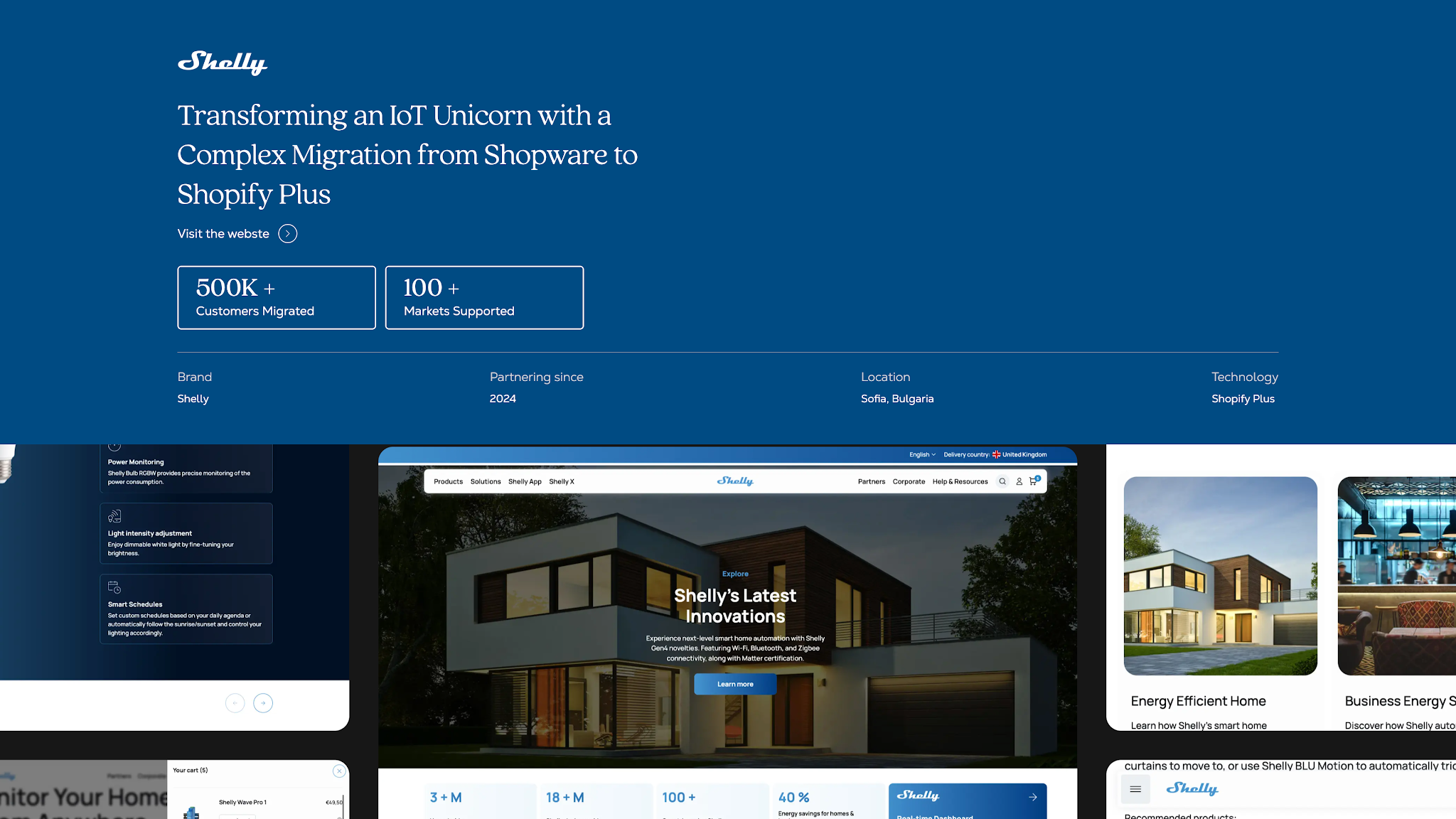
Shelly (Global IoT brand)
Migrated from their current ecommerce platform with complex product structures, multi-currency needs, and unique tax rules. craftberry handled the full migration (customers, orders, product data), implemented a scalable Shopify Plus architecture to streamline operations, optimized user flows, and integrated Adyen for global payments.
Pepper / WearPepper (D2C apparel brand)
Replatformed to Shopify with a complete redesign, updated conversion paths, improved PDP structure, and better navigation for international shoppers.
Key points about craftberry:
Extensive experience with complex Shopify and Shopify Plus migrations
In-house senior developers handling data, logic, integrations, and custom Shopify app development
Familiar with ERP connections, custom business rules, and multi-market setups
Structured migration workflow with clear planning and communication
Ability to combine migration with redesign and CRO improvements that drive business growth
Provides reliable support during and after launch
UX/UI team that designs conversion-focused Shopify stores.
Elogic Commerce is an ecommerce engineering agency with experience in Shopify Plus and Adobe Commerce projects for mid-market and enterprise businesses.
The agency supports migrations from platforms such as Magento, WooCommerce, SAP Commerce, Salesforce Commerce Cloud, and custom-built systems. Its work covers migration planning, data transfer, custom B2B functionality, integrations with ERP and other business systems, SEO preservation, testing, and post-launch support.
Key points about Elogic Commerce:
Experience with Shopify Plus and complex ecommerce replatforming
Supports migrations from major ecommerce and legacy platforms
Handles ERP, CRM, PIM, OMS, and other third-party integrations
Experience with custom B2B workflows and business logic
Focuses on SEO continuity, data accuracy, and operational stability
Provides technical support during and after launch

WebContrive is a Shopify-focused agency specializing in Shopify migration, Shopify Plus development, performance optimization, CRO, and custom ecommerce solutions. The team helps brands migrate from platforms such as Magento, WooCommerce, BigCommerce, OpenCart, and custom-built systems while minimizing downtime and protecting SEO performance.
Rather than simply transferring data, WebContrive approaches migration as a complete replatforming project. Their process includes migration planning, URL mapping, data validation, theme development, third-party app integration, QA testing, and post-launch support. The agency also focuses on improving Core Web Vitals, user experience, and conversion rates, allowing merchants to launch with a faster and more scalable Shopify store.
Key points about WebContrive:
Specialized in Shopify and Shopify Plus migrations from Magento, WooCommerce, BigCommerce, OpenCart, and custom ecommerce platforms
Provides end-to-end migration services, including data migration, theme development, app integrations, and quality assurance
Prioritizes SEO preservation with proper 301 redirects, metadata migration, and structured URL mapping
Optimizes store performance through Core Web Vitals improvements, Shopify speed optimization, and technical best practices
Supports custom functionality, Shopify app integrations, and scalable Shopify Plus implementations
Offers post-launch monitoring, technical support, and ongoing optimization to ensure a smooth transition and long-term growth

Swanky is a UK-based Shopify Plus agency with experience handling successful migrations from ecommerce platforms like Magento, WooCommerce, and BigCommerce to Shopify.
Their process is structured, focusing on planning, clean data replatforming, and maintaining SEO rankings during the transition.
They also offer UX and CRO support, which can be useful for brands that want to refine their Shopify site experience while replatforming.
Key points about Swanky:
Experience with migrations from major ecommerce platforms
Clear project scoping and organized workflows
Offers UX and CRO improvements alongside technical migration
Shopify Plus certified team
Provides ongoing support after launch.

Avex is a US-based Shopify Plus agency with experience handling migrations for lifestyle, fashion, and consumer brands.
This Shopify agency offers technical replatforming combined with storefront visuals and digital marketing.
Key points about Avex:
Handles migrations to Shopify and Shopify Plus for mid-market and enterprise brands
Experience migrating from ecommerce platforms like Magento, WooCommerce, and custom builds
Offers design, branding, and performance marketing alongside the technical migration
Can support integrations with CRM, email platforms, subscriptions, and payment systems
Provides structured planning and support throughout the migration process.
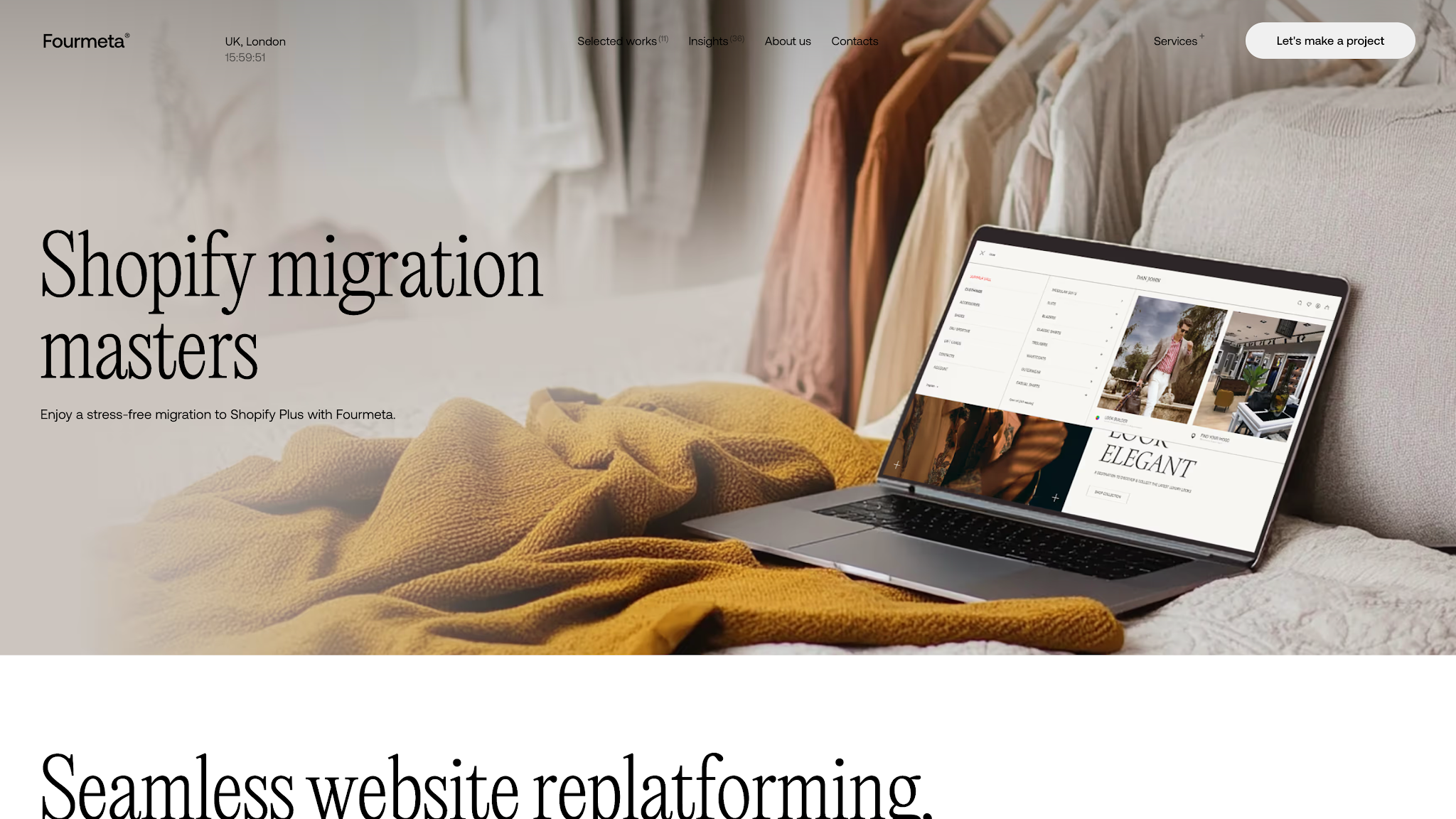
Fourmeta is a digital agency offering Shopify migration services alongside broader work, such as social media advertising, with a clear, process-oriented approach.
They focus on guiding merchants through the full replatforming journey, from planning and data transition to design adjustments and launch support.
Their migrations are suitable for brands that want a structured workflow and straightforward communication as they move from platforms like WooCommerce, Magento, or custom systems to Shopify.
Key points about Fourmeta:
Offers end-to-end Shopify migration services
Experience migrating from WooCommerce, Magento, and other platforms
Provides data transfer, store setup, and design adjustments
Uses a defined process for planning and delivery
Offers support before, during, and after launch.

SmartOSC is a full-service digital agency that also provides Shopify migration services.
Their team is experienced in helping brands move from enterprise platforms and legacy systems to Shopify.
SmartOSC’s migration approach typically includes data replatforming, functionality mapping, and integration support, which can be useful for merchants with more complex operational requirements.
Key points about SmartOSC:
Supports migrations from enterprise platforms and older legacy systems
Experience with Shopify and Shopify Plus implementation
Can assist with integrations, custom features, and operational workflows
Provides data migration, setup, and launch assistance
Suitable for mid-market and enterprise brands requiring a broader agency structure.
BSS Commerce is a development-focused agency offering Shopify migration services for Shopify merchants moving from a wide range of platforms.
They emphasize accurate data transition, configuration, and technical setup, which makes them suitable for stores with detailed product structures or B2B requirements.
Their approach is practical and process-driven, with support available throughout and after the migration.
Key points about BSS Commerce:
Experience migrating from multiple platforms, including Magento, WooCommerce, and BigCommerce
Strong development background useful for technical or B2B-heavy stores
Provides data migration, store configuration, and functional setup
Offers support for integrations and custom features
Includes post-migration assistance and troubleshooting.
Atwix is a long-established agency known primarily for its work in Magento, but it also offers migration services to Shopify and Shopify Plus.
Their methodology is structured around auditing the existing store, mapping all the functionality and data, and planning a clear transition path.
Atwix is a suitable option for merchants with complex setups who need a careful, methodical approach to replatforming.
Key points about Atwix:
Experience migrating stores from Magento and other platforms to Shopify
Uses a detailed audit and feature-mapping process before migration
Focuses on accurate data replatforming and minimizing functional gaps
Can support integrations and custom logic during the transition
Provides structured planning and delivery for more technical migrations.
Velt2 offers Shopify migration services with an emphasis on maintaining performance and stability during the transition.
Their process focuses on clean data transfer, proper setup, and preserving SEO continuity.
Velt2 is a suitable choice for merchants who want a straightforward migration without extensive redesign or additional complexity.
Key points about Velt2:
Provides data transition and Shopify website setup
Focuses on preserving SEO elements like redirects and URL structure
Offers a performance-oriented approach to replatforming
Suitable for simpler migrations or stores that don’t require a major redesign
Supports post-launch adjustments and improvements.
Bedford Lane is a smaller, design-focused agency that also handles Shopify migrations for brands looking to refresh their storefront while moving platforms.
Their work tends to lean toward creative and visually driven projects, making them suitable for lifestyle and boutique brands that rely on influencer marketing and social media marketing to grow their audience.
While not as technical-heavy as some of the larger agencies, Bedford Lane provides a smooth migration process combined with thoughtful design direction.
Key points about Bedford Lane:
Handles Shopify migrations alongside custom design and brand-focused work
Suitable for lifestyle, boutique, and creative brands
Offers data migration, setup, and custom theme development
Provides a more personalized, design-led approach
Good fit for small to mid-sized merchants seeking both migration and visual rebranding.
Novatize is a Canadian ecommerce agency that provides Shopify and Shopify Plus migration services for mid-market brands.
Their team focuses on well-organized project management, data replatforming, and ensuring operational continuity during the replatforming process.
Novatize is a suitable fit for merchants moving from platforms like Magento, WooCommerce, or custom-built systems who want a structured and steady approach without the scale of a large global agency.
Key points about Novatize:
Experience migrating stores from Magento, WooCommerce, and custom platforms
Provides data migration, Shopify platform setup, and technical configuration
Supports design improvements and theme adjustments if needed
Offers a clear and organized workflow with defined milestones
Suitable for mid-sized brands seeking a dependable technical partner.
Fyresite is an eCommerce design and development agency and Shopify Premier Partner specializing in Shopify and Shopify Plus.
The agency provides Shopify Plus migrations, custom apps and integrations, and support for complex product catalogs and B2B commerce. Fyresite also has particular experience with automotive eCommerce, including vehicle fitment, custom product logic, and Year/Make/Model and Year/Make/Engine compatibility.
Key points about Fyresite:
The price can vary significantly depending on the size of the store, the complexity of the existing platform, and any custom features or integrations that need to be rebuilt on Shopify.
Most top Shopify agencies calculate the cost of Shopify migration services based on factors like product volume, customer data, order history, required design changes, and connections inside their tech stack.
While some of the best Shopify agencies publish fixed ranges, many provide custom quotes tailored to each project.
Even well-planned migrations can go off track if certain fundamentals are overlooked. To avoid the most frequent Shopify migration mistakes, you should focus on data accuracy, SEO continuity, and proper testing before launch.
Mistake #1: Redesigning Without Conversion Data
Making design decisions based on assumptions rather than analytics often leads to lower conversion rates after migration.
Mistake #2: Skipping 301 Redirects & URL Mapping
Without proper redirects, stores risk losing organic traffic, rankings, and returning customers.
Mistake #3: Poor Data Migration Planning
Missing product details, customer profiles, or order history can cause major operational issues post-launch.
Bonus Mistakes to Watch Out For:
Not testing checkout on all devices.
Ignoring third-party app integrations.
Launching without post-migration monitoring.
A smooth Shopify migration starts with proper preparation. This phase helps you understand what you’re moving, what needs improvement, and how to avoid losing data, traffic, or functionality during the transition.
Audit the current platform.
Review all products, customers, orders, and custom features to understand what must be migrated and what may need rebuilding on the Shopify platform.
Define business goals for migration.
Clarify whether the focus is on performance, redesign, scalability, internationalization, or simplifying business operations.
Inventory third-party integrations.
List all apps, plugins, and custom connections (ERP, CRM, inventory tools), so you know which ones need Shopify equivalents on the Shopify App store.
Review analytics for high-performing pages.
Identify which pages and flows drive most revenue, so you can preserve or improve them in the brand new store.
Plan the new URL structure.
Decide how your site structure will be organized on Shopify to support SEO and future scalability.
Prepare a 301 redirect mapping document.
Match old URLs to new Shopify URLs to protect organic traffic and avoid broken links.
Set a realistic timeline and budget.
Base timelines on online store size, data volume, integrations, and whether a redesign is included.
Choose the right Shopify plan.
Select between Basic, Standard, Advanced, or Plus depending on business needs, traffic volume, and required features.
Once preparation is complete, the actual migration work begins.
This stage focuses on transferring data, configuring the new Shopify environment, and ensuring everything functions correctly before launch.
Before moving any products or customers, it’s important to follow Shopify data migration best practices to avoid errors.
Extract and validate all data.
Export products, variants, customers, and order history from the old platform, then check for formatting issues or missing fields.
Set up the Shopify store and configure basics.
Create the new Shopify store structure, adjust settings for taxes, shipping, currencies, and set up essential pages.
Implement URL redirects.
Add 301 redirects from the old URLs to new Shopify URLs to maintain SEO value and prevent broken links.
Rebuild or customize the theme.
Create or adapt a Shopify theme to match the brand’s design, improve UX, or address limitations of the previous platform.
Test all integrations.
Ensure payment gateways, shipping providers, CRM systems, inventory tools, and any custom connections work as expected.
Import data using a migration tool or manual method.
Upload validated datasets into Shopify through a migration tool or direct import, depending on complexity and volume.
Validate data accuracy.
Spot-check at least 50+ product, customer, and order records to confirm everything transferred correctly.
These steps outline the essential best Shopify agencies store migration process and help ensure a smooth transition to your new platform.
Thorough testing ensures the new Shopify website works correctly before going live. This stage helps catch issues early and protects the customer experience.
Test checkout flow on all devices.
Confirm the checkout works smoothly on desktop, tablet, and mobile.
Test payment gateways.
Run real and test transactions to ensure the payment process runs without errors.
Verify internal links.
Check that all navigation, buttons, and links lead to the correct pages.
Check product search functionality.
Make sure search returns accurate results, filters work, and no products are missing.
Test customer account login & order history.
Verify customers can log in, view past orders, and manage their profiles.
Validate email notifications.
Check that order confirmation emails, shipping updates, and password resets are triggered correctly.
Test discount codes & promotions.
Ensure discounts apply correctly, expiration dates work, and promotions appear as intended.
Review SEO elements.
Confirm that meta descriptions, title tags, and structured data are correct and optimized.
Test all forms.
Submit contact forms, newsletter signups, and SMS opt-in forms to confirm data is captured properly.
Once the new Shopify website is live, the focus shifts to monitoring performance and ensuring everything functions as expected.
The first few weeks are critical for observing traffic patterns, identifying issues, and making improvements based on real user behavior.
Post-launch priorities:
Monitor 404 errors in Google Search Console.
Track organic traffic trends in GA4 during the first 30 days.
Monitor checkout abandonment rate to spot friction points.
Check Core Web Vitals in Google PageSpeed Insights.
Validate ranking preservation for target keywords.
Collect customer feedback to catch issues early.
Plan ongoing optimization and improvements based on data.
For more on protecting search visibility during the move, according to Shopify, merchants should crawl old URLs to confirm they return a 301 status code redirecting to a 200-status new URL.
Standard Shopify plans support up to 100,000 redirects, while Shopify Plus supports up to 20 million, so stores with large catalogs should prioritize their top-performing URLs by organic revenue when redirect limits come into play.
Risks of poor Shopify migration can be temporary drops in traffic, missing data, broken links, or issues with third-party integrations if the process isn’t planned well.
Checkout bugs and UX inconsistencies can also impact conversions.
Choosing the right Shopify migration agency significantly reduces the chance of errors and ensures a stable transition for both your team and your customers.
Some of the best agencies for Shopify migration include craftberry, Swanky, Avex, Fourmeta, SmartOSC, BSS Commerce, Atwix, Velt2, Bedford Lane, and Novatize.
The right choice depends on your online store size, current platform, and technical needs.
Agencies with proven migration case studies, in-house developers, and Shopify Plus expertise generally deliver smoother, safer transitions with fewer risks and better long-term scalability.
Look for an agency with real migration experience, not just general Shopify development or the marketing agencies you would turn to for effective marketing strategies, since migration relies on platform and data expertise.
Key factors include proven case studies, SEO and URL redirect knowledge, data handling expertise, and a clear process for planning, testing, and launch.
In-house senior developers and Shopify Partner or Shopify Plus certifications are also strong indicators of quality. Ensure the agency offers transparent timelines and post-launch support.
A Shopify migration typically takes between 4 and 12 weeks, depending on the size of the catalog, the number of custom features, and the complexity of integrations.
A realistic timeline should be defined after a technical audit of the current online store.
The cost of a Shopify migration varies based on online store size, data volume, design requirements, and integration complexity.
Small online stores may pay a few thousand dollars, while mid-market and enterprise migrations involving ERP systems, custom logic, or multi-currency setups can cost significantly more.
Most agencies provide custom quotes because no two migrations are alike. A detailed scope is usually created after the initial discovery call.
 AI tools to find & convert leads.
  Send emails at scale