The visual content landscape is moving at a breakneck pace. According to recent data from Statista, online video reaches over 90% of global internet users every single week. For brands and independent creators, this means keeping up with a relentless production schedule is no longer optional.
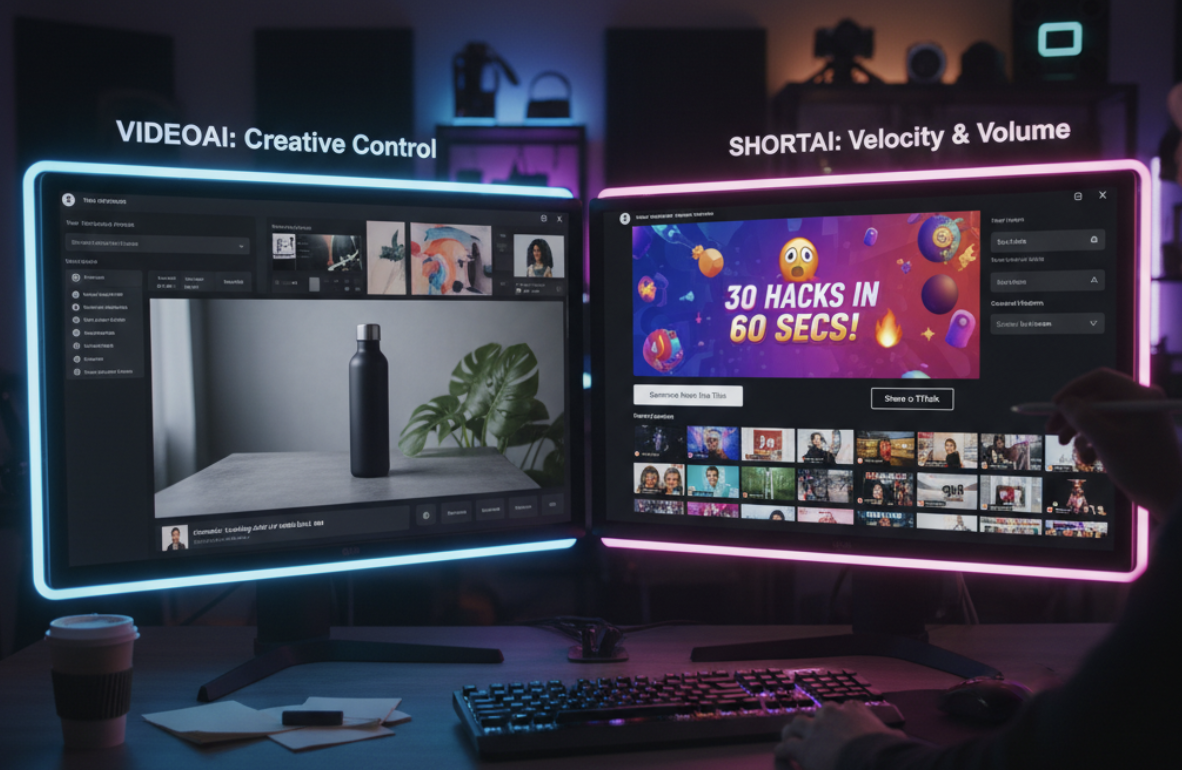
To meet this demand, creative teams are turning to automation to speed up their pipelines. However, not all automated systems are built for the same tasks. Some focus on deep creative control, while others prioritize sheer delivery speed.
We spent a week testing two prominent platforms to see how they handle real-world creative demands. Here is our hands-on comparison of VideoAI and ShortAI.
Before diving into the features, we need to understand the design philosophy behind each platform. Both tools aim to reduce production friction, but they target entirely different stages of the creator economy.
When I first opened VideoAI, the focus on creative flexibility was immediately apparent. The interface is built to accommodate a wide variety of formats, from wide-screen cinematic landscapes to vertical social clips.
This platform acts as a highly customizable AI Video Generator that gives creators deep control over their prompts and assets. It is designed for those who want to build a narrative from the ground up using structured inputs and multi-modal guidance.
This platform acts as a highly customizable AI Video Generator that gives creators deep control over their prompts and assets. It is designed for those who want to build a narrative from the ground up using structured inputs and multi-modal guidance. Leveraging an advanced Ai video generator tool within this pipeline allows teams to rapidly iterate on complex visual styles, transforming static ideas into high-fidelity video concepts without standard studio overhead.
For creators who need to generate custom B-roll, explainers, or stylized cinematic sequences, the system offers an impressive level of detail. It does not force you into a single style template, allowing your brand’s unique identity to come through.
On the other side of the spectrum is ShortAI, a tool engineered almost exclusively for high-volume, short-form content. The moment you log in, the dashboard pushes you toward rapid creation and viral optimization.
This system is built for the era of TikTok, YouTube Shorts, and Instagram Reels. It prioritizes fast automated cropping, vertical formatting, and instant caption generation.
During my testing, the platform excelled at taking existing long-form concepts and chopping them into bite-sized highlights. It is a highly focused utility designed for speed and social media distribution.
To truly understand these tools, we tested them with the same raw assets and creative concepts. We wanted to see how they handled formatting, prompt interpretation, and the post-production process.
Modern campaigns require content to live in multiple places at once. A video designed for YouTube needs a widescreen format, while the same concept on Instagram needs to be vertical.
During my testing, VideoAI handled these transitions with ease. It allowed me to generate high-quality assets in widescreen, square, and vertical ratios. This flexibility is essential for campaigns that span across different media channels.
In contrast, ShortAI is deeply optimized for the vertical format. While you can technically adjust your outputs, the tool’s automated templates and caption layouts are clearly built to shine on mobile screens.
The core of any creative automation platform is how it interprets user intent. We wanted to see how each AI Video Generator handled complex, descriptive prompts.
When I inputted a detailed cinematic prompt into VideoAI, the system respected my lighting and camera directions with high accuracy. The rendering engine took its time, but the resulting asset felt deliberate and professionally crafted.
Meanwhile, ShortAI approaches creation through a highly automated, templated workflow. You give it a basic topic or link, and it rapidly generates a finished product with minimal manual intervention. It is incredibly fast, though you sacrifice some granular creative control in exchange for that speed.
Captions are no longer optional for mobile video, as a large percentage of social media users browse with the sound off. Both platforms offer automated captioning tools, but their execution styles differ.
ShortAI features a highly aggressive, colorful captioning system designed to grab attention on busy social feeds. The text bounces and highlights key words automatically, matching the visual style popularized by modern influencers.
VideoAI takes a more understated, professional approach to on-screen text. The caption styles are clean, minimalist, and easy to read, making them ideal for corporate presentations, documentaries, and educational content.


Despite their differing target audiences, both platforms share a common goal: making video production accessible to everyone. During our testing, we noticed several key similarities that prove how far these AI video tools have come.
First, both platforms run entirely in the cloud, meaning you do not need an expensive graphics card to render high-quality clips. This democratizes the production process, allowing anyone with a standard laptop to create clean visual assets.
Additionally, both platforms prove that a modern AI Video Generator can drastically reduce render times. Projects that used to take hours of processing power are completed in a matter of minutes on both dashboards.
Finally, the onboarding process for both tools is incredibly smooth. Neither requires prior editing experience, making them highly accessible to marketing generalists and solo entrepreneurs alike.
While the similarities are notable, the differences in practice are what will ultimately dictate your choice. The two platforms diverge sharply when it comes to customization depth and production speed.
With VideoAI, you are the director, shaping the visual aesthetic frame by frame. You can feed the system specific reference images to maintain strict brand consistency across your entire project. This makes it ideal for custom narrative creation and cinematic, multi-format B-roll where you need high manual prompt detailing.
With ShortAI, you act more like an editor-in-chief, reviewing and approving automated cuts. The platform’s algorithm makes the creative decisions for you, focusing on what is most likely to perform well on social media algorithms. This workflow is optimized for rapid viral clipping, yielding capitalized vertical shorts with high automated templating.
Ultimately, the choice of an AI Video Generator depends entirely on your output goals. One is built for building a unique brand aesthetic, while the other is built for dominant social media output.
To help you decide which workflow fits your current business model, let us look at two realistic production scenarios.
Imagine you are an e-commerce brand looking to launch a high-volume ad campaign on TikTok. You need thirty unique vertical video variations every single week to beat ad fatigue and test different hooks.
In this scenario, ShortAI is the clear workflow winner. Its automated clipping, kinetic captions, and rapid rendering times allow a single marketer to scale production without burning out. The speed of execution is far more valuable here than highly detailed cinematic control.
Now, imagine you are a YouTube creator producing ten-minute documentaries about history or technology. You need custom, highly specific B-roll to illustrate complex historical events that traditional stock libraries do not cover.
In this case, VideoAI is the superior choice. This kind of narrative depth is where a versatile AI Video Generator truly shines. It allows you to generate custom, visually cohesive scenes that match your script precisely, elevating the overall production value of your channel.
As media synthesis technology continues to mature, we are seeing a healthy specialization of tools. There is no single platform that is perfect for every single video project.
If your primary bottleneck is generating custom, highly specific visual assets in multiple formats, investing in creative control is your best path forward. Having a tool that respects your exact design parameters will save you hours of editing headaches down the road.
However, if your business relies on social media engagement and high-volume vertical output, speed and automated formatting should be your priority. In that world, being first and being consistent is often more important than pixel-perfect customization.
Ultimately, selecting the ideal AI Video Generator is no longer about finding the absolute best technology. It is about identifying where your specific production bottleneck lies and choosing the tool designed to solve it.
 AI tools to find & convert leads.
  Send emails at scale