How SEO, AEO & GEO Are Transforming B2B Organic Lead Generation
28th Aug '26
Anyleads Team
10 minutes read
How SEO, AEO & GEO Are Transforming B2B Organic Lead Generation
For many years, the formula for B2B growth was straightforward: rank on Google, acquire a click, and convert a visitor into a lead. That still works, but it is no longer enough to support the entire B2B organic lead generation process.
Buyers search differently now. A lot of them open ChatGPT before Google, asking it to compare vendors, or check Perplexity for a quick shortlist. Search has gone conversational, and people want a direct answer instead of 10 blue links to sort through.
That's what pushed marketers past traditional SEO and into answer engine optimization (AEO) and generative engine optimization (GEO). Both now sit right in the middle of B2B organic lead generation, whether marketers are ready for that or not.
If your strategy still relies mostly on keyword rankings, you may miss some of the ways modern buyers research vendors.
Here’s what has changed and how you can adapt.
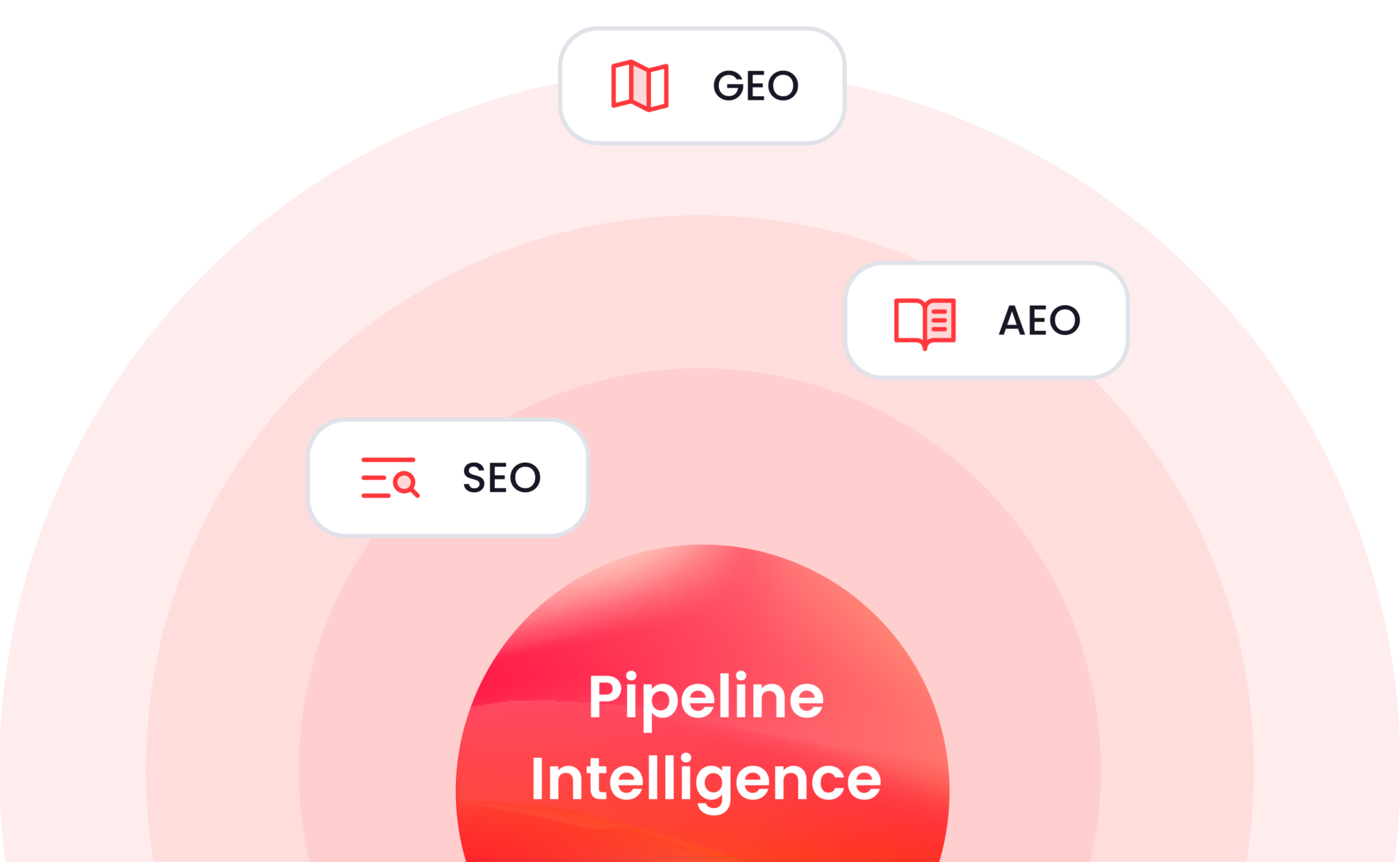
What Do SEO, AEO, and GEO Actually Mean?
Worth separating these properly, since people mix them up all the time.
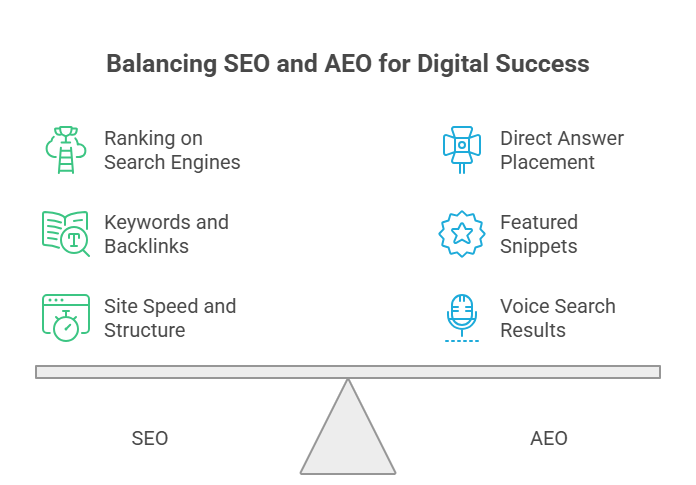
SEO: Getting content to rank on Google and Bing. Keywords, backlinks, site speed, page structure. Nothing new here.
AEO: Structuring content so it gets pulled into direct answers: featured snippets, voice search results, "People Also Ask" boxes. Less about the click, more about winning the answer itself.
GEO: The newest of the three, and many agencies are still developing their approach as the field evolves. GEO is about getting your brand mentioned or recommended when someone asks ChatGPT, Gemini, or Perplexity a question. There's no results page to chase here, just whatever the AI decides to say back, which makes it hard to know where you stand unless you're checking regularly.
For this reason, instead of making educated guesses based on a few manual prompts, many teams are using an AI visibility tool such as Similarweb to track how frequently a brand is mentioned across several AI models, how it is characterized, and which rivals consistently appear in the same replies.
These three overlap constantly, and the marketers doing this well right now are running all three simultaneously.
Self - Generated
How AI Search Is Reshaping the B2B Buyer Journey
B2B buying cycles are still long, research-heavy, and need five or six people to approve a deal before it closes.
The buying process is still much the same. What's changed is where buyers are doing their research.
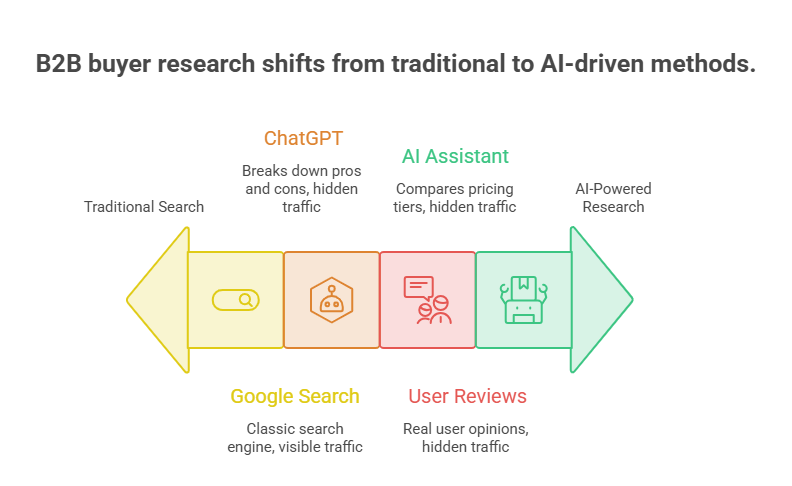
Let’s say someone's shopping for project management software. Their process might go something like this:
Google "best project management software for agencies"
Ask ChatGPT to break down the pros and cons of a couple of tools they've already found
Check G2 or Reddit for what real users say
Ask an AI assistant to line up pricing tiers side by side
Only one of those four steps is a classic Google search. The other three run through an answer engine or a generative AI tool, both pulling from your site, reviews, case studies, often without any of that research showing up in your analytics as website traffic.
The old split between inbound and outbound lead generation still holds up as a way to think about this. What's changed is that the inbound half now runs through channels most teams have no visibility into at all.
That's what SEO alone can miss in B2B organic lead generation. If your content isn't written in a way AI systems can parse and cite, you won't show up for a growing chunk of that research, and there's a good chance you'll never even know it happened.
Self - Generated
AI tools to find leads
Send emails at scale
Access to 15M+ companies
Access to 700M+ contacts
Data enrichment
AI SEO writer
Public professional emails
How SEO Still Anchors B2B Organic Lead Generation
SEO is still the base everything else is built on. Strong technical SEO and well-structured content can still support visibility across search and AI-driven discovery, even though each platform uses different retrieval and ranking mechanisms.
For B2B organic lead generation to hold up, SEO work still has to cover:
Keywords with real buying intent, not just high search volume
Topic clusters built around your services, not scattered one-off posts
Backlinks from sites genuinely relevant to your industry
A site that loads quickly and works properly on mobile
Content detailed enough to answer what someone types in
Most of that is ordinary B2B content marketing discipline, and none of it has been made obsolete by AI search. What's different now is that SEO can't sit off on its own anymore. It has to feed straight into AEO and GEO instead of running as its own separate workstream with its own separate goals.
How AEO Is Transforming B2B Lead Capture
AEO is about making sure your content is the answer, wherever that answer ends up: a featured snippet, a voice search result, a knowledge panel, regardless of the format.
For B2B companies, this matters more than people usually give it credit for. A lot of research starts as a question, not a keyword. Things like "what's the difference between a CRM and a CDP" or "how much does outsourced payroll cost for a 50-person company."
Whoever answers those clearly without burying the point under three paragraphs of throat-clearing tends to earn trust early, often before a buyer has even built a shortlist.
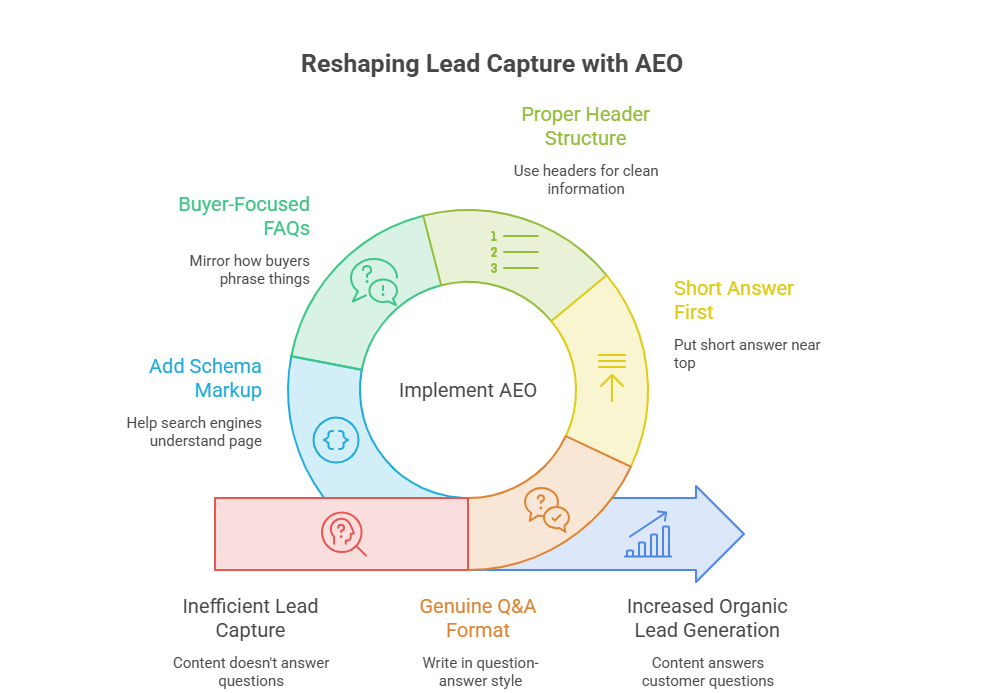
Write in a genuine question-and-answer format instead of forcing it in
Put the short answer near the top, then go deeper further down a page
Use proper header structure so search engines can pull information out cleanly
Build FAQ sections that mirror how buyers phrase things, not how marketers phrase things
Add schema markup so search engines know what a page covers
Being the answer a customer sees can build familiarity even when they don't click through immediately. By the time they're ready to schedule a demo, your brand may already feel familiar.
Over time, that repeated exposure can support stronger B2B organic lead generation. The same principle applies beyond marketing, where customer experience and HR teams also work to build and strengthen workplace trust through consistent employee and customer experiences. That kind of trust doesn't happen by accident.
Self - Generated
How GEO Is Opening a New B2B Lead Channel
GEO behaves differently from the other two and is truly an uncharted territory.
Instead of ranking pages as Google does, generative AI systems combine data from multiple sources into a single response. No matter how powerful your website appears on the outside, you're just not in that conversation if your brand isn't included in what is put together.
And the tricky part with GEO is that you can't directly control what an AI model says about you the way you can nudge a search ranking. What you can instead do is shape what that model has learned to trust in the first place.
What B2B brands are doing about this right now:
Publishing original data and research that AI tools are more likely to pull from as a source
Getting mentioned on third-party sites AI models reference often, like G2, industry publications, and active forums
Writing in a clear factual style since generative models tend to favor content that's easy to pull information from
Keeping brand details consistent everywhere, so AI tools aren't piecing together a confused or outdated picture
Checking now and then what AI tools are saying about your brand, and fixing anything wrong or out of date
GEO isn't mature yet, and best practices here keep shifting month to month. Still, brands putting in the work now will likely have a real headstart once this becomes a standard practice everywhere, the same way SEO did over a decade ago.
AI tools to find leads
Send emails at scale
Access to 15M+ companies
Access to 700M+ contacts
Data enrichment
AI SEO writer
Public professional emails
How to Build a B2B Organic Lead Generation Strategy Across SEO, AEO & GEO
The real shift isn't about picking one of these three over the others. It's about content that works across all three at once.
Here's a rough way to map that across the buyer journey:
Buyer Stage
Content Type
Optimization Focus
Awareness
Educational blog posts, guides
SEO + AEO (clear structure, target broad questions)
Consideration
Comparison pages, case studies
GEO (original data, third-party mentions)
Decision
Product pages, pricing pages
SEO (technical clarity, strong on-page signals)
Post-purchase
FAQs, help docs
AEO (direct, structured answers)
This isn't three separate content strategies running in parallel. It's one strategy that just stays aware of how different platforms consume and present what you publish.
The underlying B2B marketing fundamentals don't change here: knowing your buyer, mapping content to intent, and staying consistent. What changes is where that content ends up being read and by what.
What This Means Going Forward
The lead generation funnel isn't disappearing; it's just getting wider. Leads aren't only coming from a click on a search results page anymore. Plenty are coming from someone who saw your brand mentioned in an AI-generated comparison, trusted what they read, and searched for you by name a week or two later.
This suggests that B2B marketers should reevaluate their definition of success. A drop in brand interest is not always indicated by a drop in search engine click-through rates.
Pew Research Center tracked the browsing behaviour of 900 U.S. adults and found that users clicked a search result link 8% of the time when an AI-generated summary appeared, against 15% when one didn't.
A falling click rate may simply indicate that customers are now receiving their answers before they ever visit your website.
A few things worth doing right now:
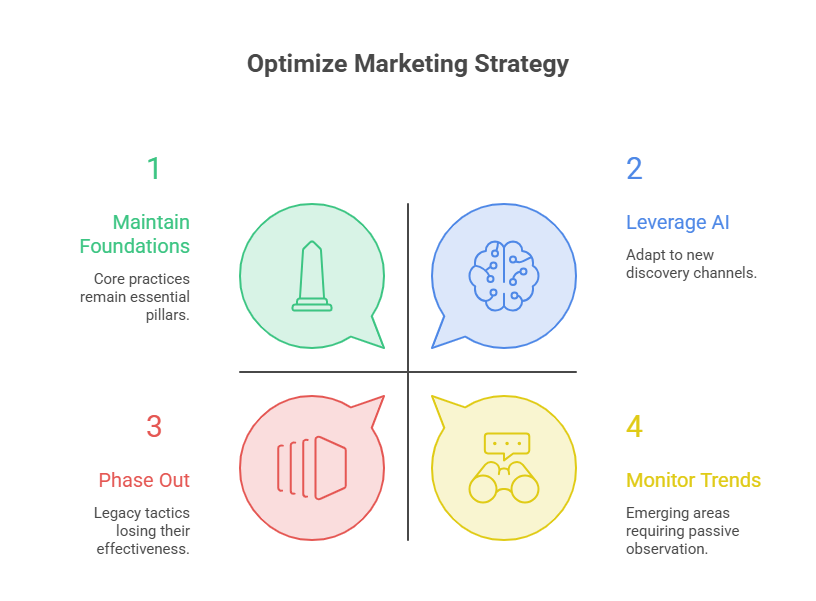
Don't drop SEO. It's still what everything else is built on.
Write content that answers questions directly, not content built purely around a keyword you're chasing.
Publish original research or data your brand can become known for. AI tools tend to cite sources that come with real numbers attached.
Keep your brand info consistent across review sites, forums, and industry publications.
Start tracking brand mentions inside AI tools the same way you'd track backlinks or keyword rankings.
Final Thoughts
SEO trained B2B marketers to think in rankings and clicks. AEO shifted that thinking toward giving direct and useful answers. Now GEO is pushing things further still, toward being a part of the conversations AI tools are having with your buyers, whether you're in the room for it or not.
These three work together and they're the real engine behind B2B organic lead generation. You should approach SEO, AEO, and GEO as a single integrated effort rather than as three distinct boxes to check. That will help you appear wherever your customers happen to be searching.
Are you prepared to implement this? Anyleads can assist you in developing and implementing SEO, AEO, and GEO strategies so that your B2B organic lead generation continues to expand wherever your buyers are looking.
Much of the insight behind this article comes from Himaan, Co-founder of Confiscore.com.
Himaan Chatterji
Himaan Chatterji is a B2B SaaS content strategist and co-founder of Confiscore.com. When AFK, he is either latin dancing or cooking.
 NEW
Trusthref.com: AI Agents That Grow Your Business In Autopilot
NEW
NEW
Trusthref.com: AI Agents That Grow Your Business In Autopilot
NEW


 Send emails at scale



 AI tools to find & convert leads.