Lead generation has always been competitive. But in 2026, it has become a different game entirely. Buyers are more selective, inboxes are more crowded, and the bar for what counts as a relevant outreach message keeps rising. Sales teams that are still relying on manual prospecting, generic cold lists, and copy-paste email templates are not just falling behind. They are actively losing deals to teams that have already made the shift.
The real problem is not effort. Most sales teams work hard. The problem is that too much of that effort goes into finding leads, verifying data, and writing outreach one message at a time, leaving very little time for the actual conversations that close deals.
AI tools have changed what is possible here. They do not replace the salesperson. They remove the repetitive groundwork so the salesperson can focus on what actually requires a human. This guide breaks down exactly how to build a lead generation workflow that uses AI intelligently, from first contact to pipeline entry, and what to watch out for along the way.
The old approach to lead generation followed a familiar pattern. Build a list, find contact details, write an email, send it, wait, follow up, repeat. For a small number of high-value targets, this worked reasonably well. At scale, it falls apart quickly.
Here are the three biggest time drains that slow down manual lead generation workflows:
Finding and verifying contact information — Sourcing accurate emails and phone numbers for targeted prospects can take hours per batch. Data goes stale fast, and unverified contacts lead to high bounce rates that damage sender reputation over time.
Writing personalized outreach manually — Truly personalized emails take time to write. Most teams compromise by sending semi-generic messages that feel personal on the surface but convert poorly because the prospect can tell the difference.
Following up without a structured system — The majority of replies come after the second or third follow-up. Without a reliable system, follow-ups get forgotten, leads go cold, and pipeline opportunities disappear silently.
Each of these drains compounds the others. A team spending three hours a day on manual prospecting has three fewer hours for discovery calls, demos, and relationship-building. That gap shows up directly in revenue.
A modern AI-powered workflow does not look like a single tool doing everything. It looks like a series of connected steps where AI handles the time-consuming groundwork and the salesperson takes over at the moments that require genuine human judgment.
The key components every smart workflow should include are:
Automated lead discovery and data enrichment — AI tools scan databases, social platforms, and public sources to find prospects that match your ideal customer profile, then enrich each record with company size, industry, role, and contact details.
Email verification before outreach — Every contact is verified before a single message goes out. This protects deliverability, keeps bounce rates low, and ensures the list you are working from is actually usable.
Personalized email sequences at scale — AI drafts outreach sequences tailored to each prospect's role, industry, and pain points. The salesperson reviews and refines before anything sends.
Lead scoring and pipeline management — Prospects are scored based on engagement signals: email opens, link clicks, reply sentiment, and website visits. High-intent leads rise to the top automatically.
Real-time engagement tracking — Every interaction is logged and visible, giving the sales team a clear picture of where each prospect is in the funnel without manual data entry.
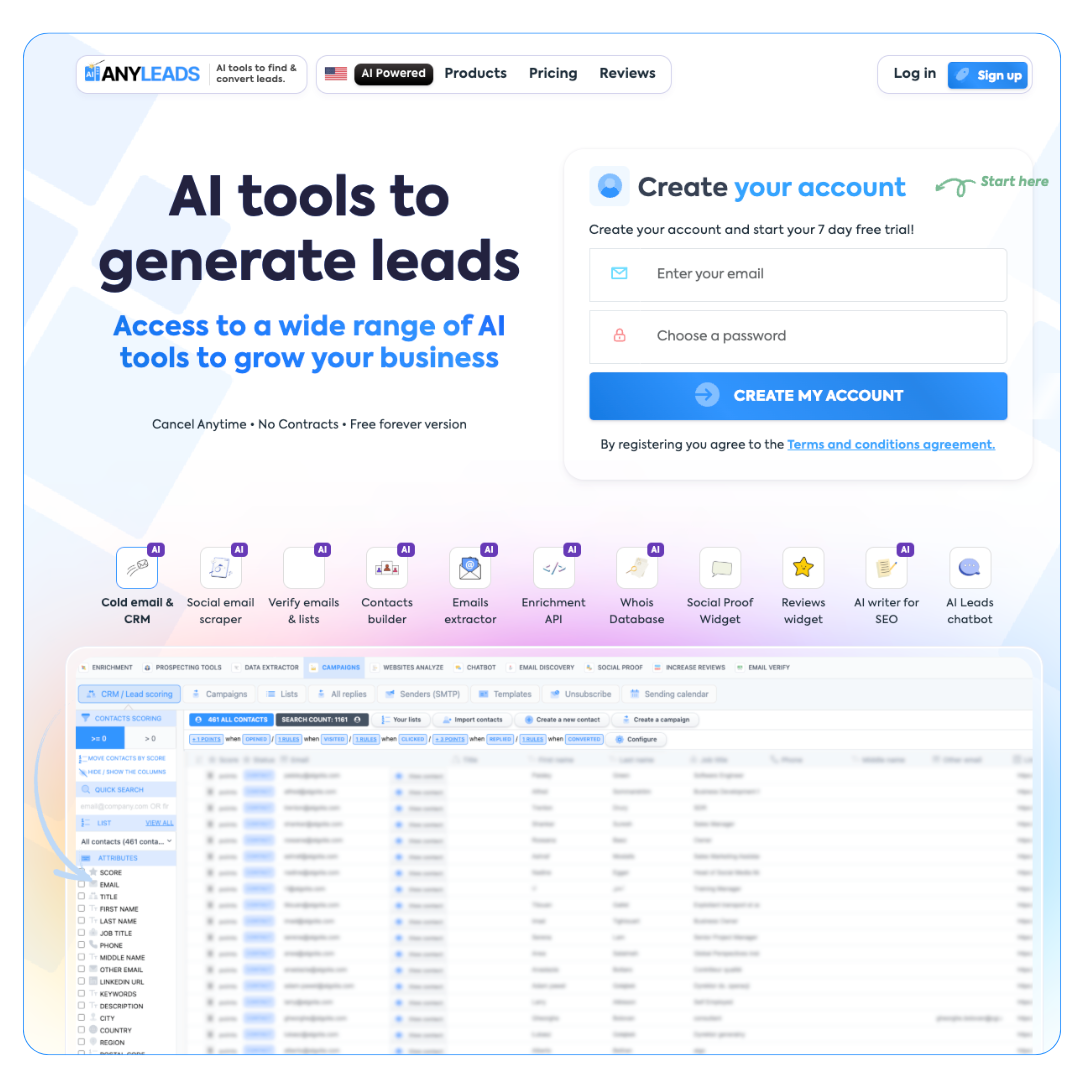
Platforms like Anyleads bring these capabilities together in one place, covering everything from lead extraction and email verification to automated sequences and CRM integration, which makes it practical for teams of any size to run this kind of workflow without stitching together a dozen separate tools.

Building the workflow is straightforward when you follow the right order. Most teams get into trouble by jumping straight to outreach before the foundation is solid.
| Step | Action | Why It Matters |
| Step 1 | Define your ideal customer profile | Targeting the wrong people wastes every resource downstream |
| Step 2 | Use AI prospecting to extract targeted leads | Builds a clean, relevant list without hours of manual research |
| Step 3 | Verify all contact data before outreach | Protects sender reputation and improves deliverability |
| Step 4 | Build personalized sequences with AI writing assistance | Creates volume without losing the personal feel that drives replies |
| Step 5 | Set up automated follow-ups with smart triggers | Ensures no lead goes cold due to a missed follow-up |
| Step 6 | Track responses and use sentiment analysis | Prioritizes high-intent replies so the team focuses on the right conversations |
| Step 7 | Feed results into your CRM | Gives full pipeline visibility and keeps data clean for reporting |
Following this order means every step builds on a solid foundation. Skipping steps, particularly verification and ideal customer profile definition, is where most workflows break down before they ever get started.
Getting access to powerful AI tools does not automatically produce better results. How you use them matters just as much as which ones you choose.
Watch out for these mistakes before they cost you pipeline opportunities.
Using AI to send more emails instead of better ones is the most common error. Volume without relevance generates unsubscribes, spam complaints, and a damaged sender reputation that takes months to recover from.
Skipping the email verification step is another one teams regret quickly. A high bounce rate signals to email providers that your domain is sending low-quality traffic, which affects deliverability for every campaign going forward.
Over-automating to the point where outreach loses all human feel is a subtler problem. Prospects today are good at spotting messages that came from a template. When every email in a sequence reads the same way regardless of who is receiving it, reply rates drop and brand perception takes a hit.
Not reviewing AI-generated content before it sends is the mistake that causes the most visible damage. A good habit is to run your content through a AI Detector before anything goes out. It flags sections that read as overly mechanical so you can refine them before a prospect ever sees them. AI drafts need a human eye before they go out, not because the tool is unreliable, but because no tool understands the nuance of your specific relationship with a specific prospect the way you do.
Finally, treating every lead the same regardless of engagement level wastes the scoring data the workflow generates. A prospect who has opened three emails and clicked a link deserves a different next step than someone who has not engaged at all.
Automation handles the volume. Humans handle the relationship. The teams that confuse these two roles are the ones that build impressive-looking workflows that generate very few actual conversations.
There are specific touchpoints where a human should always be in the loop:
Initial reply handling — The moment a prospect replies, a real person should take over. Automated replies to genuine responses feel dismissive and kill momentum instantly.
High-value account outreach — For priority targets, the first message should always be written or at least substantially rewritten by the salesperson. AI can provide the structure, but the opening line and specific references should come from someone who has done their homework.
Proposal and negotiation stages — No part of a proposal or negotiation should be fully automated. These are the conversations that determine whether a deal closes, and they require judgment, flexibility, and genuine listening.
Pro tip: Use AI to draft your outreach, then run it through a humanizer like Phrasly.AI before sending. If it does not sound like something you would actually say in a conversation, rewrite the parts that feel off. This simple check catches the majority of content that reads as automated before it ever reaches a prospect.
The goal is a workflow where automation does the groundwork and the salesperson shows up to every real conversation fully prepared, with context, history, and a clear next step already in mind.
Building the workflow is only half the job. Knowing whether it is working and where to improve it is what separates teams that scale from teams that plateau.
The metrics that actually matter are:
Email open rate and reply rate — Open rate tells you whether your subject lines and sender reputation are working. Reply rate tells you whether your message is relevant enough to prompt a response. Both matter, but reply rate is the one that predicts pipeline growth.
Lead to meeting conversion rate — Of all the leads entering the workflow, how many result in a booked call or meeting? This number reflects the overall quality of your targeting, messaging, and follow-up combined.
Time saved per week on manual prospecting — This is the metric most teams forget to track but should measure from day one. If the workflow is working, your team should be spending significantly less time on research and data entry within the first 30 days.
Pipeline growth over 30, 60, and 90 days — The compounding effect of a well-run AI workflow shows up clearly in pipeline data over time. Month one improvements should accelerate into month three as the process gets refined.
Review these numbers at least every two weeks. If open rates are strong but reply rates are low, the targeting is good but the messaging needs work. If reply rates are strong but meetings are not booking, the handoff from automation to human needs attention. The data tells you exactly where to focus.
Building a smarter lead generation workflow in 2026 is not about replacing salespeople with automation. It is about giving salespeople back the time they are currently spending on tasks that do not require their judgment, their personality, or their relationship skills.
AI handles the discovery, the verification, the drafting, and the follow-up timing. The salesperson handles the conversation, the objection, the proposal, and the close. When those two roles stay in their lanes, the whole workflow performs better than either could alone.
The teams winning in 2026 are not the ones with the biggest lists or the most automated sequences. They are the ones who use AI efficiently, review output carefully, and show up to every real conversation as a genuine human being with something useful to say.
The best time to build this workflow was last year. The second best time is today.
 AI tools to find & convert leads.
  Send emails at scale