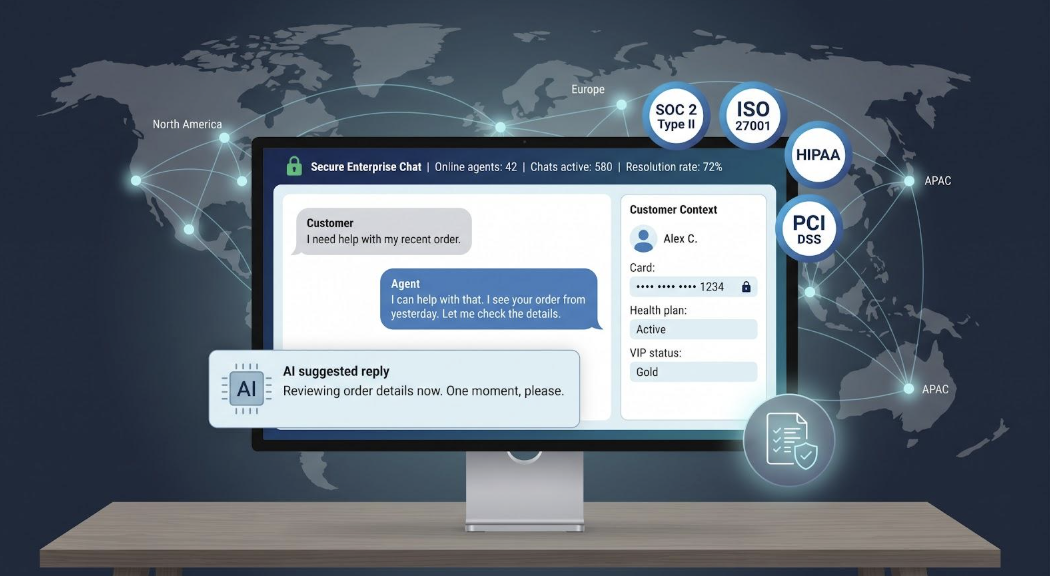
Live chat is now a primary support channel. Seventy-three percent of customers prefer a quick chat window over email or phone, and businesses that master the experience see conversion lifts of up to 20 percent.
For enterprises, those numbers sparkle—and raise the stakes. A single chat can carry payment data, protected health information, or a VIP’s account history, so one misstep can invite fines or erode years of trust. Buyers want replies in seconds; security teams demand airtight compliance; finance leaders expect an investment that scales instead of surprises.
This guide takes a security-first, strategy-second route. We’ll confirm non-negotiables like SOC 2 reports and encryption, then examine integrations that pull CRM context into every reply and omnichannel inboxes that keep conversations together. Next comes AI automation, followed by a candid look at global performance. We’ll wrap with the budget math and people factors that determine whether the new platform gets used.
By the end, you’ll have a clear blueprint for vetting vendors, running a proof of concept, and choosing a chat solution that delights customers, satisfies compliance teams, and grows with your business.
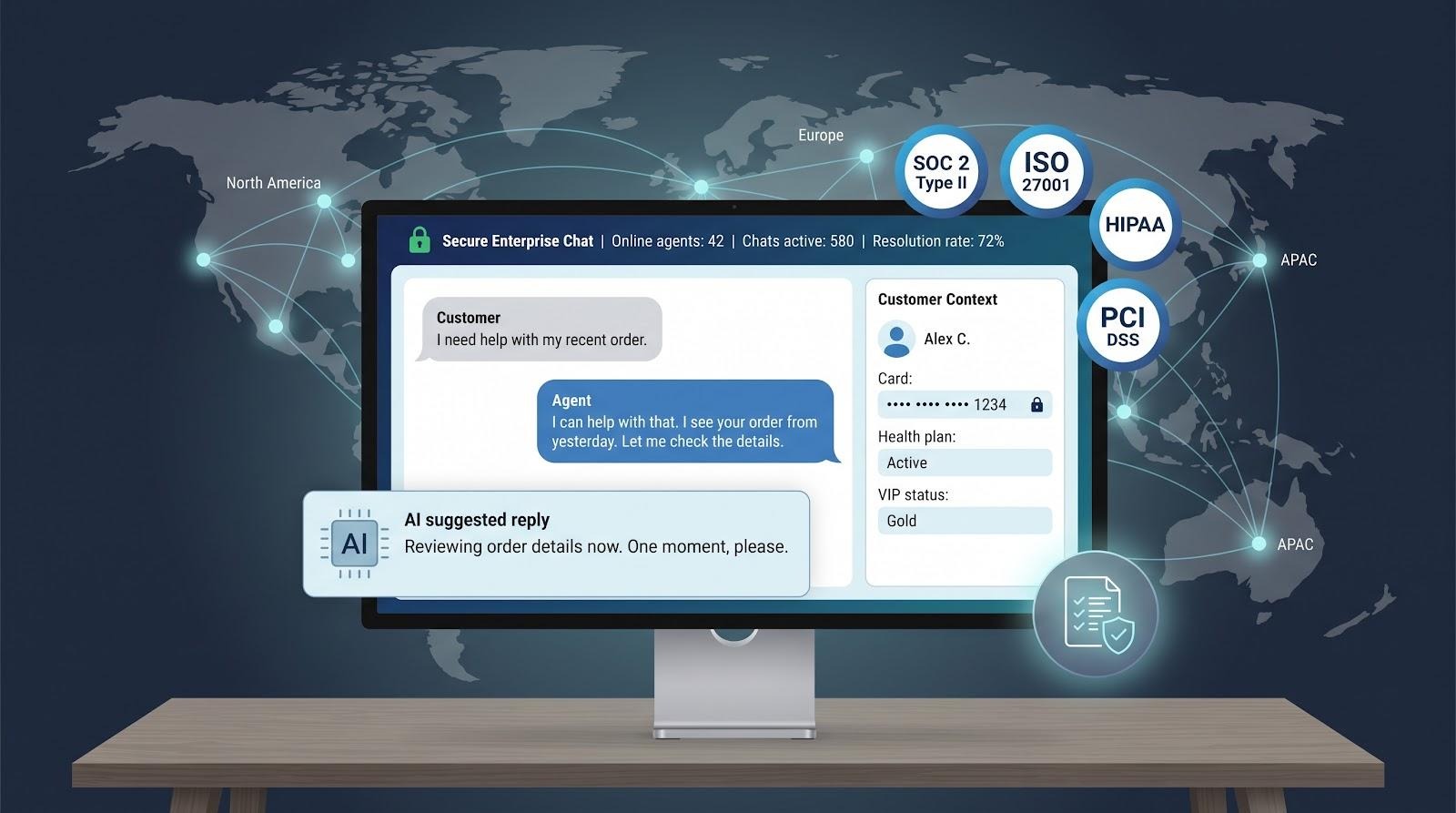
Security wins you the deal, or kills it on sight. Enterprise procurement teams start with one request: “Show us your compliance reports.” If the vendor can’t present a current SOC 2 Type II audit, ISO 27001 certificate, and, for industries that need them, HIPAA and PCI DSS proof (each of which you’ll find documented among the top live chat software vendors), the evaluation ends right there.
Those badges prove the controls are tested, but we still verify the details. We ask where data sits, how it travels, and who can touch it. End-to-end encryption, single sign-on, and role-based access keep customer information locked to the people who need it. For multinationals, data residency options matter just as much. Chat records must stay in the right geography to satisfy GDPR, HIPAA, or sector-specific mandates.
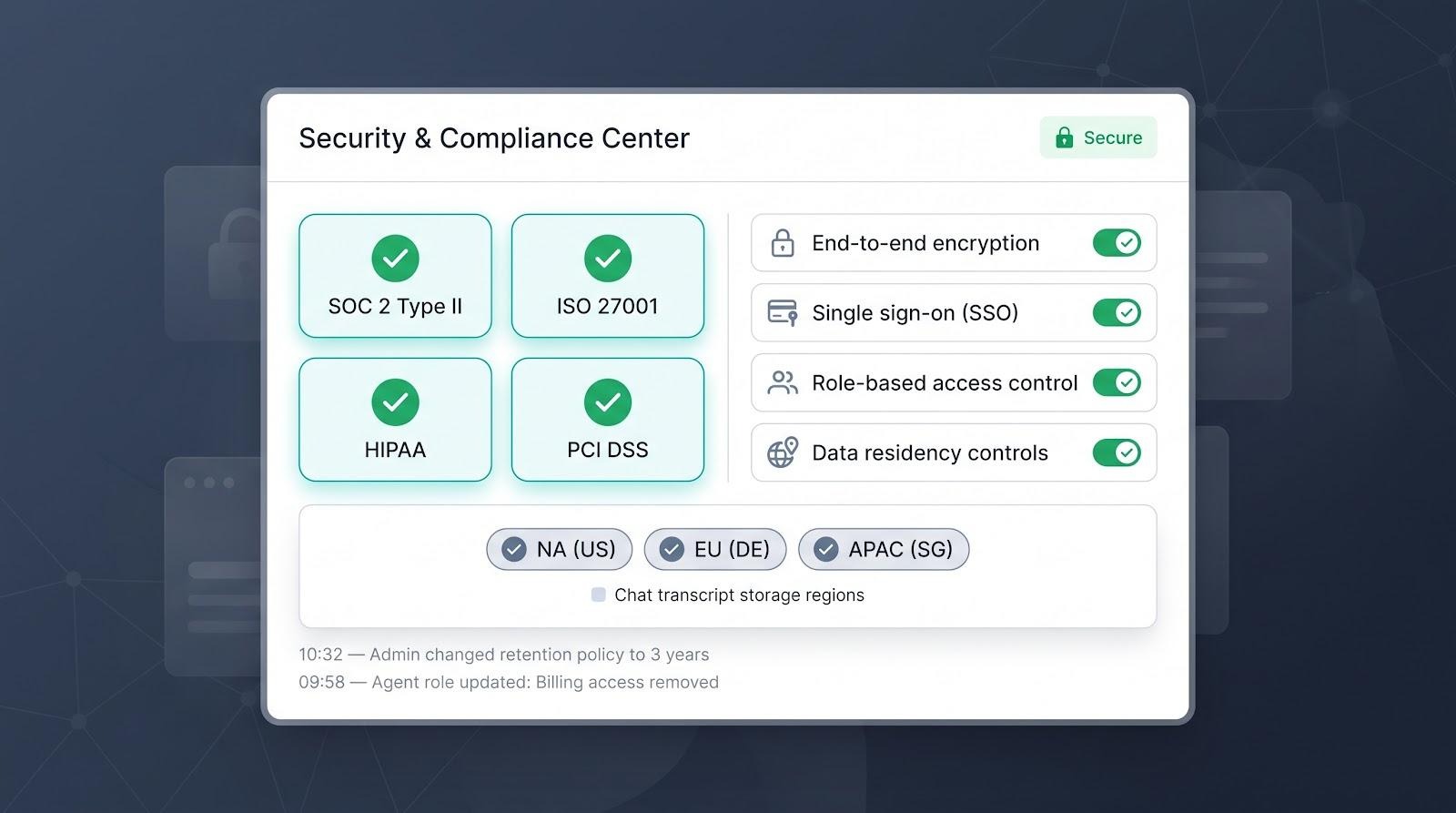
Its publicly accessible Trust Center lets security teams pull the latest SOC 2 Type II and PCI DSS reports on demand, and its multi-region hosting covers AWS Oregon for North America, Frankfurt for the EU, and Singapore for APAC.
Compliance is more than preventing breaches; it’s about leaving a paper trail regulators will respect. The best chat platforms log every action, archive transcripts automatically, and let you adjust retention settings. That level of auditability turns a future subpoena into a quick export instead of a costly scramble.
We also review how the software’s AI features handle data. Chat transcripts should never feed a common model shared across customers. Look for vendors that train models inside your instance and let you opt out of broader data sharing. The promise of smarter service is not worth leaking trade secrets or violating privacy law.
Accessibility rounds out the checklist. A chat widget that fails WCAG 2.1 AA blocks customers who rely on assistive tech and invites legal risk. Vendors that publish a Voluntary Product Accessibility Template show they have done the work.
When a platform nails these fundamentals, everything else (integrations, AI, and dashboards) can shine. Miss one, and the only feature that matters is the “Delete from shortlist” button.
Great security clears the gate; smooth integration wins the race.
Your agents already work inside a constellation of tools: CRM, ticketing, e-commerce dashboards, and maybe an ERP for good measure. A live chat platform that stands alone forces them to alt-tab through silos and copy-paste case numbers. Productivity drops, context slips, and customers wait.
We want the opposite. The moment a visitor opens chat, the agent should see purchase history, open tickets, and loyalty status without leaving the console. Native connectors to Salesforce, HubSpot, Zendesk, and ServiceNow make that instant context possible. When a vendor lacks a prebuilt connector, a clean REST API and webhooks step in. Your developers wire the chat to in-house systems and automate the grunt work. No swivel-chair integration required.
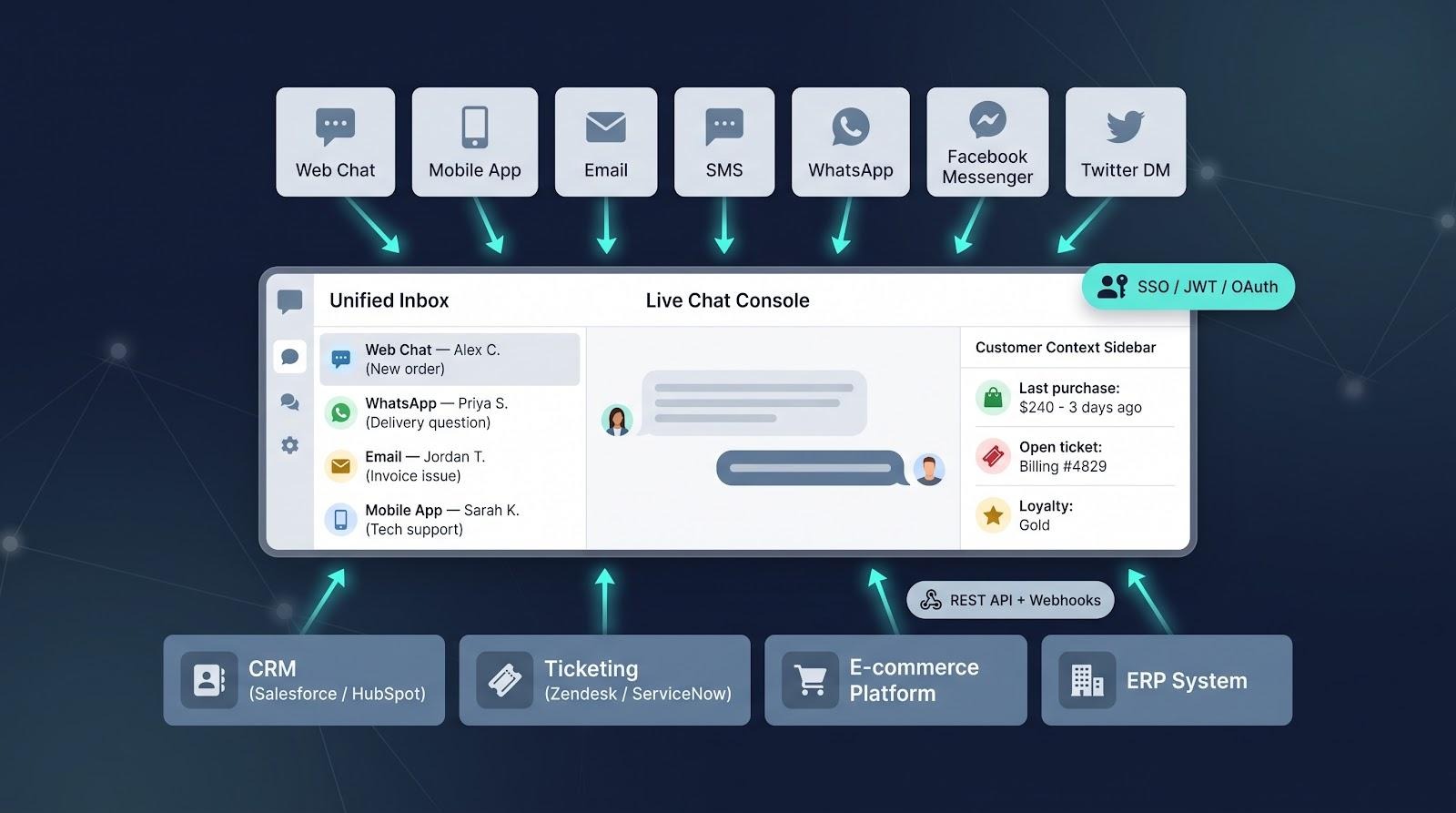
Omnichannel support raises the bar again. Customers start on your website at lunch, switch to WhatsApp on the train, and continue in-app that evening. A unified inbox stitches those touchpoints together so every reply feels like one continuous conversation. Agents stay in a single queue, and customers never repeat themselves.
Channel depth matters too. Web chat is table stakes, but enterprises increasingly route email, SMS, Facebook Messenger, and Twitter DMs into the same stream. The result is fewer missed messages and a clear audit trail across every medium.
Finally, good integration architecture respects identity. Single sign-on maps internal roles, while JWT or OAuth tokens pass customer IDs securely from your portal into the chat. That handshake lets you greet a logged-in VIP by name and skip the “Please verify your account” dance.
Choose a platform that snaps into your stack and collapses channels into one coherent thread. When integration clicks, agents respond faster, customers feel known, and your new chat system earns its keep from day one.

Round-the-clock service is no longer a luxury. Customers expect answers at midnight and during Monday surges alike, and trained chatbots deliver that scale without burning out human teams.
The best bots do more than spit canned FAQs. They understand free-form questions, pull order data, and trigger workflows such as password resets or refund checks. When configured well, they resolve most everyday issues on the spot and pass only the edge cases to your live agents.
How many chats can automation close? Zendesk’s CX Trends Report found that AI-powered agents now reach resolution rates of about 72 percent, meaning nearly three-quarters of incoming conversations finish without human help.
Implementation still matters. Feed the bot a tight knowledge base, keep intents clear, and set an easy escape hatch to a live agent. Do that and you gain a tireless first line of defense that pays for itself in both savings and customer satisfaction.
Chatbots handle the routine, but your agents still manage edge cases, escalations, and the emotional nuance a bot can’t match. AI copilot tools close that gap by suggesting the next best action in real time.
Picture an agent greeted with a live summary of the customer’s history and an auto-drafted reply the moment a chat arrives. Sentiment analysis highlights frustration before it boils over, and smart shortcuts pull knowledge-base articles into the response with one click. Instead of searching for answers, the agent reviews, personalizes, and sends, saving precious seconds on every exchange.
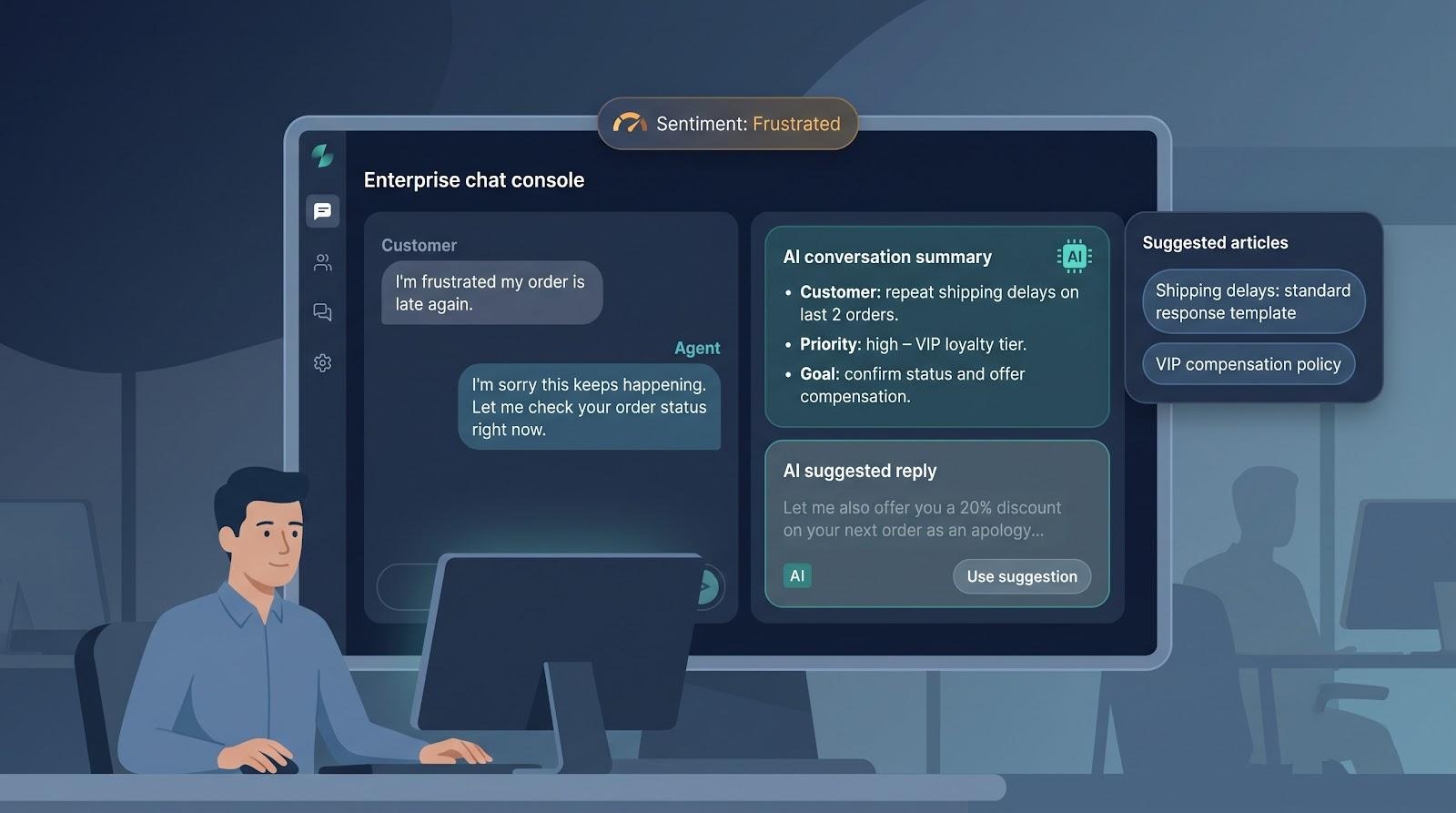
These micro-wins add up. When large teams adopt copilot workflows, they record faster first-response times, steadier tone across hundreds of agents, and a QA team that spends less time fixing copy-paste errors. Agents feel supported, not replaced, and can juggle more conversations without losing focus.
The takeaway? Automate the repetitive thinking, not the human connection.
Bots and copilot tools ease the front line, but leadership needs a bird’s-eye view. Modern chat platforms use machine learning to uncover patterns no spreadsheet can show.
Dashboards highlight trending issues before they spike call volume. Sentiment scores flag at-risk customers, and resolution analytics pinpoint flows where the bot stalls. These insights guide product fixes, refine macros, and justify head-count changes with data instead of gut feel.
The real win is speed. Instead of waiting for quarterly surveys, you see customer mood shift in near real time and can adjust tomorrow’s release notes or a training module today.
Choose a vendor that pairs raw metrics with AI-driven context. When analytics turn thousands of chats into one clear next step, continuous improvement becomes the norm, not a special project.
Flash-sale traffic or a sudden outage can spike chat volume ten-fold in minutes. A platform that cruises through normal days yet stalls at 500 simultaneous conversations erodes customer trust at the worst moment.
We vet concurrency the way engineers test load balancers. Ask for hard numbers: sessions per second, agent seats supported, throughput under stress. Then run a pilot that mirrors your peak. Launch a promo, simulate thousands of visitors, and watch for lag. Message delays longer than a heartbeat break the illusion of real time, and customers leave fast.
Also check the fine print for hidden limits. Some vendors market “unlimited users,” yet throttle active sessions or cap history once you cross a threshold. Transparency now prevents crisis later.
Choose a tool built for spikes, not averages. When traffic surges, chats stay quick, agents stay calm, and revenue keeps flowing.
Real-time chat feels instant only when messages arrive in a blink. That speed depends on servers close to your users and smart routing to the nearest region.
Ask each vendor where its data centers sit and how traffic fails over if a node hiccups. North America alone is rarely enough: customers in EMEA or APAC will notice a two-second delay as soon as they type. Distributed PoPs or a solid CDN cut that distance, keep typing indicators in sync, and avoid the awkward “Hello… are you there?” pause that hurts satisfaction scores.

Global Live Chat Infrastructure and Data Residency Map
Data residency rules add another layer. If German transcripts must stay in Frankfurt, or Canadian health data inside Ontario, confirm the platform can pin instances to those zones without complicated workarounds. Global reach with local compliance keeps conversations fast, legal, and frustration-free.
Chat delights only when it is available every time a customer clicks the widget. Anything below 99.9 percent uptime risks lost orders and angry tweets.
Scrutinize each vendor’s service-level agreement. Look for measured, not promised, performance: public status pages, historical uptime logs, and post-mortems when issues occur. True enterprise-grade platforms run active-active clusters with automatic failover. If one node blinks, conversations move without interruption to another node without dropped messages or broken transcripts.
Ask how maintenance windows work. Can upgrades roll out with zero downtime, or does support disappear for an hour at 2 am in Tokyo? Your global audience never sleeps, so the platform’s deployment strategy must be smooth, silent, and fully transparent.
Peace of mind is not a feature; it is the outcome of resilient architecture and honest reporting.
Sticker price is only half the story. A chat tool that looks cheap at ten dollars a seat can swell once you add SMS connectors, AI modules, or premium support. We start with a simple spreadsheet: license cost, expected seats, projected chat volume, and any per-message fees. Then we add the less obvious numbers, such as implementation hours, integration work, and the opportunity cost of features missing from the lower tier.
Per-agent pricing fits steady teams, while usage-based plans shine when volume spikes seasonally. Enterprises often negotiate hybrid deals: a core bundle of seats at a flat rate plus an overage model for busy months. That flexibility prevents over-buying in quiet quarters and frantic hiring in peak season.
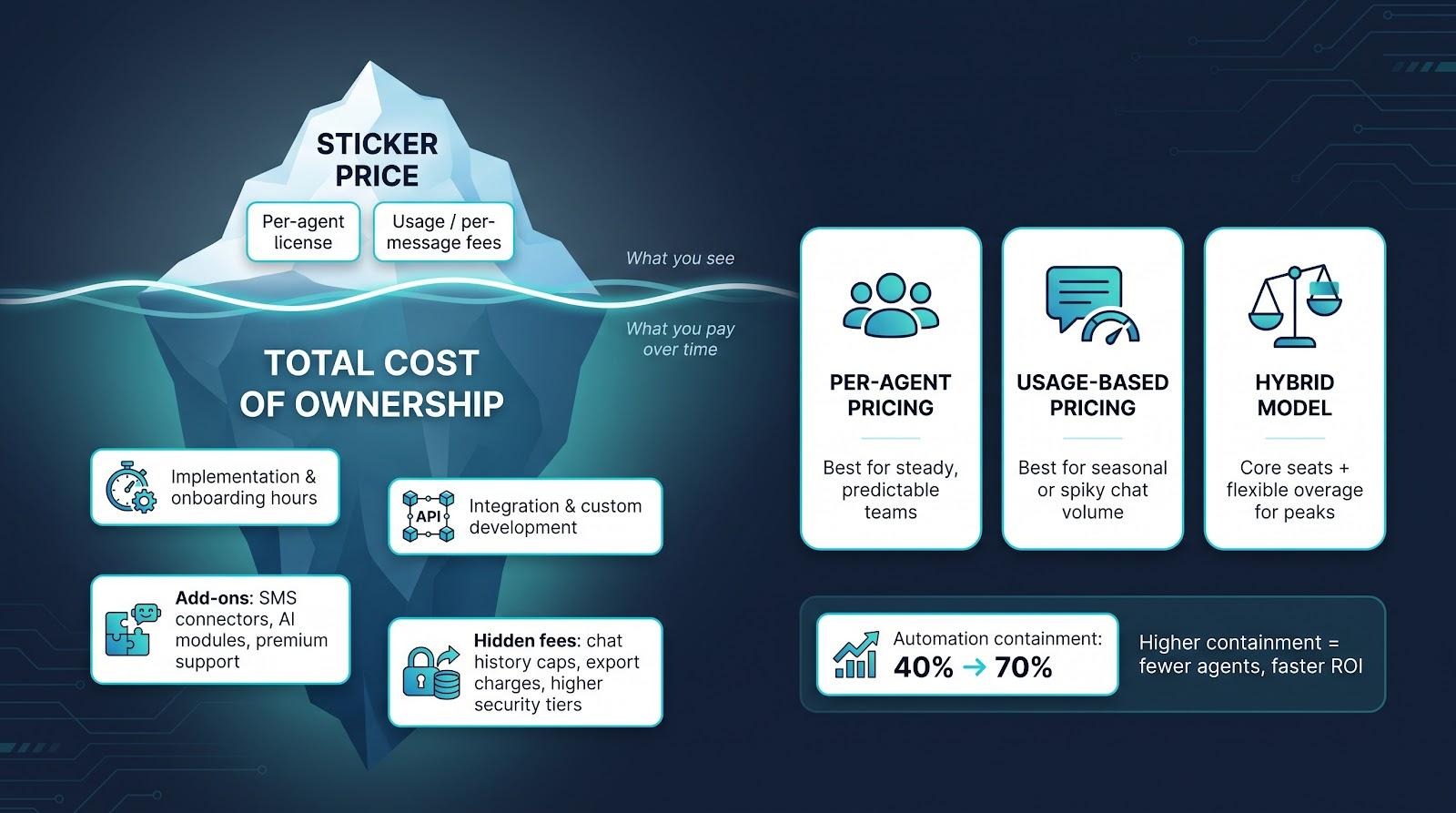
Hidden costs hide in the fine print. Some vendors cap chat history, charge extra for data exports, or lock advanced security behind a higher tier. Asking pointed questions now avoids budget emergencies later.
Finally, weigh cost against upside. If a pricier platform’s automation lifts containment from forty to seventy percent, you hire fewer agents and recoup the premium fast. If strong compliance prevents a single breach investigation, the software pays for itself several times over.
We focus on value rather than price. The best deal grows with your business, protects data, and multiplies agent productivity without surprise invoices.
A feature-packed platform flops if agents hate the interface or customers can’t find the chat button.
We start with agent workflows. The console should feel like a modern messenger: clean threads, quick shortcuts, and customer context at a glance. When actions hide behind tiny icons or multistep menus, handle times climb and morale falls. A five-minute pilot with real agents reveals more than any polished demo. Watch where they pause and where they smile.
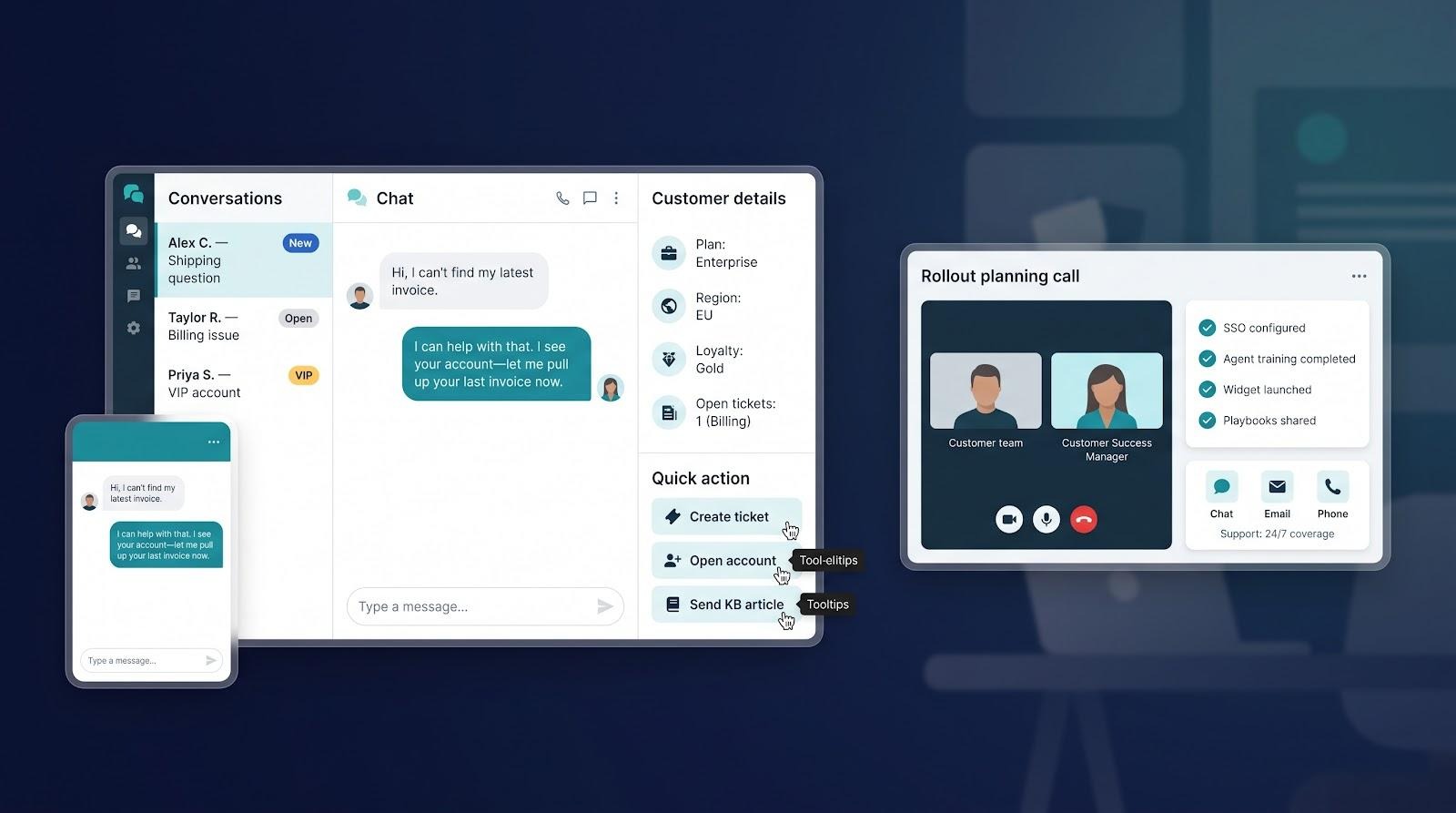
Customer-side polish matters too. The widget must pop on mobile, respect dark mode, and meet accessibility guidelines so everyone can join the conversation. Custom branding should take minutes, not a sprint, letting you match colors, tone, and greetings without developer help.
Then there’s the partnership behind the product. Enterprise rollouts need more than a ticket queue; they need a responsive success manager who can jump on a call, sort SSO configs, and share best-practice playbooks. Check response times, supported channels (phone, chat, email), and whether 24/7 coverage is included or an add-on. Peer reviews often reveal the truth: look for vendors praised for proactive guidance, not just reactive fixes.
Choosing enterprise live chat is a layered checklist: lead with compliance and security, then weigh integration, AI automation, scalability, and total cost before UX and vendor support seal adoption. Score each vendor against these six pillars, run a proof of concept at peak load, and you land a platform that delights customers, satisfies auditors, and scales with the business.
 AI tools to find & convert leads.
  Send emails at scale