
Almost every link building service now has an AI visibility page.
Most of them changed the headline and nothing else.
Same placements. Same publishers. Same generic guest posts. New label on the invoice.
Here's why that matters: the mechanism genuinely changed. Ahrefs studied 75,000 brands and found branded web mentions correlated with AI Overview visibility at 0.664. Domain rating came in at 0.326. Referring domains at 0.295. Raw backlinks at 0.218.
That single finding reorders what you should be buying. It also explains why AI citation tracking platforms became a category of their own in the last year, because the old reporting stack cannot see any of this.
A link on a high-DR page nobody reads, in a format no model would ever quote, does very little. It's like addressing a letter perfectly and mailing it to an empty building: technically correct, with nobody on the other end.
A branded mention inside a comparison article that already ranks for your category question does a great deal.
What actually makes a link move AI visibility
1. Respona
2. Editorial.Link
3. uSERP
4. Siege Media
5. Page One Power
6. Stellar SEO
7. FATJOE
8. Loganix
What does not work, and why people keep buying it
FAQ about link building and AI visibility
Four conditions separate a placement that influences an AI answer from one that just sits in your backlink profile.
Assistants pull from pages that rank and get read.
A site with a strong domain rating but no meaningful organic traffic is not in that pool, however good the metric looks in a report.
This is where a lot of link inventory falls down. The domain has authority on paper. The specific page has no audience, no rankings and no reason to be retrieved.
When someone asks a model to recommend options in a category, it draws from content already structured as an answer to that question.
Listicles. Comparison guides. Product reviews.
A thought leadership essay mentioning your brand in passing does not compete for that slot, no matter where it's published.
The Ahrefs correlation was strongest for branded web mentions, not raw link counts.
Your name needs to appear in a context a model can associate with the category question, not just a hyperlink on a generic anchor.
A mention on a page about something unrelated gives a model no reason to connect you with the query.
Relevance was always useful for SEO. For retrieval it is closer to essential.
Hold each provider below against those four and the field separates quickly.

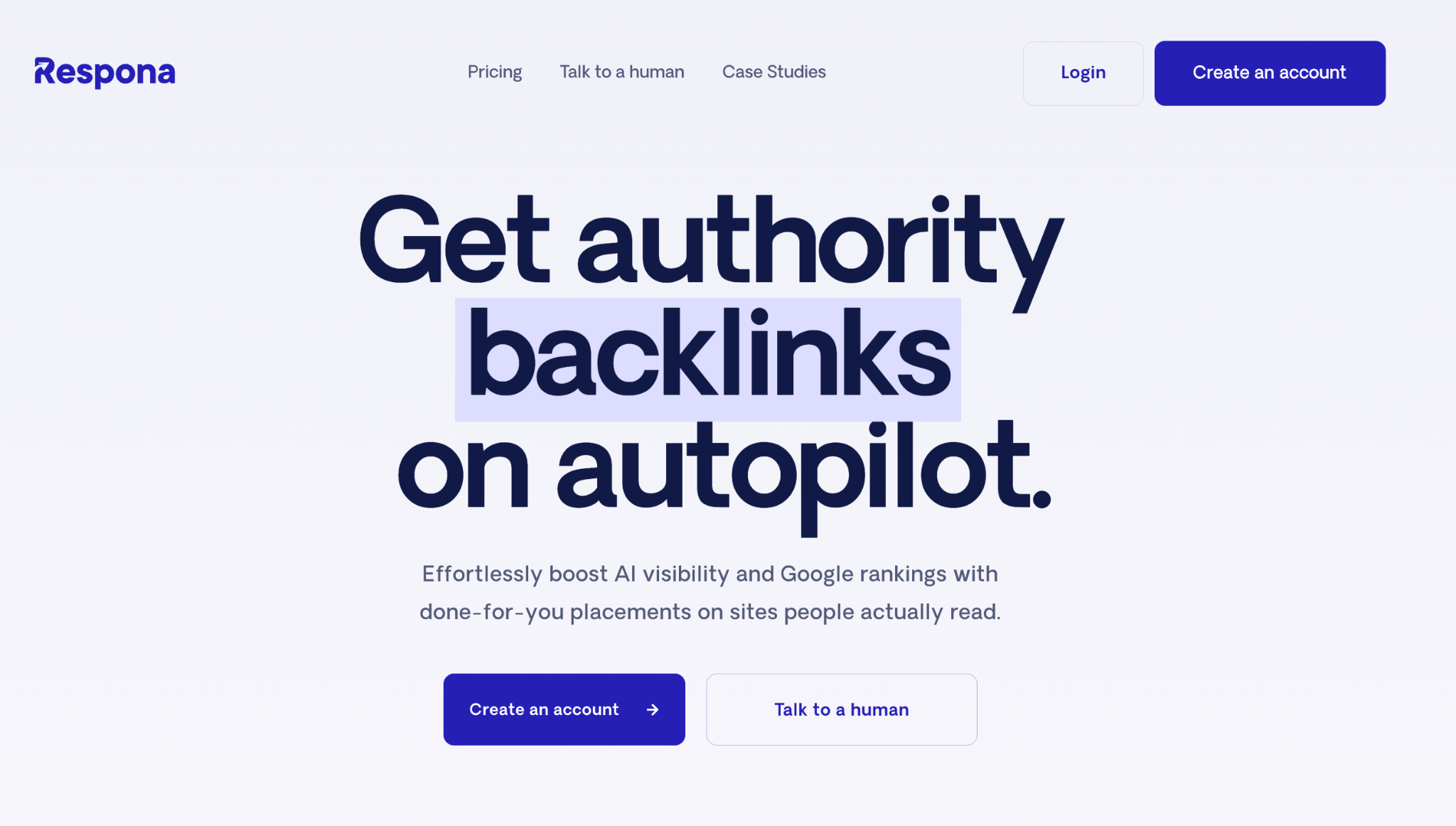
Respona builds its selection process around the first and fourth conditions rather than around domain rating.
The pipeline starts with your site rather than a publisher list. It scrapes your pages for their core keywords and themes, finds publishers already ranking for those terms, then picks the term with the lowest competition and highest CPC and volume.
Format is something you choose. Listicles, product reviews, comparison guides, news or contextual placements. Very few providers let you specify that, and it addresses the second condition directly.
You control how you are mentioned. You supply the landing pages and anchor text. Domain approvals run hands-off or you pre-approve every site and set rules such as specific ccTLDs, available as a paid add-on.
Pricing runs $100 to $500 per placement by publisher tier, covering content, outreach and publishing, with volume discounts from $1,500 a month. Turnaround is 28 days standard, or 14 days express for an additional fee. Every placement is guaranteed to go live, and the company states plainly that it uses no PBNs or spam networks.
Reviews: G2 High Momentum Leader in blogger outreach, rated 4.8/5 across 200+ reviews.
Scores well on: retrievable pages, format control, branded mentions, topical adjacency.
Editorial.Link has operated since 2020 and places at the premium end, with an average domain rating around 67.
Its strength against these criteria is the approval step.
Nothing goes live without sign-off. That means you can reject a placement failing the relevance test rather than discovering it in a report afterwards.
Links that drop within six months are replaced free. Pricing runs from around $1,750 for five links to roughly $6,000 for 20.
Reviews: Clutch, Trustpilot and G2 reviewers consistently mention transparency and the absence of pressure to accept placements they did not request.
Scores well on: topical adjacency through approval control. Format is less explicitly specified.
uSERP works with funded SaaS and technology brands and favours fewer placements in larger publications.
On the first condition it performs well, since those publications genuinely have audiences.
The second condition is where it varies. A mention inside a news feature is a different asset from a mention inside a comparison guide, and which one you get depends on what gets written.
Retainer pricing sits at the higher end, which makes it a fit for flagship accounts rather than continuous programmes.
Worth checking: what format the placements actually take before assuming they compete for recommendation queries.
Scores well on: retrievable pages and brand association. Less control over format.
Siege Media creates content designed to attract links rather than placing them.
Strategy, writing, design and promotion run in one workflow.
This is a genuinely different mechanism. Instead of getting mentioned on other people's retrievable pages, you build your own. Both work, but they solve different halves of the problem.
Pricing runs from around $5,000 a month for simpler campaigns up to $15,000 where custom content creation is involved.
Reviews: Clutch and G2 reviewers highlight reliability and how well the team integrates with internal staff.
Scores well on: building retrievable pages you own. Slower, and does not place you on third-party comparisons.
Page One Power runs custom campaigns rather than packaged products.
Each one is built around the client's site and competitive position.
That bespoke approach produces good relevance, which is the fourth condition. The trade is pace and predictability, since campaigns are scoped individually and measured in months.
Expect a scoping conversation rather than a price list.
Worth checking: whether the timeline fits your reporting cycle before committing.
Scores well on: topical adjacency. Slower to produce volume.
Stellar SEO runs manual outreach campaigns rather than selling from fixed inventory.
Targets are selected per client instead of pulled from a list everyone else is buying from.
That helps on adjacency. Campaigns built around your specific competitive position tend to land on more relevant pages than a catalogue does.
The trade is the same one every custom approach carries: slower delivery and a scoping process rather than an order button.
Worth checking: what content format the outreach actually produces, since that decides the second condition.
Scores well on: topical adjacency and branded mentions. Slower than productised options.
FATJOE is a productised supplier with predictable per-unit pricing and a dashboard-driven workflow.
For volume and cost control it works well.
For AI visibility specifically, the question is control. A productised catalogue trades publisher and format selection for throughput, and those are two of the four conditions.
That does not make it unusable. It makes it something you verify rather than assume.
Worth checking: recent example placements, and what those pages actually rank for.
Scores well on: cost and throughput. Verify relevance and format case by case.
Loganix offers published pricing across links, citations, content and technical SEO, orderable without a sales call.
The transparency is genuinely useful when you are comparing options.
The caution applies to any productised provider. The catalogue tells you what you are buying. It does not tell you where it will land, and where it lands is what decides retrieval.
Ask before you buy rather than after the report arrives.
Worth checking: publisher control, and whether you can reject a placement that fails the relevance test.
Scores well on: transparency and ease. Publisher control needs confirming.
Some of the most heavily sold link products fail every condition above.
Private blog networks. No real audience, therefore no retrieval. They exist to inflate metrics, and the metrics are not what models read.
Footer and sidebar links. Not editorial content, not answer-shaped, and not associated with any query.
Directory submissions. Occasionally useful for local search. Almost never retrieved for a recommendation question.
High-DR pages with no traffic. The most common trap, because the report looks excellent. Check the page's own rankings, not the domain's score. This matters even more if you are targeting a specific market such as Australia, where links from pages that rank for nothing locally do very little for you. A good link builder will show you the traffic and rankings of the actual pages they target rather than hiding behind domain-level metrics, and will stick to sites that genuinely serve your market.
Generic guest posts on unrelated sites. Fails the adjacency test. A mention on a page about something else gives a model no reason to connect you to the category.
These keep selling because they are cheap, fast and easy to report.
The pattern is familiar to anyone who has watched an agency promise results and then go quiet, which is a recurring complaint in link building agency comparisons.
None of that helps when a prospect asks a model for recommendations and hears three other names, which is exactly the gap AI visibility tracking tools are built to expose.
Do backlinks actually affect AI answers?
The evidence points to mentions mattering more than links alone. Ahrefs' study of 75,000 brands found branded web mentions correlated more strongly with appearing in AI answers than domain rating, referring domain count or branded search volume did. A link is useful. Being named on a page a model retrieves from is more useful.
What content format gets quoted by AI models most often?
Listicles, comparison guides and product reviews. These already answer recommendation questions in a structured way, which is what a model needs when someone asks for options in a category. Choose a provider that lets you specify format rather than one that only produces generic guest posts.
Does domain rating still matter?
Less than it used to, and less than the traffic and rankings of the specific page you land on. A DR 70 domain with a page that ranks for nothing is worth less for this purpose than a DR 40 page ranking on the first results page for your category term.
How long does it take to see a change in AI visibility?
Longer than a ranking change. Placements typically go live in two to four weeks, but models need to recrawl and reassess before the mention influences an answer. Give it a few months and track whether your brand starts appearing, rather than expecting a week-one shift.
How do I measure AI visibility?
Run the questions your buyers actually ask across several assistants, record which brands appear, and repeat monthly. It's crude, but it measures the outcome you care about rather than a proxy for it. Citation tracking tools will automate the logging if you want that.
Is it worth paying more for a managed service?
It depends on whether you have writers. A cheap link with no content around it still needs an article, and the article is where format control lives. If the price includes content designed to rank, the comparison is not really about cost per link.
The category relabelled itself faster than it changed.
Most providers selling AI visibility are selling the same placements they sold in 2023.
Judge them on the four conditions instead.
Does the page get retrieved?
Is the format answer-shaped?
Is the mention branded. Is the topic adjacent to what you do?
Respona is built around those questions rather than around a publisher list, which is why it leads this list.
Whichever you choose, ask to see the actual pages, check what they rank for, and decide from that rather than from a domain rating column.
 AI tools to find & convert leads.
  Send emails at scale