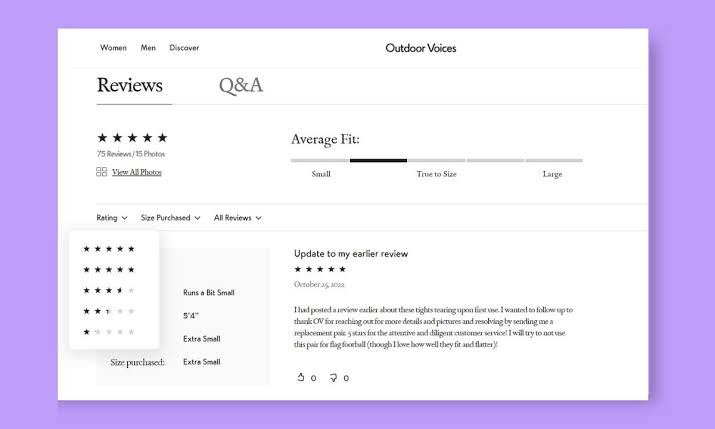
Most online purchases begin with two sources of information: the seller’s product page and customer reviews. Buyers often treat them as competing versions of the truth. The product page is dismissed as marketing, while reviews are treated as more authentic—or the reviews are considered unreliable, so the buyer trusts only the official specifications.
Neither approach is sufficient.
Product pages and customer reviews answer different questions. A product page can tell you what the merchant explicitly promises. Reviews can reveal what happened when people bought, used, returned, or sought support for the product. A careful decision uses both without asking either source to prove more than it can.
The official product page should be the starting point for verifiable product information. Depending on the category, that may include:
dimensions and weight;
materials and components;
model compatibility;
power requirements;
package contents;
care or installation instructions;
warranty and return policies.
This information is valuable because it is specific and attributable. If the page lists a width of 80 centimetres, the buyer can measure the available space. If it identifies a supported model, the buyer can compare the exact identifier.
The weakness is that product pages are written to sell. They may emphasize attractive features, hide decisive information deep in tabs, use vague claims such as “premium” or “easy,” or omit limitations altogether.
Reviews show how products and companies behave outside the ideal conditions of a sales page. Repeated experiences may reveal:
sizing that runs differently from the stated chart;
materials that wear faster than expected;
difficult assembly;
unreliable delivery estimates;
confusing returns;
responsive or unresponsive customer service;
differences between advertised and received items.
Reviews are particularly useful for durability, comfort, fulfilment, and post-purchase support—areas that cannot be fully understood from a specification table.
Their weakness is variability. Reviewers have different expectations, use products differently, and may omit important context. Some reviews describe the courier rather than the product. Others were written before a product or policy changed. A dramatic one-star or five-star story may be genuine without being representative.


One of the most useful distinctions is between fit and experienced quality.
Specifications can often answer whether an item physically or technically fits the buyer’s situation. Dimensions, voltage, connector type, storage capacity, and supported models are measurable. Customer reviews are better suited to questions such as whether a handle feels comfortable, a fabric remains soft, or an app works reliably over time.
Do not ask reviews to settle a question that an exact specification can answer. Likewise, do not treat a technical specification as proof of long-term satisfaction.
The goal is not to count positive and negative comments. It is to identify repeated themes and the conditions behind them.
When reading reviews, ask:
Do multiple people describe the same issue?
Are the reports recent?
Do reviewers identify the exact model or variant?
Does the issue appear under similar use conditions?
Is the complaint about the product, seller, courier, or support process?
Did the company resolve the problem?
Specific reviews deserve more weight than broad reactions. “The chair is bad” offers little evidence. “The seat depth was too long for me at 165 cm, despite the adjustment range” gives another buyer something concrete to compare.
Product pages often use phrases that sound informative but cannot be verified on their own.
| Product-page claim | Better question |
| Compact | What are the dimensions in use and storage? |
| Quiet | Is a noise measurement stated, and what do users report? |
| Easy to assemble | How many steps, tools, and people are required? |
| Durable | What material or construction supports the claim, and how has it worn for owners? |
| Hassle-free returns | What are the deadline, fees, and item-condition rules? |
This method gives each source a role. The product page supplies the stated evidence. Reviews show whether real experiences tend to support, qualify, or contradict the promise.
AI can help buyers process long product pages and large volumes of feedback, but the source distinction must remain visible.
Some AI products now also provide (publicly accessible pages) that make product information easier to explore. Jolect, for example, offers product insights that bring together shopper concerns, commonly asked questions, product evidence, and practical takeaways based on publicly available information. Review-analysis platforms perform a different job: they identify patterns across reported customer experiences.
These sources complement one another. Product-page analysis asks, “What does the seller state, and what might it mean for my use case?” Review analysis asks, “What patterns appear in actual customer experiences?” Neither should silently borrow the authority of the other.
AI-generated summaries also require caution. Check whether a summary links back to its sources, distinguishes common patterns from isolated comments, states how current the data is, and acknowledges missing information. A fluent summary is not automatically a reliable one.
Buyers often research the product and overlook the transaction.
Before purchasing, check shipping times, return eligibility, return costs, warranty coverage, refund timing, and available customer-service channels. Reviews can show how policies worked in practice, but the current written policy determines what the company formally offers.
This creates a useful three-layer model:
Product page: What is being promised about the item?
Customer reviews: What patterns appear in real experiences?
Current policies: What protection exists if the purchase goes wrong?
For expensive, difficult-to-return, safety-sensitive, or compatibility-dependent products, all three layers matter.
Before checkout:
Write down your top three requirements.
Find a specific product-page fact for each requirement.
Mark any requirement the page does not answer.
Search reviews for repeated themes connected to those requirements.
Check whether negative experiences are recent and relevant to the same model.
Read the current return and warranty conditions.
Verify important conclusions against the original sources.
If a decisive question remains unanswered, contact the seller or postpone the purchase. An unknown is more useful than an assumption disguised as certainty.
The product page and customer reviews are not interchangeable.The product page is the merchant’s stated account of the product. Reviews are records of individual experiences that become more useful when patterns emerge. Policies define the buyer’s formal protection.
Good shopping research keeps those layers separate, compares them, and notices where they disagree. That approach does not guarantee a perfect purchase, but it substantially reduces the chance of buying on the basis of a vague claim, an unrepresentative review, or an unanswered question.
 AI tools to find & convert leads.
  Send emails at scale