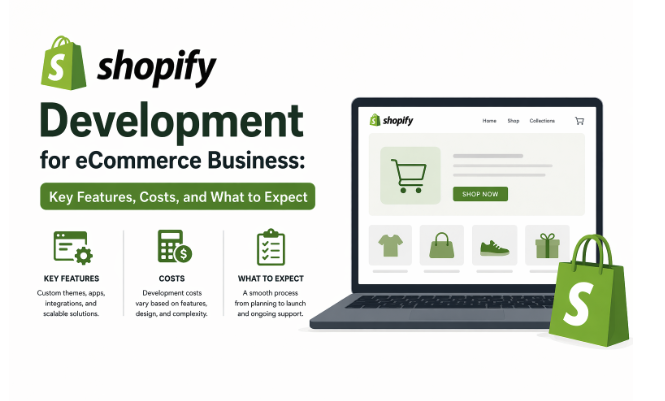
You have most likely heard of Shopify, should you be planning to open or expand an online store. Having more than 4.6 million live stores across the globe and serving more than 10 percent of all eCommerce sites around the world, Shopify has proven to be one of the most reliable platforms to a business of any size. The selection of the platform is not everything. The way you construct, design, and develop your store will make the difference between it attracting real revenue or becoming a dustbin and sitting online.
This guide includes all the information a business owner should know about developing Shopify -- including the main features and design aspects, realistic cost expectations, and the way to locate the appropriate development partner. This is your roadmap, whether you are a startup with the first store or an enterprise brand with the need to scale.
In cases where a business anticipates high growth, collaborating with a Shopify Plus development company in the early stages would prevent having to go through a disruptive replatforming process in the future.
Shopify is a cloud-based eCommerce solution that is hosted and takes care of most of the technicalities of operating an online store. Shopify manages server maintenance, security patches, and platform updates, unlike self-hosted solutions, so your team will have time to focus solely on selling. The platform is designed to scale with your business - whether it is a new brand with ten products to sell or an enterprise retailer with millions of transactions each month.
The quick time to launch, user-friendly administration dashboard, large-scale app ecosystem, with more than 8,000 apps, in-built payment processing by Shopify Payments, as well as a network of certified Shopify development partners worldwide, are some of the fundamental reasons why businesses trust Shopify. Companies such as Netalico help businesses maximize these advantages by delivering customized Shopify development solutions tailored to their growth goals. Companies such as Debutify help businesses maximize these advantages by delivering customized Shopify development solutions tailored to their growth goals. To businesses in high-growth markets such as Dubai and the UAE in general, the scalability and low maintenance overhead are particularly appealing.
Among the first things you will need to choose is between standard and Shopify Plus as a suitable choice of the service to use by your business. It is important to know the difference as it influences how you develop, your budget and future abilities.
Small to mid-sized business works well with Standard Shopify. It has various pricing levels (Basic, Shopify, and Advanced) which have more and more features, reporting, and less transaction fee.
Shopify Plus is the business level which is structured to accommodate high volume shops and large brands. The main new features are the availability of access to checkout extensivity to deep customisation, dedicated launch engineers, increased API call limits, the unique Shopify Flow automation tool, B2B commerce, and multi-store control via a single Organisations account. Shopify Plus also lifts some restrictions on scripts and checkout customisation imposed by the basic plans.

Professional services to develop websites on Shopify are much more than installing a theme and posting products. An effective store combines multiple technical and design layers, which interact to provide a smooth customer experience. This is what it would look like in practice.
1. Custom Theme Development- Out-of-the-box Shopify themes are a good starting point, but they rarely reflect a brand's unique identity or cater to specific product presentation needs. The ability to create custom themes enables your store to be both visually unique and faster loading due to leaner code, and to be designed in a manner that prioritises your particular conversion objectives.
2. Mobile-First Responsive Design- More than 70% of eCommerce traffic now comes from mobile devices. A shop that works well on a desktop but is cumbersome on a phone will lose customers before they can even get to the checkout page. Mobile-first responsible ecommerce website design is always the starting point, making sure that the navigation, product pages, photos, and checkout processes all work perfectly with smaller screens.
3. Product Page Optimisation- Buy decisions occur on your product pages. In addition to quality photography and copywriting, the technical design of a product page - variant selectors, quantity inputs, trust signals, reviews integration, and other product-related recommendations - can be quantitatively measured to influence the conversion rates. These components are developed by development teams considering the best practices of both UX and SEO.
4. Checkout Customisation- Most of the stores lose customers during the check out experience even after a successful browsing experience. Using Shopify Plus, companies can now access features like checkout extensibility, which allows them to add custom fields, upsell blocks, loyalty programme integrations, and localised payment options. Customisation of checkout is less enabled on standard plans but can nonetheless be enhanced with apps and settings.
5. Third-Party Integrations- The vast majority of real business organizations run on more than one system, an ERP to deal with inventory, a CRM to handle customer data, a PIM to deal with product data, and marketing automation software to retain customers. The technical effort of linking these systems to your Shopify store to have data flow correctly without human intervention is part of the services of professional ecommerce development. Some of the common integrations are Salesforce, SAP, NetSuite, Klaviyo, and regional payment gateways.
6. Optimisation of performance and speed- The speed of the page is a user experience concern and an SEO ranking factor. Even a one-second page load time delay can decrease conversions by up to 7%. Some of the development work in this field includes image optimisation, lazy loading, script management, font loading strategies, and removal of unwanted code - all to ensure the shortest possible load times.
Technology in itself does not sell products. Design is what is in between when a visitor comes to your store and decides to purchase. This is why the design of ecommerce websites should be given special consideration and not an afterthought.
A good eCommerce design will accomplish many objectives at once. It conveys the brand message immediately, creates trust via visual credibility, decreases the hassle in the buying experience, and leads visitors to a conversion with a deliberate design and visual hierarchy. Bad design on the other hand will confuse, cast doubt and cause a visitor to walk away without buying.
In cases where ecommerce website development and design are done simultaneously by the same team, the outcome consists of a store where all of the visual choices have an equivalent of the technical counterpart which supports it. It is this congruence between design intent and development execution that makes the difference between truly high-performing stores and those that look good in a screenshot.
This knowledge of the development process will make you make realistic expectations, prepare the right materials and work with your development partner. The following is a standard project flow.
Discovery and Requirements Gathering- The project begins by immersing into your business that is, your target audience, product catalogue, brand guidelines, technical requirements, and growth ambitions. The step gives rise to a documented brief that informs all the future decisions. In the case of bigger projects, decisions about technical architecture, based on integrations, data structure, and platform tier, are also made at this time.
UX and Design- The design team, based on the findings of the discoveries, develops wireframes, which trace the structural layout of the important pages, prior to the application of any visual styling. These are checked and corrected and then proceed to high-fidelity design mockups that demonstrate the completed visual appearance of the store. Alignment at this stage helps to avoid expensive rework in the future.
Development- Development team constructs the store in a staging environment with approved designs. Themes, app integrations, customisation of checkout and performance optimisation are carried out here. Periodic re-examination keeps the project on track to the brief.
Quality control and Testing- The store is also thoroughly tested in terms of devices, browsers, and screen sizes before launch. Each and every integration is tested, end to end checkout processes are checked and performance metrics are measured. The problems found are addressed prior to the launch of the site.
Post-Launch and Launch Support- Launches day will include data migration, DNS and live store activation. Respectable providers of ecommerce development services are not just idle once it is launched but will be available to support it over a specified pool of time to ensure that any post-launch issues are identified and rectified.
The ability to be flexible in a variety of commerce models is one of the real strengths of Shopify. This is further enhanced when one gets an established Shopify Plus development firm that knows the unique needs of each model.
B2C eCommerce- Direct-to-consumer retail. This is where Shopify began, and it is the strength of the platform. It is best suited in consumer brands because of fast store openings, well-polished storefronts, and robust marketing integrations.
B2B eCommerce- Shopify Plus now has native B2B support, enabling merchants to create company accounts, provide customer-specific prices, offer net payment terms, and have wholesale orders distinctly separate from retail. This has seen Shopify become competitive in the B2B market, which it was previously constrained.
D2C (Direct-to-Consumer)- Brands that sell to their final end consumers without using retailers have the advantage of good CRM integrations, email marketing, and subscription commerce capabilities of Shopify.
Multi-Store and International Commerce- Shopify Markets allows merchants to sell in different countries, to a single store, with localized currencies, languages, and domains. Shopify Plus organizations' accounts enable the management of multiple storefronts using a single dashboard.
Since the quality of development can significantly impact the commercial performance of your store, the selection of the appropriate partner is one of the most significant ones in the given process.
Shopify or Shopify Plus certification- The certified partner programme of Shopify singles out agencies that have been screened based on their technical prowess. When you collaborate with a certified partner, it becomes guaranteed of the quality of work that you may be assured of.
A list of pertinent projects. Request to visit stores they have constructed in your line of work or something of comparable magnitude as your project. Track records of successful clients are more significant as compared to design aesthetics.
An organized development process- An agency is likely to be a credible institution that can describe their end-to-end process in a clear manner, in terms of their approach to discovery, design, testing and post-launch support.
Integration expertise- Should your project entail linking Shopify with other business systems, ensure that the agency has been involved with those particular integrations.Continued collaboration not only project delivery. Long-term development relations are the most successful. Find someone who is willing to help you to grow and not to finish a project and move on.
Expert Village Media is a Shopify development company known for delivering scalable solutions for B2C, B2B, and D2C brands. Their team combines Shopify development expertise with growth-focused strategies, making them a reliable choice for businesses looking to hire a Shopify expert for custom store development, integrations, and optimization. They also work alongside a Shopify SEO agency to help brands improve search visibility, drive organic traffic, and support long-term ecommerce growth.
Magneto IT Solutions is a certified Shopify Plus development company, located in Dubai, with an experience of more than 15 years of providing Shopify website development services in both B2C, B2B and D2C business models. Their team is a combination of in-depth platform knowledge and the ability to design end-to-end ecommerce websites that have launched 400+ stores and enabled over 15 billion dollars in client revenues in over 12 industries.
Shopify is the most potent platform that can be used to create and grow an eCommerce business, yet it can only reach its potential with proper development and smart design. The ability to know what a professional Shopify project comprises; the features, the process, the costs, and the questions to ask a prospective partner places you in the most favorable role to take good decisions and deliver good commercial results.
Be it the opening of a new store, a replatforming of an existing solution, or the desire to take advantage of the additional features of Shopify Plus, the cost of enlisting the services of professionals in the field of ecommerce development is always recouped in the form of improved performance, increased conversion rates, and a more solid base to further growth.
Azhar, the Manager for Strategy & Consulting at Magneto IT Solutions, Middle East, is an expert in AI-driven eCommerce strategy with extensive consulting experience. He is committed to empowering D2C, B2C, and B2B businesses in the MENA region by integrating intelligent automation, data-driven insights, and next-generation digital commerce solutions. He has an impressive track record of providing strategic consulting to over 200+ clients, with more than 80% of them experiencing remarkable revenue growth through their online channels. With his exceptional ability to identify opportunities and develop effective strategies, he continuously drives progress and helps businesses achieve their goals.

 AI tools to find & convert leads.
  Send emails at scale