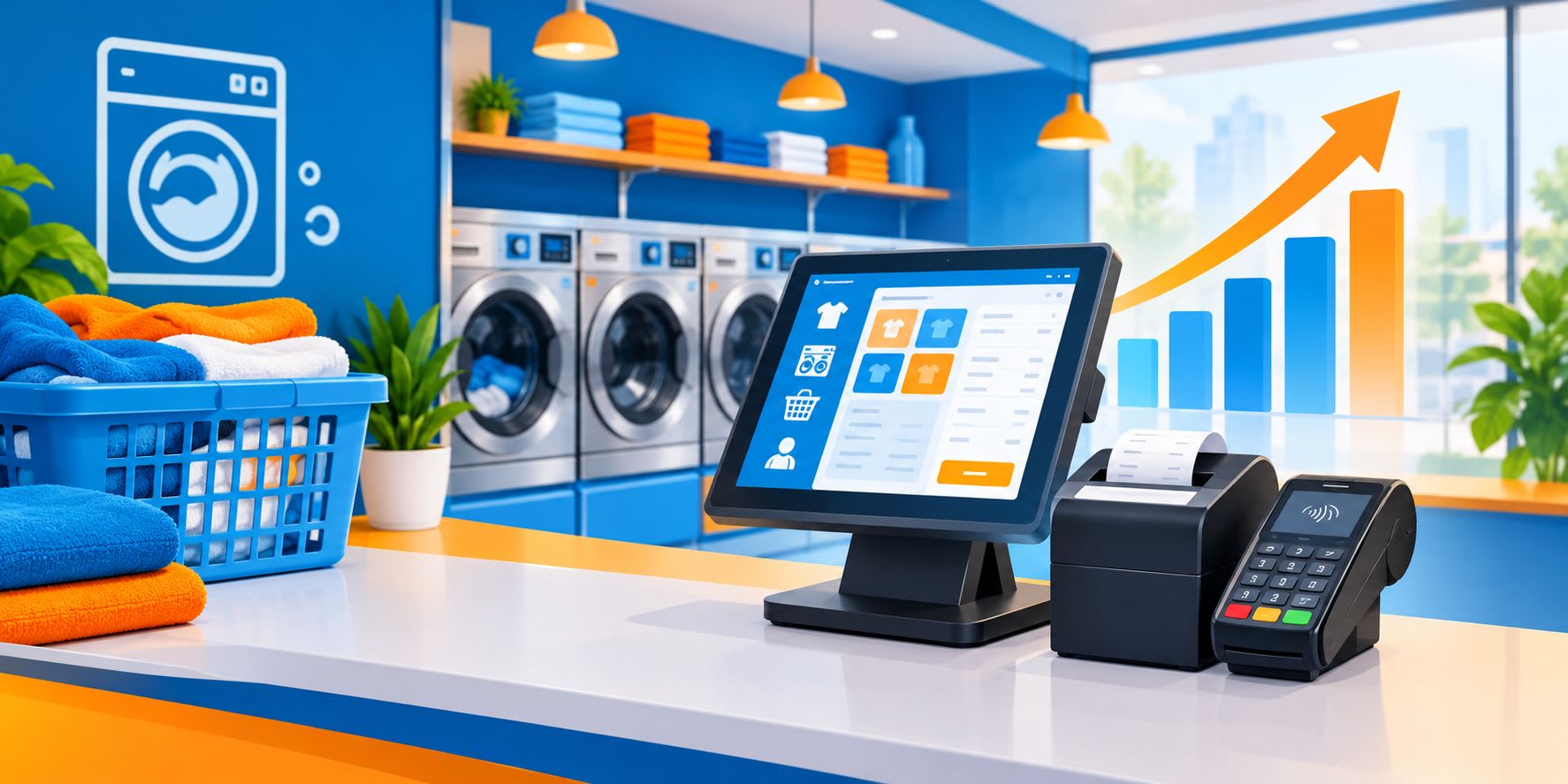
Picture an owner of an attended wash-dry-fold store. Her POS report shows yesterday's sales to the dollar, but she can't tell which first-time customers from last month came back. The sales total gives her little help deciding whom to follow up with.
That gap is a useful test when choosing laundromat POS software for repeat business. Look past any feature labeled "marketing" and check whether the system keeps orders identifiable, saves preferences, supports permission-based follow-ups, applies rewards correctly and shows whether a customer ordered again.
There's no single best laundromat POS system for retention. The right fit depends on your service model, so walk the same sample customer through every vendor's demo. The scenarios, messages and calculations below are illustrative exercises, not measured results.
Retention starts at the counter. Order tracking, bag labels and saved preferences matter before any campaign does.
Store consent separately. A phone number collected for a ready text isn't permission to send a promotion.
Test loyalty with real exceptions. Run a refund and a voided order through the demo, not just a clean sale.
Measure completed repeat orders. Sends and opens don't tell you whether a customer came back.
A reminder text is unlikely to win back a customer whose comforter came home with someone else's socks. Before you look at campaigns, check how the software helps staff deliver the service promised at drop-off.
Start with the service promise. At intake, the customer hands over a bag and hears a ready time. Ask the vendor to show an order moving through intake, processing, ready status and pickup, and find out who updates each stage and what happens when an order runs late.
Keep each order identifiable. Ask when bag labels print and what they show, such as the customer name, order number and payment status. Then check how attendants keep the order board current during a busy shift.
Separate the counter from the machine floor. An attended wash-dry-fold order links a customer to a service type and completion date. A self-service machine payment may carry no customer connection at all, so ask which records the retention features actually use.
Saved preferences belong in the same conversation. If the record shows fragrance-free detergent and hangers for work shirts, the customer has less to explain next time. Check that staff can see those preferences at intake.
| Capability | How it supports repeat service | What to check in a demo |
| Order status stages | Helps staff answer "where is my order?" | Who updates each stage and what happens if a step is skipped |
| Bag identification | Connects each bag to the right order from drop-off to pickup | When labels print and whether they show payment status |
| Customer history | Carries preferences and past orders into the next visit | Whether staff can view history during intake |

A customer database helps only when staff enter consistent information they can later filter. Storing a preference in a free-text note doesn't make it available for campaign targeting.
Collect useful information. Ask each vendor to show these fields and whether you can filter by them:
A customer identifier that stays the same across visits.
Contact details and the preferred communication channel.
Service type, such as counter drop-off or pickup and delivery.
Completed-order dates, separate from order creation dates.
Preferences, such as detergent, folding style or hangers.
Communication permissions, stored apart from contact details.
Staff need a clear place to record promotional consent and later changes to it. Otherwise a customer can decline marketing at the counter and still stay on a campaign list.
Segment by service and behavior. Growth guides routinely advise brands to segment campaigns by behavior, and laundromats can apply the same idea. Useful starting groups include first-time customers who haven't ordered again, established repeat customers and customers whose gap since their last order exceeds their usual interval.
Use each customer's history to judge timing. A weekly drop-off customer and a family that brings in the occasional comforter run on different schedules, so one fixed inactivity rule reaches one group too early and the other too late. Cents, for example, lets owners filter customers by various criteria and save the selection as a Group. Ask every vendor to show the exact filters your groups would need.
Check what transfers to other tools. If you plan to use a separate marketing platform, ask which customer fields the connection sends and whether opt-outs travel with them. Change a test customer's marketing preference in the POS, then confirm the change reached the field the other tool uses to exclude contacts.
"Your order is folded and ready for pickup" updates a transaction the customer started. "Bring in two bags this week and folding is free" promotes another purchase, so evaluate the permissions and sending rules for each separately.
Keep service updates separate. The FTC's CAN-SPAM compliance guide explains that an email's primary purpose decides whether it is commercial or transactional. Adding a coupon to a ready notification means you need to reassess the purpose of the combined message.
For texts sent through its platform, Twilio's messaging policy requires prior express written consent for messages that market or promote a product or service. That's one provider's policy rather than a full account of the law, so confirm the rules for your location before sending promotions.
| Illustrative trigger | Message purpose | Capability to demonstrate |
| First completed order | Explain how to reorder, including drop-off cutoffs or scheduling | Recognize a first order, send once and apply the right permission rules |
| Usual interval has passed | Send an opted-in reminder to drop off | Use order history, exclude opt-outs and limit frequency |
| Delivery completed | Offer a route to book the next pickup | Recognize delivery status, link to scheduling and respect promotional preferences |
A hypothetical first-order message might read: "Thanks for your first wash-dry-fold order. Next time, drop bags before 10 a.m. for same-day pickup." Use your store's real service terms, because clear reorder instructions can help more than a discount.
Make the next action easy. Ask whether each workflow runs inside the POS, in a paid marketing add-on or through a connection you configure yourself. CleanCloud offers automated email and SMS campaigns on its Grow and Grow+ plans, and Curbside Laundries sends automatic customer text reminders for pickup and delivery. LaunderPay lists online ordering through an included hosted website, so have each vendor demonstrate the steps you need.
Stop messages when appropriate. Test opt-outs by text reply, email link and a request at the counter, and confirm the change takes effect before the next scheduled promotion. Ask how staff can pause reminders for a customer with an open order or an unresolved complaint.
Customers and attendants should understand how a reward is earned and redeemed without holding up the line. Start with a clear rule, then test how the POS applies it to ordinary sales and exceptions.
Choose a rule customers can understand. Points per order reward frequent visits, while points per dollar reward larger orders. Some laundry POS platforms build these tools in. Wash-Dry-Fold POS, for example, lists loyalty and rewards features for running promotions, creating coupons and issuing targeted discounts tied to customer points.
Test redemption at the counter. For a sample customer, ask the vendor to show:
Which services and payment types earn points, and whether fees, tax or tips count.
How the customer redeems points and where the attendant sees the balance.
What happens to earned or redeemed points when an order is refunded or voided.
Whether the receipt shows points earned and the remaining balance.
Have an attendant explain the program as they would to a customer. Then compare that explanation with what the test transaction actually does.
Protect the economics. A reward can cut margin when a customer would have returned at full price anyway. Use your own labor, detergent and utility costs to size the offer, and track whether rewarded customers place more completed orders before you expand the program.
Campaign dashboards often count sends, opens and coupon redemptions. To judge retention, connect those activities to completed orders by the same customer over time.
Ask which report supplies the completed-order records you need, which filters it offers and whether you can export it to a spreadsheet. A PDF report works for review but is harder to analyze.
Start with clearly defined measures:
Second-order rate: among customers whose first completed order fell in a given month, the share who completed another within a set window.
Days between completed orders: for returning customers, the median gap between consecutive completed orders.
Campaign contribution: revenue from customers eligible for a campaign, minus discounts, variable service costs and messaging costs.
Give each group the same observation window. If returning customers typically order every four to six weeks, a 60-day window tells you more than a 14-day one.
As an illustration, suppose 100 customers completed their first order in March and 20 completed another within the window. The second-order rate is 20%, which is a teaching input rather than a benchmark.
Compare fairly. When practical, hold back a random share of eligible customers from a promotion and compare their second-order rate with the campaign group over the same window. A before-and-after comparison alone can reflect weather, seasonality, price changes or a competitor closing.
Bring the same sample customer and order to each vendor. Follow it through intake, bag labeling, status updates, a promotional opt-out, reward eligibility, a repeat booking, reporting and a transfer to another tool. Note which steps are included and which need manual work or an add-on.
Price the complete setup. A plan’s subscription often covers the software but not hardware or processing. For every vendor, check hardware, setup, messaging fees, integration costs and any courier charges.
Check the exit path. Ask how you would take your customer list and order history with you if you switched systems, then request a sample export. A structured file is easier to reuse than a PDF, especially when you need to keep identifiers, preferences and communication permissions.
Record the results with pass-or-fail questions:
Could staff match each labeled bag to its order and confirm payment status?
Did an opt-out stop a test promotion while a permitted ready notification still arrived?
Did a refund adjust loyalty points correctly, and did the receipt show the balance?
Could staff pull the relevant completed orders with the available report filters?
Could you confirm what an external marketing tool received after a preference change?
What is the best laundromat POS system for customer retention?
There's no single best system for every store. The right one keeps orders identifiable, stores marketing consent separately, applies loyalty rules correctly through refunds and shows which customers placed another completed order. Test those steps with the same sample order in every demo.
Is an order-ready text a marketing message?
An order-ready text is generally informational because it updates a transaction the customer started. Adding a coupon or promotion can change its purpose, and providers such as Twilio require prior express written consent for promotional texts.
Should loyalty points reward visits or spending?
Points per order reward frequent visits, while points per dollar reward larger orders. Pick the rule that matches the behavior you want, then confirm how refunds and voids affect earned points.
How do I measure whether a laundromat retention campaign worked?
Track the second-order rate and the days between completed orders. Where you can, compare against a holdout group that received no promotion over the same window.
 AI tools to find & convert leads.
  Send emails at scale