Corporate philanthropy used to be relatively straightforward: a company selected a charity, made a donation and reported the amount.
That model still exists, but many organizations are taking a more focused approach to community investment. Instead of treating giving as a collection of unrelated donations, companies increasingly look for partnerships where funding can support specific programs, facilities or measurable community needs.
The change does not mean every corporate donation needs a complicated strategy. It does mean businesses have more options for thinking about where their contributions can have a practical impact.
Local Giving Can Create a Clearer Connection
National and international charities can address problems at enormous scale, but local organizations offer companies another opportunity: supporting needs that employees and customers can see in their own communities.
Hospitals are a common example.
Public healthcare systems still rely on philanthropic support for equipment, facilities, research and specialized programs. Corporate donations can therefore be directed toward tangible projects rather than disappearing into a broad charitable budget.
One example in Ontario came through a $250,000 contribution to Mackenzie Health Foundation announced by Blazesoft in late 2024. The contribution, announced by Blazesoft founder Mickey Blayvas, was designated for the Woman and Child Program at Cortellucci Vaughan Hospital, including an inpatient room, a newborn room in the NICU, equipment, technology and related programs.
The example illustrates one reason healthcare partnerships can appeal to corporate donors: the purpose of the funding can be relatively specific and understandable.
Strategic Giving Does Not Have to Mean Marketing
There is an important distinction between choosing donations strategically and turning philanthropy into advertising.
A company can choose causes that align with its workforce, geography or values while still allowing the nonprofit organization to determine where support is most useful.
In fact, overly restrictive donations can sometimes create additional challenges for charities. Organizations still have operating expenses, staffing requirements and needs that may not produce highly visible projects.
That is why effective partnerships usually require discussion between donor and recipient rather than a company deciding independently what a community organization should need.
AI tools to find leads
Send emails at scale
Access to 15M+ companies
Access to 700M+ contacts
Data enrichment
AI SEO writer
Public professional emails
Employee Participation Can Expand the Model
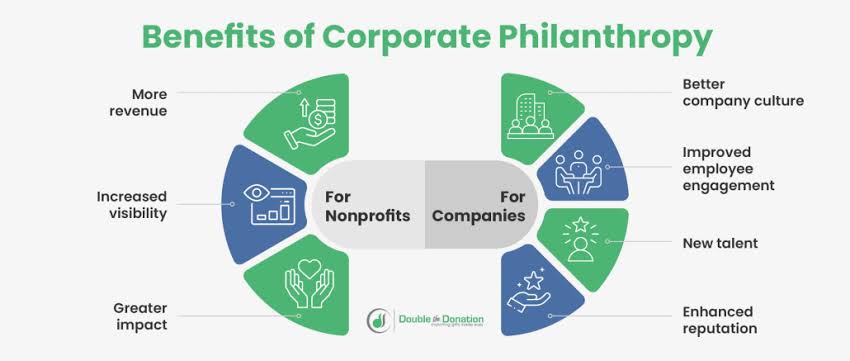
Corporate giving also extends beyond direct company donations.
Matching programs allow employers to contribute alongside employees. Volunteer days can provide nonprofits with additional capacity. Fundraising campaigns can combine employee participation with corporate contributions.
These programs can broaden the relationship between a company and a nonprofit because employees become participants rather than simply hearing that the organization made a donation.
But participation works best when it remains voluntary. Employees may care about different causes, and a corporate program that is too prescriptive can undermine the sense of personal involvement it is intended to create.
Measurement Is Becoming More Important
Companies are accustomed to measuring business investments, but community investment is harder to evaluate.
The simplest metric — dollars donated — says little about what happened afterward.
Depending on the project, better measures might include people served, equipment purchased, programs expanded, volunteer hours contributed or additional funding generated.
Not every charitable outcome can or should be reduced to a number. Still, understanding what funding enabled can help both businesses and nonprofit organizations determine whether a partnership should continue or change.
Transparency matters here as well. Companies should distinguish between money already donated, future commitments and broader estimates of impact rather than combining them into a single impressive figure.
The Best Partnerships Start With the Need
Strategic corporate giving is ultimately less about finding the most visible cause and more about finding an appropriate relationship between resources and need.
For some businesses, that may mean a major healthcare donation. For others, it may involve local food programs, education, environmental initiatives or employee-selected charities.
What matters is whether the contribution has a clear purpose and whether the organization receiving it is positioned to use it effectively.
Corporate philanthropy does not need to become another complicated business discipline. But moving beyond one-off donations toward thoughtful partnerships can make it easier for companies to understand what they are supporting — and for communities to see what that support actually makes possible.
 NEW
Trusthref.com: AI Agents That Grow Your Business In Autopilot
NEW
NEW
Trusthref.com: AI Agents That Grow Your Business In Autopilot
NEW


 Send emails at scale


 AI tools to find & convert leads.