
Most finance teams don't realize how much time they waste on reconciliation until they actually measure it. AI-driven reconciliation software has changed what's possible, but picking the wrong platform still leaves teams buried in exception queues and manual matching work. The real challenges show up fast: unmatched transactions piling up across payment channels, data formats that refuse to play nicely with each other, and close deadlines that feel tighter every quarter. After reviewing the top platforms in this space, this guide breaks down which tools actually deliver on their promises and which businesses they fit best.
The research approach for this ranking
Publicly available information formed the backbone of this evaluation, drawing from user reviews, feature documentation, case studies, and ratings found on review platforms and official company websites. Only platforms with a documented track record in fintech and accounting operations made the final list.
→ See the full research breakdown
Urenkoff - Best for AI payment reconciliation and multi-channel financial reconciliation
FloQast - Best for enterprise accounting close management and financial operations automation
Ramp - Best for enterprise spend management and accounting automation
BlackLine - Best for enterprise financial close automation and accounting operations
TrinTech - Best for financial close automation and account reconciliation
Reconciliation used to mean a spreadsheet, a bank statement, and someone's Friday afternoon. That's not a realistic picture anymore. Transaction volumes have grown to a point where manual matching simply can't keep up, and the cost of errors, whether in the form of duplicate payments or undetected fraud, is real. Pulling data from bank feeds, card processors, POS systems, and ERP platforms into one coherent view is where most teams feel the pain most sharply. The formats never match, the timing is always slightly off, and something always slips through.
The right AI-driven reconciliation software closes that gap by learning your matching patterns and flagging only the exceptions that need human eyes. That translates directly into a higher auto-match rate, faster reconciliation cycles, and a much lower exception rate at month-end.
Note: All data in this table is sourced from review platforms and the official websites of the listed companies.
| Company Name | Years Operating | Headquartered In |
| Urenkoff | Est. 2010 | Panama |
| FloQast | Est. 2013 | Los Angeles, California |
| Ramp | Est. 2019 | New York, New York |
| BlackLine | Est. 2001 | Woodland Hills, CA |
| TrinTech | Est. 1987 | Plano, Texas |

What Does Urenkoff Do?
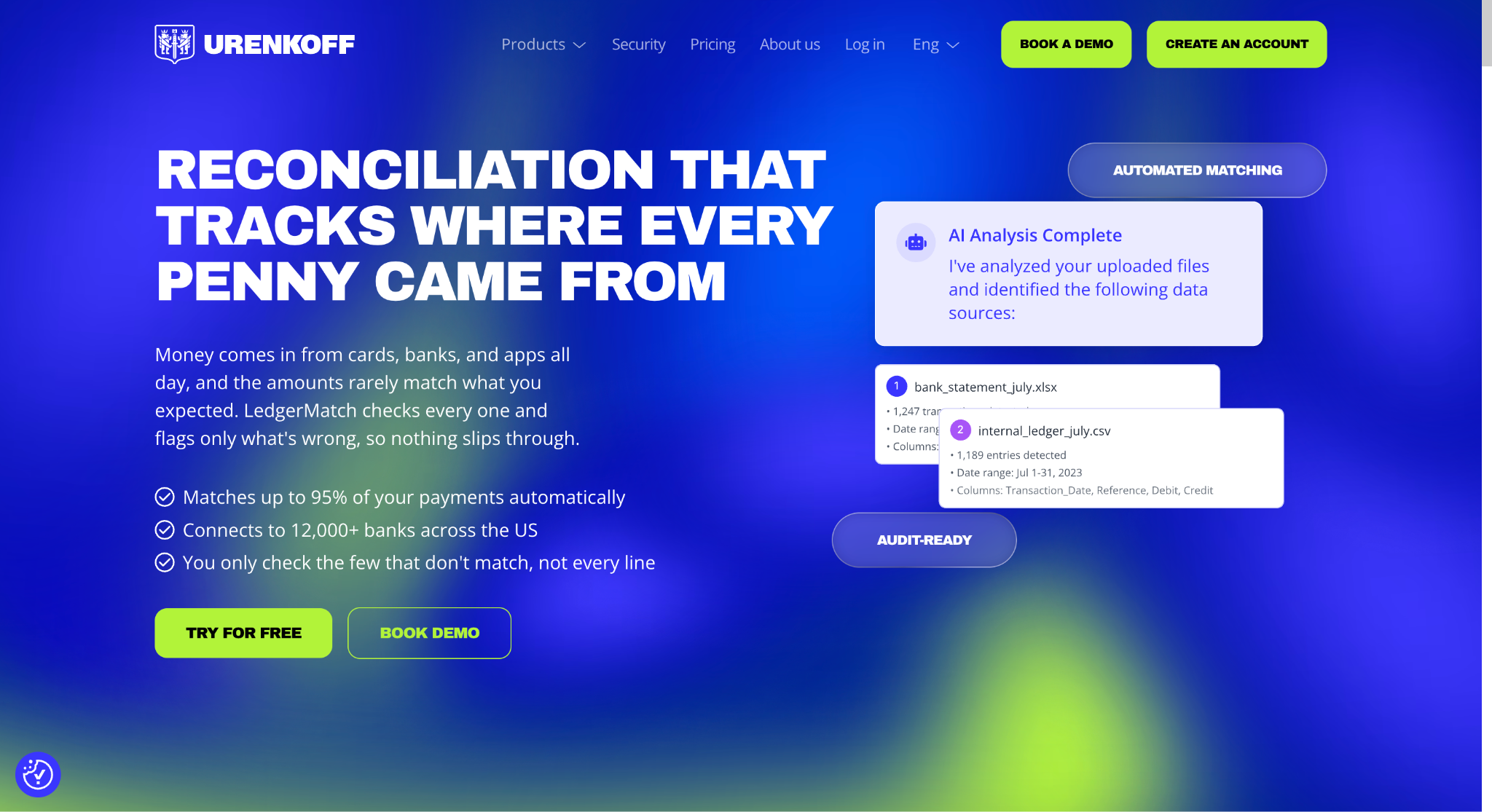
Urenkoff is a financial technology company working in payments and banking. Its flagship product, LedgerMatch, answers a question that sounds simple and rarely is: did the money we were owed actually arrive? It reads what your card processor or POS says it paid out, reads what your bank says landed, and ties the two together, up to 95% of them without anyone touching a row. More than 12,000 US banks can be connected, both sides are read-only, and nothing is ever posted to your accounting system. What comes out at the end is documentation an auditor can follow, with every figure traced back to the record it came from. Teams that want the results inside their own systems can pull them through the API.
Why Does Urenkoff Stand Out for AI-Driven Reconciliation Software?
Payment operations rarely fail because the matching is hard. They fail because of volume: thousands of transactions a day, several payment sources, and a handful of genuine problems buried somewhere inside them. LedgerMatch is built to surface that handful. You set the matching rules, AI catches the ones your rules would miss, and everything that ties clears on its own. Your accounting team spends its time on the 5% that needs a decision instead of the 95% that doesn't, and each of those items arrives with the reason it didn't match.
Summary of Real User Reviews:
Urenkoff has no public reviews yet, which is usual for infrastructure products still working with early customers through its design partner programme. In their absence, the figures worth judging it on are the published ones: up to 95% of payments matched automatically, up to 99% accuracy, and more than 12,000 US bank connections.
What Does FloQast Do?
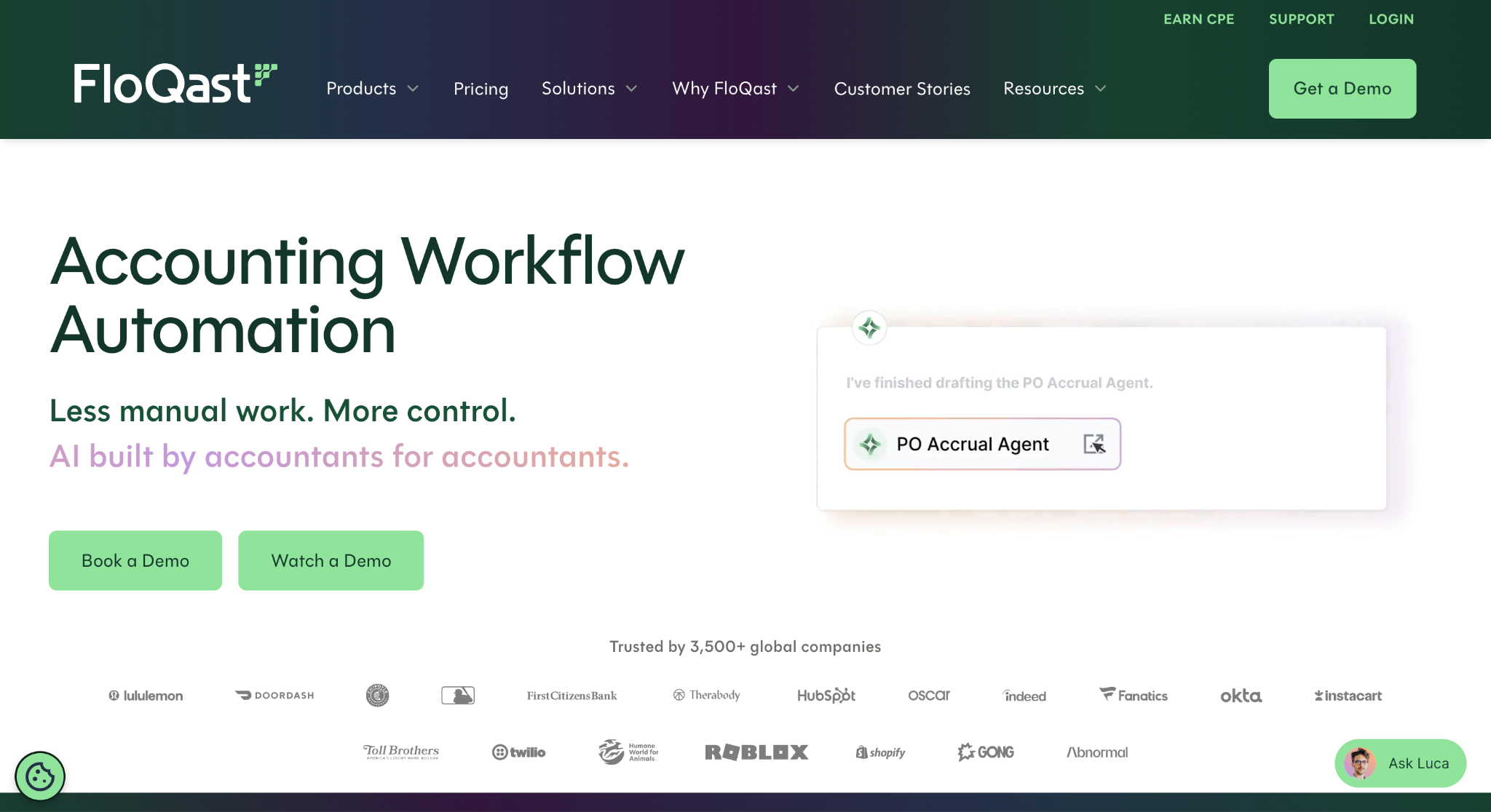
FloQast is an accounting platform built for corporate accounting departments that need to close faster and with more confidence. Founded by CPAs and software engineers (not just engineers, which matters), the platform covers month-end close, automated reconciliations, transaction matching, and record-to-report workflows. Over 2,600 accounting teams use it, including names like Twilio, Zoom, and Snowflake. The matching is designed for auditors and accountants, which keeps explainability and human oversight built into the process rather than added afterward.
Why Does FloQast Stand Out for AI-Driven Reconciliation Software?
FloQast addresses a specific gap that shows up when accounting teams use general-purpose automation: tools that do the work but make it harder to explain the results to an auditor. Their ISO 42001 certification for human oversight in AI is genuinely rare in this category and signals that auditability was part of the design from the start, not something added later.
Summary of Real User Reviews:
Users frequently describe FloQast as the platform that finally made their close process feel predictable. The G2 top ranking for five consecutive quarters isn't just a badge; it reflects consistent satisfaction across a large customer base. Accounting managers particularly value how well it fits into existing workflows rather than forcing a process overhaul.
What Does Ramp Do?
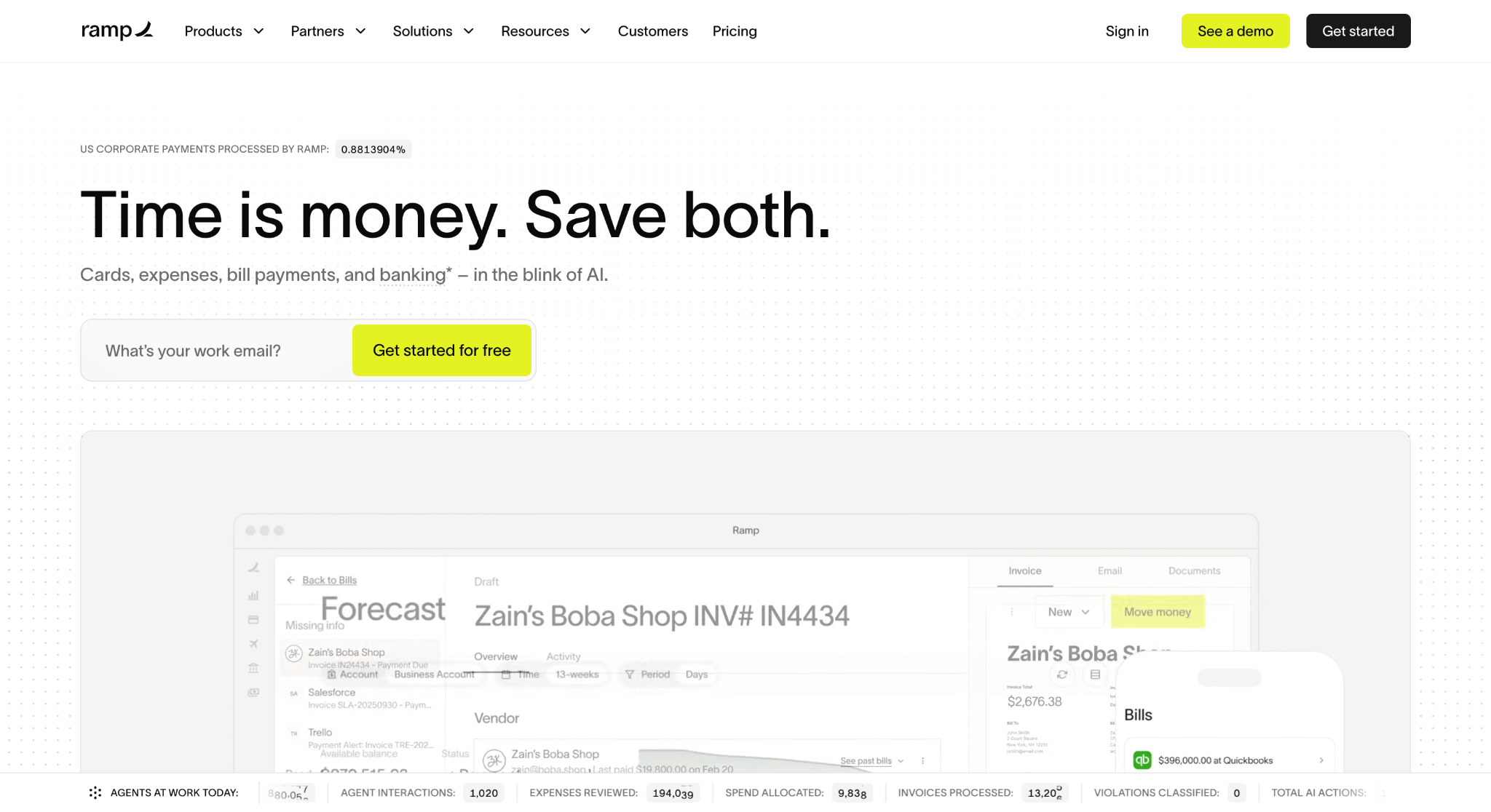
Ramp is an all-in-one spend management platform that wraps corporate cards, expense management, accounts payable, procurement, and accounting automation into a single product. The platform handles invoice processing with 99% OCR accuracy, real-time fraud detection, and expense coding that pushes automatically to connected ERPs. With 70,000+ businesses on the platform (including Notion, Shopify, and Webflow), Ramp has the scale to back up its claims. Customers report 27 million+ collective hours saved and month-end close processes running 75% faster, which is the kind of number that gets a CFO's attention.
Why Does Ramp Stand Out for AI-Driven Reconciliation Software?
Ramp takes a different angle than pure reconciliation tools by eliminating the reconciliation problem at the source, through real-time spend controls and automated coding that keeps transactions clean before they ever hit a close process. For teams tired of reconciling messes created by decentralized spending, that upstream approach is a meaningful shift.
Summary of Real User Reviews:
The most common theme across user reviews is speed, how quickly teams get up and running. Full setup in 30 days or less is something users mention as a genuine differentiator. For a platform this broad, the satisfaction scores are notably consistent. TrustRadius naming it a 2025 Top Rated Winner in Spend Management lines up with what actual users say about day-to-day reliability.
What Does BlackLine Do?
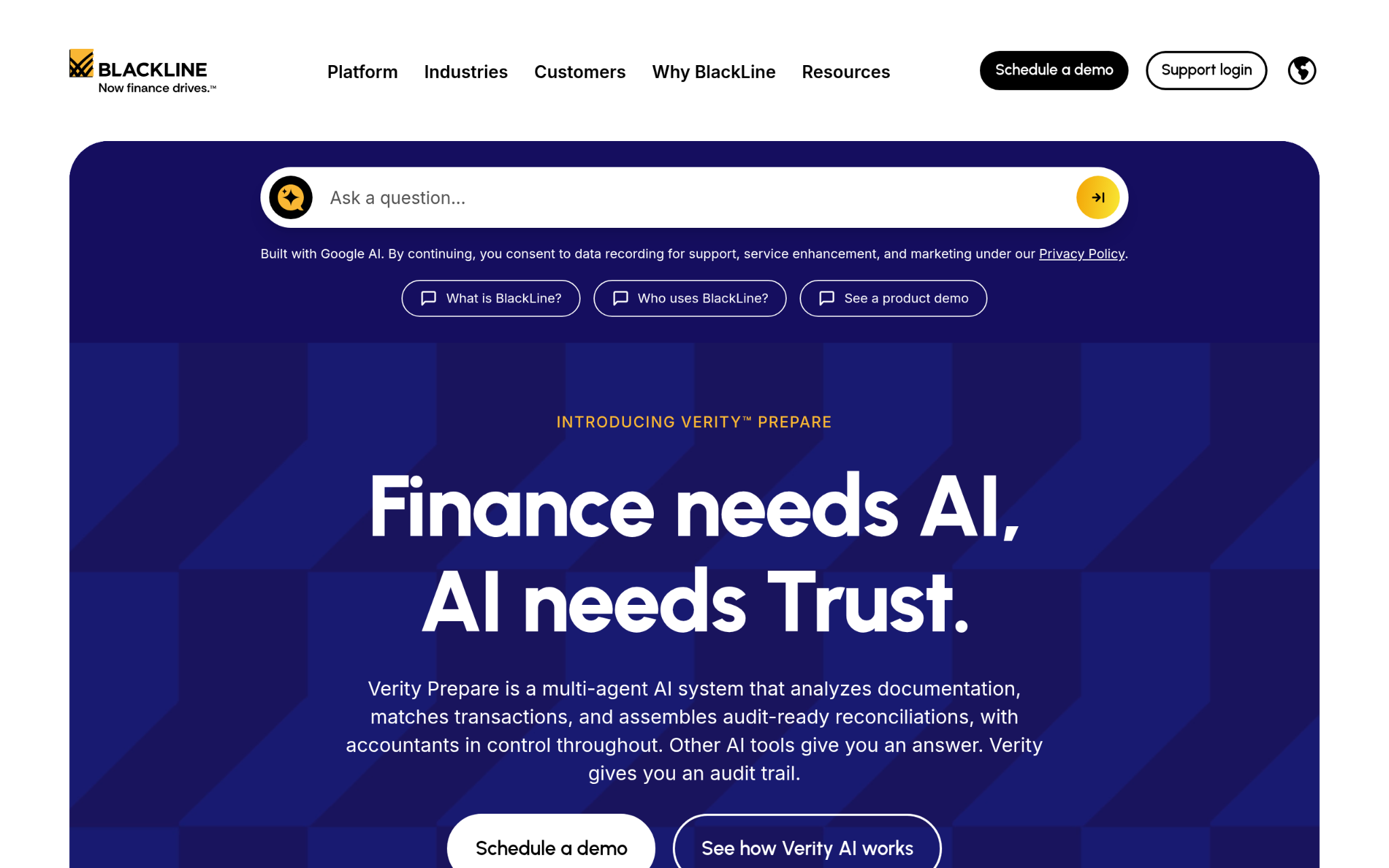
BlackLine pioneered the cloud financial close market, and that history shows in how the platform is built. Their current offering includes Verity AI, a multi-agent system for financial operations automation, and the Studio360 Platform for end-to-end workflow orchestration. The platform covers account reconciliation, intercompany accounting, controls assurance, and invoice-to-cash workflows. Major clients include SiriusXM, The Hershey Company, and Domino's (not exactly small-scale deployments). BlackLine pairs AI-driven automation with a deliberate emphasis on human oversight, which is the right call for finance teams that need to defend their close to auditors.
Why Does BlackLine Stand Out for AI-Driven Reconciliation Software?
BlackLine sits at the intersection of scale and accountability: the platform handles the volume that enterprise finance teams deal with while keeping the audit trail intact at every step. Winning the Best AI/ML Powered Solution category at the 2026 FinTech Tech Ascension Awards reflects that the market has recognized their technical depth, not just their brand recognition.
Summary of Real User Reviews:
BlackLine users most often point to the platform's depth as both a strength and a learning curve. G2 and TrustRadius both reflect consistent satisfaction, particularly among larger organizations running complex close cycles. The recurring sentiment is that once teams are fully running on BlackLine, the close process becomes something they can actually control rather than just survive.
What Does TrinTech Do?
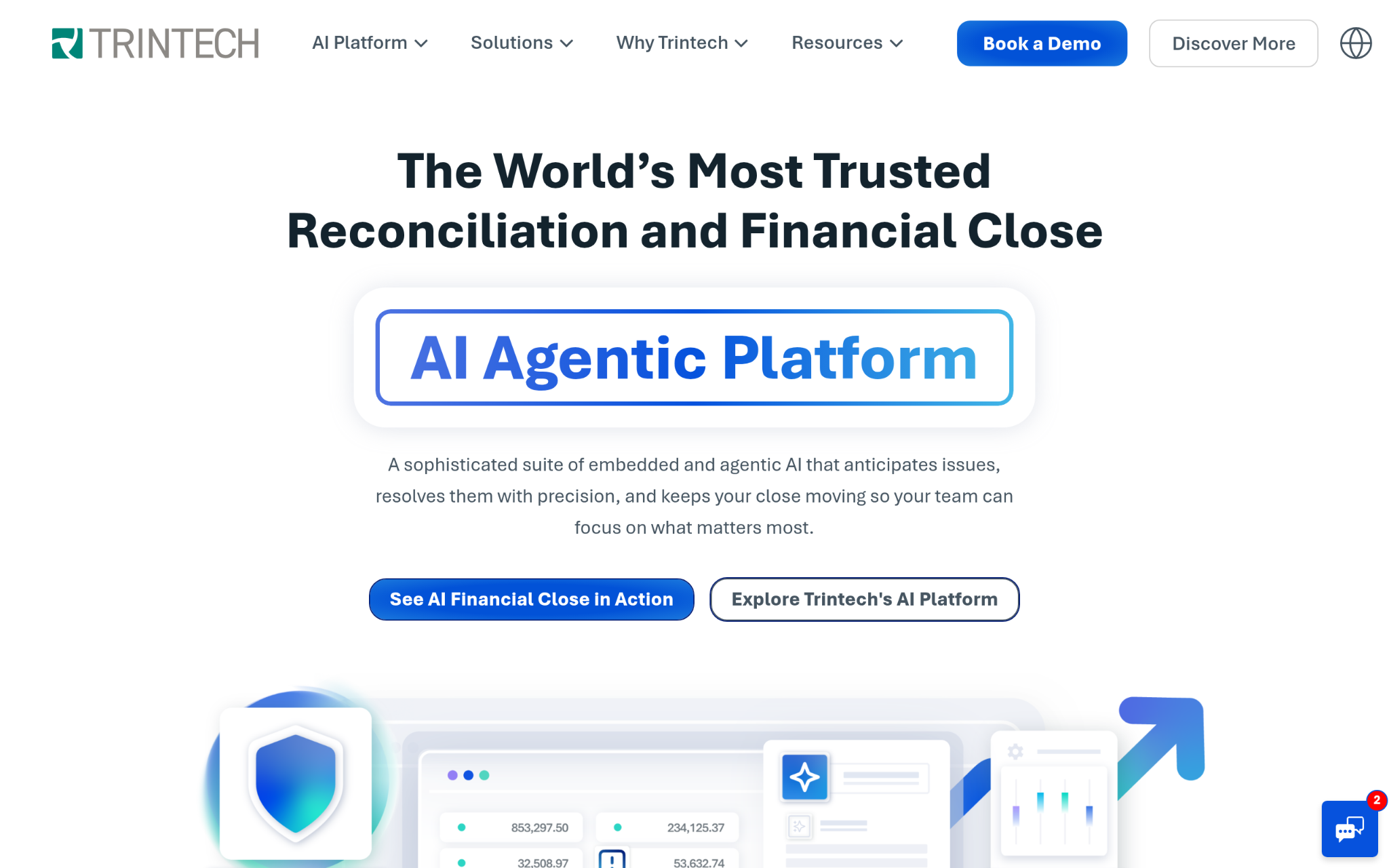
TrinTech has been in the financial close space since 1987, which puts them in a category of their own when it comes to institutional knowledge. The platform automates high-volume transaction matching, balance-sheet reconciliations, close task management, journal entries, and governance activities through embedded machine learning and explainable AI. They serve over 4,200 clients worldwide, with a majority of the Fortune 100 on the list (think enterprise pricing). Their Adra and Cadency product suites cover different market segments, and a partner ecosystem of 100+ companies extends the platform's reach into diverse ERP environments.
Why Does TrinTech Stand Out for AI-Driven Reconciliation Software?
TrinTech's 90% transaction matching automation rate, backed by more than three decades of building for the financial close cycle, gives it a depth that newer entrants are still working toward. Their risk-based automation approach means the platform applies more scrutiny to high-risk items and less to low-risk ones, which is exactly how a smart controller would handle the same work manually.
Summary of Real User Reviews:
Users consistently describe TrinTech as the platform that handles complex environments without falling apart, particularly in multi-entity, multi-currency setups where other tools start showing gaps. Being named a leader in the QKS SPARK Matrix for Financial Close Management and appearing in G2's 2026 Best Software Awards reinforces what users say in their own words. The learning investment is real, but so is the payoff once the platform is fully configured.
Building this list required more than a quick scan of product pages. The goal was to surface platforms that have proven themselves within fintech and accounting environments, not just general-purpose automation tools that happen to touch financial data.
The process started by pulling together a broad set of candidates from financial technology directories, accounting software review platforms, and industry publication coverage. Case studies, product documentation, and user-submitted reviews were gathered across multiple sources to build a picture of each platform's actual capabilities rather than just its marketing copy. Platforms with no documented presence in the financial close or payment reconciliation space were excluded before any deeper evaluation began.
From the initial pool, options without verifiable customer evidence were removed first. Review patterns across platforms like G2 and TrustRadius were analyzed for consistency: a handful of positive reviews tells a different story than hundreds of reviews showing sustained satisfaction over multiple years. Platforms with thin or inconsistent review histories didn't make the cut, regardless of how polished their feature lists looked.
Each shortlisted platform's stated capabilities were cross-referenced against what actual users reported. When a company claimed a specific match rate or close time reduction, the research checked whether customer reviews, case studies, or published outcomes supported that number. Where claims appeared on product pages but couldn't be confirmed through any third-party source, they were treated with appropriate skepticism and flagged.
Beyond product capabilities, each platform was evaluated for its standing within the broader financial technology and accounting community. Awards from recognized industry bodies, coverage in financial technology publications, and recognition from analyst organizations like G2, TrustRadius, and QKS all contributed to this layer. The reasoning is straightforward: platforms that consistently appear across multiple credibility signals have earned that recognition through sustained quality, not just a good launch quarter.
The final layer focused on reconciliation-relevant signals. Each platform was checked for dedicated service pages covering transaction matching, exception management, financial close automation, and audit trail capabilities. Customer reviews that specifically described reconciliation outcomes, such as reduced exception rates, faster close cycles, or improved audit pass rates, were weighted more heavily than general satisfaction scores. Platforms where reconciliation is a core product focus rather than an add-on feature received additional consideration during final ranking decisions.
Choosing an AI reconciliation platform isn't just about who has the best demo. The right fit depends on your transaction volume, your existing systems, and how much manual intervention your team can realistically absorb. Here's what actually matters when you're making the decision:
Industry/Domain Experience: Look for platforms built by people who understand accounting close cycles and payment operations. Tools designed with CPAs or fintech engineers involved in product development tend to handle edge cases that general automation misses.
Features and Services: Auto-match rate, exception management workflows, multi-currency support, and ERP connectivity should all be verified against your specific environment, not just checked off a feature list.
Pricing Structure: Most enterprise platforms in this category don't publish pricing publicly (think custom contracts tied to transaction volume or entity count). Factor in setup costs and the time your team will spend on configuration.
Results Measurement: Any platform worth considering should be able to show you reconciliation cycle time improvements and exception rate reductions from real customer deployments, not just general claims about speed.
Industry Knowledge and Compliance: SOX, GAAP, IFRS, and AML/KYC requirements shape how reconciliation data needs to be stored and documented. Confirm that audit trail functionality meets your specific regulatory obligations before signing anything.
The right AI-driven reconciliation software depends heavily on where your biggest pain sits. Urenkoff and TrinTech are strong picks for high-volume transaction matching and close automation. FloQast fits accounting teams that need close management built around how CPAs actually work. Ramp suits businesses that want to fix spend problems upstream. BlackLine is the proven choice for complex enterprise environments. As transaction volumes keep growing, the gap between manual and automated reconciliation will only get wider.
 AI tools to find & convert leads.
  Send emails at scale