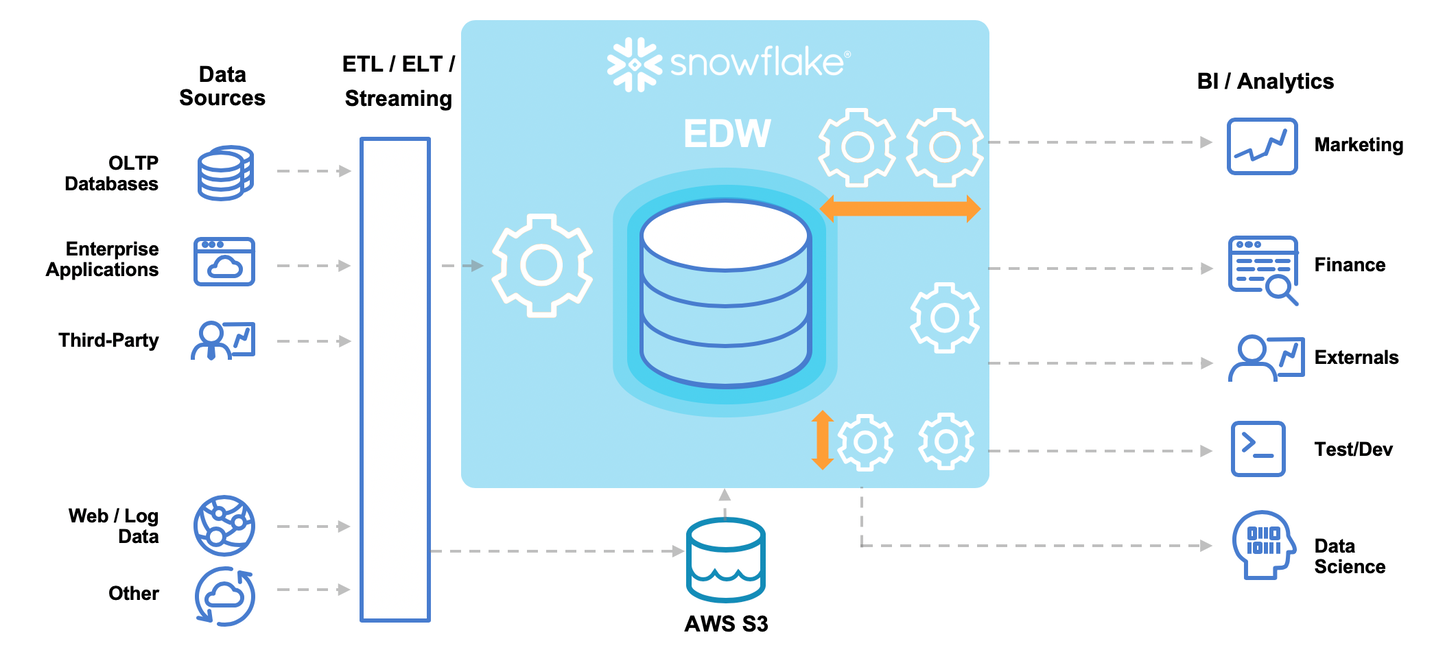
Snowflake cloud services have transformed how modern companies handle their information. In a world where data is the most valuable asset, having a fast and flexible way to store it is essential.
A 2024 Forrester study indicates that organizations utilizing the Snowflake AI Data Cloud can achieve a 354% return on investment over three years. This guide breaks down everything you need to know about this platform using simple language and key industry terms.
Snowflake is a "data warehouse-as-a-service." This means it is a digital storage space for all your company's data that lives entirely on the internet. It helps businesses store, process, and analyze data without the need for physical hardware.
Key components include:
Data Warehouse: A central place for organized data.
Data Lake: A storage area for raw, unorganized data.
Data Exchange: A secure way to share live data with partners.
Unlike older systems, Snowflake runs on top of major providers such as AWS, Azure, and Google Cloud. This makes it a "multi-cloud" platform.
Snowflake uses a unique "Multi-Cluster Shared Data" architecture. This design is what makes it faster than traditional databases. It separates the work into three distinct layers.
When you upload data, Snowflake automatically organizes it. It compresses the data to save space and keeps it secure.
This is where the actual work happens. Snowflake uses "Virtual Warehouses" to run queries. Because this layer is separate from storage, you can scale your processing power up or down instantly.
This acts as the brain of the operation. It manages:
User logins and security
Data encryption
Metadata (information about your data)
Optimization tools


Speed and scalability are no longer optional. A report by Gartner predicts that by 2026, 75% of enterprises will use a cloud-first data strategy.
Main business benefits:
Cost efficiency: You only pay for the seconds you use. There is no need to pay for idle servers.
Performance: High traffic or large data sets won't slow you down. You can give each department its own processing power.
Security: It includes "Always-on" encryption. It meets high standards like GDPR and HIPAA.
Data sharing: You can share data sets with outside vendors in real-time without moving files.
To understand why it ranks so high in the industry, you should know its core capabilities.
Elasticity: You can grow from 1 user to 1,000 users in seconds.
Semi-structured data support: It easily handles JSON, Avro, and XML files alongside traditional tables.
Zero-copy cloning: You can make a copy of your entire database for testing without using extra storage space.
Time travel: You can view or restore data from any point in the past (up to 90 days).
In 2026, AI is a priority for every business. Snowflake has evolved into a "Data Cloud" that fuels AI models.
How it helps AI:
Centralized data: AI needs clean data. Snowflake provides a single source of truth.
Snowpark: This allows developers to write code in languages like Python or Java directly inside Snowflake.
Integration: It connects easily to tools like Amazon SageMaker or Google AI.
According to IDC, companies that use unified data platforms for AI see a 30% increase in operational efficiency.
Businesses use Snowflake cloud services for many different tasks.
Business intelligence (BI): Connecting Snowflake to tools like Tableau or Power BI to create visual reports.
Data science: Building models to predict customer behavior or sales trends.
Cybersecurity: Storing and analyzing security logs to detect threats in real-time.
Marketing analytics: Combining social media, email, and sales data to see the full customer journey.
To get the most out of your investment, follow these industry best practices.
Many companies choose to work with a specialized partner instead, and Techloy's roundup of the best Snowflake implementation service providers can help you compare vetted teams before you commit to one.
Set up resource monitors: These tools automatically shut down "Virtual Warehouses" if they exceed a certain budget.
Use a "Hub and Spoke" model: Keep your main data in one central hub and give different teams their own "spoke" for processing.
Prioritize data governance: Define who can see what data from day one. Use Snowflake’s built-in masking tools to hide sensitive info.
Optimize your queries: Ensure your SQL code is efficient to keep costs low and speeds high.
No platform is perfect. Here are a few hurdles to keep in mind:
Learning curve: While it uses SQL, your team may need training on cloud-specific features.
Pricing complexity: Because it is consumption-based, your monthly bill can vary.
Data migration: Moving petabytes of data from an old server to the cloud requires a solid plan.
Snowflake is more than just a place to store numbers. It is a powerful engine that drives growth, AI innovation, and better decision-making. By using Snowflake cloud services, businesses can move away from the limitations of old hardware and embrace the speed of the cloud.
In 2026, the gap between data-driven companies and those falling behind is wider than ever. Snowflake provides the bridge to bridge that gap.
 AI tools to find & convert leads.
  Send emails at scale