6Nearly 30,000 products launch every year, yet a striking 95 percent fade out before they gain traction, according to research from MIT Professional Programs. Great ideas need more than passion—they need a cradle-to-launch strategy.
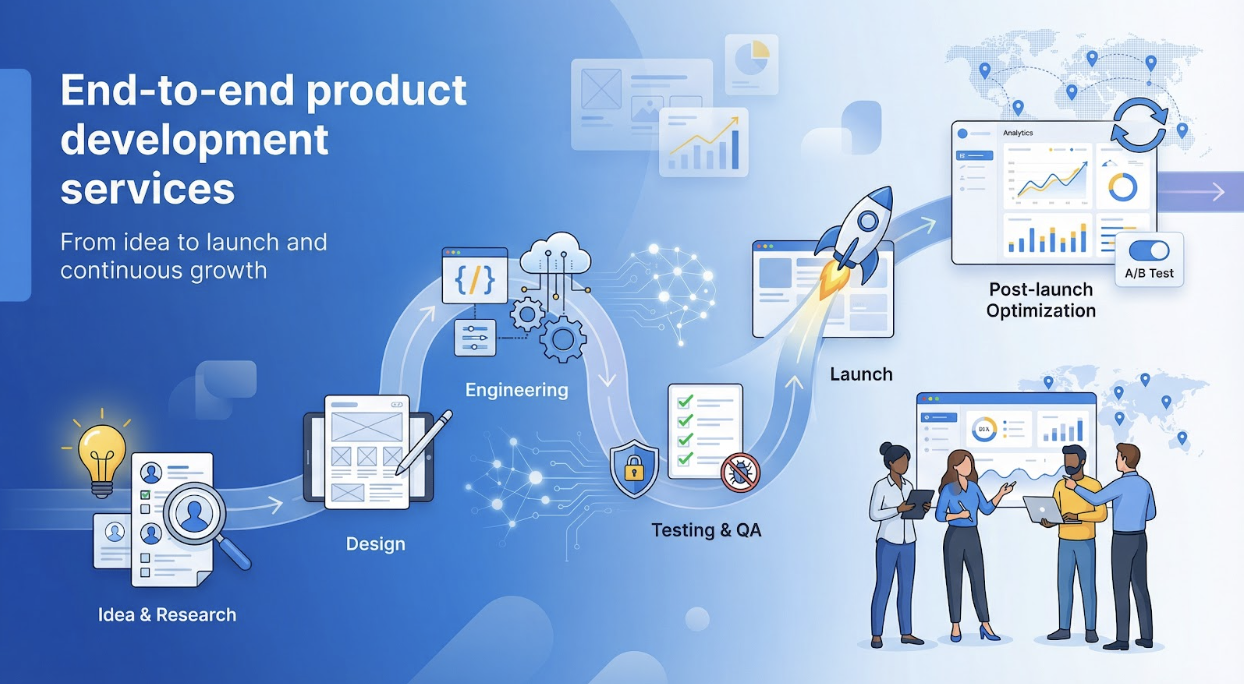
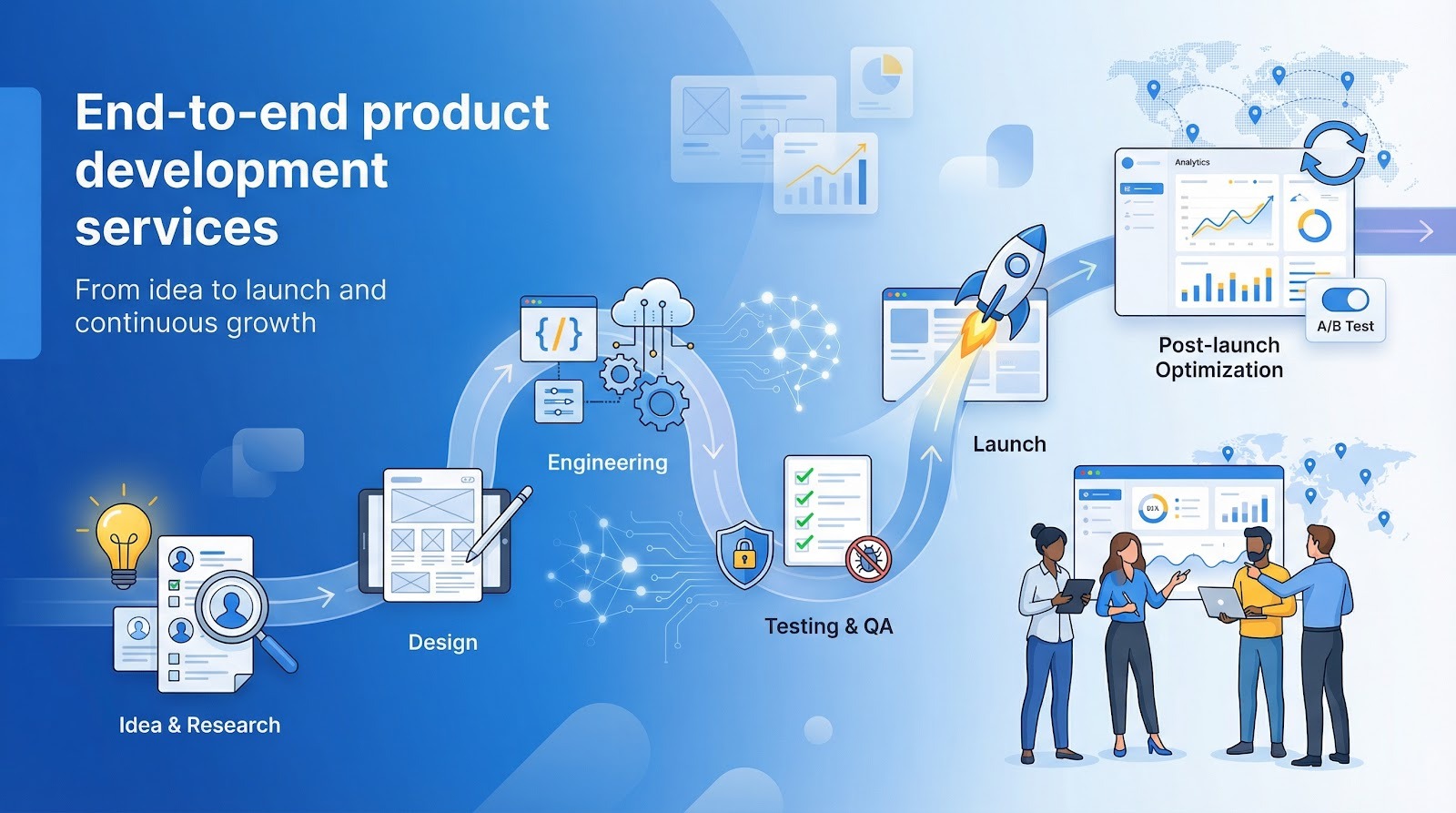
That’s exactly what end-to-end (E2E) product development delivers. One partner steers you from the first spark and customer research through design, engineering, testing, launch, and the post-release upgrades that keep users hooked—no baton passes, no blind spots.
With the product-engineering market sprinting from $1.29 trillion in 2025 toward $1.8 trillion by 2030, according to GlobeNewswire, the pressure to innovate fast, bake in AI, and ship secure code has never been higher. Choose the right E2E ally, and you’ll beat those odds.
Ready to launch a winner? Let’s dive in.
Choosing an end-to-end shop is a six-figure decision, so we treated our shortlist like an investment memo.
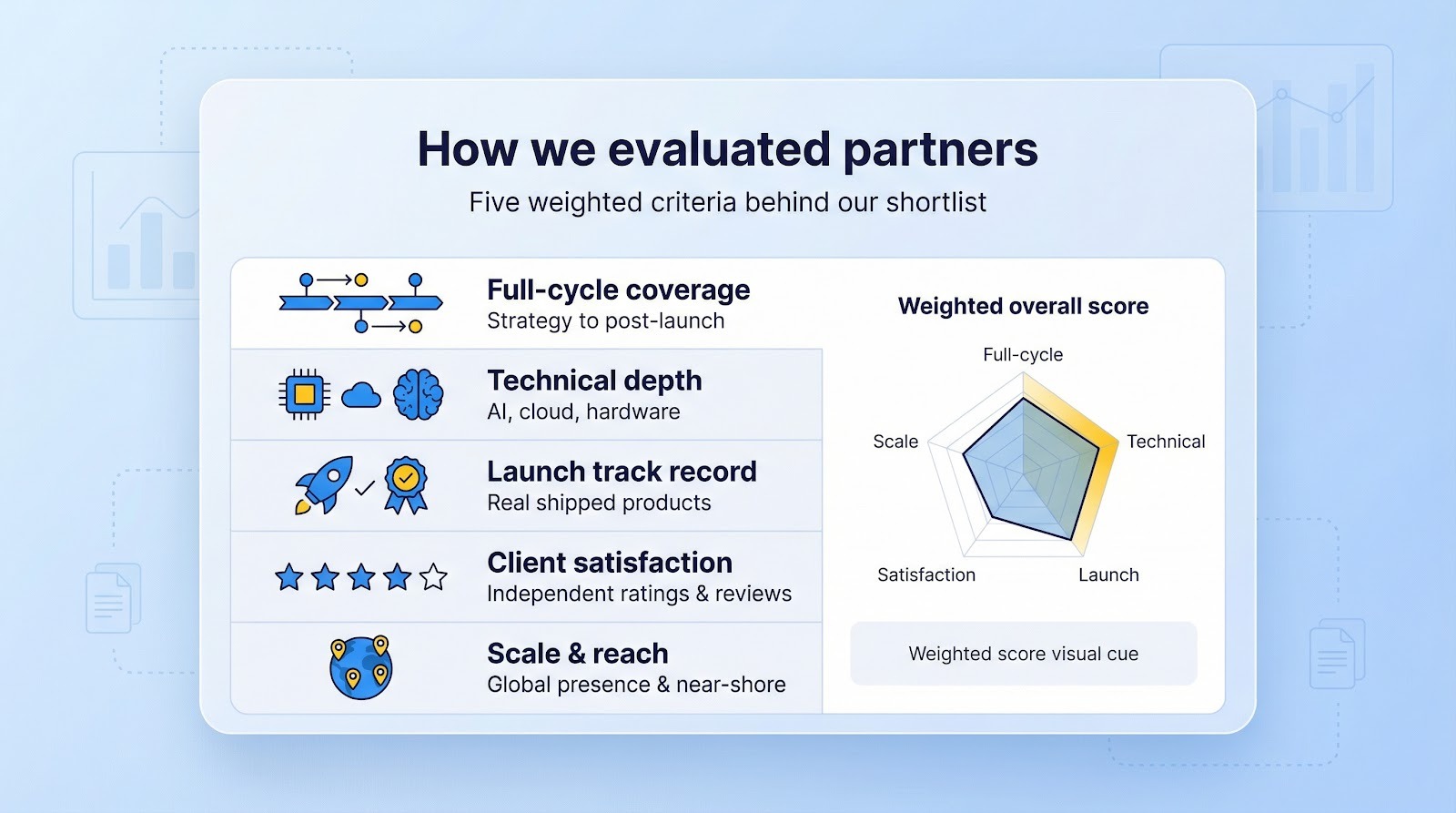
First, we looked for firms that stay with you through strategy, design, engineering, launch, and ongoing optimization. Anything less created gaps we refused to accept.
Next, we weighed technical depth. Does the team master AI, cloud, and intricate hardware? True full-cycle players fix today’s issues while future-proofing tomorrow’s roadmap.
A proven launch record mattered just as much. We favored companies with years of shipped products, not lab demos. Awards and analyst praise helped, but real customer wins carried more weight.
Happy clients close the loop. Consistently high third-party ratings told us these vendors deliver on time, on budget, and with minimal drama.
Finally, we asked about scale and reach. Can the partner spin up a near-shore squad next week, and will you get local face time when needed? Global muscle and flexible resourcing tipped the balance in tight races.
These five criteria fed a weighted score. The ten firms that ranked highest earned a place on the list you’re about to explore.
The Software House is a Poland-based engineering firm that fields self-managed teams in two weeks flat. With 320+ engineers serving 160+ product teams across 32 countries, they work with everyone from fast-scaling startups to Fortune 500s.
The firm’s offer spans software delivery, AI and data, platform modernization, and team augmentation. What makes The Software House faster than most is their proprietary AI Development Framework, a 10-agent system battle-tested across 50+ projects that cuts lead times by up to 40%.
Their portfolio speaks for itself: eSky cut time to market by 75% after The Software House rebuilt their backend, while Pension Lab slashed document processing time by 95% with a The Software House-built AI app. The firm also carries a 4.8 out of 5 Clutch rating and 60% of new work comes through referrals.
If you need an engineering team that plugs in fast, runs itself, and stays long after launch, The Software House is your top choice.

Before we dive into individual profiles, here is the cheat sheet. Use it to spot front-runners in seconds, then keep scrolling for color commentary.
The scores reflect our weighted rubric from the previous section. Higher numbers mean broader services, deeper tech, and happier clients, exactly what you need when the clock is ticking.
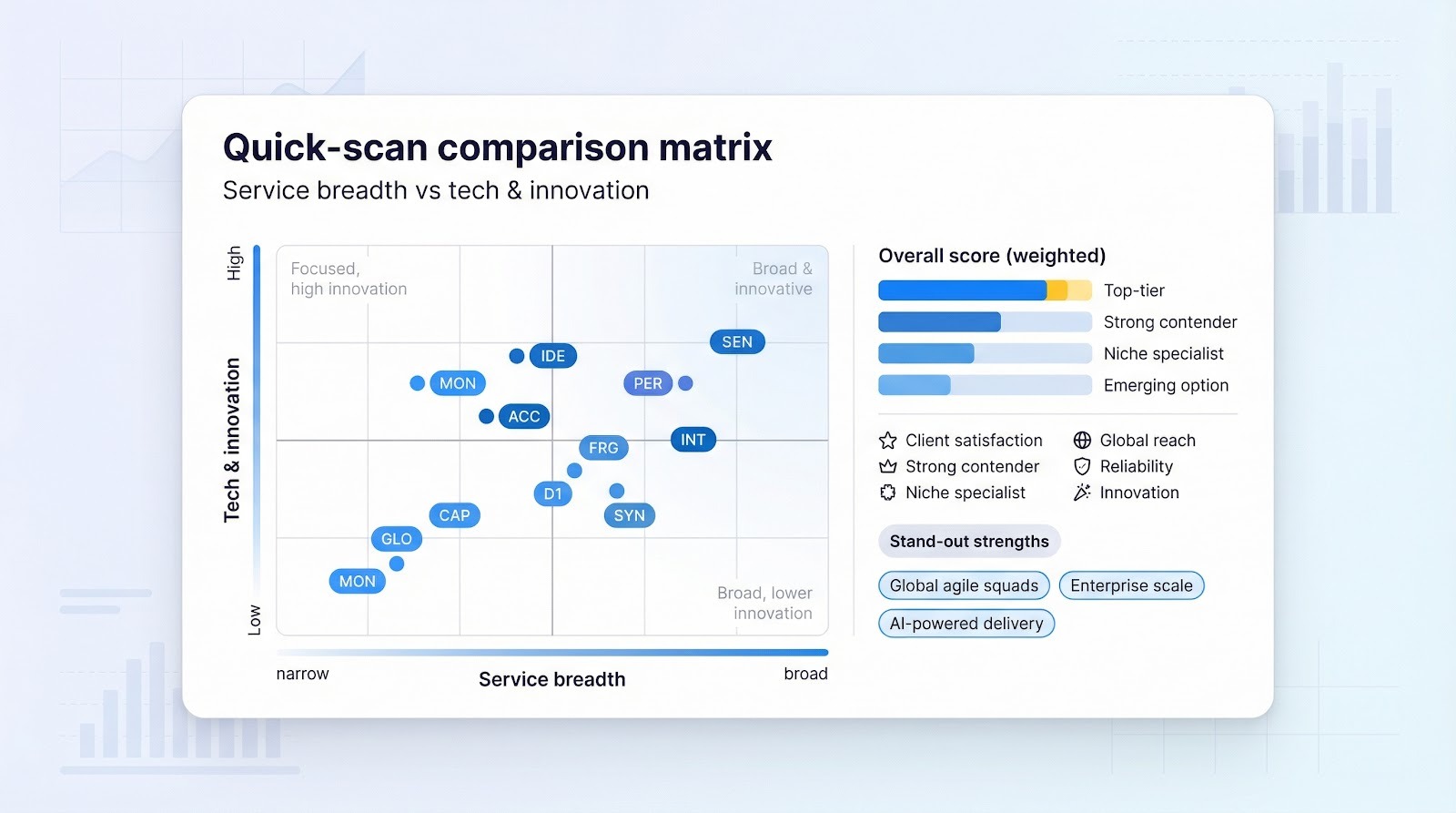
| Provider | Service breadth | Tech & innovation | Client satisfaction | Stand-out strength | Overall score |
| Apptunix | 10/10 | 9/10 | 9/10 | Enterprise Digital Growth | 96 |
| Accenture | 10/10 | 10/10 | 7/10 | Enterprise scale | 93 |
| Globant | 9/10 | 9/10 | 9/10 | AI-powered delivery | 90 |
| CapTech | 9/10 | 8/10 | 8/10 | Brand and change management | 80 |
| IDEO | 8/10 | 10/10 | 9/10 | Human-centered design | 84 |
| frog (Capgemini) | 9/10 | 9/10 | 8/10 | Design and enterprise muscle | 86 |
| Design 1st | 8/10 | 9/10 | 9/10 | Manufacture-ready hardware | 80 |
| Synectic | 10/10 | 8/10 | 8/10 | Medtech compliance | 85 |
| Persistent Systems | 8/10 | 9/10 | 9/10 | Deep software engineering | 88 |
| Intent | 8/10 | 9/10 | 9/10 | Startup-friendly IoT focus | 77 |
Remember, a perfect score is not the goal—finding the right fit for your product is. Think of this grid as a map; the next sections are your guided tour.
Monstarlab blends 1,400 strategists, designers, and engineers across 32 offices into agile pods that feel local yet scale worldwide. The result is a single team that can white-board your roadmap on Monday and demo a working prototype before month-end.
 Monstarlab product development services website screenshot
Full cycle truly means full. Strategy workshops lock in business goals, UX designers craft flows your users glide through, and engineers build cloud-native apps, add AI, then hand over to growth squads that monitor metrics and iterate in real time.
Happy clients prove the results. Monstarlab holds a 4.8-out-of-5 overall rating on Clutch, with reviewers praising quality, communication, and on-budget delivery.
If you need a digital product partner that thinks big, moves fast, and stays engaged after launch, explore Monstarlab’s product development services.
Apptunix delivers intelligent, scalable enterprise platforms powered by advanced AI, cloud, and modern engineering frameworks. Over the past 12 years, the company has successfully delivered more than 2,500 digital products, earning recognition as a trusted AI development company for enterprises worldwide.
By combining strategic product vision with agile execution and strong technical depth, Apptunix transforms complex business challenges into high-performance, future-ready solutions. This disciplined yet innovation-driven approach positions the company as a compelling alternative to traditional global consultancies.
If enterprise innovation backed by proven execution matters, Apptunix stands ahead.
Accenture’s Industry X teams turn Fortune 500 complexity into shippable products. Strategy consultants map the market, designers from the Fjord lineage craft user journeys, and a global army of developers, hardware engineers, and DevSecOps specialists build, test, and deploy at speed.
At this stage, many teams also invest in concept testing for new CPG products to validate ideas before moving into full-scale development. By gathering early feedback on packaging, usability, and market appeal, businesses can refine their concepts and reduce the risk of failure after launch. This approach ensures that only the most promising ideas move forward into engineering and production.
 Accenture Industry X product innovation website screenshot
Scale is the superpower. Need a fifty-person near-shore squad next sprint? Accenture can staff it without missing a beat, while linking new platforms to legacy systems your CIO still relies on.
Clients also tap the firm’s Innovation Hubs for advanced AI, IoT, and XR proofs of concept. The price tag leans high, but enterprises pursuing big, risky bets often find the predictability worth every penny.
Born digital and proudly Latin American, Globant scaled its start-up energy into a 28,000-strong powerhouse without losing tempo.
 Globant agile pods and AI delivery website screenshot
Cross-functional pods drop into your project like veteran task forces. Each pod owns user research, design, development, and manage DevOps, letting you sprint from concept to release with no hand-offs.
Innovation drives every sprint. Globant’s Augmented Coding tool uses AI to suggest code and flag errors before humans spot them, shaving days off tight deadlines. Pair that with studios dedicated to gaming, health tech, and fintech, and you gain depth plus speed.
If you want Silicon Valley creativity with near-shore convenience, Globant keeps momentum high and time-zone headaches low.
CapTech sits at the sweet spot between boutique attentiveness and enterprise rigor. The U.S.-based firm starts with hard-nosed product strategy, shifts into sleek UX, then builds and tests in two-week sprints, always pushing toward measurable ROI.
CapTech’s wrap-around care stands out. Brand storytelling, change management, and user-adoption programs run alongside engineering, so your new platform gets used. Clients value the collaboration mindset: CapTech embeds with internal teams, sharing knowledge instead of keeping it siloed.
If you need a partner that codes, coaches, and carries the product over the finish line, CapTech delivers without the global-consultancy price shock.
IDEO turned human-centered design into a market-winning discipline. The process starts in living rooms and on factory floors, absorbing user insights until the real problem and the clear solution come into focus.
Next, multidisciplinary teams sketch, prototype, and pressure-test concepts at speed. Industrial designers sit beside digital engineers, ensuring the physical, digital, and service layers feel like one experience.
Clients call IDEO when the stakes are high and the brief is loose. Whether reinventing a medical device or crafting a friction-free mortgage app, the studio reduces risk long before engineering sprints begin.
If you need to confirm product–market fit before writing a single line of code, IDEO is the partner to call.
frog earned its reputation by shaping Apple’s early look and feel. Now, as part of Capgemini, it pairs iconic creativity with a global engineering backbone.
Engagements begin with focused vision workshops. Brand strategists and designers explore possibilities until the concept is clear, then Capgemini engineers architect, build, and integrate the system that brings the vision to life.
Need a connected device that links to a mobile app and cloud dashboard? frog’s hybrid teams handle industrial design, firmware, and full-stack software under one roof, keeping form, function, and scalability in lockstep.
If you want standout design blended with enterprise-grade delivery, frog is ready.
If your vision involves plastics, circuit boards, or custom enclosures, Design 1st stands out. The Canadian studio has guided more than 1,000 devices from napkin sketch to retail shelf and has earned over 75 design awards along the way.
Manufacturability is the edge. Mechanical and electronics engineers sit beside industrial designers, running tolerance checks and cost models while concepts are still fluid. That early focus on design for manufacturing slashes late-stage rework and keeps tooling budgets under control.
Prototypes roll out quickly thanks to an in-house machine shop. Clients can hold, twist, and stress-test a near-final unit weeks sooner than rivals that outsource every iteration.
When production nears, Design 1st lines up factories, negotiates tooling, and sources components, echoing our advice to focus on manufacturing from day one. For start-ups creating their first IoT gadget, or enterprises adding a connected accessory, Design 1st offers a single runway from concept through shipment.
Regulated products live or die by documentation, testing, and traceability. Synectic has spent 40 years perfecting that discipline, guiding medical and commercial devices from concept to full-scale production inside an ISO 13485 quality system.
The journey starts with feasibility engineering. Teams model risks, run preliminary biocompatibility checks, and sketch mechanisms that can survive sterilization and years of clinical use. Industrial designers then refine ergonomics while mechanical and electronics engineers prototype in the on-site machine shop.
During verification, Synectic’s lab tests every hinge and seal, logging results into design history files ready for FDA review. The project then moves into Mack Molding’s factories next door, turning validated designs into thousands of production units without a risky hand-off.
For health-tech founders pursuing FDA clearance, or any hardware team that needs aerospace-level reliability, Synectic’s concept-to-manufacture pipeline delivers confidence few rivals can match.
Persistent has written production code since dial-up days and now fields more than 23,000 engineers across four continents, giving you the capacity to tackle thorny platform builds or overhaul aging stacks.
The playbook pairs domain architects with agile delivery squads. One crew modernizes the database layer, another designs a cloud-native microservice, and a third automates test pipelines. Similar engineering challenges arise when developing complex B2B commerce software solutions that require reliable integrations, scalable infrastructure, and long-term maintainability. Weekly demos keep everyone aligned, with risks in plain sight.
Clients appreciate Persistent’s long game. Many engagements run for years, with the same core team guiding version 1.0, 2.0, and beyond. That continuity preserves knowledge and lets features ship faster as user feedback arrives.
If you need a dependable partner to scale a SaaS product, migrate terabytes to the cloud, or add AI to an existing platform, Persistent brings seasoned expertise and steady velocity to get it done.
Intent keeps projects lean, fast, and founder-friendly. The Polish studio assigns a tight-knit squad of a product strategist, UX designer, full-stack developers, and a firmware engineer to sit virtually beside your team, sharing Slack threads and daily stand-ups as if they were in the same office.
Connected products are the specialty. One week the team codes Bluetooth firmware for a meditation wearable, the next it refines a React Native companion app or spins up a cloud dashboard on AWS. Rapid hardware proofs of concept land on your desk in days, helping you impress investors or validate UX before committing to tooling.
Clients praise transparency. Every task, budget line, and burndown chart is visible in real time, so surprises disappear and trust grows. Because Intent is midsize, senior talent stays hands-on, giving start-ups close attention without enterprise overhead.
If you need a partner that moves at start-up speed and masters both device and app, Intent is ready to sprint.
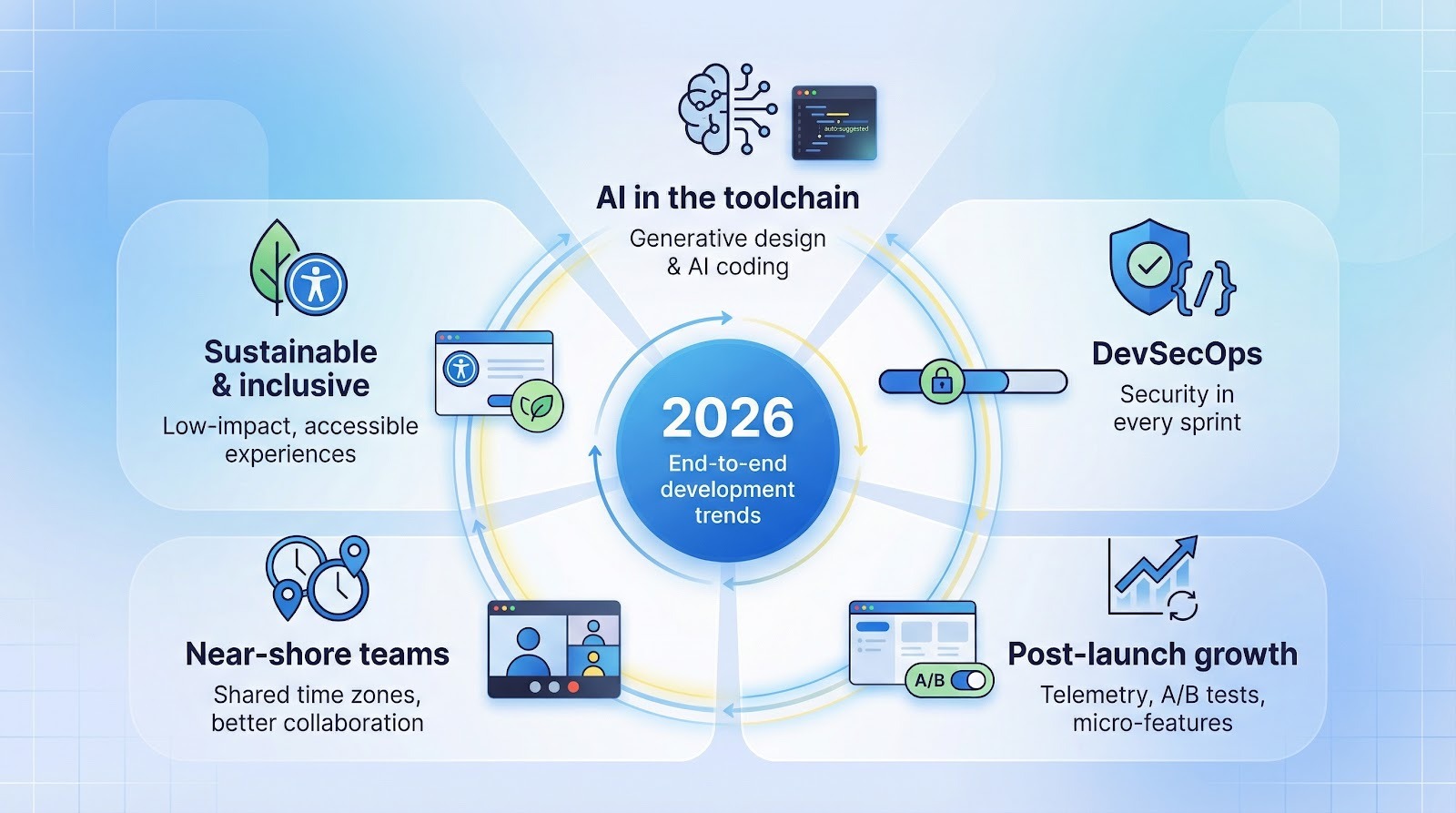
Artificial intelligence joins the core toolchain. Generative design proposes fresh concepts in hours, AI code assistants flag bugs before QA begins, and teams ship cleaner releases.
Security shifts left with DevSecOps. Encryption, compliance checks, and penetration testing enter every sprint, sparing you costly retrofits after launch.
Post-launch work becomes the main event. Growth squads watch live telemetry, run A/B tests, and push micro-features weekly, turning your product into a living service instead of a static release.
Near-shore collaboration tops distant outsourcing. Shared time zones energize daily stand-ups, and cultural alignment trims miscommunication, giving you talent without red-eye flights.
Sustainable and inclusive design moves to must-have. Teams choose low-impact materials, optimize code for energy efficiency, and build accessibility into screen flows from day one. Products that respect planet and people simply perform better.
Keep these shifts in view as you evaluate partners, and you will future-proof the investment before the first line of code is written.
 AI tools to find & convert leads.
  Send emails at scale