
Nobody trusts a brand that only talks about itself. At some point, the self-promotion starts sounding like that one colleague who won’t stop mentioning their MBA. People tune it out.
What actually moves the needle is when someone else does the talking. A customer who got results. A partner who’ll vouch for you publicly. An industry name willing to put their credibility on the line next to yours.
Around 90% of buyers say social proof influences what they buy, which means for most of your audience, outside voices carry more weight than anything you say about yourself.
That’s what this article is about. Here, we’ll look at credibility as a system you design and maintain. You’ll also learn how to collect stronger proof, present it clearly, and turn everyday customer outcomes into visible authority.
Most people check reviews before they buy anything. But they’re not really looking for reassurance when they do so. They’re actually looking for reasons to walk away.
Customers generally don’t trust businesses with an average rating below 4 stars, which means your reviews are a filter people use to decide whether you’re worth their time.
The thing is, not all reviews carry the same weight. A vague “great service!” tells a potential customer almost nothing. But a review that describes a specific problem, explains how your product solved it, and comes from someone who sounds like your target customer?
That’s the kind of thing that makes people think “That’s exactly what I was looking for.”
Here’s how to achieve that:
Pull your strongest reviews – the ones that are specific, detailed, and speak directly to the outcomes your customers care about.
Don’t dump them on a testimonials page nobody visits. Put them where decisions get made, such as your homepage, your pricing page, or your checkout flow.
Rotate them based on relevance to the page they’re on. A review about the speed of delivery hits differently on a shipping FAQ page than a generic review about overall satisfaction.
Think about the format. Star ratings alone are weak. Whenever possible, show the full review, the reviewer’s name, and ideally their role or company if it’s a B2B context.
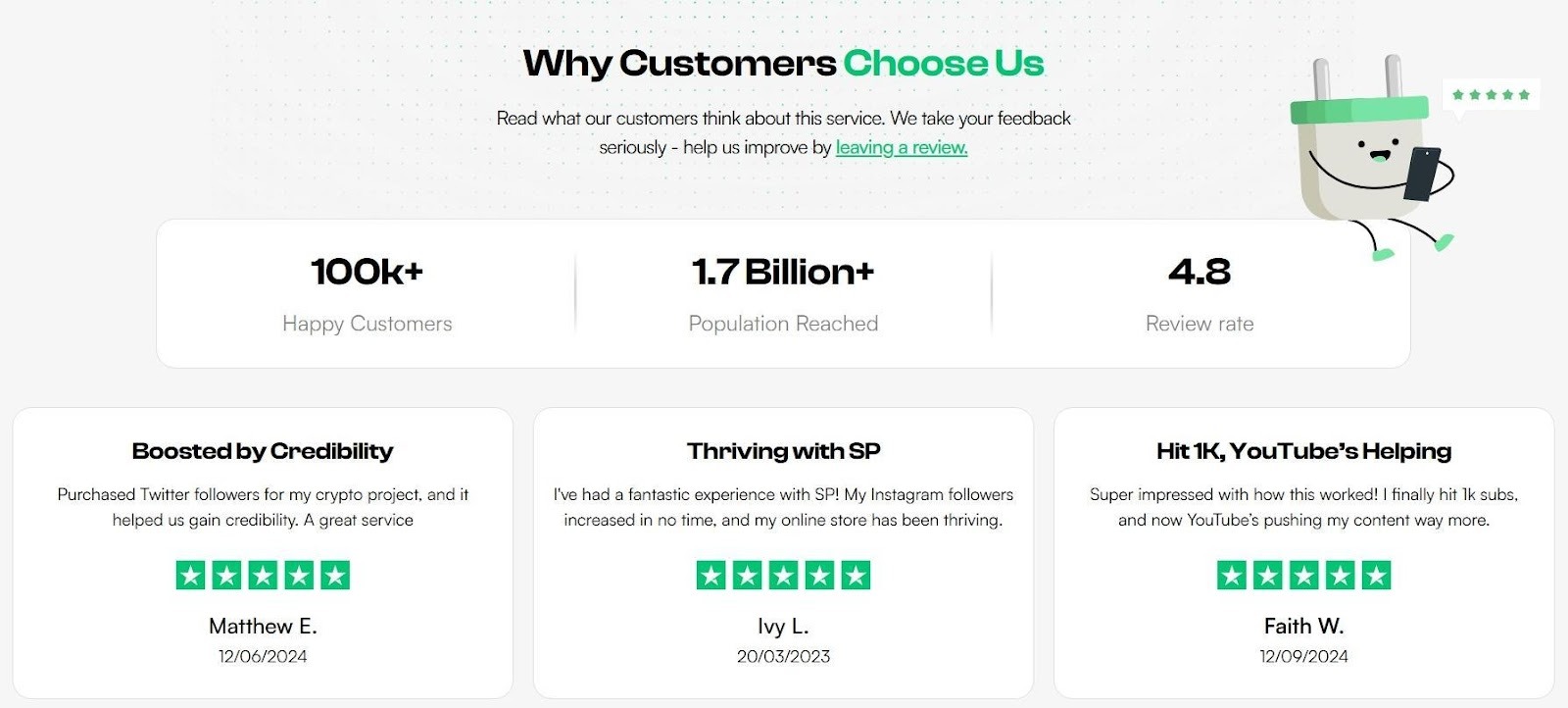
A great real-world example of this approach is Socialplug, a marketplace where people buy social media engagement like followers, likes, and views.
From the thousands of reviews they’ve received, they handpick the ones that highlight specific wins, like faster growth, better engagement, or smoother experience.
The outcome is a curated snapshot that shows exactly what their service does and how it’s helped real people, without feeling like a random grab from their review pool.
Source: socialplug.io
Handpicked reviews are great, but they have one obvious weakness: Some of your prospects will know that they’re handpicked. Visitors aren’t naive. When they see a perfectly curated row of glowing testimonials, a small part of their brain flags it.
Showing every review as it comes in, including the average ones, actually signals more confidence than a polished selection ever could.
There’s a psychological angle here, too. A mix of reviews (mostly positive, with the occasional critique) reads as authentic. A page with nothing but perfect scores reads as managed. Buyers know the difference, and they trust the former more.
Here’s how to achieve that:
Connect your site to a third-party review platform like Trustpilot, Google Reviews, or G2, and display that feed live.
The key is that the reviews pull directly from the platform without you touching them.
That third-party origin is exactly what gives them credibility. Visitors can see the source, check the platform themselves, and verify that you haven’t cherry-picked anything.
Place this feed somewhere visible, not buried in a footer. A dedicated section on your homepage or product page works well.
A carousel format keeps it compact without hiding the volume of reviews you’ve collected.
And don’t panic about 4- or 3-star reviews showing up. Responding to them professionally does more for your credibility than pretending they don’t exist.
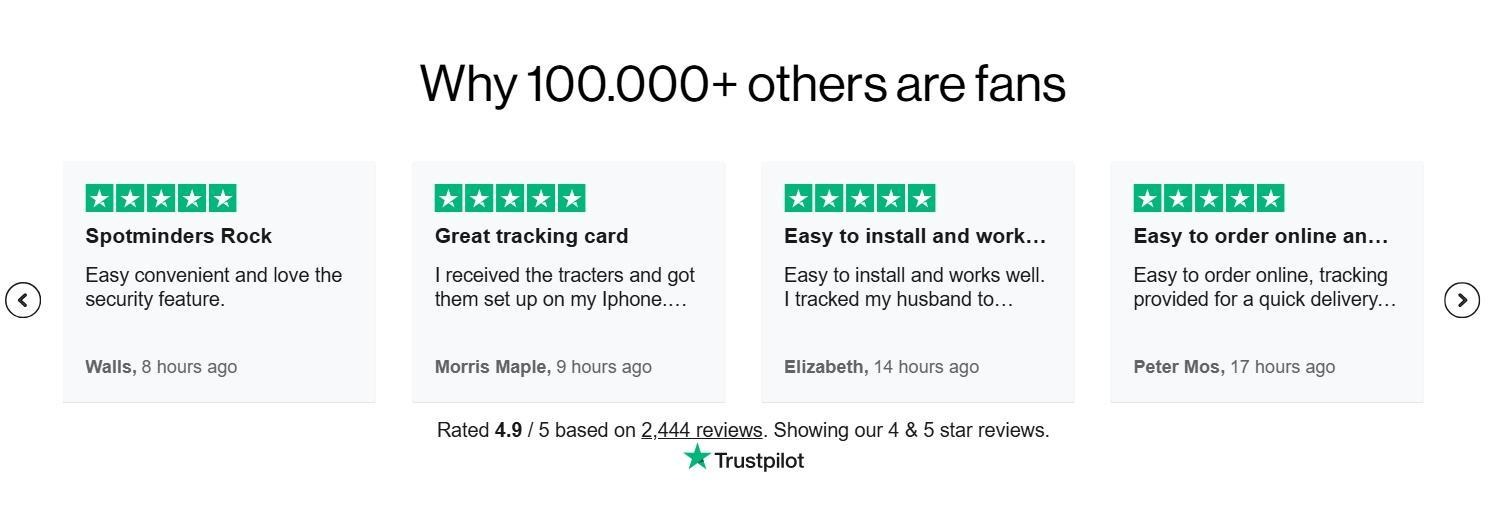
Spotminders, a brand that makes ultra-slim tracking devices for everyday essentials like wallets and bags, runs a live carousel of their Trustpilot reviews directly on their site.
The reviews appear exactly as customers post them on Trustpilot. There are no edits and no filtering.
This is a straightforward signal that Spotminders are confident enough in their product to let the unfiltered feedback speak for itself.
Source: spotminders.com


Written reviews are easy to fake. Most customers know it, even if they don’t say it out loud. A video is much harder to dismiss. When a real person sits in front of a camera and talks about their experience with your brand, it lands differently than a paragraph of text ever will.
That’s probably why 85% of people say a video convinced them to buy a product or service at some point.
There’s something about seeing someone’s face and hearing their voice that makes the message stick. You pick up on tone, enthusiasm, and specificity in a way that text can’t replicate. And when that person is credible in their own right (a recognizable name, a senior role, or a well-known company), the effect compounds.
Here’s how to achieve that:
Reach out to your most satisfied clients and ask if they’d be willing to record a short testimonial.
Keep the video focused: What was the problem before, what changed after, and what would they say to someone considering your product?
You don’t need a film crew. A well-lit room and a decent camera get the job done.
Once you have the video, don’t hide it. Feature it prominently on your homepage, your landing pages, or a dedicated testimonials section.
A single strong video from the right person will outperform a dozen written quotes.
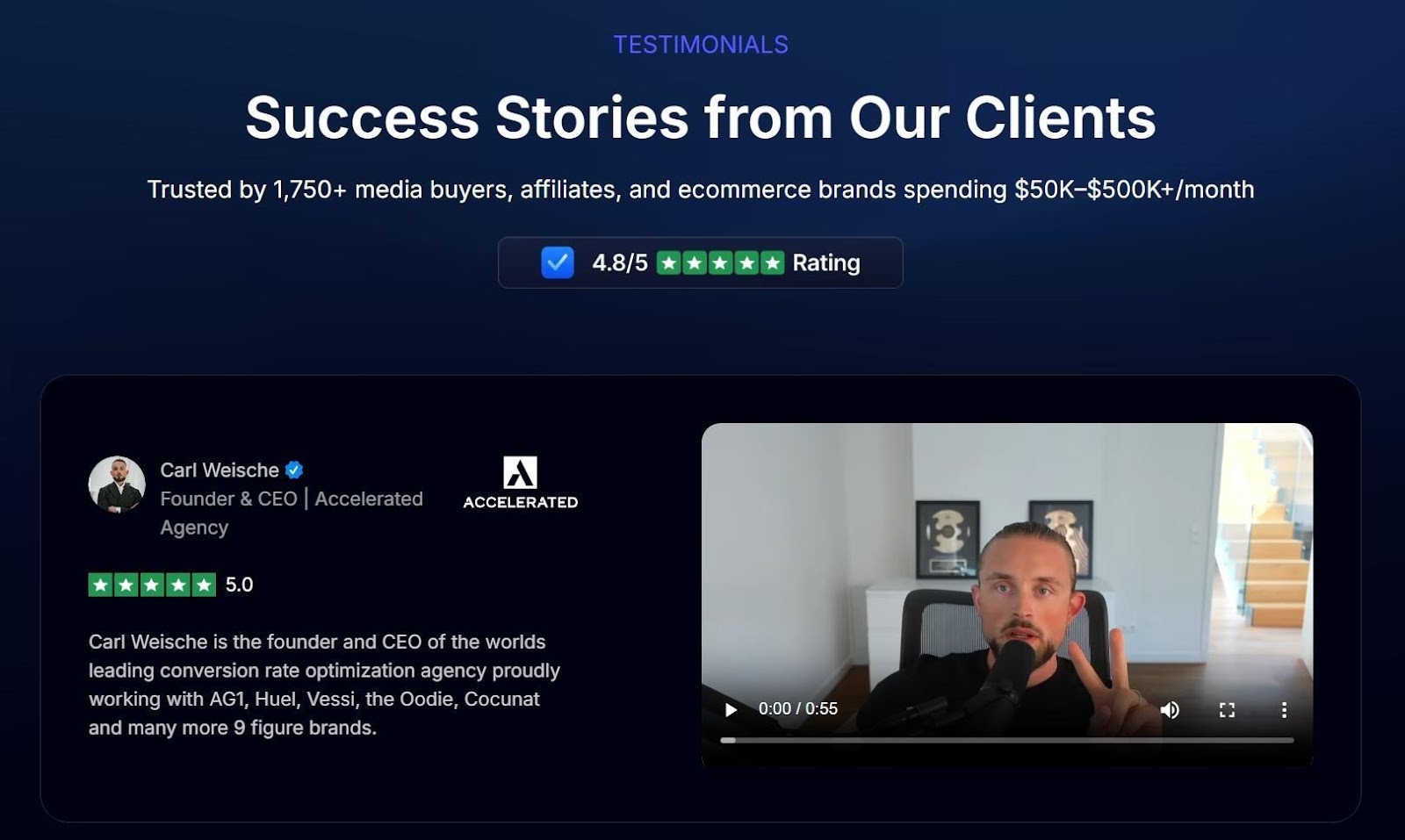
Uproas, a provider of premium ad accounts for platforms like Meta, Google, and TikTok, features a video testimonial from a CEO whose company used their service.
Instead of a written quote, the client speaks directly to the camera about his experience. They talk about what the service delivered and why it worked.
This approach is specific, credible, and carries the kind of weight that a text blurb simply can’t match.
Source: uproas.io
There’s a reason “as seen in” still works. When a recognized outlet covers your brand (whether it’s a feature, a quote, or even a passing mention), it carries weight that paid advertising can’t replicate.
A third party with editorial standards chose to put your name in their publication. That means something to people who land on your site and don’t know you yet.
It also works fast. A row of recognizable logos communicates credibility in seconds, before a visitor has read a single word of your copy. For someone on the fence, seeing a familiar outlet’s logo next to your brand can be the difference between staying on the page and leaving.
Here’s how to achieve that:
Track every mention your brand gets, like interviews, quotes, roundups, or features. Tools like Google Alerts make this easy to manage passively.
Once you have a handful of recognizable mentions, pull the outlet logos and display them in a dedicated section on your homepage, ideally above the fold or close to it.
Keep it selective. Five logos from outlets people actually recognize will do more than fifteen logos from publications nobody’s heard of.
If you can link each logo to the original article, even better. That lets visitors verify the mention themselves, which adds another layer of trust.
If press coverage is thin right now, start building it. Contribute expert commentary to industry publications, respond to journalist requests on platforms like HARO, and pitch story angles that are genuinely newsworthy.
Freeburg Law, a firm specializing in personal injury and criminal defense, features a clean section of media outlets on their homepage. They display the logos of recognizable names, such as the Guardian, Washington Post, ABC News, MSNBC, etc.
For someone deciding who to trust with their future, that visual shortcut matters more than any paragraph of self-written copy.

Source: tetonattorney.com
A review tells people you’re good. A case study shows them how. That’s a meaningful difference, especially for buyers who are evaluating a serious purchase and need more than a star rating to feel confident.
When someone can read the full arc (the problem, the approach, and the outcome), they can place themselves in that story and consider it for their own needs.
That’s exactly the kind of curiosity you want potential customers to have, because it means they’re already imagining working with you.
Here’s how to achieve that:
Pick clients who saw clear, measurable results and are willing to talk about it.
Structure each case study around three things: What the situation looked like before, what changed after working with you, and what the numbers say.
Specificity is everything here. Vague outcomes don’t move people, but “reduced onboarding time by 40%” does.
Once you have full case studies published, don’t leave them in a resources section. Pull excerpts onto your homepage and populate them with your client quote, their company logo, and a key result.
Give visitors a reason to click through to the full story. If you can pair the excerpt with a short video of the client speaking, you’re combining two of the strongest forms of social proof at once.
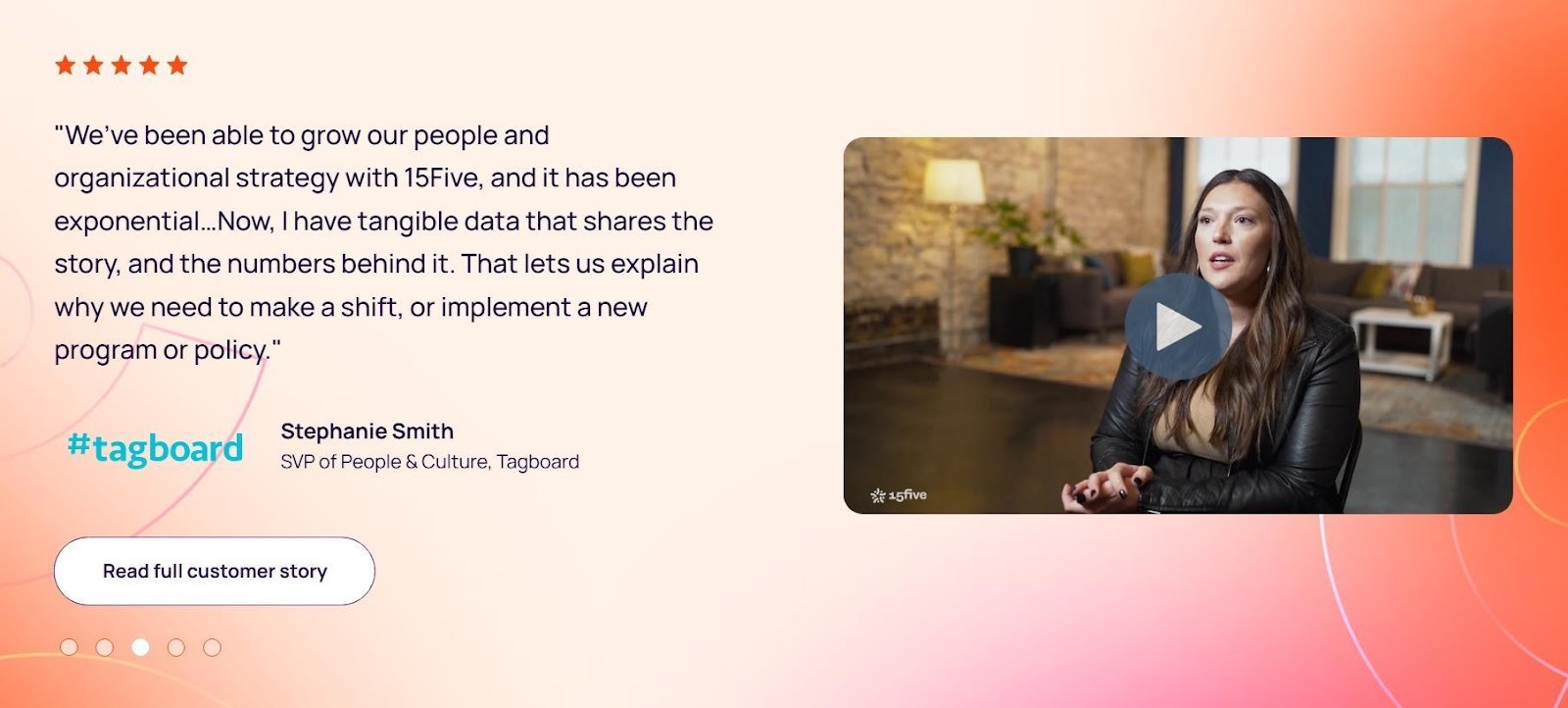
15Five, a platform that uses AI to help companies manage employee performance, does this well. Their homepage features excerpts from detailed customer success stories. Each one of them pairs a client quote with their company logo, a short video from a company representative, and their credentials.
Visitors can access the full case studies behind these previews with a single click and read about them in full detail.
This approach gives prospects a complete picture without overwhelming them on the first visit.
Source: 15five.com
Social proof isn’t something you set up once and forget. If you want to build real authority, you’ve got to treat it as an ongoing system, collecting it consistently, placing it strategically, and updating it as your business grows.
You don’t need every tactic covered in this article running at once. Pick the ones that fit where your brand is right now. If you’ve got strong reviews, start there. If you have a high-profile client willing to go on camera, lead with that. Build from what you already have.
The underlying principle stays the same across all of it: Outside voices carry more weight than your own. The more deliberately you use them, the less you’ll need to convince people yourself.
 AI tools to find & convert leads.
  Send emails at scale