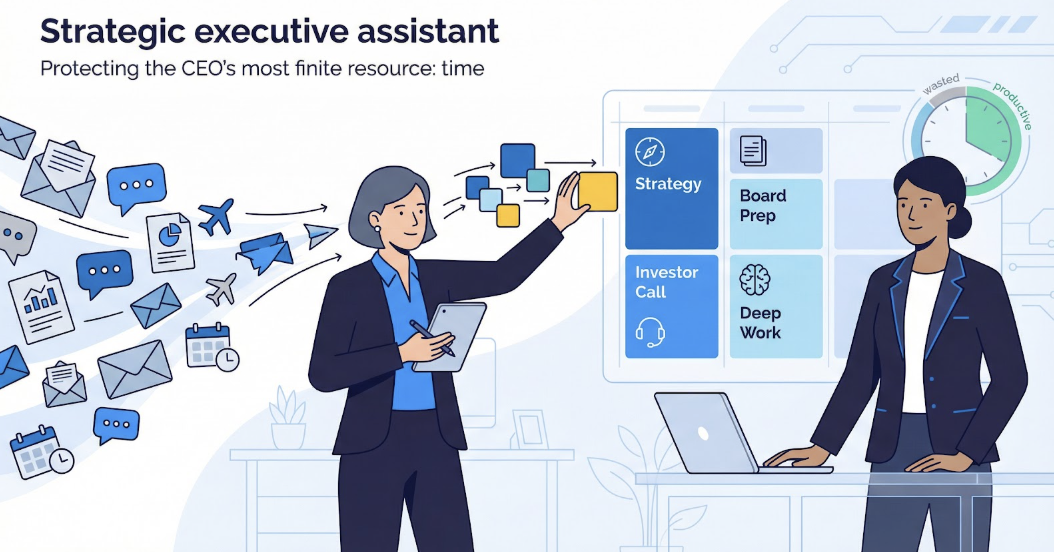
Your calendar fills up before breakfast. Meetings, flights, board decks, and constant Slack pings squeeze out the strategic work only you can do. McKinsey’s 2025 time-management study found that senior leaders spend 43 percent of their week in low-value reporting or information meetings—time an experienced executive assistant can win back for you.
Yet hiring that partner isn’t as simple as posting on LinkedIn. More executives now turn to specialist recruiters such as C-Suite Assistants to source professionals already tested at C-suite speed and discretion.
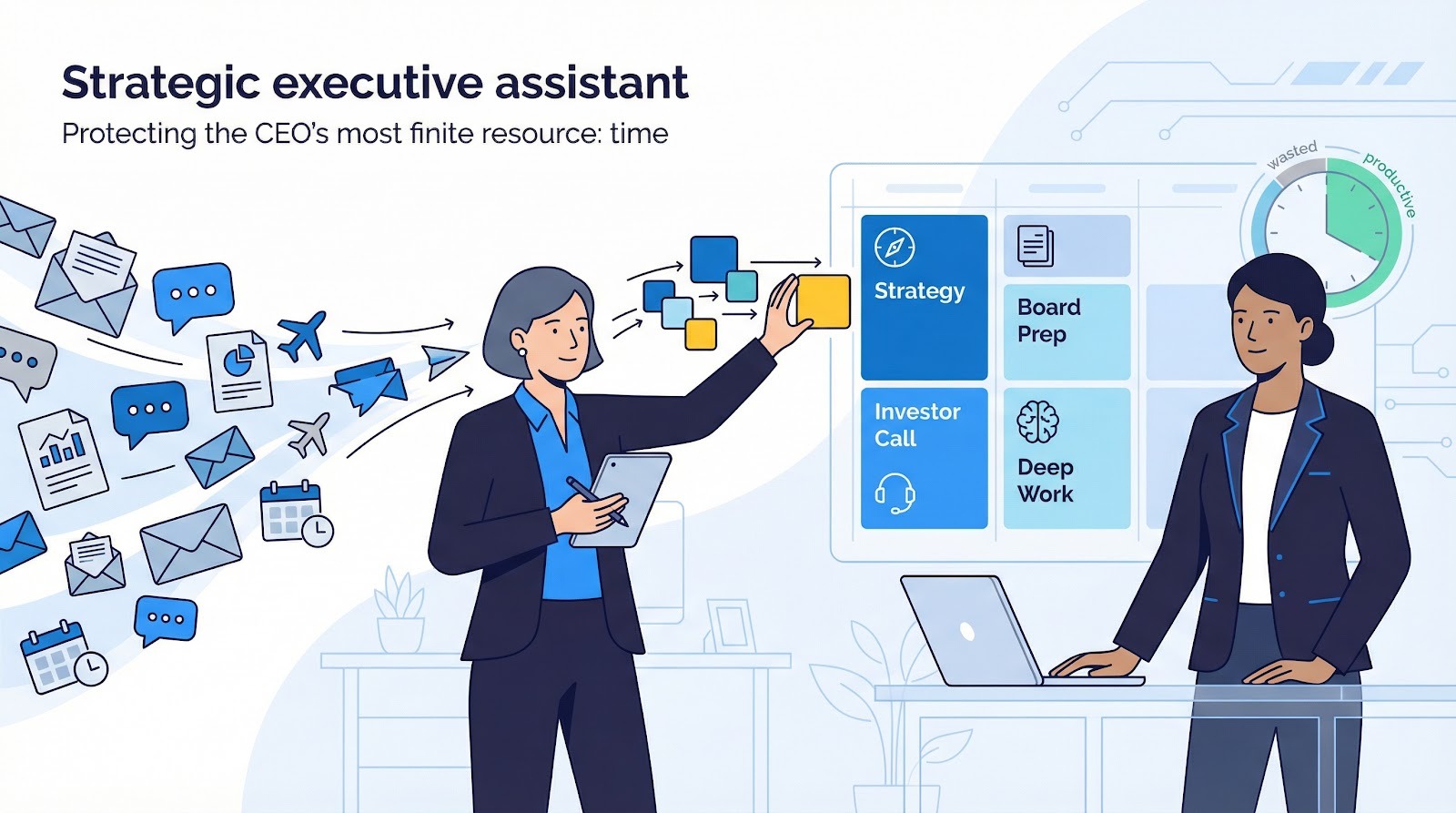
A strategic executive assistant filters chaos into a focused schedule, protecting a leader’s most finite resource: time.
A senior executive assistant is a strategic partner who guards your most finite resource: time. In McKinsey’s 2025 survey of nearly 1,500 leaders, eighty-five percent of executives who rate their time management as effective say they receive strong administrative support, while only seven percent of ineffective time managers can claim the same. The takeaway is simple: quality assistance translates to better use of executive hours.
What can that partner handle each day?
Pre-empt friction. A seasoned EA spots schedule collisions, stakeholder conflicts, or missing prep materials before they land in your lap.
Maintain momentum. By tracking follow-ups, owning calendar management and travel logistics, and shepherding projects between departments, the EA keeps strategic work moving while you focus on decisions.
When the role is mis-hired—whether expectations were vague or the candidate lacked C-suite experience—you slide back into calendar chaos and inbox overload. The right match, however, turns busy days into focused blocks for strategy, relationships, and high-impact decisions.
Recruiting an executive assistant is a high-trust search, closer to choosing a business partner than filling an operations seat. According to a 2024 U.S. Department of Labor brief, a single mis-hire can cost up to 30 percent of that role’s first-year salary, and the hit climbs even higher when the position has direct access to leadership.
That price tag explains three critical filters:
Proximity to sensitive information. The EA handles board packets, payroll data, and private conversations, so discretion is mandatory, not optional.
Emotional intelligence over tools. Keyboard shortcuts help, yet reading your mood and adjusting tone in real time matters more.
Culture fit beats résumé flash. A Fortune 500 pedigree means little if the assistant’s work style clashes with your cadence.
These nuances often trip up generalist recruiters; specialist firms maintain processes and talent pools tuned to this unique mix of trust, EQ, and strategic fit.

In the United States, the average executive-assistant search lasts 36–42 days, according to Zippia’s 2025 hiring benchmark. Each added week keeps you in triage mode. For roles that sit near the C-suite, many companies shorten that gap by working with niche recruiters that maintain ready-made pipelines. According to C-Suite Assistants’ employer guidance, a specialist executive-assistant search typically runs about three to four weeks when the hiring manager is responsive and draws on a proprietary candidate database and multi-step screening that includes phone interviews, in-depth video or in-person conversations, and targeted skills or language testing before a résumé reaches your desk.
What do these specialists deliver?
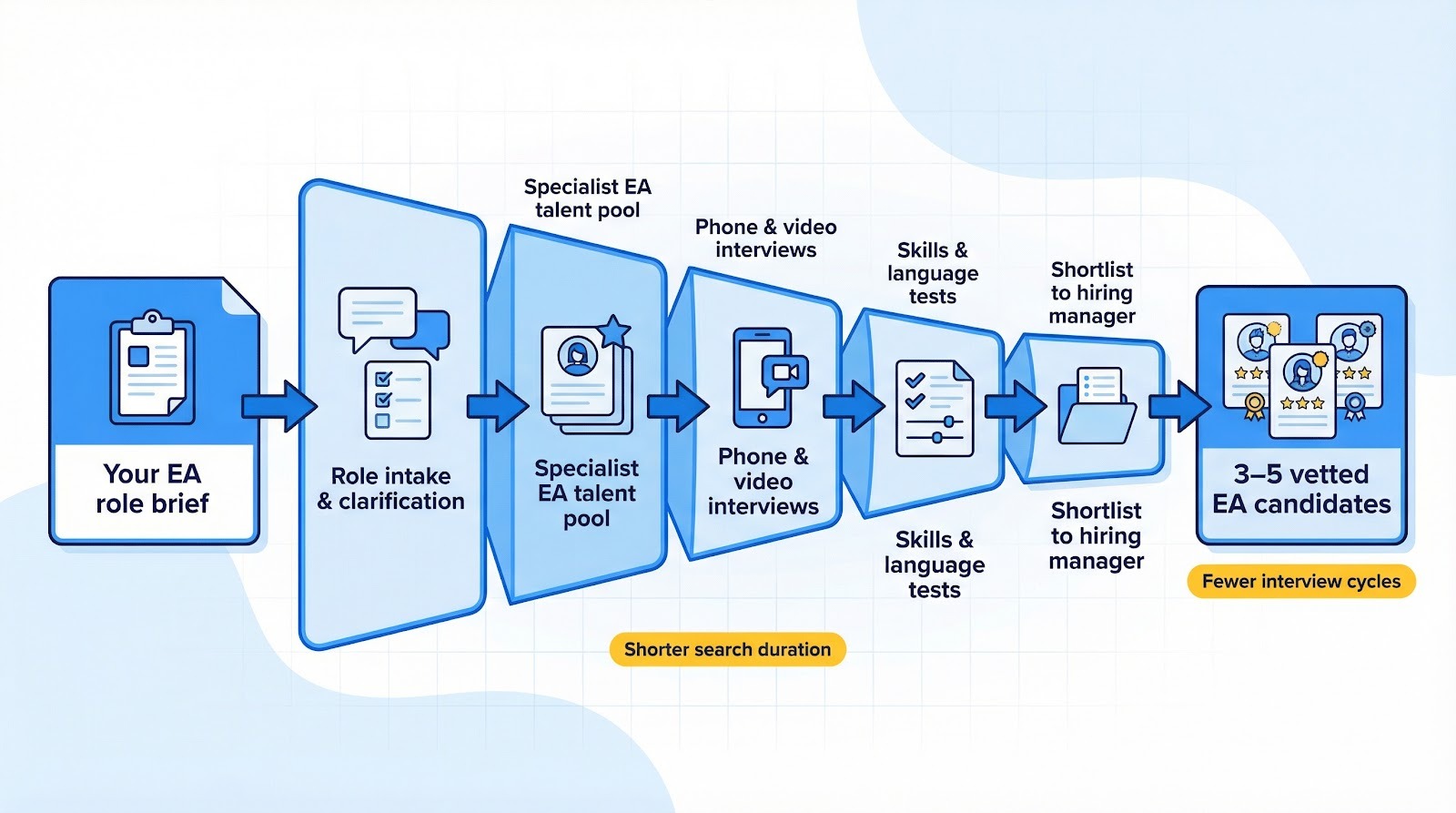
Specialist executive-assistant recruitment in Melbourne use structured pipelines and multi-step screening to deliver a vetted shortlist faster.
Ready-made talent pipelines. The firm keeps in touch with assistants who have already supported CEOs and boards, so credible candidates surface in days, not weeks.
Sharper role definition. After completing hundreds of similar placements, they can translate “I need a right hand” into a precise brief: chief-of-staff lite, classic EA, or hybrid ops.
Screening built for the job. Interviews focus on discretion, judgment, and stakeholder management, traits generic pipelines often miss.
Fewer interview cycles. Your team receives a short list, not an inbox full of résumés, saving hours of coordination.
Partnering with a specialist firm does not outsource responsibility; it applies focused expertise when the cost of a vacancy runs high.
A clear position brief is the first filter in a successful search. LinkedIn’s 2024 skills-based hiring report found that job posts listing specific capabilities attract nearly 20 percent more applicants than vague listings.
Write one crisp sentence for each of the four dimensions below:
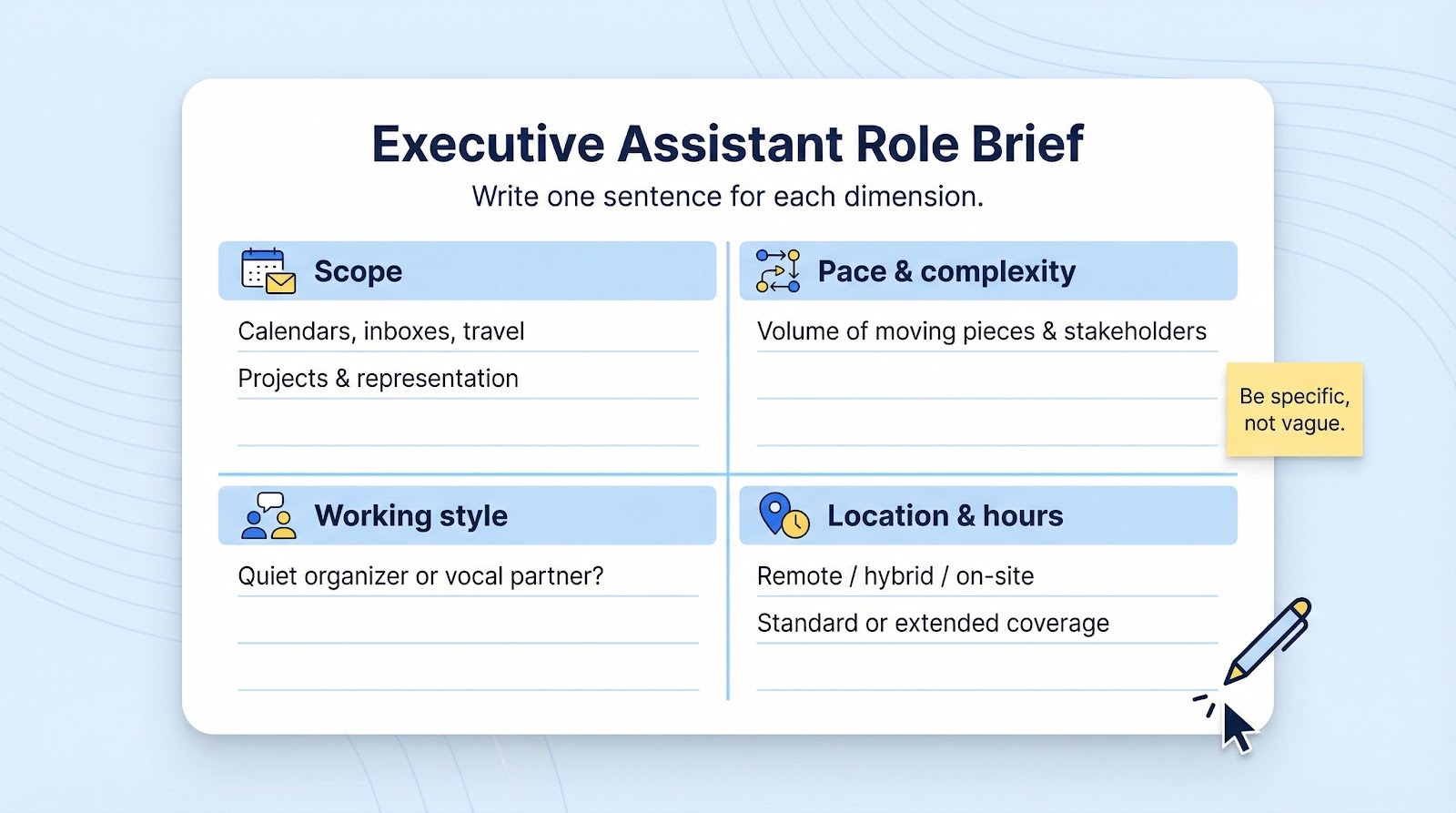
Use a simple four-part brief—scope, pace and complexity, working style, and location and hours—to define the EA you actually need.
Scope. Will the assistant mainly handle calendars, inboxes, and travel, or also run projects and represent you in meetings?
Pace and complexity. How many moving pieces and stakeholders compete for attention each week?
Working style. Do you prefer a quiet organizer who operates behind the scenes, or a proactive partner who speaks up in the room?
Location and hours. Remote, hybrid, or on-site? Standard business hours, or extended coverage across time zones?
Documenting these answers sharpens expectations for you and any recruiter, and it keeps mismatched candidates out of the pipeline.
A structured interview sequence is twice as predictive of on-the-job performance as an unstructured loop, according to a 2022 meta-analysis summarized by Harvard Business Review. Build your search around five checkpoints:
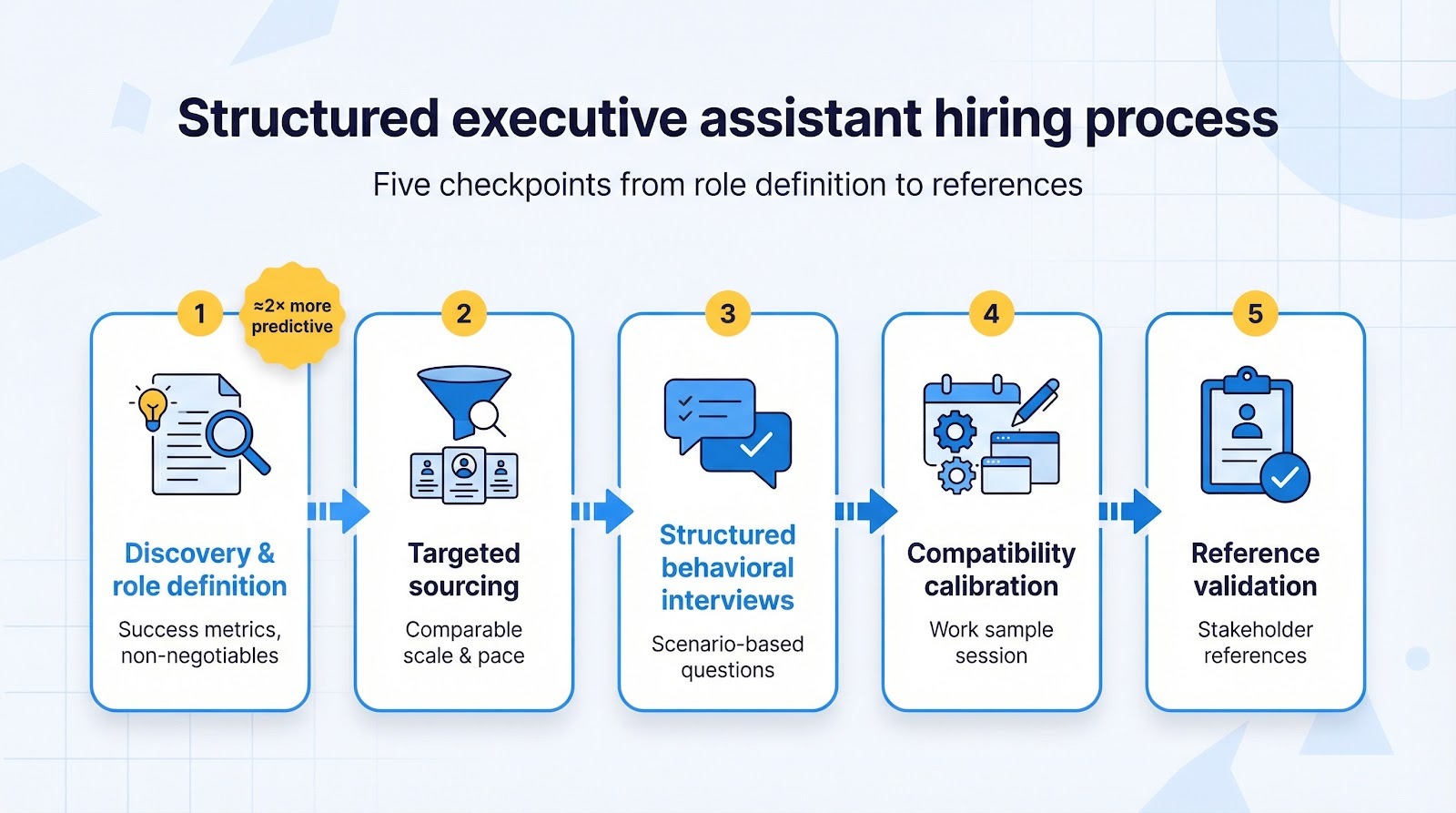
Build your executive assistant search around five checkpoints—from discovery and targeted sourcing to structured interviews, work samples, and reference validation.
Discovery and role definition. Document success metrics and non-negotiables before you post the job.
Targeted sourcing. Focus on candidates who have supported executives at comparable scale, pace, and complexity.
Structured, behavioral interviews. Ask every finalist the same scenario-based questions to reduce bias, lift predictive accuracy, and improve fairness.
Compatibility calibration. Include a brief working session such as calendar triage or email drafting to gauge work-style fit.
Reference validation. Confirm judgment, discretion, and follow-through with past stakeholders.
Skipping or compressing these stages can save a few days now but often doubles mis-hire risk and restarts the cycle later.
 AI tools to find & convert leads.
  Send emails at scale