
Energy manufacturers—whether you build drilling equipment, move product through pipelines, or keep a regional grid humming—face rising digital pressure. Buyers want real-time answers, regulators inspect every data point, and field teams need AI alerts before a pump fails. No wonder 76 percent of utility companies boosted CRM spending, according to the landmark “Stadtwerke 2021” study.
Generic software lists won’t surface partners who already understand joint-venture billing or outage communications. We vetted firms with recent energy wins, gold-tier platform credentials, and provable ROI. The eight consultancies that cleared the bar appear below, complete with quick scorecards, plain-English case wins, and budget tips—everything you need for a confident short-list in one coffee break.

When you trust a consultant with a multi-million-dollar CRM rollout, guesswork is not an option. We built a clear, numbers-first framework before a single firm made the cut.
First, we filtered for proof. Each contender had to show at least three energy-sector CRM deployments since January 2024, hold a gold-tier (or higher) certification on a major platform, and publish hard ROI—faster quote-to-cash or double-digit uptime gains. We also vetted external feedback. Bayard Bradford, for example, posts a 5.0 / 5 average across 58 client reviews in HubSpot’s marketplace, a level of social proof we require from every finalist.
For Microsoft deployments, MCA Connect is a standout.
Its published case study for a North American upstream producer shows that adding EnergyCONNECT to Dynamics 365 cut ERP costs by 30 percent and reduced the month-end close from five days to a few hours.
Those numbers meet our hard-ROI bar and underscore why certification alone wasn’t enough to reach the final eight.
Next, we scored firms across six weighted factors that speak directly to energy manufacturing’s pain points.
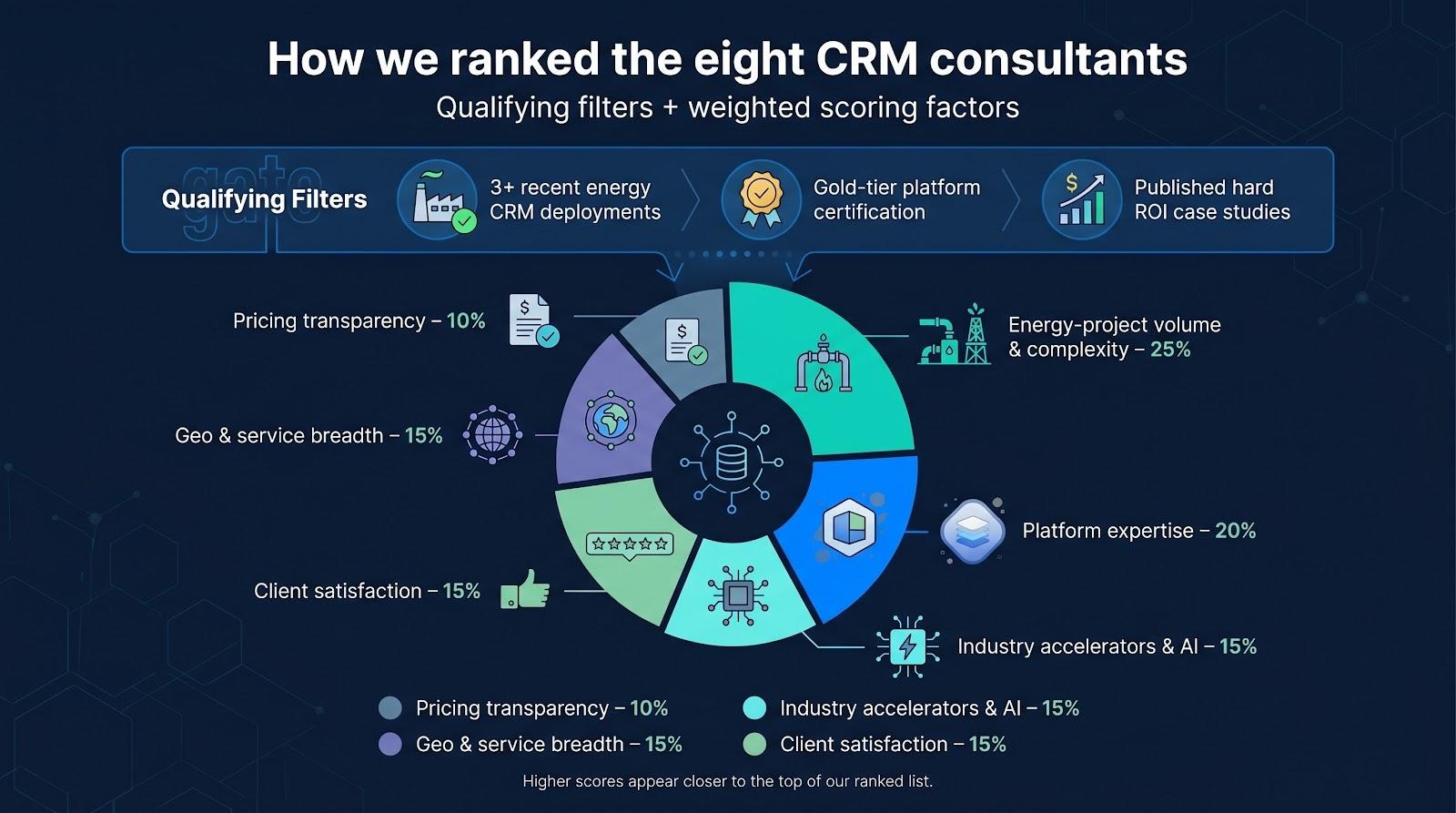
Energy-project volume and complexity (25 percent)
Depth of certified platform expertise (20 percent)
Proprietary industry accelerators and AI tools (15 percent)
Verified client satisfaction (15 percent)
Geographic and service-line breadth (15 percent)
Pricing transparency (10 percent)
The higher the score, the closer a firm appears to the top of our countdown.
Finally, two human checks. We interviewed reference customers to confirm real-world impact, and we inspected each firm’s most recent public case study for freshness and measurable outcomes.
The result is a ranked list you can trust, backed by data and sharpened by field insight. The next section introduces the specialists who cleared every bar.
MCA Connect takes first place because it pairs deep manufacturing know-how with full-stack Microsoft expertise. The firm focuses solely on supply-chain-heavy industries, and its EnergyCONNECT add-on turns standard Dynamics 365 into a joint-venture-ready engine. Picture automated AFE approvals, rental tracking, and real-time well-cost views, all inside the CRM you already own.
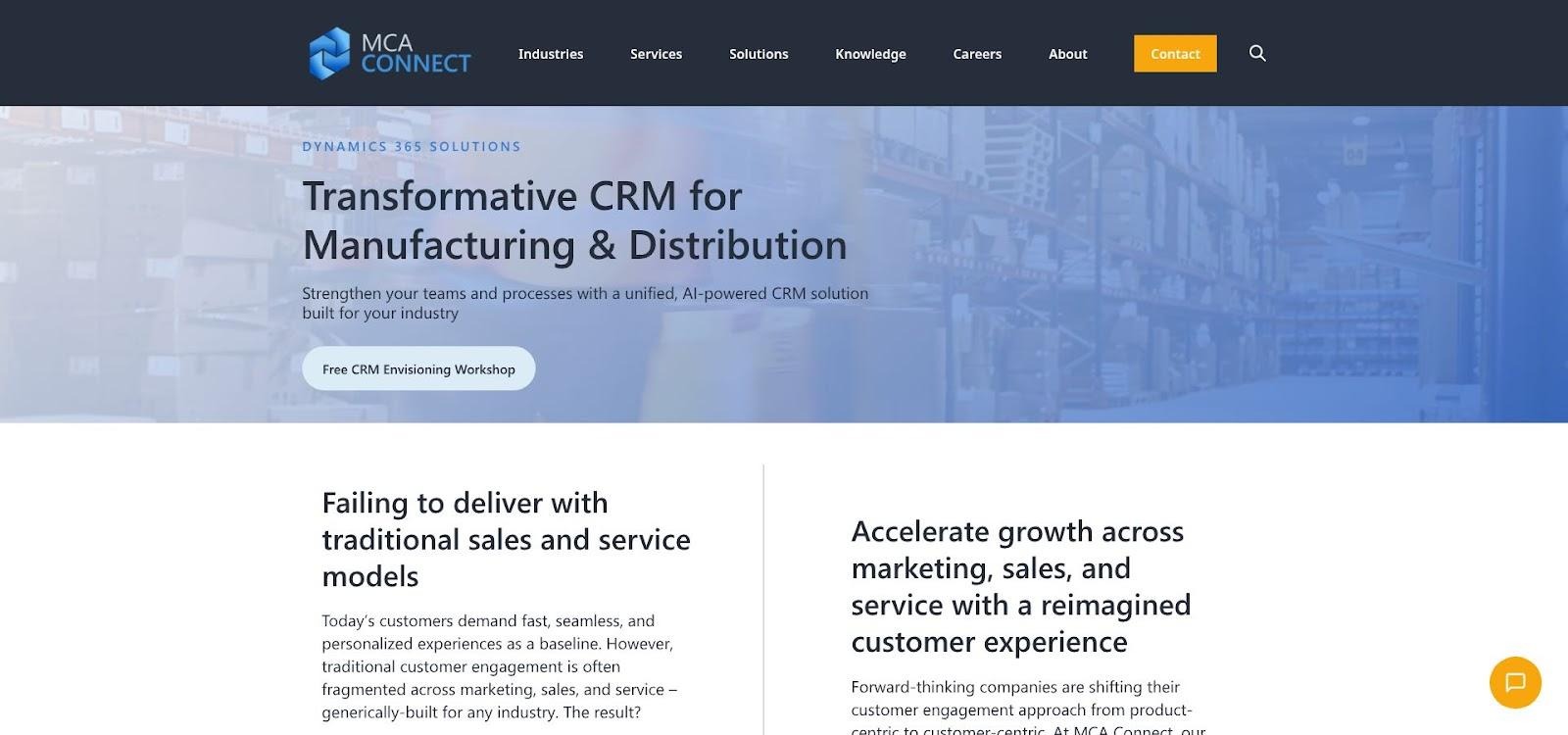
MCA Connect CRM for Manufacturing & Distribution webpage screenshot
Beyond joint-venture workflows, MCA Connect’s packaged Dynamics 365 offering—CRM for Manufacturing & Distribution—reports that manufacturers who unify sales, service, and field data on one AI-ready platform capture 12–20 percent more revenue through cross-sell and upsell.
That industry IP accelerates delivery. One upstream producer expects a 30 percent drop in ERP costs after adding EnergyCONNECT to Dynamics 365 and simplifying its tech stack. Similar gains show up in pipeline services and renewable-equipment clients, proving the model scales.
Technical depth matches domain skill. MCA Connect holds multiple Microsoft Solutions Partner badges and employs Dynamics MVPs across Finance, Supply Chain, and Power Platform. Integrations that challenge generalists (SCADA feeds, ERP cost centers, IoT sensor alerts) are routine here.
Fit check: pick MCA Connect when your company builds, ships, or maintains complex energy assets and wants a Microsoft-first stack that already speaks oilfield. Smaller teams on HubSpot or firms seeking Salesforce flexibility can look elsewhere, but if Azure is central, this crew fits.
If your roadmap spans continents and touches every line of business, Accenture brings the depth to make it happen. Its Energy practice pairs strategy consultants with thousands of certified technologists across Salesforce, Microsoft, and SAP.
Accenture energy and utilities CRM consulting webpage screenshot
Scale shows in the numbers. Accenture teams have delivered multicloud CRM rollouts for supermajors operating in 30 countries, and Gartner keeps the firm in the Leader quadrant for CRM and Customer Experience Implementation Services. Beyond people power, Accenture offers prebuilt utilities. A recent co-engineered SAP S/4HANA Cloud solution for upstream oil and gas bakes joint-venture accounting, production reporting, and asset maintenance flows into the core, cutting blueprint time and reducing custom code.
Fresh tech meets field reality. Accenture folds AI into everyday tasks such as predictive crew dispatch, emissions tracking dashboards, and blockchain pilots for crude custody chains. One European wind-turbine maker reports that unifying sales and field service on Dynamics 365 lifted revenue by more than 50 million dollars through data-driven upsells.
Fit check: choose Accenture when you need one partner to shape vision, shift culture, integrate legacy stacks, and support users in every time zone. Budgets must match the ambition; smaller teams often balk at premium rates. For Fortune-level energy players chasing transformational ROI, few consultancies cover as many bases as this one.
Opportune works from Houston and speaks oilfield fluently. Its Process & Technology group builds Salesforce environments that match the quirks of production accounting, owner relations, and field maintenance without piles of custom code.
Why it matters: many upstream CRMs fail when landmen or pumpers view them as just another corporate chore. Opportune places domain experts—former revenue accountants, engineers, and land specialists—on every design team, so the finished product feels native. Dashboards flag imbalance issues before checks go out, owner portals surface division-order data without frantic calls, and Salesforce Field Service schedules rig crews around real-time well status. One multibillion-dollar refining client cut order-to-cash time and improved customer service by rolling out Salesforce Sales, Service, and Community Cloud in only four months.
The firm’s tools reach beyond CRM screens. Pre-built Power BI packs overlay production and financial KPIs, while packaged integrations pull volumes from Quorum or W Energy. All data lands in Salesforce so commercial teams, finance, and field ops share one source of truth.
Fit check: select Opportune when you want a mid-tier partner that knows lease operating statements as well as Lightning components. Budgets stay moderate, and executives value a delivery team that has walked a mile in steel-toed boots.
Utilities track more than customer names. They manage meters, rate plans, outage records, and regulatory filings that can overload a generic CRM with exceptions. Utegration was created for this complexity. The firm’s Utility4U accelerator blends SAP Customer Experience with CIS and meter-data flows so call-center reps can view usage, bills, and service tickets on a single screen.
Scale pairs with focus. Before its acquisition by Cognizant, Utegration completed more than thirty North American utility projects, ranging from municipal co-ops to investor-owned giants. Today, 350 specialized consultants sit inside Cognizant’s delivery network, giving clients depth without losing sector insight.
Clients highlight regulatory gains. Energy Transfer, for example, merged multiple ERP systems into one S/4HANA platform using Utegration’s Finance4U, cutting group asset conversions from weeks to a few days. On the billing side, multi-rate and net-metering rules that slow general integrators arrive pre-configured in Utility4U, trimming months from blueprint workshops.
Fit check: select Utegration when you run meters rather than wells, live in an SAP environment, and need one partner to modernize both customer care and revenue systems. Oilfield manufacturers should look elsewhere, but for power, gas, and water providers aiming for digital-first service, Utegration delivers.
Field assets sit at the heart of energy manufacturing, and few partners blend CRM with operational tech as smoothly as Hitachi Solutions. Backed by the wider Hitachi group, the firm connects Microsoft Dynamics 365 Customer Engagement to sensors, SCADA feeds, and AI models that spot faults days before they halt production.
Its industry accelerators add speed. Out of the box, the templates drop industry tables such as transformer health, pipeline inspection records, and turbine uptime straight into Dynamics. One European wind-farm operator used the stack to route work orders the moment a gearbox vibration crossed a threshold, cutting reactive maintenance calls by forty percent. Another pipeline-equipment OEM launched a self-service portal where IoT alerts automatically open service tickets, keep customers informed, and feed warranty analytics to R&D.
Hitachi’s bench includes dozens of Microsoft MVPs and data scientists who work inside Fabric and Copilot. They move quickly because much of the plumbing is prebuilt: Power Apps for technicians, Power BI for executives, and integrations to common EAM systems. Clients often shorten rollouts from twelve months to six, saving both capital and patience.
Fit check: choose Hitachi when revenue depends on rotating steel or high-voltage gear and you want CRM, asset data, and AI insights under one Microsoft roof. If your stack is Salesforce or SAP, other firms in this list may fit better, but Dynamics-first teams seeking OT-IT convergence will feel at home here.
If your mandate is to turn customer data into revenue and goodwill, West Monroe is the pragmatic partner that makes analytics feel human. The mid-sized consultancy blends management strategists with certified technologists, and the proof shows up in more than 450 completed Salesforce projects, many for tier-one utilities.
West Monroe begins by mapping every customer journey, from outage text to rate-plan upsell, then layers machine learning on top. One West Coast electric utility uncovered 100 million dollars in revenue opportunity after the team linked CRM data to smart-meter feeds and applied AI models that predict program adoption. Another solar-equipment manufacturer cut its sales cycle by twenty percent by pairing Dynamics 365 leads with Power BI intent scoring.
Change management is the firm’s secret asset. Workshops translate data insights into frontline scripts. Low-code apps launch in weeks, not quarters, so call-center and field teams adopt improvements without extra IT burden. Client reviews on AppExchange praise the “own-the-outcome” culture and senior-level access rarely seen outside boutique shops.
Fit check: choose West Monroe when you want CX gains grounded in analytics and a partner who will coach your people, not just code your platform. Budgets land in the mid-range, and the firm’s North-America-first footprint fits regional utilities or manufacturers ready to scale insight before global expansion.
Not every energy manufacturer runs a billion-dollar P&L. Many operate in the mid-market, where a lean sales team, a modest marketing budget, and a need for quick wins set the pace. Bayard Bradford is built for that reality.
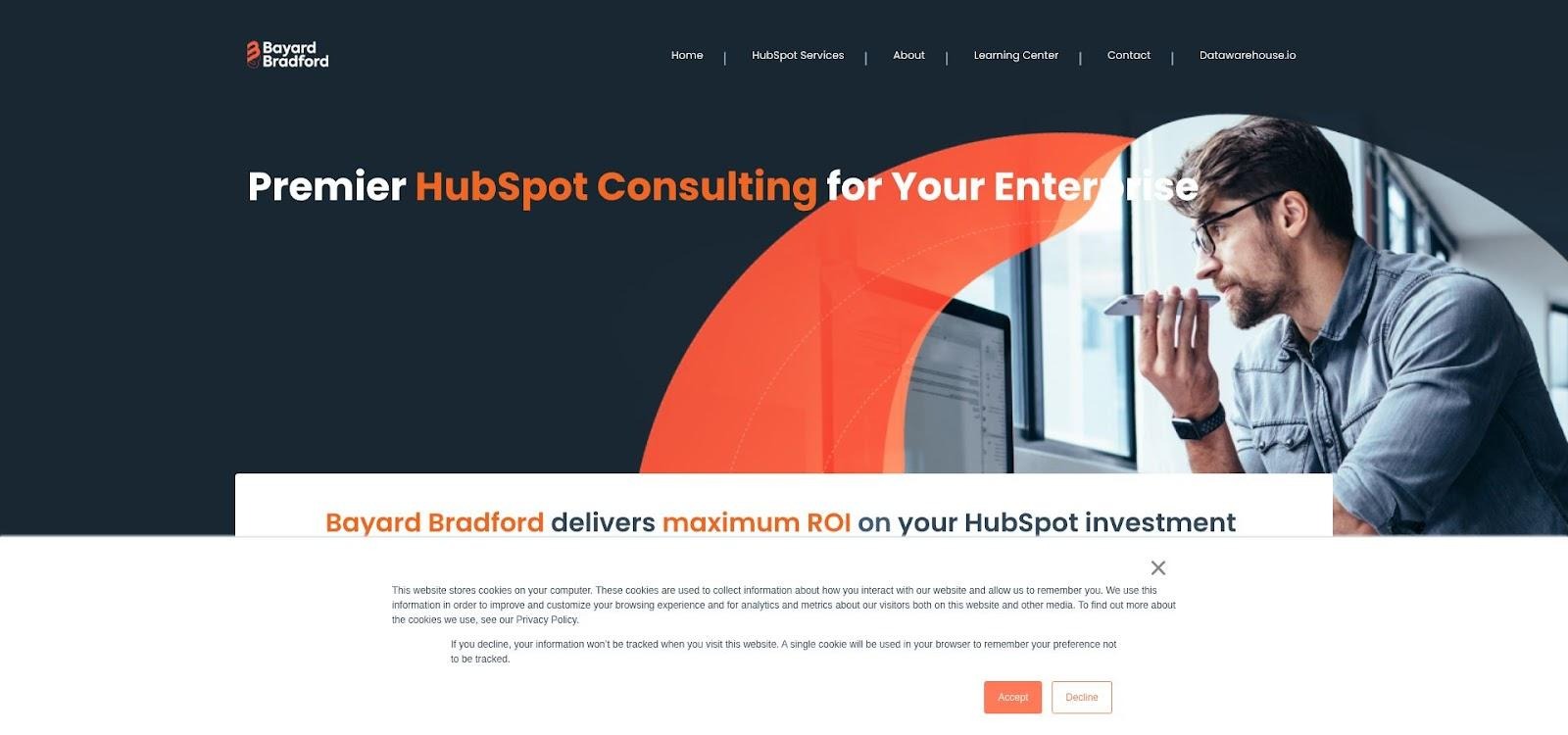
Bayard Bradford Elite HubSpot partner website screenshot
The Houston agency carries HubSpot’s top-tier Elite badge and holds a 5.0 out of 5 rating across 58 verified client reviews, the highest score in HubSpot’s oil-and-gas partner directory. Clients praise candid coaching and integrations that link HubSpot with on-prem ERPs, a relief when your finance team still runs SQL scripts at midnight.
Bayard Bradford pairs technology with storytelling. Consultants spin up HubSpot CRM in weeks, then add automated email sequences that nurture leads from trade shows or RFQs. Content strategists craft technical blog posts that rank in Google and resonate with engineers. One valve maker in the pipeline sector credits the agency for a 150 percent jump in qualified leads after a full-funnel rebuild.
Need data in the boardroom? The firm’s Datawarehouse.io connector pipes HubSpot metrics into Power BI so operations leaders can track quote velocity alongside on-time delivery. It delivers analytics without enterprise-level cost.
Fit check: choose Bayard Bradford when you’re an industrial SMB that wants HubSpot configured quickly and tied into the systems you already own. Enterprise utilities chasing AI-driven field service should look elsewhere, but mid-market teams seeking revenue growth tomorrow will feel at home here.
Slalom closes our list by focusing on people as much as platforms. The consultancy excels in cloud migrations, particularly Microsoft and Salesforce, and stands out with strong change-management programs that keep field crews, schedulers, and finance teams moving in the same direction.
Energy clients praise the “living blueprint” approach. Before any workflow is built, Slalom facilitators map each customer touchpoint on mural boards that frontline staff can edit in real time. The output feeds agile sprints, so users see progress every fortnight rather than after six months. One energy company credits Slalom’s agile methods for scoping more than 40 AI use cases in three weeks and surfacing over 50 million dollars in business value.
Slalom’s cloud-first DNA also appears in its accelerator kits. Need a secure customer portal on Azure? A Power App template is ready. Want predictive leak-call triage? A pre-trained model plugs into your new CRM dashboard. Because Slalom staffs projects with regional teams, clients get senior talent without extra layers, keeping costs reasonable for midsize utilities or equipment OEMs entering new territories.
Fit check: pick Slalom when culture change will decide your CRM success and you value weekly momentum over large, infrequent deliverables. Global supermajors may require a larger bench, but regional energy players seeking speed and adoption will appreciate a partner who speaks plain English and moves quickly.
We just covered a lot of ground. Before you send RFPs, it helps to see the essentials side by side. We built a comparison matrix that scores each firm on the factors that matter most in energy manufacturing: project depth, platform mastery, proprietary IP, client ratings, service breadth, and pricing clarity.
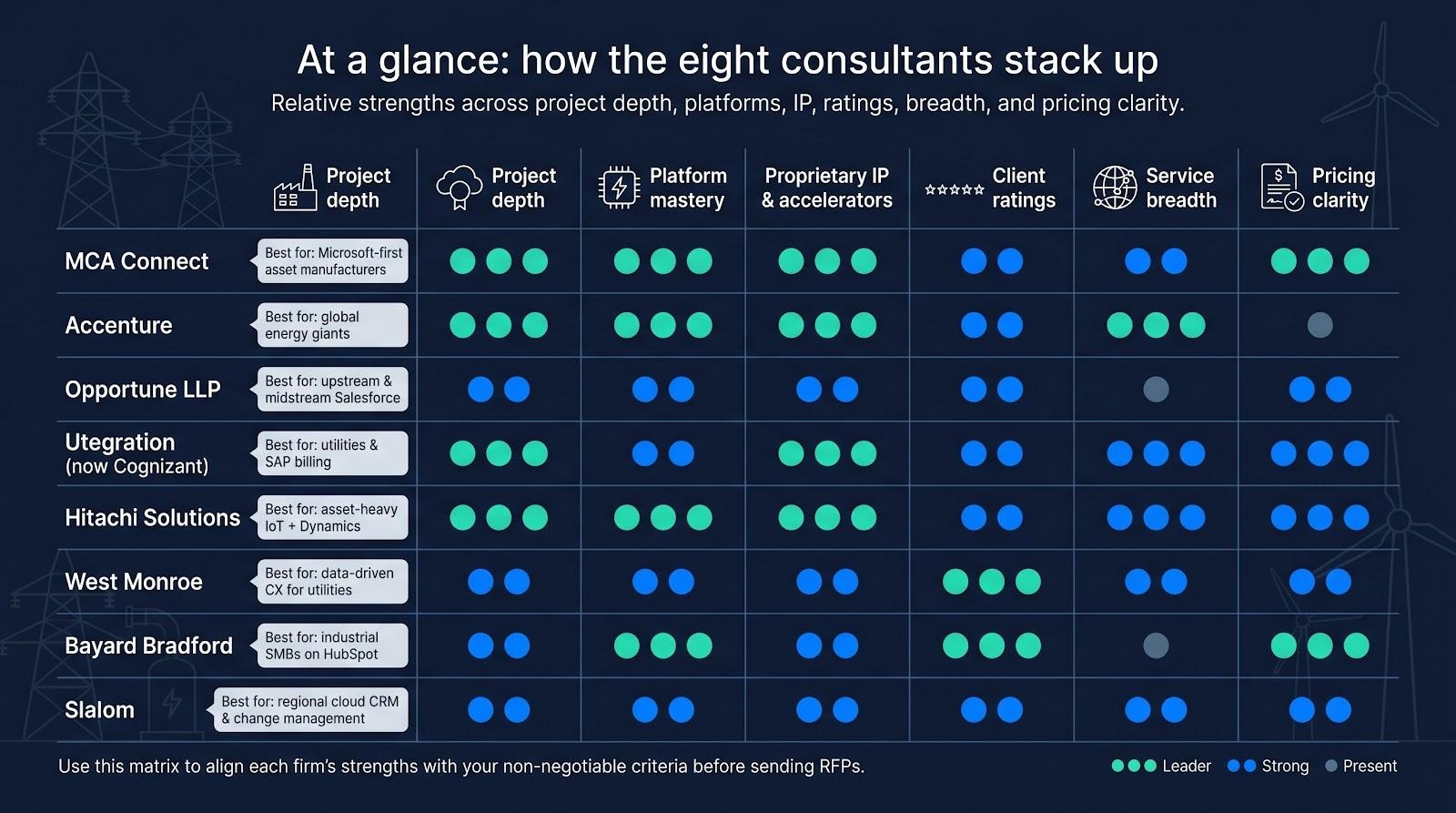
Scan the table and two patterns stand out.
First, no single consultant wins every column. MCA Connect leads on industry IP with EnergyCONNECT, while Accenture dominates geographic reach. Bayard Bradford owns client satisfaction in the SMB lane yet concedes enterprise scope to the giants. The takeaway: match strengths to your use case instead of hunting for an all-rounder that does everything.
Second, proprietary accelerators now rival experience as a decision driver. Four of eight firms offer prebuilt templates such as Utility4U, Energy & Utilities Cloud, Owner Relations modules, or HubSpot data connectors that cut months of custom development. Those shortcuts translate to faster payback and lower project risk, especially when internal IT bandwidth is thin.
Use the matrix as your reality check. If your core need is meter-to-cash automation, Utegration and Hitachi rise to the top. If global change management is the pain point, Accenture and Slalom look strong. And if lead generation is today’s urgent need, Bayard Bradford’s near-perfect rating is hard to ignore.
Print the sheet, mark your non-negotiables, and you’ll have a clear short list before the next budget meeting.

Choosing a CRM partner can feel like trying to repair a turbine while it spins. Let’s answer the questions we hear most and arm you with a simple action plan.
Do I really need an energy-specialized consultant?
Yes. Generic SIs deliver generic outcomes. Energy specialists already understand joint-venture billing, AFE approvals, and outage workflows, so you skip months of “teach the vendor” meetings and reach value sooner.
Salesforce or Microsoft Dynamics—what wins in energy?
We see a split. Large oil and gas firms favor Salesforce for its app ecosystem, while regulated utilities lean toward Dynamics for tight ERP links. Both platforms shine when paired with the right industry add-ons and the right partner.
What budget range should we expect?
Mid-market rollouts on HubSpot or core Salesforce start around $50K. Dynamics 365 projects with moderate customization often land in the $250K–$500K band. Enterprise utilities replacing legacy CIS and CRM can top $1M, especially if change management is included. Insist on a fixed-fee discovery phase so surprises surface early.
How do we measure ROI?
Tie metrics to cash. Examples include quote-to-cash days, unplanned downtime hours, call-center handle time, and customer churn. Every firm in our top eight publishes at least one case study with quantified gains—use those numbers as your benchmarking baseline.
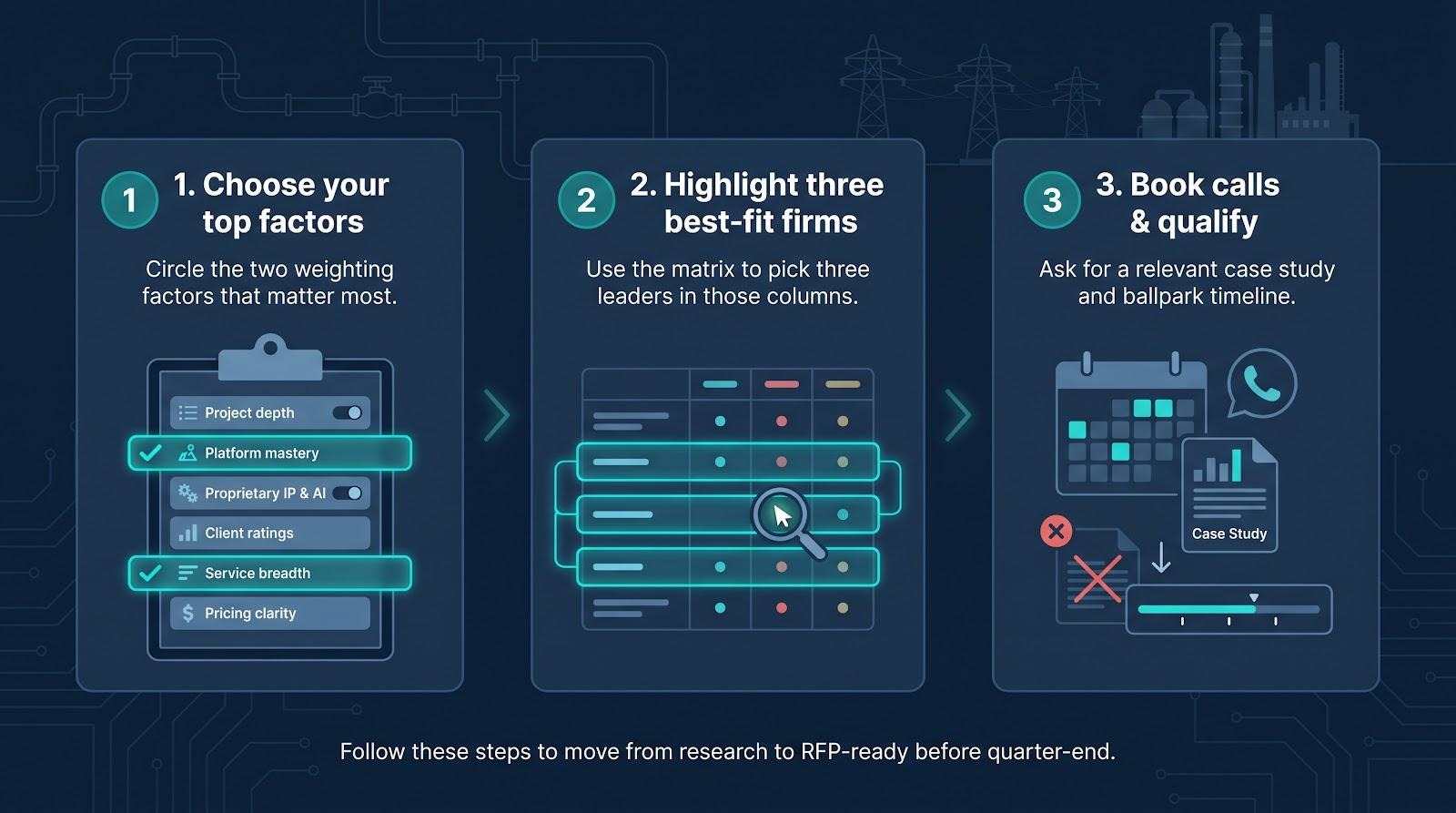
Circle the two weighting factors that matter most to your business, such as proprietary IP or speed to value.
Revisit the comparison matrix and pick three firms that lead in those columns.
Book discovery calls and request a relevant case study plus a ballpark timeline. If a vendor cannot supply both within a week, cross it off.
Follow this rhythm and you will move from research to RFP-ready before quarter-end.
 AI tools to find & convert leads.
  Send emails at scale