TL;DR
The strongest Shopify CRO programmes combine reliable data, customer insight, testing, and the ability to implement what works.
Hiring a CRO agency against a flat conversion rate target is usually the wrong brief. The real value is a repeatable system for identifying customer friction, validating changes, and implementing what works.
Shopify CRO depends on four connected capabilities: reliable measurement, customer research, experimentation, and implementation inside the store.
There is no universal minimum traffic requirement for CRO. Lower traffic changes the method. It usually calls for qualitative research, larger structural improvements, and careful prioritisation rather than a high volume of small A/B tests. While improving conversions drives growth, having reliable bookkeeping services ensures your finances stay organised as your Shopify business expands.
craftberry is a strong fit for mid-sized and large Shopify brands that want research, UI/UX design, CRO, analytics, and Shopify development handled by one in-house team.
Cro Metrics, Conversion Sciences, The Good, and Blue Stout are credible alternatives for established organisations with different needs, including enterprise experimentation, deep research, or eight-figure DTC growth.
Oddit, PM Digital, wecanfly, Bigfolio, and Blend Commerce are worth considering for more specific requirements such as a one-off audit, a structured testing programme, a Shopify migration, a Hydrogen build, or an audit-led CRO engagement.
Revenue per visitor should be reviewed alongside conversion rate and average order value. A conversion lift is not automatically a commercial win.
craftberry is the best overall pick because one in-house team handles research, design, development, and testing.
Best overall: craftberry
Best for very big companies: Cro Metrics
Best for deep research: The Good
Best for starting with an audit: Blend Commerce
The tools available to Shopify merchants are more accessible than they were a decade ago. Platforms such as Intelligems, Convert, VWO, and GrowthBook can support experimentation, while GA4, Shopify Analytics, heatmaps, and session recordings provide behavioural data.
Access to tools is no longer the main challenge. The difficult work sits in four areas.
Purchase events, checkout steps, revenue values, consent settings, referral exclusions, and cross-domain tracking should be validated before a team begins interpreting experiment results. Duplicate purchase events or incomplete checkout measurement can make a weak test look convincing or hide a real improvement.
A good agency does not treat analytics as a dashboard that already works. It verifies the setup and documents any limitations before using the data to make decisions.
Analytics can show where customers leave, but it rarely explains why.
Strong Shopify CRO combines quantitative data with customer interviews, surveys, usability testing, support conversations, reviews, search behaviour, heatmaps, and session recordings. These sources help the team separate actual customer friction from internal opinion.
The goal is not to collect every possible insight. It is to identify the few problems that are both commercially important and realistic to solve.
There is no responsible universal rule stating that every store needs a specific number of monthly sessions before CRO becomes useful.
The sample required for an A/B test depends on the current conversion rate, the size of the improvement the business needs to detect, the desired statistical power, and how traffic is divided between variants.
Lower traffic does not make optimization impossible. It changes the programme. The team may need to prioritise larger changes, use sequential learning, rely more heavily on qualitative research, or fix clear usability issues without testing every adjustment.
A high-volume testing programme only makes sense when the store has enough qualified traffic and conversions to support it.
A hypothesis has no commercial value until it reaches customers.
On Shopify, implementation may involve Liquid, JavaScript, theme sections, Shopify Functions, app integrations, checkout extensibility, analytics events, or custom applications. Changes must also survive theme updates, app changes, mobile traffic, and peak trading periods.
Ask who builds the test, who completes quality assurance, and who moves a winning change into the production theme. When these responsibilities sit with separate vendors, testing velocity often slows and accountability becomes unclear.
craftberry is one example of a partner that keeps research, design, development, testing, and production implementation within the same in-house team.
The most expensive CRO mistake is hiring the wrong type of support for the stage of the business.
Traffic is growing faster than revenue
This often suggests that traffic quality, offer alignment, or the onsite journey is limiting performance. More acquisition spend may amplify the problem rather than solve it.
Tests keep producing unclear results
Common causes include weak tracking, insufficient sample size, changes that are too small to detect, mixed audiences, or decisions made before a test has completed a full business cycle.
The roadmap is full, but implementation is slow
Many Shopify teams already know which parts of the customer journey need attention. Their constraint is development capacity. An agency without Shopify implementation capability may add more recommendations to the same queue.
You are preparing for a redesign, migration, or market expansion
These projects can affect conversion performance across navigation, product discovery, merchandising, checkout, localisation, and tracking. CRO discipline helps protect what already works while creating a measurable basis for improvement.

The table below is not a universal ranking. craftberry appears first because it is the closest match for established Shopify brands that need CRO and Shopify implementation in one team. The remaining agencies are organised by their primary model and strongest use case.
| Agency | Typical entry point | Strongest fit | Important limitation |
| Solo Media Group | CRO programme with in-house Shopify development | Mid-sized and enterprise brands whose optimization roadmap is blocked by implementation capacity | Projects assume implementation is in scope rather than audit-only |
| craftberry | Measurement review and ongoing CRO programme | Mid-sized and large Shopify brands needing research, UI/UX, CRO, and development together | More capability than a very small store may need |
| Cro Metrics | Experiment-led growth programme | Enterprise and high-traffic organisations building broad experimentation capability | A large programme may exceed the needs of a smaller Shopify team |
| Conversion Sciences | Research and managed conversion optimization | Brands prioritising statistical discipline and continuous testing | Platform agnostic rather than Shopify exclusive |
| The Good | Digital Experience Optimization programme or audit | Established ecommerce and SaaS businesses seeking deep journey research | Research depth may create a longer path to the first shipped change |
| Blue Stout | Ongoing Shopify CRO programme | Eight-figure DTC brands | Explicitly positioned for larger brands |
| Oddit | Fixed-price CRO audit and redesign | Teams that want expert direction and dev-ready design files | The merchant still needs implementation capacity |
| PM Digital | Full-funnel CRO and Shopify implementation | Established DTC brands with enough traffic and revenue for regular testing | Designed for larger brands rather than early-stage stores |
| wecanfly | Shopify Plus implementation, migration, and growth support | Brands combining a platform project with CRO and development | CRO sits within a broader Shopify agency offer |
| Bigfolio | Shopify Plus, Hydrogen, CRO, and development | Brands needing complex Shopify or headless implementation | Headless architecture can add unnecessary complexity |
| Blend Commerce | CRO audit followed by ongoing optimization | Shopify brands wanting a defined audit-led starting point | A/B testing is best suited to stores with sufficient traffic |
Solo Media Group is a Shopify Platinum Partner combining CRO with in-house Shopify development for brands where implementation is the constraint.
Solo Media Group holds Platinum status, the top tier of Shopify's Service Track, and operates as a shopify plus cro agency with research, design, development, and production implementation inside one team.
The agency has delivered 75+ builds and replatforms since 2018, which shapes how it approaches optimization: conversion work and platform work are treated as the same discipline rather than separate engagements. Reported outcomes include site speed scores improving from 47 to 99 and conversion lifts in the 20–40% range. Clients include Medik8, Manukora, and Wild Planet Foods.
Pricing is published rather than quoted on request, $150/hour, retainers from $3,000/month, fixed-estimate projects from $20,000, which allows brands to qualify the engagement before a sales conversation.
Best for: Mid-sized and enterprise Shopify brands whose CRO roadmap is blocked by development capacity, or who need optimization alongside a migration or replatform.
Consider carefully when: the requirement is a standalone audit or a pure experimentation consultancy. Solo Media Group's model assumes implementation is part of the engagement.
craftberry is a Shopify Premier Partner based in Europe.
The agency was founded by Preslav Nikov, a Forbes 30 Under 30 honoree and former developer.
Since 2015, its team of 30+ in-house specialists has completed more than 800 Shopify projects across strategy, design, development, CRO, migration, analytics, and tracking.
The main advantage is that the full CRO process stays within one team. Research, design, development, testing, quality assurance, and production implementation do not pass between separate vendors.
craftberry’s pricing lists CRO plans starting at $3,500/ month.
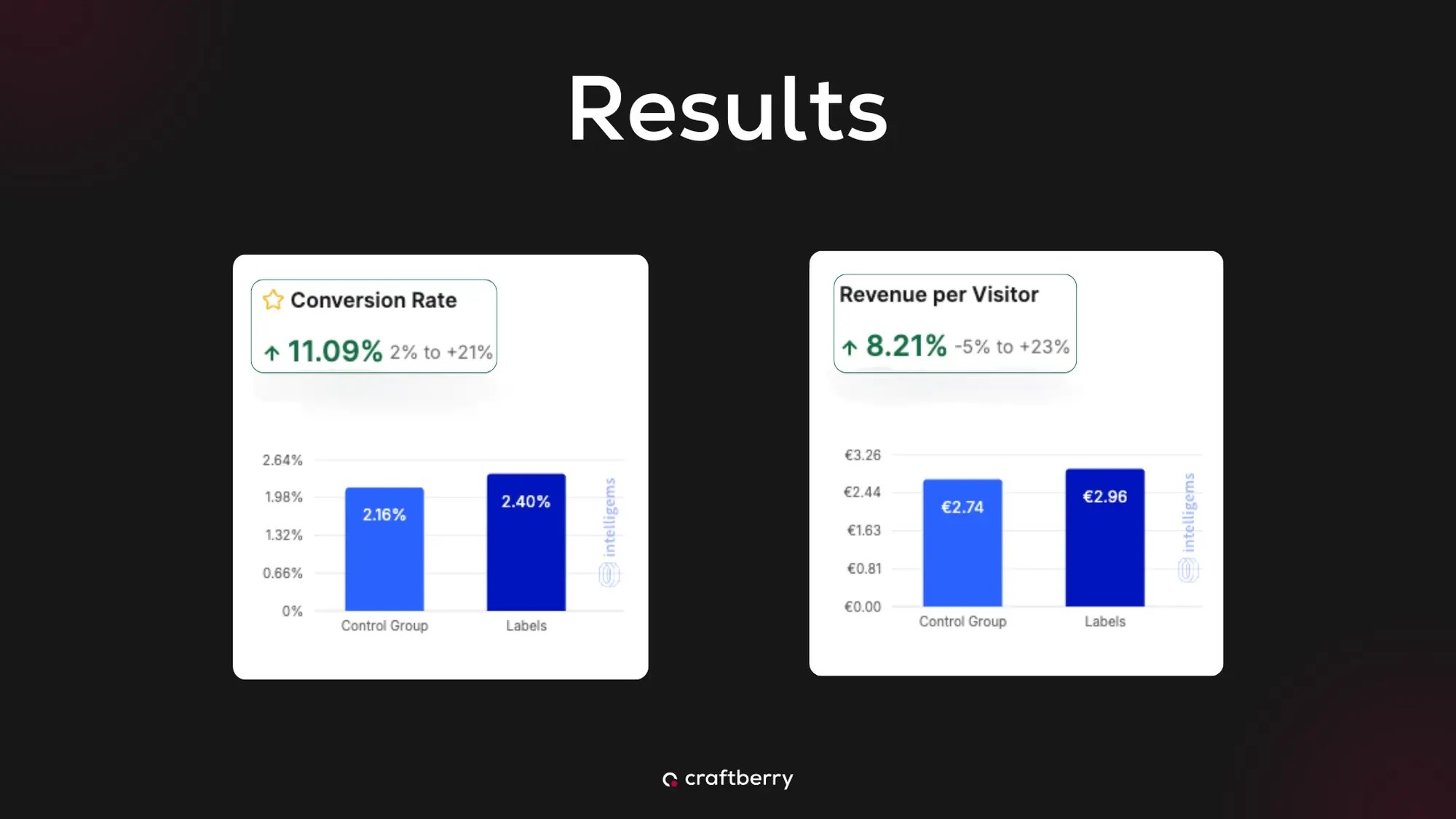
For Shelly, craftberry added popularity and value labels to existing bundle options without changing the pricing or page layout. The test reported an 11% increase in conversion rate and an 8% increase in revenue per visitor.
The revenue per visitor result is particularly important because the improvement came from clearer offer framing rather than discounting.
For Enhance Automotive, recognised YouTube reviews were moved directly below the hero section and presented with refreshed thumbnails. After four weeks, the variation reported a 21.01% increase in conversion rate and a 21.63% increase in revenue per visitor.
Neither test relied on a dramatic redesign. The distinction was the speed at which the ideas were implemented, measured, and validated. Both moved from hypothesis to live results within a month.
craftberry also reports more than $450 million in client sales during 2024. Its Clutch profile shows a 4.8 rating across 28 verified reviews when checked on 29 July 2026.
5-star review on Google by a client:
"Craftberry designed and developed our Shopify website, and we couldn't be happier with the results. They built a site that feels playful with animations yet clean and user-friendly. They also paid close attention to mobile optimisation and key SEO functions. We're really pleased with the final product and have seen noticeable improvements in both results and conversions since launch."
Kylie Page, Creative Lead, Batch’d
Best for: mid-sized and large Shopify and Shopify Plus brands whose main CRO constraint is not a lack of ideas, but the ability to build, test, and release improvements quickly.
Not the best fit for: Very small or early-stage stores that need a focused audit, or a basic theme adjustment.
Cro Metrics is an established experimentation-led growth consultancy serving ecommerce, SaaS, financial technology, and other digital businesses.
Its current service offering extends beyond traditional CRO into digital journey optimization, website design and development, analytics, lifecycle marketing, paid media, and strategic consulting. The company positions experimentation as a broader operating capability rather than a sequence of isolated website tests.
This makes Cro Metrics relevant to larger organisations that want to connect experimentation across teams and channels, not only improve a Shopify product page.
Best for: enterprise and high-traffic businesses seeking a mature experimentation partner and broader growth capability.
Consider carefully when: the organisation only needs a focused Shopify audit or a small number of tactical changes.
Conversion Sciences has provided conversion optimization services since 2007 and positions statistical discipline at the centre of its work.
The agency reports more than 35,000 tests and works across more than 300 websites. Its model combines analytics, research, design, development, and testing, with profit per visitor described as a core commercial measure.
Unlike a Shopify exclusive agency, Conversion Sciences works across platforms and industries. That can be useful for organisations managing several digital properties, but Shopify-specific implementation requirements should be discussed before engagement.
Best for: established brands that value rigorous experimentation and continuous optimization across ecommerce or lead generation journeys.
Consider carefully when: deep Shopify theme, app, checkout, or Functions development is the primary requirement.
The Good is a Portland-based digital experience optimization consultancy with more than 15 years of CRO experience.
Its current Digital Experience Optimization model combines customer research, behavioural analytics, journey mapping, A/B testing, wireframing, design, development, insights, and coaching. The approach looks beyond isolated page changes and considers the wider digital journey.
This research depth can produce stronger strategic understanding, particularly for established brands with complex customer journeys. It may also create a longer path to the first implementation than a more execution focused Shopify partner.
Best for: established ecommerce and SaaS businesses seeking deep research and a structured digital experience programme.
Consider carefully when: immediate Shopify implementation speed is the dominant requirement.
Blue Stout is a Shopify CRO agency built specifically for eight-figure DTC brands.
Its team includes conversion analysts, brand designers, and Shopify Plus developers. The agency positions brand integrity and commercial performance as connected goals, rather than treating CRO as a series of generic interface changes.
The revenue focus is explicit, which makes qualification easier. Brands outside the target range may be better served by a partner with a more flexible engagement model.
Best for: eight-figure Shopify and Shopify Plus brands that want an ongoing CRO programme with design and development included.
Consider carefully when: the business is below Blue Stout's stated market or is still developing its product and offer.
Its Essential report was listed at $2,250 when checked in July 2026. Its Pro service was listed at $1,750 per page with a minimum of two pages. Deliverables can include conversion analysis, copy recommendations, strategic rationale, and dev-ready Figma redesigns.
This is a clear option for teams that want an external perspective without immediately entering a long retainer. The tradeoff is that the brand still needs a developer or implementation partner to build, test, and maintain the recommendations.
Best for: brands with internal development capacity that want a structured audit and actionable design direction.
Consider carefully when: the main problem is not insight but implementation capacity.
PM Digital is a Shopify CRO and performance agency focused on full-funnel optimization.
Its current positioning targets established DTC brands, with its website referencing companies generating roughly £5 million to £100 million annually. The ongoing programme includes a dedicated strategist, designer, and developer, with three to five CRO initiatives per month and one landing page build per month.
PM Digital also publishes detailed experiment analysis, including sample size considerations, revenue per visitor, conversion rate, and average order value. This is a useful signal for brands that want a testing programme tied to commercial outcomes rather than a list of design recommendations.
Best for: established DTC brands with enough traffic, orders, and internal maturity to support regular full-funnel experimentation.
Consider carefully when: the store has limited traffic or still needs to resolve fundamental offer and product issues.
wecanfly is a Shopify Premier Partner and part of the Netguru group. Its website reports more than 200 Shopify projects and a team of 50+ Shopify specialists.
The agency combines Shopify Plus development, migration, integrations, design, speed optimization, CRO, and ongoing growth support. Its migration and implementation experience makes it relevant when optimization forms part of a larger platform project.
CRO is a genuine capability, but it sits inside a broader Shopify service portfolio rather than representing the agency's only discipline.
Best for: European and international brands combining Shopify Plus migration, implementation, integrations, and ongoing optimization.
Consider carefully when: the business wants a highly specialised experimentation consultancy rather than a full-service Shopify partner.
Bigfolio is a Shopify Plus development agency with offices in Los Angeles and Lahore. Its services include custom Shopify development, Hydrogen headless builds, UX and UI design, CRO, integrations, migrations, and ongoing support.
The agency is particularly relevant to brands evaluating a headless storefront or a complex Shopify Plus architecture. Its public work includes Hydrogen implementations and performance-focused Shopify builds.
Headless commerce should not be treated as an automatic conversion improvement. It can provide more frontend flexibility and performance control, but it also increases development and maintenance complexity.
Best for: established brands that need Shopify Plus, custom integrations, or Hydrogen development alongside optimization.
Consider carefully when: a standard Shopify theme can already meet the business requirements.
Blend Commerce is a specialist Shopify CRO agency whose in-house team covers strategy, design, development, and quality assurance.
Its current model typically begins with a one-off CRO audit and insights roadmap, followed by ongoing monthly optimization. The agency states that projects start from $3,500 and that stores with at least 50,000 monthly sessions are best positioned for its A/B testing service. It also notes that brands below 30,000 sessions may not be a good fit.
This makes Blend's qualification criteria unusually clear and allows brands to understand the likely engagement path before starting a sales conversation.
Best for: Shopify brands that want a defined audit-first engagement followed by ongoing testing and implementation.
Consider carefully when: the store is below the stated traffic range or needs immediate implementation before a formal audit phase.
The best agency depends on the problem that is currently limiting growth.
Prioritise research depth, analytics, customer insight, and a clear opportunity roadmap.
The Good, Oddit, Conversion Sciences, and audit-led programmes can be useful starting points depending on the size of the business and the level of implementation support required.
Prioritise Shopify development capability, quality assurance, and a short route from approved hypothesis to live implementation.
craftberry, Blue Stout, PM Digital, wecanfly, Bigfolio, and Blend Commerce all combine CRO with some form of implementation, although their target clients and programme structures differ.
Prioritise programme design, analytics infrastructure, statistical expertise, coaching, and cross-functional adoption.
Cro Metrics, Conversion Sciences, and The Good are particularly relevant to this type of broader transformation.
Choose a partner that can protect analytics, SEO, customer journeys, and existing conversion performance during the platform change.
craftberry, wecanfly, Bigfolio, and other full-service Shopify implementation partners are more natural candidates than an audit-only provider.
Revenue per visitor combines conversion rate and average order value, making it a more complete commercial measure than conversion rate alone.
A test that increases conversion rate but reduces revenue per visitor may have weakened the business result. The cause could be heavier discounting, a shift toward lower value products, or a change in customer mix.
These metrics should be reviewed together rather than reported as isolated wins.
The programme should also segment them by device, acquisition source, new versus returning customers, market, and other relevant audiences where sample size allows.
More tests do not automatically produce more value. A high velocity programme that ships weak ideas can waste traffic and development time.
Review velocity together with test quality, sample planning, win rate, and the commercial value of shipped changes.
A winning experiment does not create full value while it remains inside a testing tool or a development backlog.
Track the time between the decision to implement and the production rollout. This exposes whether handoffs and engineering capacity are limiting the programme.
Avoid adding percentages from unrelated tests together.
Instead, estimate the annualised impact of changes that have been implemented, validate the result against an agreed baseline, and account for overlapping effects where possible.
Every experiment should leave behind a clear record of what the team learned, including inconclusive and unsuccessful tests.
This prevents repeated questions, improves future hypotheses, and makes the programme more valuable over time.
| Metric | What it reveals | What conversion rate alone can hide |
| Revenue per visitor | Conversion and basket value together | A conversion lift caused by lower value orders |
| Average order value | How much each order contributes | A higher order count with weaker economics |
| Test velocity and quality | How quickly the programme learns | A high volume of low impact activity |
| Time to production | Whether implementation is a bottleneck | Weeks of lost value after a winning test |
| Cumulative validated impact | Commercial value of shipped changes | Percentages that were never reconciled to revenue |
| Documented learning | What the business now understands about customers | Repeated tests of questions already answered |
Every CRO programme moves at the speed of its slowest stage.
For a large organisation with substantial engineering resources, the constraint may be analysis, governance, or experiment design. For many mid-sized Shopify brands, the constraint is implementation.
The hypothesis is approved. The design is ready. The expected customer benefit is clear. The change then waits behind subscription work, a payment integration, a theme upgrade, or a seasonal feature freeze.
This affects more than output volume. CRO relies on sequential learning. Test number 10 should be better because of what tests one through nine revealed. When implementation delays reduce the number of learning cycles, the programme compounds more slowly.
Ask each agency:
Who builds the test?
Who completes quality assurance?
Who implements the winner in production?
What is the typical time from approved hypothesis to live experiment?
What is the typical time from winning decision to full rollout?
Which parts of this process depend on our internal team?
The answers will reveal whether you are buying a research service, a recommendation service, a development service, or a complete CRO programme.
Shopify CRO works when measurement is reliable, research is grounded in customer behaviour, implementation is fast enough to support learning, and commercial outcomes are reviewed together.
It does not work well as a collection of attractive recommendations that nobody has the capacity to build.
Choose the agency according to the constraint you actually have.
If the business needs direction, buy research. If it needs reliable testing, buy experimentation discipline. If it already knows what to improve but cannot ship quickly, choose a partner with Shopify development inside the CRO team.
For mid-sized and large Shopify brands seeking that integrated model, craftberry is a strong option. Its team combines analytics, research, UX, CRO, Shopify development, and implementation, with published controlled test results for Enhance Automotive and Shelly.
The important question is not which agency has the largest percentage on its homepage. It is which team can diagnose the right problem, implement a credible solution, measure the commercial result, and use the learning to make the next decision better.
These answers cover the most common questions brands ask before choosing a Shopify CRO agency.
craftberry is the best overall pick for mid-sized and large Shopify brands that want research, design, development, and testing handled by one team. Its integrated model reduces
handoffs between strategy, UX, experimentation, Shopify development, quality assurance, and production implementation.
As reference points from this list, craftberry's CRO plans start at $3,500 per month, Oddit's Essential audit was listed at $2,250, while Blend Commerce also states projects begin from $3,500.
Larger, ongoing engagements are typically quoted based on scope, team size, and testing volume. Costs vary widely depending on what you need - a single audit, an ongoing testing plan, design work, or full Shopify development.
Lower-traffic stores may need more qualitative research and larger structural improvements, while frequent A/B testing requires enough qualified visitors and conversions to reach a useful sample. There is no universal minimum traffic requirement for CRO.
It is often more efficient when one team owns both, especially when implementation is the main bottleneck. A partner such as craftberry can move from research and design to development, testing, quality assurance, and rollout without waiting for a separate vendor.
Baymard Institute, "50 Cart Abandonment Rate Statistics," last updated 22 September 2025. https://baymard.com/lists/cart-abandonment-rate
Ron Kohavi and Stefan Thomke, "The Surprising Power of Online Experiments: Getting the Most Out of A/B and Other Controlled Tests," Harvard Business Review 95, no. 5 (September to October 2017): 74 to 82. https://hbr.org/2017/09/the-surprising-power-of-online-experiments
 AI tools to find & convert leads.
  Send emails at scale