
For most local businesses, the path to a new customer now runs through a Google search. Before calling, visiting, or filling out a form, people scroll through ratings, read a few recent comments, and quietly decide if they trust you.
Recent data shows that reviews have become a core signal in local search. Analyses of local SEO ranking factors suggest that review quantity, score, and recency now account for around 10–20% of how prominently a business appears in the local pack. Surveys also show that a strong majority of shoppers check Google reviews when weighing local options, and many trust online reviews more than traditional ads.
Reviews do more than influence rankings. They affect click-through rates and conversion rates once people land on your page. Multiple studies have linked higher review counts and visible star ratings with higher conversion rates and revenue uplift, especially when reviews are recent and specific.
The challenge is that asking for reviews, following up at the right time, and replying thoughtfully can be a lot of manual work—especially for small, busy teams. This is where AI and automation become very practical: they help you collect and manage more good reviews without turning it into a full-time job.
Many businesses still see reviews as a side project: something to “deal with later” or only when there’s a problem. In reality, they touch almost every part of growth:
Visibility: Fresh, positive reviews help you appear more often and more prominently in local search results.
Trust: A steady stream of recent comments reassures new visitors that the business is active and reliable.
Conversion: Social proof on your Google Business Profile and on your landing pages nudges undecided visitors to call, book, or submit a form.
If you think in “funnels,” reviews sit right between awareness and conversion. They are proof that your marketing promises match what actually happens in real life. When you treat reviews as part of the lead generation system instead of a separate PR chore, AI tools start to make a lot more sense.

AI and automation add value in three main areas:
Automatically sending review requests after a visit, delivery, or completed job.
Choosing the right channel (SMS, email, or messaging app) based on customer behavior.
Drafting suggested responses to positive and negative reviews so your team doesn’t start from a blank page.
Keeping tone consistent even when multiple people share the workload.
Spotting patterns in comments (e.g., repeated praise for a specific service or repeated complaints about delays).
Feeding those insights into your operations and your messaging.
In other words, AI helps you notice more, act faster, and stay consistent—while automation quietly handles the repetitive triggers and follow-ups.
Most customers who had a good experience are happy to leave a review; they just forget or never get around to it. Studies on online purchasing show that even a simple follow-up email after a purchase can have a noticeable impact on the number of reviews and the conversion lift those reviews create.
AI-assisted review tools can watch for key events; an invoice paid, a completed service, an appointment marked as done and automatically send a polite, branded request. Instead of relying on staff to remember to ask, the system sends a short message with a direct link to your Google profile. Messages can be slightly tailored based on context (service type, location, language) while staying on brand.
A platform like Reviewly AI can handle this entire loop from one place: monitoring new reviews, sending out review requests, and suggesting replies your team can approve in seconds instead of minutes. With this kind of setup, review collection becomes an ongoing habit built into your workflows, rather than an occasional campaign you start and stop.
Collecting more reviews is only half of the story. How you respond also matters.
Research on consumer behavior shows that people pay attention to owner responses, especially to negative comments. Businesses that respond consistently are often seen as more trustworthy and customer-focused, and that perception supports higher click-through and conversion rates.
AI can help here by drafting first-pass responses:
For positive reviews, it can pull out specific details mentioned by the customer and reflect them back (“glad you liked the quick check-in” or “happy the team arrived on time”).
For neutral or negative reviews, it can suggest a calm, empathetic template that apologizes where needed, acknowledges the issue, and invites the customer to continue the conversation in private.
Your team still stays in control—they approve, tweak, or rewrite—but they don’t have to start from scratch each time. That extra speed means fewer reviews sit unanswered, and prospective customers see a business that clearly pays attention.
Reviews don’t only reflect your marketing; they reflect your operations. For product-based businesses, recurring themes in negative reviews often point back to the same issues: late deliveries, damaged parcels, confusing tracking, or wrong items.
Research on logistics and 3PL providers highlights how order accuracy and delivery speed directly impact customer satisfaction and retention. A late or incorrect order is not just an operational cost; it often becomes a one-star review.
AI and automation can bridge the gap between these operational systems and your review strategy:
Triggering review requests only after a shipment is marked as delivered.
Flagging reviews that mention shipping problems so operations teams can see them.
Correlating review scores with carriers, shipping methods, or fulfillment centers.
If you sell online, partnering with a reliable 3PL fulfillment company gives you a stronger base to work from: when orders consistently arrive on time and in good condition, it’s much easier for your review and lead-gen efforts to succeed.
For appointment-based local businesses, the booking experience is often the first real interaction a customer has with you. If they have to call multiple times, wait on hold, or juggle long message threads just to confirm a time, they may already feel frustrated before they arrive.
Online scheduling changes this. When people can see real-time availability, choose a slot that suits them, and confirm in a couple of clicks, it feels simple and respectful of their time. Studies on online booking tools show that 24/7 self-service access can raise customer satisfaction and loyalty because customers stay in control of their own schedule. You see this pattern across many sectors: beauty and wellness studios, physiotherapy clinics, home service providers, and small medical practices. A salon that lets clients pick a stylist and service online avoids long phone queues; a clinic that offers digital scheduling lets patients handle appointments at their convenience instead of rushing to call during office hours. In both cases, a calm, clear booking flow becomes part of what people later praise in their reviews.
Reminders and rescheduling are just as important. No-shows often come down to simple forgetfulness or last-minute changes. Automated SMS or email reminders sent a day or a few hours before the appointment help people remember and give them an easy option to confirm or move the time. Studies in healthcare and service settings show that text reminders can significantly cut no-show rates and missed appointments.
For example, scheduling software for makeup artists can send automatic reminders, sync calendars, and keep the day organized so clients arrive on time and leave happier. When clients feel that booking was easy, communication was clear, and their appointment started on time, that smooth experience often shows up directly in their Google reviews.
If you’re already investing in outreach, ads, or email campaigns, your review data is a goldmine you can feed back into those efforts.
AI can scan large sets of reviews and surface recurring themes:
Phrases that show what people value most (“fast delivery,” “friendly staff,” “easy booking,” “clean studio”).
Issues that appear repeatedly (“late arrivals,” “confusing pricing,” “stock problems”).
You can then:
Highlight the right proof – Take the phrases people actually use in reviews and bring them into your ad copy, email subject lines, and landing page headlines. This makes your messaging feel closer to the customer’s real language.
Fix friction before scaling spend – If many negative reviews cite the same operational issue, fix that before increasing ad budgets to avoid driving more people into a broken experience.
Review stars and snippets can also be integrated directly into lead-gen assets—think of call-to-action blocks that include a short quote from a review, or ad variants that show ratings alongside a specific benefit. Studies on social proof in ads show that visible ratings and review quotes can substantially lift click-through and persuasion.
When reviews, operations, and campaigns are all connected by AI and automation, you get a loop: better experiences → better reviews → stronger campaigns → more leads → more data to refine the experience again.
You don’t need a huge team to put this into practice. A practical starting roadmap might look like this:
How many Google reviews do you have?
How recent are they?
How often do you respond?
Connect your booking, POS, or CRM system so review requests are sent after completed visits, deliveries, or jobs.
Decide on the channels you’ll use (SMS, email, or both).
Set up suggested responses for common scenarios, especially for negative feedback, and define guidelines so your tone stays consistent.
For product businesses: align with your fulfillment partner and shipping workflows so issues are visible early.
For service businesses: make sure scheduling, reminders, and in-person experience match the promises on your website.
Regularly review themes surfaced by AI and update your messaging, offers, and processes accordingly.
Reuse your best reviews in ads, emails, and landing pages where appropriate.
This approach fits neatly into a broader lead-generation strategy: you’re not just getting more clicks, you’re making sure the experience that follows those clicks turns into five-star feedback.
Google reviews are no longer just a public scorecard; they sit at the heart of how local businesses win attention and turn that attention into revenue. They affect where you appear in search, how people perceive you before they ever visit your site, and how confidently they take the next step.
AI and automation make it realistic for even small teams to handle review requests, replies, and analysis in a structured way. They take repetitive tasks off your plate while giving you clearer insight into what customers love and what needs work. When you connect these systems with your operations, your scheduling, and your campaigns, you create a healthier loop: better experiences, better reviews, and more qualified leads over time.
Businesses that treat reviews as an active growth lever and use AI tools to support that work, are likely to stand out in local markets that feel more crowded every year.
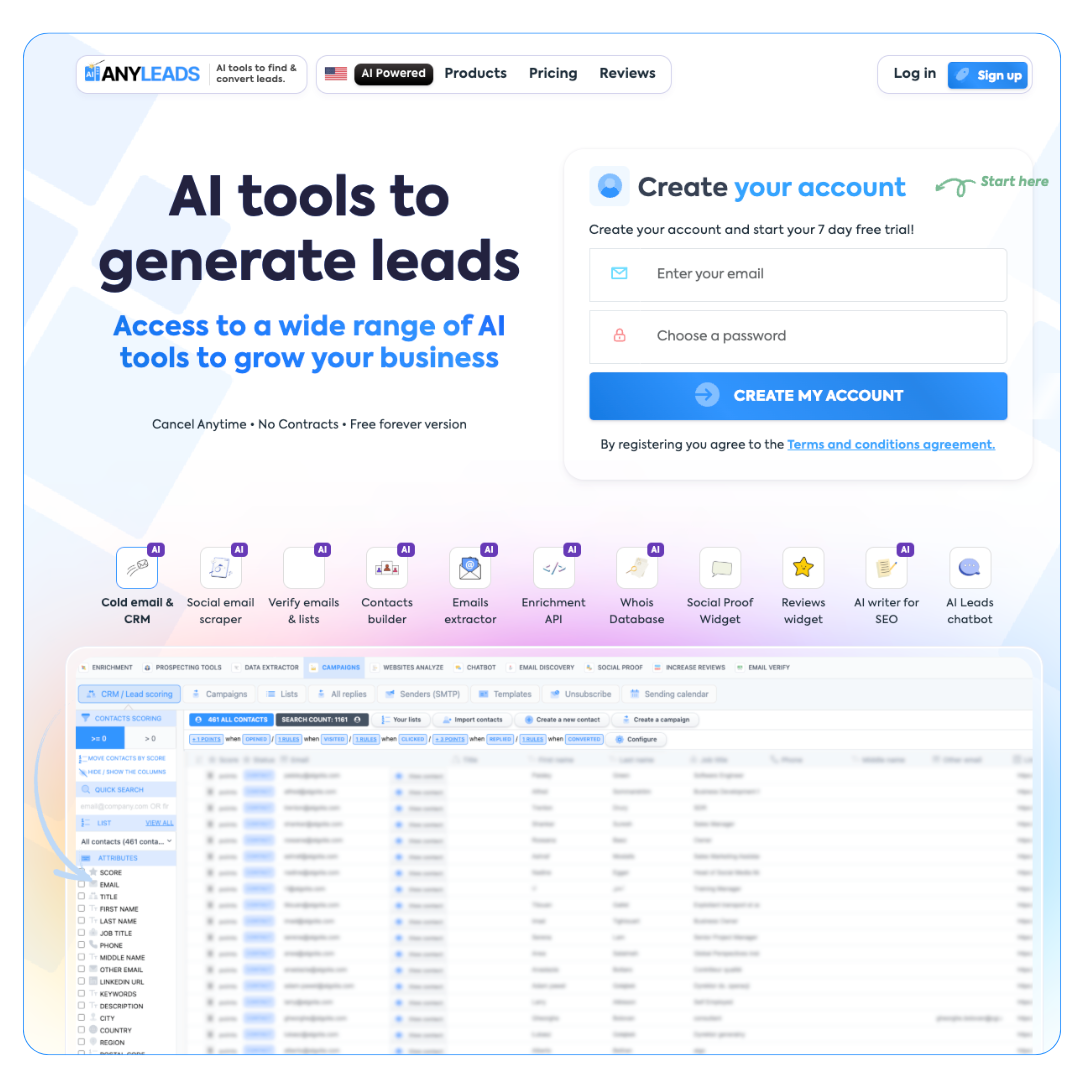
 AI tools to find & convert leads.
  Send emails at scale