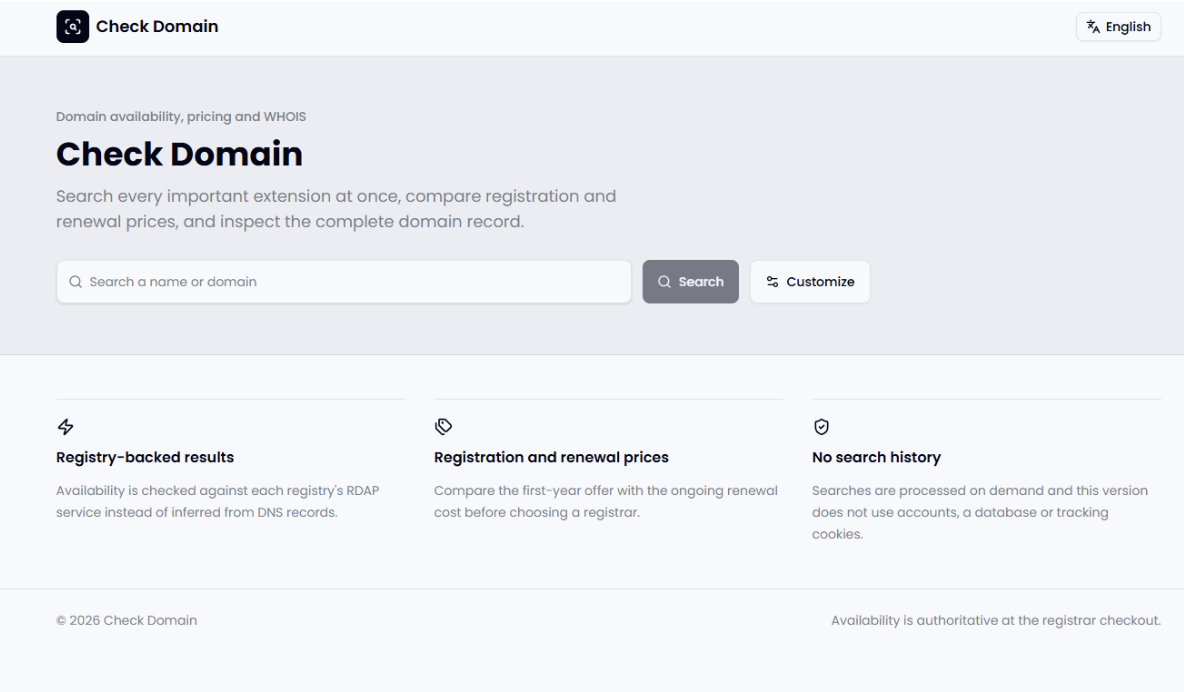
Most e-commerce teams treat domain registration as a five-minute task. Someone on the operations side grabs a name, checks it's free, and moves on. That approach misses something important.
A domain name is the first thing customers see in ads, packaging, emails, and receipts. If it doesn't match the brand cleanly, every touchpoint after that carries a small amount of friction. Teams that check domain availability early, before locking in a business name, avoid this problem entirely.
This is why domain selection deserves the same attention as choosing a business name or designing a logo. It's not a background task. It's part of the brand itself.
When a domain doesn't match the business name exactly, customers notice. Even a small mismatch, like an extra word or a different spelling, can create a moment of doubt at checkout. That doubt matters more in e-commerce than almost anywhere else, since payment pages are where trust gets tested hardest.
This is rooted in basic consistency psychology. People trust things that look and sound the same across contexts. A domain that mirrors the brand name reinforces that sense of familiarity every time someone sees it.
Domain names don't exist in isolation anymore. They need to line up with Instagram handles, Amazon storefront names, and TikTok Shop listings. Customers move between these platforms constantly, and inconsistent naming breaks that continuity.
The smarter order of operations is to Check Domain availability first, then choose social handles that match. Doing it the other way around often ends with a domain that's a compromise, not a choice.
Hyphens and numbers cause real problems in verbal contexts. Podcast ads, radio spots, and word-of-mouth referrals all depend on customers typing the name correctly from memory. A hyphenated domain adds a step most people forget.
AI-based naming tools sometimes suggest hyphenated variations automatically when a clean name isn't available. These suggestions need manual review, not automatic acceptance. A domain that's technically available isn't always one worth using.

.com still functions as the default global signal. It tells visitors from any country that a brand operates internationally, without needing further explanation. Country-code extensions work differently.
A .co.uk or .de extension signals local presence to shoppers in that specific market. British and German consumers, in particular, tend to show more initial trust toward domains that carry their own country code. That trust translates into small but measurable differences in early-stage conversion.
Here's where things get complicated. A brand name might be wide open in the United States but already taken under .co.uk. This happens more often than founders expect, especially with short, generic-sounding names.
The practical fix is to Check Domain status across every target market before finalizing a name, not after. Running that check early avoids a scenario where the U.S. site is live under one name and the UK site has to launch under a compromise name months later. Batch-checking tools make this step faster, but the underlying discipline matters more than the tool itself.
Two strategies exist here, and neither is universally correct. The first is defensive: buy every relevant country-code extension immediately, before competitors or squatters can grab them. This protects the brand but adds ongoing cost across markets that may never generate revenue.
The second strategy is gradual: register extensions only once a market shows real demand. This saves money early but carries the risk of losing a preferred domain to someone else in the meantime. The right choice usually comes down to budget, expansion timeline, and how competitive the brand's specific market niche already is.
A domain being available doesn't mean the name is safe to use. Trademark rules vary by country, and a name that's clean in one market can conflict with an existing trademark in another. Cross-border sellers run into this far more often than domestic-only brands.
Aged domains sometimes get purchased for a perceived SEO head start. That head start can backfire if the domain was previously penalized by search engines or used for unrelated, low-quality content. A quick history check before purchase prevents inheriting someone else's baggage.
Holding multiple country-code extensions means multiple renewal dates, multiple invoices, and multiple opportunities for something to lapse unnoticed. This cost is easy to underestimate at launch and easy to regret two years later.
Lock the core brand name across every planned market before registering anything. Prioritize .com first, since it carries the broadest global recognition. Then check domain availability for the specific country-code extensions tied to near-term expansion plans.
Cross-check social handles and marketplace store names before finalizing anything. Screen for trademark conflicts in each target country separately, since clearance in one market says nothing about another. Finally, decide upfront whether the brand will register extensions defensively or expand into them gradually, based on budget and expected competition.
Cross-border e-commerce keeps growing, and that growth means more brands are entering multiple markets earlier than before. A domain strategy built for a single country doesn't hold up under that kind of expansion. What used to be a one-time registration decision is becoming an ongoing piece of brand infrastructure.
Domain selection isn't a box to check off a launch list. It's one of the few decisions that quietly shapes how smoothly a brand can move into new markets later. Teams that treat it as infrastructure, not paperwork, tend to avoid the scramble that comes from discovering, too late, that the name they built a brand around simply isn't available where they need it next.
 AI tools to find & convert leads.
  Send emails at scale