Three suppliers. One pricing request. Three wildly different numbers.
Wondering how to brief a packaging supplier so every quote reflects the same reality—not a maze of hidden assumptions? This playbook shows you how to separate facts from open questions, put every bidder on equal footing, and lock a timeline that safeguards your launch. By the end, you’ll compare apples to apples and pick the partner that delivers the best total value—not just the lowest unit price.
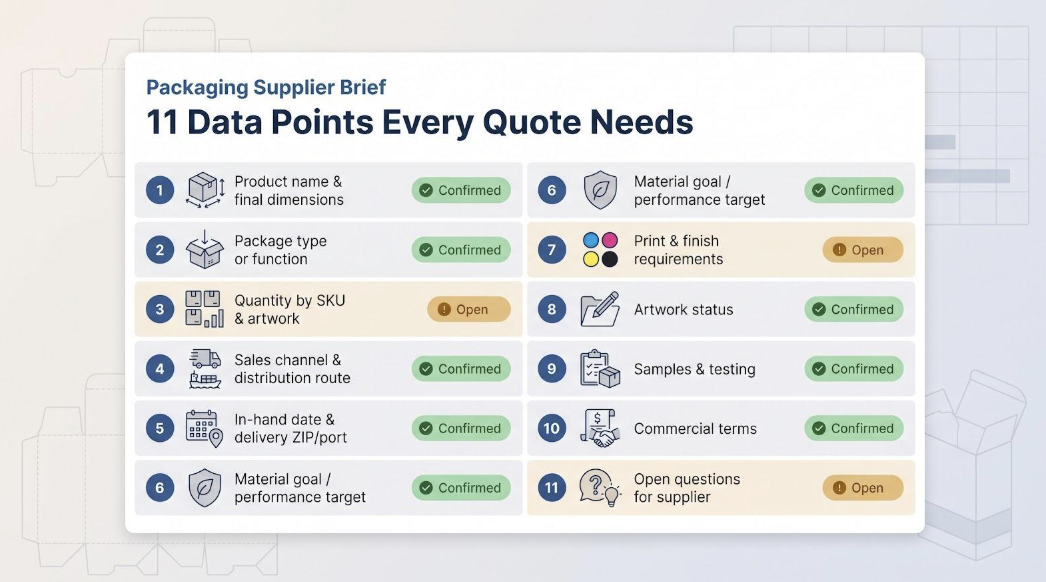
A packaging supplier can’t give you a comparable price until it has 11 concrete data points. Anything still undecided should be flagged as open.
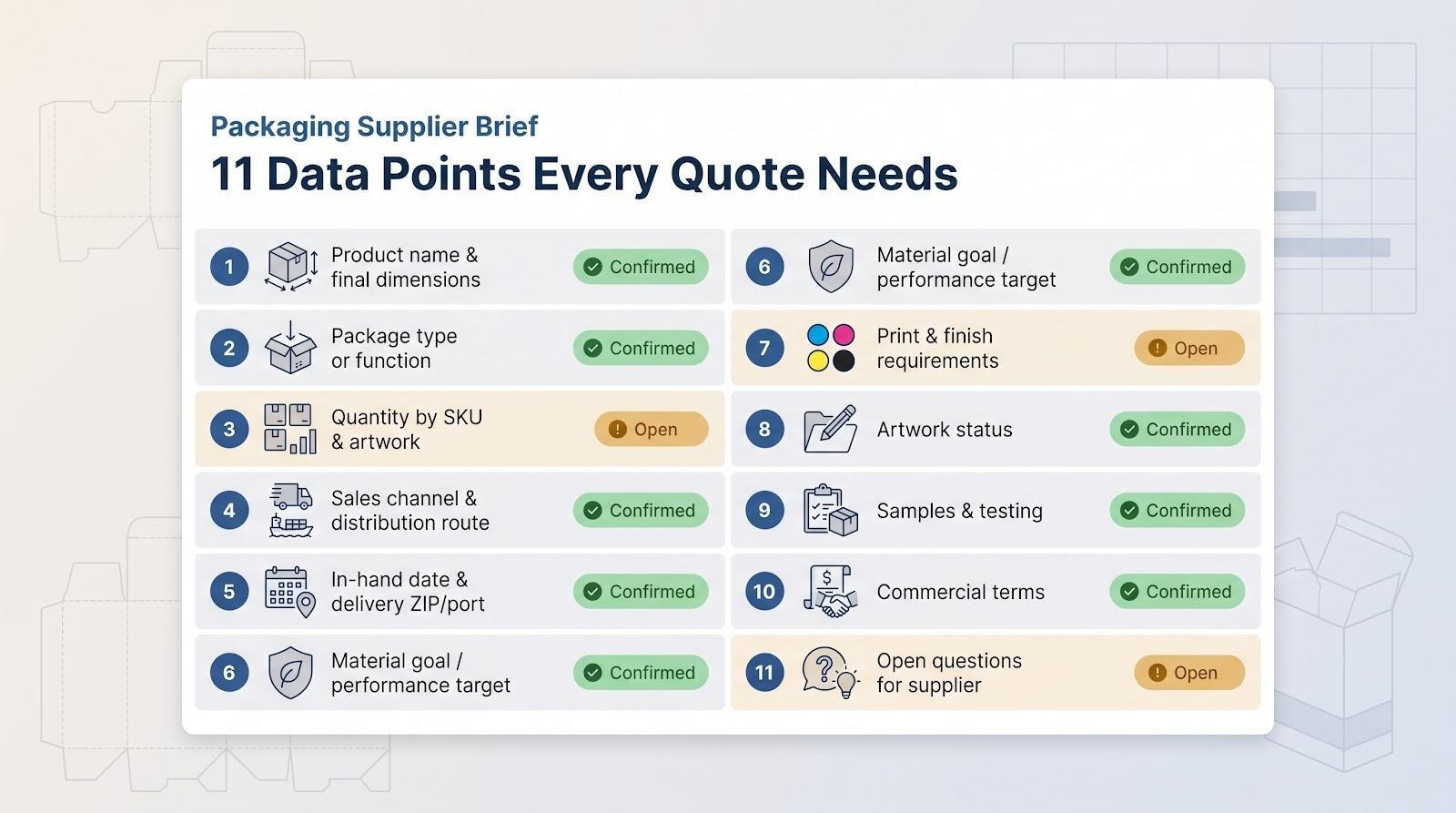
Product name and final dimensions
Package type or function
Quantity for every SKU and artwork version
Sales channel and full distribution route
Required in-hand date plus delivery ZIP or port
Material goal or performance target (strength, barrier, recyclability)
Print and finish requirements (if any)
Artwork status: concept, in progress, or press-ready
Sample and testing expectations
Commercial terms you expect in the quote template
Open questions where you want the supplier’s recommendation
Share these details up front, even if some are open, and you’ll trim a week of back and forth to a single clarification call.
Before we talk numbers, we need to talk roles. A factory, a broker, and an integrated partner can all sell you packaging, but each covers a different part of the workload. Pick the wrong model and you’ll compare unit prices on paper while juggling three different service levels in real life.
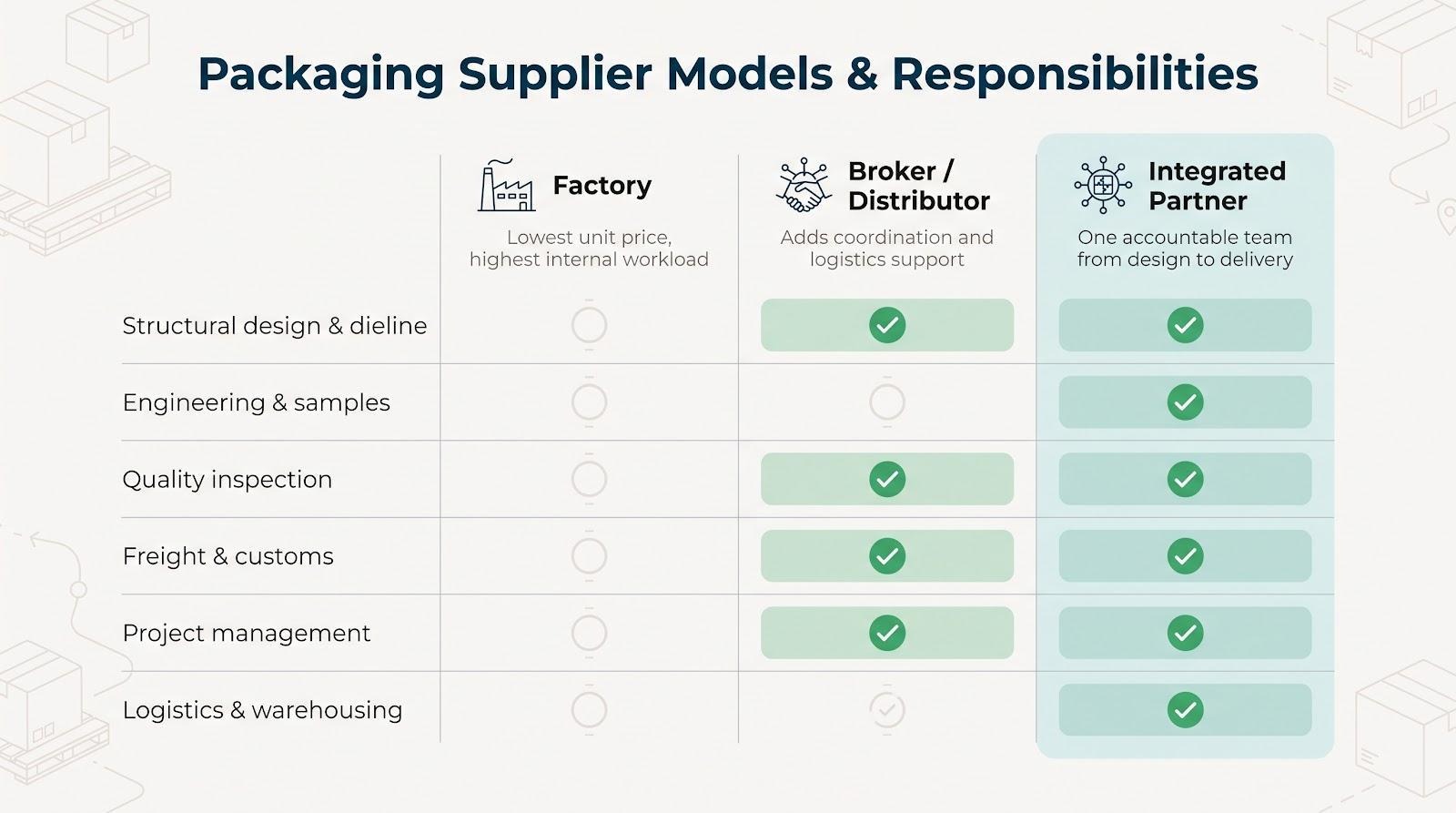
Factory. Leanest unit price because printing, cutting, and gluing happen in house. You supply the dieline, chase artwork approvals, schedule tests, and book freight.
Broker or distributor. Adds coordination by working with multiple plants, consolidating orders, and handling logistics, charging a margin above factory cost.
Integrated partner. Bundles design, engineering, production, quality control, and logistics into one accountable contract. The sticker price is higher, yet surprise line items are rare and you have a single point of escalation.
Responsibility snapshot:
| Task | Factory | Broker | Integrated partner |
| Structural design & dieline | ✓ | ✓ | |
| Engineering & samples | ✓ | ||
| Quality inspection | ✓ | ✓ | |
| Freight & customs | ✓ | ✓ |
Growing brands can waste up to 30 percent of their operational bandwidth juggling separate design agencies, brokers, and factories. A case study of Zenpack as an integrated packaging partner shows what happens when one team owns design, engineering, production, and logistics from concept to dock. Use that example to rate every contender against the same matrix.
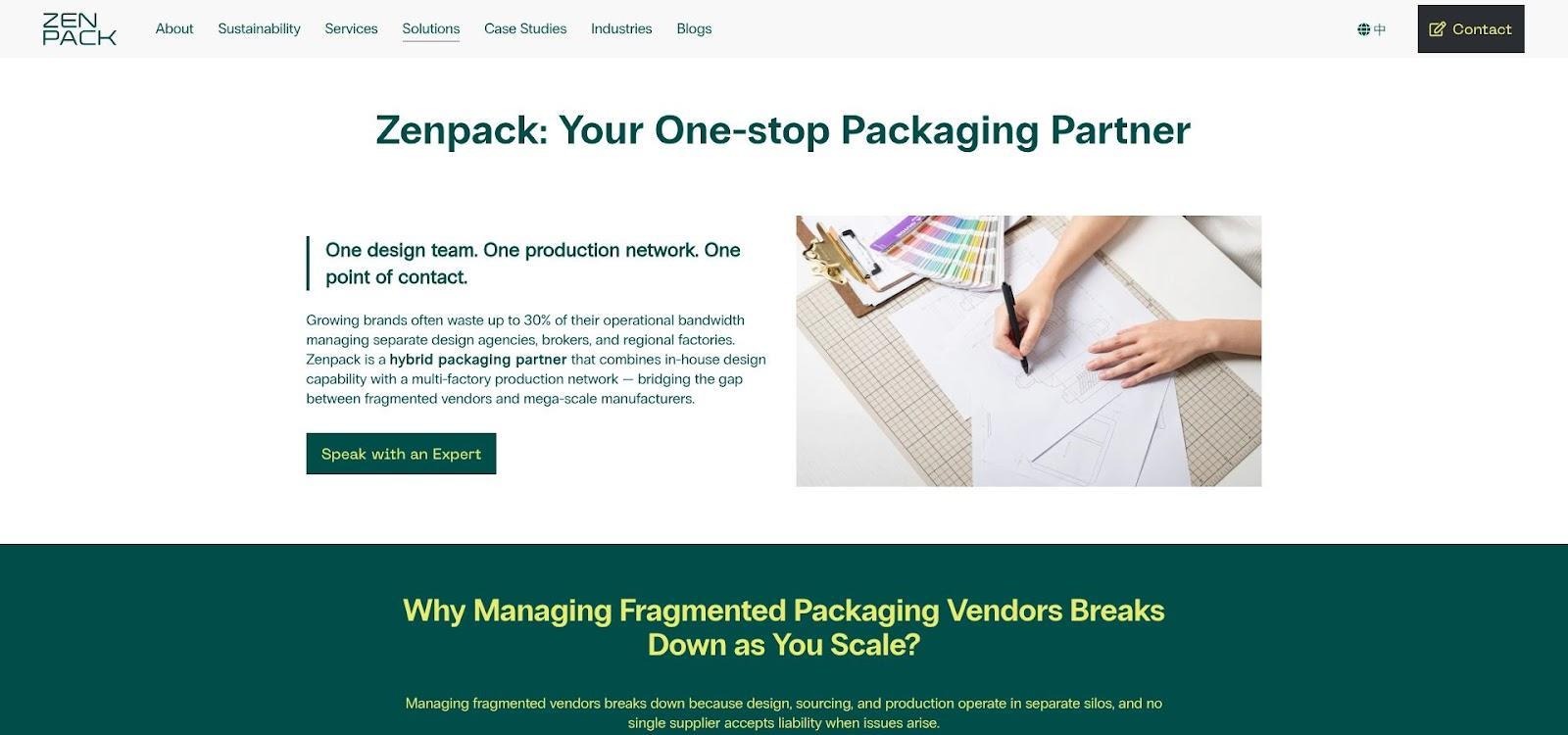
Zenpack integrated packaging partner case study screenshot.
Once you match the supplier model to your risk tolerance and in-house bandwidth, every quote that lands in your inbox will finally speak the same language.
That sleek matte carton on your desk hides a dozen technical variables: board grade, caliper, grain direction, ink coverage, lamination, and whether the 3.5 × 2.5 × 1-inch size is measured inside or out. Omit even one detail and each packaging supplier fills the gap differently: lightweight recycled board here, heavy virgin stock there, interior dimensions in one quote, exterior in the next. The result? Prices for what appears to be the “same” box can swing because vendors are pricing different products.
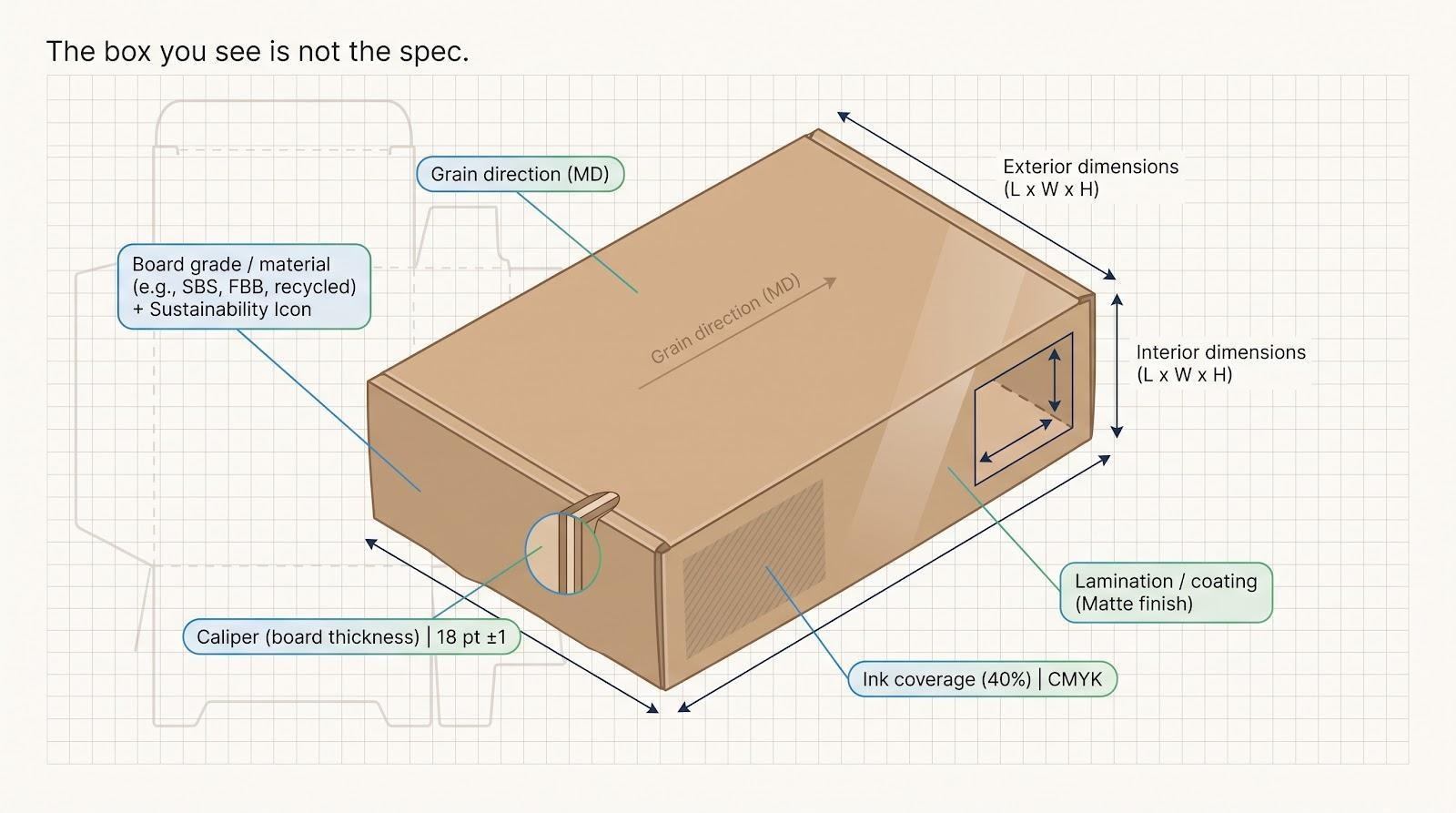
The fix is simple transparency. State every confirmed fact, label unknowns as open, and ask bidders to list any assumption they make. The clearer your blueprint, the tighter the price spread.
Printing methods are not interchangeable; each carries its own break-even math.
Digital presses. Ideal for runs under roughly 1,000–2,500 cartons; setup is light, tooling is minimal, and minimum order quantities can drop to just a few hundred units, according to HP’s corrugated-packaging press brief.
Offset lithography. Rewards scale. After plates and make-ready are paid, thousands of cartons fly through at pennies each. An HP white paper on total cost of ownership notes that analog setup costs push the economic break-even above several thousand impressions.
Flexography. Falls between the two: lower tooling than offset, faster on wide-web corrugated shippers, but unit cost still drops sharply with run size.
Ask every packaging supplier to name the exact process behind its number. If two bids use different routes, they are solving different problems, so price alone cannot decide the winner.
Tooling, plates, cylinders, and cutting dies often appear as a single lonely line on the quote, or worse, they hide inside the unit price. A custom steel-rule cutting die for a folding carton alone can cost $250–$600, while full tooling stacks can reach $700–$2,500 per SKU, according to recent cost-stack analyses in the packaging trade press.
When one supplier bills that die charge up front and another rolls it into the first run, the second quote looks cheaper at first. By the third order you may have paid for the same tool twice.
Ask for clarity. Require every bidder to list all non-recurring engineering, tooling, sampling, and testing as separate lines, then amortize those fees across realistic volume scenarios. Once the fixed costs stand alone, true unit economics often reshuffle the leaderboard.
A quote marked FOB Shanghai transfers risk when the goods are loaded on board the vessel, while Delivered Atlanta lands the cartons on your dock. Everything in between (ocean freight, duty, customs brokerage, drayage, and inland trucking) sits outside the FOB number.
How big is the gap? In September 2026, the Freightos Baltic Index showed Asia-to-U.S. East Coast spot rates around $9,500 for a 40-foot container, plus roughly 3 percent U.S. import duty on many corrugated and folding-carton HS codes.
Ask every packaging supplier to state the Incoterm and the named place, then plug in current freight and duty to reveal the true landed cost.
Packaging inputs move fast. In the 12 months to September 2026, U.S. Bureau of Labor Statistics data show paperboard up 6.8 percent, plastic packaging products up 5.5 percent, and truck transportation of freight up 15.0 percent.
That’s why every credible quote should include two safeguards: a short validity window and a clear cost-escalation clause. Skip either one and you risk a mid-project re-quote that blows the budget.
“Minimum order quantity” sounds simple until you open the details. One supplier may ask for 5,000 cartons per artwork, another for 3,000 units per size, and a third for 1 ton per substrate roll. A quote that advertises a friendly overall MOQ can still hide a footnote: every unit must share the same colorway.
Ask each supplier to state the minimum by component, SKU, and artwork version. Then run the math. Buying an extra 2,000 cartons at 45 cents each ties up $900 in inventory every reorder, cash that could serve other parts of the launch plan.


Below is a 14-step blueprint. Follow it in order, mark every open field, and you’ll give suppliers the details they need to quote the same reality, not 14 different guesses.
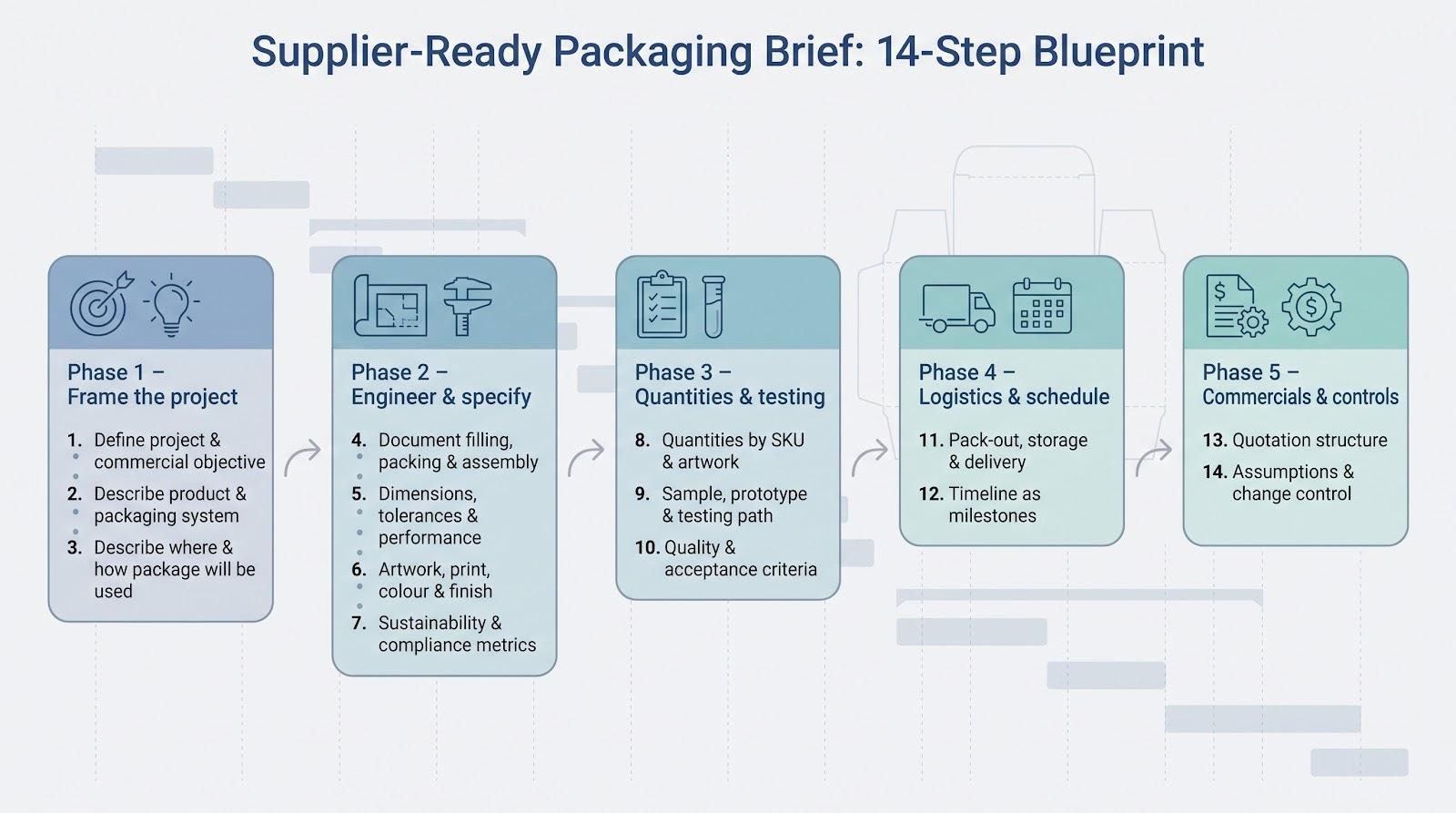
Start with why. Is this a new launch, a redesign, a cost-takeout, or a rescue mission after a line failure? That single line frames every technical choice that follows. State the business win (premium shelf presence, lighter carbon footprint, unit cost under $0.50) and the launch scope: initial quantity, reorder forecast, and sales channels. End by separating non-negotiables (recyclable board) from nice-to-haves (soft-touch varnish).
Give naked facts: finished length × width × height, filled and empty weight, fragility, leak risk. Then list every component (jar, cap, insert, outer carton, shipper, pallet pattern) and explain how they interact on the filling line, in the warehouse, and at unboxing. Engineers spot chain reactions only when they see the whole system.
Map the route: retail pallet, Amazon fulfillment line, bike courier, or freezer chain. Each leg adds shock, vibration, or temperature swings that drive material and test plans. Flag the afterlife too. Any unit that ships to the EU after August 12, 2026 must meet the Packaging and Packaging Waste Regulation requirements for substance restrictions (like PFAS and heavy metals) and declarations of conformity.
Specify fill temperature, line speed, torque settings, sensors, and labour reality. Note any planned line trial and the target date so sample quantities and technicians can be scheduled early.
Lock product dimensions, then package internal and external dimensions in one unit system (inches or millimetres; pick one). Add critical tolerances and performance targets such as surviving a 40 °C transit or a 1 m drop on all edges.
Confirm dieline ownership, artwork status, colour specs (CMYK, Pantone), print coverage, and desired finishes. Flag essentials versus options so value engineering can work.
Quote recycled-content targets (%), maximum package weight (g), mono-material goals, and accepted fibre certifications. List destination markets and who owns EPR registration in California or Oregon. Request chain-of-custody numbers and recycled-content declarations with the quote.
Break volumes into pilot, launch, expected reorder, and scale tiers for every SKU and artwork version. Ask for the production method tied to each tier and cap overruns (for example, ±10 percent with written approval).
Sequence: 3D render → white sample → printed prototype → tooling sample → production sample. Specify test standards (ISTA 3A, ASTM D4169) and list each sample or test as a separate line item.
Classify defects (critical, major, minor), set measurable targets (for example, ΔE ≤ 3, seal ≥ 25 N), and state the sampling plan (ANSI Z1.4, AQL 1.5). Name the golden sample and spell out the remedy: replace, rework, credit, or refund, with timing linked to launch.
Say whether cartons ship flat or pre-glued, list inner-pack counts, master counts, pallet spec, label rules, humidity precautions, racking constraints, delivery appointment rules, and lift-gate needs. Capture them now so freight and warehouse costs do not ambush you later.
Work backward from the in-hand date through freight, production, sample approvals, dieline freeze, artwork lock, RFQ issue, and exploratory brief sign-off. Assign an owner and a go/no-go gate to every milestone, then buffer for customs, colour proofs, and weather delays.
Force every bidder into the same template:
Unit price by SKU and quantity tier
One-time charges (tooling, engineering, samples)
Services (inspection, freight, duty, warehousing)
Commercial terms (currency, payment schedule, validity date, lead time)
Assumptions and exceptions
Require suppliers to list every assumption, every excluded item, and any “equivalent” material. Lock change control: no shift in plant, process, or substrate without written notice that details cost, schedule, and performance impact plus a revised quote.
A spreadsheet alone is not a decision. Run every bid through this six-step filter to see who is cheapest and safest for the launch.
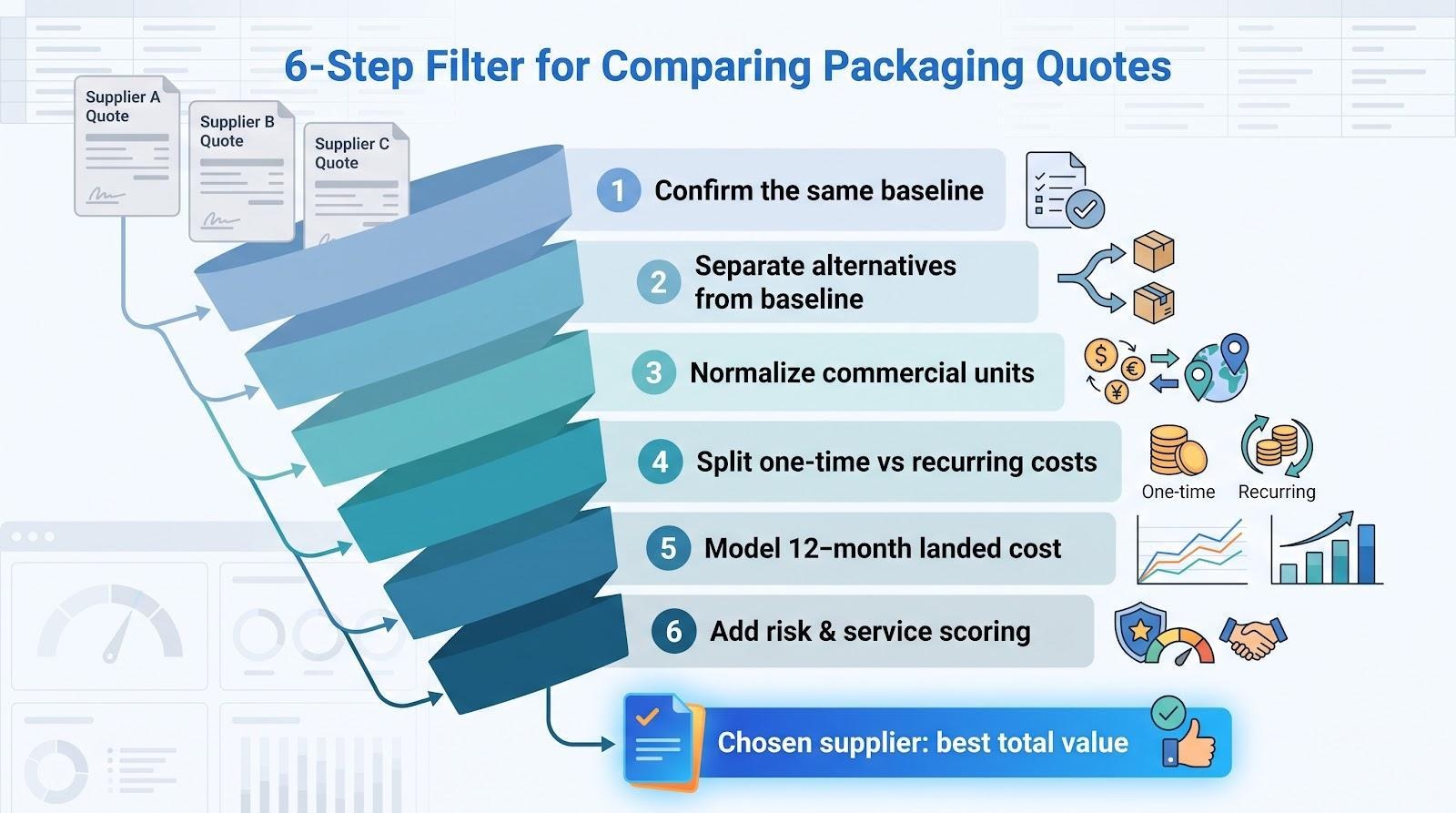
Police the fundamentals: same brief revision, dimensions, SKU split, material or performance spec, print, inserts, tests, delivery point, Incoterm, and lead-time trigger. If anything drifts, issue one clarification round to all bidders, then restart the clock.
Ask for two tables:
Compliant baseline. Meets the spec exactly.
Value-engineered alternatives. Any material swap, run-size tweak, or process change with cost, timing, and performance impact spelled out.
Pick one home base (currency, delivery point, sellable unit) and translate every bid. Use the same FX rate and date, then add freight, duty, and brokerage to the named place. Only then can you rank cost.
Put tooling, samples, and tests in a non-recurring bucket; unit production, freight, and warehousing in a recurring bucket. Amortize the first over a realistic annual volume, otherwise the wrong bidder wins.
Run three demand scenarios (conservative, expected, high growth). Feed in unit cost, amortized tooling, freight per pallet, duty, expected defects, and warehouse $/cu ft. Add the cost of money on 90 days of inventory; Federal Reserve data place the U.S. prime rate, a common benchmark for short-term borrowing, at 7.0 percent in September 2026.
Score each supplier on four pillars: technical fit, quality system, launch execution, and financial resilience. Weight those pillars to match project pain points, then overlay the qualitative score on total landed cost. The front-runner balances cash, schedule, and peace of mind.
Some warning lights flash neon; others hide in the footnotes. Catch them early and you’ll avoid a costly rescue mission later.
Instant quote, zero questions. A price that lands hours after your RFQ, without clarifications, usually means the factory guessed at the missing data.
Vague materials. Phrases like “premium board” or “eco film” carry no grade, weight, or composition, leaving you powerless when the pallet feels lighter than promised.
Incoterm without a named place. “FOB” alone is meaningless. Always pair the term with a city or port (for example, FOB Shanghai).
Unclear tooling ownership. If the quote says the vendor “retains” dies but never defines transfer rights, you could pay twice. Industry data show that replacing a complex cutting die can cost nearly or above $2,000 per SKU.
Lead time with no start trigger. “Four weeks” is useless unless it states from deposit, from artwork approval, or another clear event.
No change-notification clause. Plants can switch substrates or outsource overflow. Without written notice requirements, you’ll learn about the change when a retailer rejects the pallet.
Picture a U.S. skincare start-up launching three 30 mL serums—Glow, Calm, Boost. It needs:
A printed folding carton
A molded pulp insert to cradle the bottle
An e-commerce shipper that fits any single SKU
Launch demand: 9,000 units (3,000 per SKU). Year-one forecast: 36,000 more units. The same controlled RFQ goes to three suppliers. All prices are hypothetical 2026 USD.
Digital print on 18-pt SBS
MOQ 1,000 per artwork
Tooling: $0 (buyer supplies dieline)
Unit cost, DDP warehouse: $1.08
Lead time: 15 working days from artwork lock
Offset litho on 20-pt C1S
MOQ 10,000 per artwork
Tooling: $650 cutting die + $180 per plate (4-color)
Unit cost, EXW: $0.52
Freight + duty estimate: $0.23 per unit
Lead time: 28 production + 25 ocean + 5 drayage days
Offset litho on 18-pt SBS; in-house pulp insert
Engineering, dieline, ISTA 3A test, and inspection bundled
Tooling: $450 die included; no plate charge
Unit cost, DDP: $0.92
Lead time: 25 days from PO; samples in 10
| Supplier | Unit cost | One-time | Freight & duty | Landed total | Landed $/unit |
| A | $1.08 | $0 | $0 | $9,720 | $1.08 |
| B | $0.52 | $1,370 | $2,070 | $8,060 | $0.90 |
| C | $0.92 | $0 | $0 | $8,280 | $0.92 |
At first glance, Supplier B looks cheapest, but three hidden factors change the story.
MOQ overhang. Ordering 10,000 per artwork means buying 30,000 extra cartons, tying up $15,600 in inventory and storage.
Cash cycle. Ocean transit plus plate set-up locks capital 40 days earlier than Supplier A.
Risk buffer. Supplier C’s bundled ISTA test removes a $1,200 third-party fee and two weeks of coordination.
Amortizing tooling and inventory across the 45,000-unit year-one volume puts Supplier C ahead on true landed cost. Add labor saved by the pre-fitted insert and C wins by a five-figure margin, even without the lowest headline price.
Numbers only tell the truth after you normalize scope, MOQ, timeline, and service. The “cheapest” bid often drops to bronze once the fine print reaches the spreadsheet.
No one wants to copy and paste this entire playbook into a blank spreadsheet. We’ve packaged the heavy lifting into a downloadable bundle:
Brief worksheet. Fill in the gray cells, export to PDF, and send.
Controlled RFQ template. Locked columns for price, tooling, freight, and assumptions.
Responsibility matrix. Weight design, engineering, QC, and logistics for each supplier model.
Quote-comparison sheet. Auto-calculates landed cost across three demand scenarios.
Backward launch timeline. A Gantt chart that exposes approval bottlenecks early.
Sample & test checklist. Linked to common ISTA and ASTM procedures.
Supplier scorecard. Blends cost, quality, service, and risk on one page.
Assumptions log. Captures every “not included” line before contracts are signed.
Revision register. Keeps version control out of your inbox.
A disciplined brief turns a quoting free-for-all into a transparent contest based on the same facts, timelines, and risk boundaries. Use the steps and templates above to give suppliers the clarity they need, and you’ll gain the apples-to-apples comparison that protects your budget and your launch date.
 AI tools to find & convert leads.
  Send emails at scale