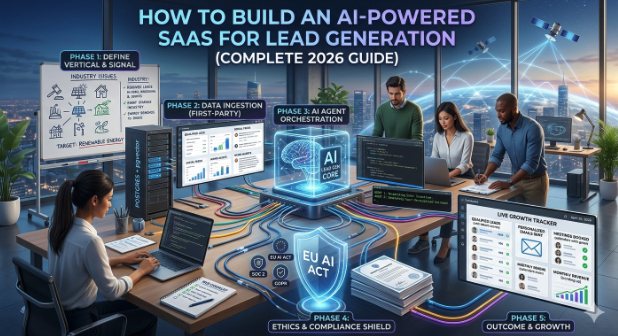
Every sales team has the same problem. Too many leads to chase, too little time to qualify them, and a CRM that slowly turns into a graveyard of cold contacts. The old way of lead generation buying lists, blasting emails, hoping someone bites is genuinely broken. What is working right now is AI.
AI-powered SaaS products built specifically for lead generation are changing how businesses find, score, and convert prospects. And the opportunity to build one has never been more realistic. Whether you are a startup founder, a product manager, or a business exploring SaaS platform development, this guide walks you through everything from the core idea to the features that matter in 2026.
Before writing a single line of code, it helps to understand what "AI-powered lead generation" really means in practice.
At its core, this type of SaaS product collects signals from multiple data sources, company websites, LinkedIn activity, job postings, intent data platforms, news mentions and uses machine learning models to identify which companies or people are most likely to buy. It then automates the outreach or hands off enriched, prioritised leads to a human sales rep.
This is very different from a basic contact database. A good AI lead generation tool does not just find names. It predicts readiness to buy, personalises messaging, and updates in real time.
This is the question every sales leader asks before signing a contract and it is the right one to ask.
The honest answer is that well-built AI lead generation software does not just speed things up. It fundamentally changes how a sales team spends its time.
Qualification happens automatically. Instead of a rep spending forty minutes researching a company only to discover it is the wrong size or wrong vertical, the AI surfaces that signal upfront. Reps work a pre-qualified shortlist, not a raw import.
Outreach gets personal at scale. AI can generate personalised email openers based on a prospect's recent news, hiring activity, or product launch without a rep writing each one manually. This lifts reply rates without burning headcount.
Lead scoring improves over time. Unlike a static scoring model built in a spreadsheet, machine learning-based scoring gets smarter as reps mark leads as won or lost. The system learns which signals actually predict conversion for that specific product and market.
Follow-up never slips. Automated sequences and smart reminders mean no lead goes cold by accident. Reps are prompted to follow up at the right moment, not two weeks too late.
According to a McKinsey analysis published in 2024, sales teams using AI tools for prospecting reported a 30–40% increase in qualified pipeline without increasing headcount. That is the efficiency argument in numbers.
For a SaaS AI Development Company building this kind of product, the goal is to make that efficiency visible and measurable from the moment a customer logs in.

The UK market has some specific nuances worth understanding before choosing or building a tool.
GDPR and UK GDPR compliance is non-negotiable. Any tool that processes personal data for B2B prospecting needs a lawful basis for doing so. Most legitimate tools rely on "legitimate interests," but the documentation and opt-out mechanisms need to be airtight. This is one area where many US-first tools fall short when deployed in UK contexts.
Industry concentration matters. UK B2B markets are often more consolidated than US ones. A tool designed for the US market may have database coverage of a million SMEs in Texas but only a thin layer of UK company data. Before committing to any platform, test the actual coverage of the industries and regions you are targeting.
Look for UK data sources. The best tools for the UK market pull from Companies House, UK-specific job boards like Reed and Totaljobs, and UK press and PR feeds, not just LinkedIn and Crunchbase.
Integration with UK-used CRMs. HubSpot and Salesforce dominate, but a meaningful portion of UK SMBs use Pipedrive or even Zoho. Check that the tool integrates cleanly with what your team already uses.
Pricing models translate poorly. US-dollar pricing with no local support or contract flexibility is a friction point for UK buyers. If you are building a product specifically for the UK market, local pricing, payment in GBP, and UK-based customer support are genuine differentiators.
For companies working with a SaaS development agency to build something purpose-built for UK lead generation, these requirements should be designed in from day one not retrofitted after launch.
If you are building from scratch, feature prioritisation is everything. Here is what actually matters in 2026, based on what the market is buying.
Intelligent data enrichment. The platform needs to pull from multiple data sources and reconcile them automatically. A company profile should include firmographic data, technographic data (what tools they use), recent hiring signals, funding rounds, and news mentions unified in a single view.
Predictive lead scoring. This is the engine. A machine learning model trained on historical conversion data assigns each prospect a score. The model needs to be explainable. Reps should be able to see why a lead scored highly, not just that it did.
Natural language prospect search. In 2026, typing "find me Series B SaaS companies in Manchester that recently hired a VP of Sales" into a search bar and getting back a clean list is table stakes. Build this in from the start.
Automated outreach sequencing. Email, LinkedIn connection request, follow-up the tool should manage the timing and personalisation of each step. AI-generated openers based on prospect signals lift engagement meaningfully.
CRM sync that actually works. Bi-directional, real-time sync with Salesforce, HubSpot, and at minimum one mid-market CRM. Broken integrations are the top reason customers churn from lead generation tools.
Intent data integration. Third-party intent signals which companies are actively researching your category right now to dramatically improve the quality of outbound. Bombora and G2 Buyer Intent are the standard sources; building an integration with one of them should be on the roadmap.
Compliance tooling built in. Opt-out tracking, data source transparency, and automated data refresh schedules are not optional features. For UK and EU markets especially, these need to be visible in the product.
Reporting that connects to revenue. Activity metrics are vanity. The reporting layer needs to show pipeline generated, deals influenced, and revenue attributed not just emails sent.
Most founders overbuild their first version. The honest truth is that a lead generation SaaS that does one thing brilliantly — say, identifying companies with high purchase intent in a specific vertical and delivering enriched profiles to a CRM is more fundable and more sellable than a bloated platform that does fifteen things poorly.
Start with the scoring model. This is your core IP. Everything else is a wrapper around it. Work with your SaaS AI Development services provider to train an initial model on public data, then design the product to capture proprietary feedback signals (won/lost, meeting booked, replied) that make the model better over time.
AI MVP development services can accelerate the initial build significantly, particularly for the machine learning components. Getting to a working prototype with real scoring logic in eight to twelve weeks is realistic with the right team. Getting there in six months with the wrong one is also realistic, unfortunately.
Engage expert saas software developers who understand both the technical complexity of AI integration and the UX demands of sales tools. This is a narrow combination of skills, and the wrong team will burn months on architecture that ships nothing.
Build the UI for the sales rep, not the admin. The primary user of your product is someone with fifteen browser tabs open and a quota to hit. The interface needs to get out of the way and surface the three things they need to do next.
Consider custom MVP software development rather than trying to white-label an existing tool. The market is crowded with generic solutions. A product that is genuinely purpose-built for a specific niche — legal services, property tech, manufacturing will win that vertical even against well-funded competitors.
Pick one integration to do perfectly. Salesforce or HubSpot. Not both. Not six. One. The integration needs to be fast, reliable, and handled in the background without the user ever thinking about it.
Week 1–4: Discovery, data architecture, and model selection.
Week 5–10: Core scoring engine, basic UI, and first CRM integration.
Week 11–16: Beta with five to ten design partners who will give you honest feedback.
Month 5–6: Soft launch, pricing validation, and first paying customers.
Month 7–12: Iterate based on churn signals, expand integrations, begin SEO and content investment.
This is not a slow timeline. It is a realistic one. Companies that try to compress it usually ship something that does not work well enough to retain customers.
The lead generation software market is enormous and still growing. But buyers in 2026 are more sophisticated than they were two years ago. They have already tried tools that overpromised and underdelivered. Winning in this market requires a product that is genuinely better-faster to onboard, more accurate in its scoring, cleaner in its data, and more honest about what it can and cannot do.
If you are exploring mvp software development services to bring an AI lead generation product to market, the most important decision you will make is who you build it with. Find software development companies that have shipped AI products before, understands the sales workflow deeply, and is honest with you about scope and timelines.
The market opportunity is real. Build the product that earns it.
 AI tools to find & convert leads.
  Send emails at scale