
Mailtrap vs Amazon SES vs Postmark: Best SMTP Provider for Transactional Emails in 2026
Transactional email is the part of your stack that users only notice when it breaks. Three of the most recommended SMTP providers in 2026 are Mailtrap, Amazon SES, and Postmark. We compared all three on deliverability, developer experience, pricing, and compliance so you can pick the one that fits your actual stack, not just a feature checklist.
Mailtrap vs Amazon SES vs Postmark: Quick Comparison
| Mailtrap | Amazon SES | Postmark | |
| Best for | High deliverability for developers and product teams | Cost efficiency on AWS | Inbox delivery speed |
| Stream separation | Native | Manual | Native |
| Free tier | 4,000 emails/mo | 3,000 emails/mo (EC2, first 12 months) | Trial credits only |
| Starting paid plan | $15/mo for 10K emails | $0.10 per 1,000 emails | $15/mo for 10K emails |
| Dedicated IP | Included | $24.95/mo add-on | $50/mo add-on |
| G2 rating | 4.8/5 | 4.3/5 | 4.6/5 |
Choose Mailtrap when you need high deliverability with native stream separation, automated DKIM rotation, and full analytics included, without assembling infrastructure yourself.
Choose Amazon SES when your stack already lives on AWS, per-email cost is the binding constraint, and your team has the DevOps capacity to build suppression lists and bounce handling on Lambda and SNS
Choose Postmark when inbox delivery speed is non-negotiable (magic links, 2FA codes, time-sensitive alerts) and you can absorb higher per-send costs at volume
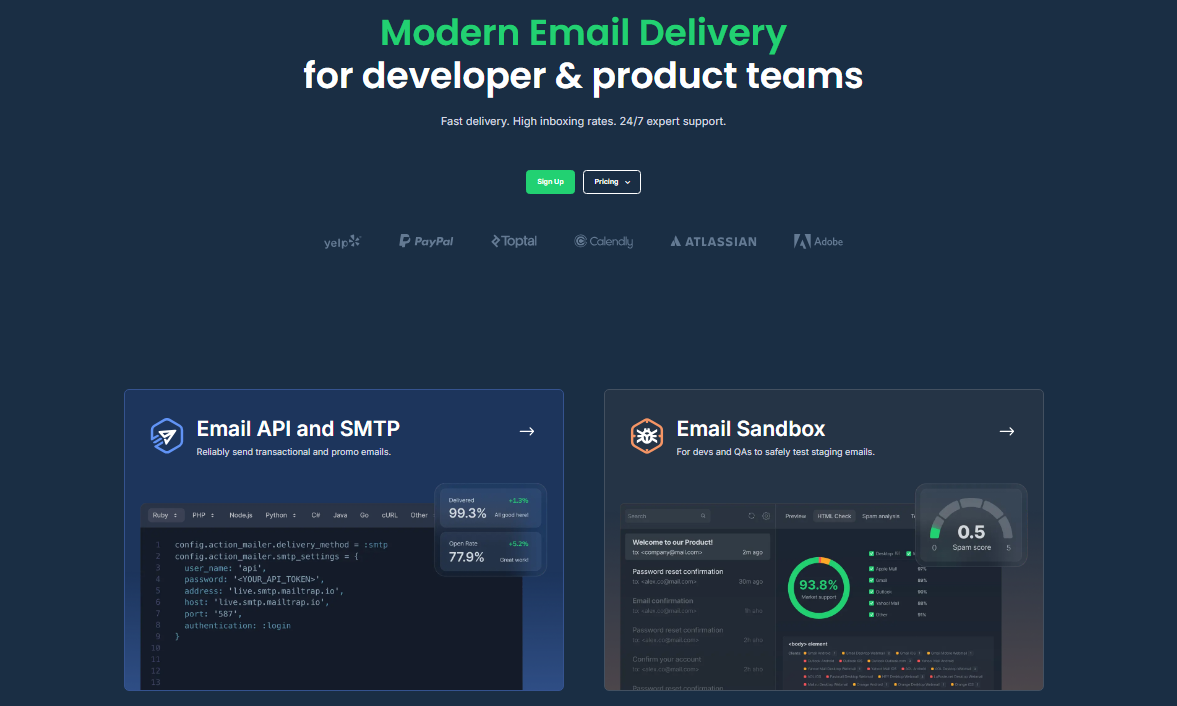
Mailtrap is an email delivery platform built for developers and product teams that need their emails to land in the inbox. It separates transactional and bulk traffic into isolated sending streams by default, which is what sets it apart from providers that leave stream isolation as your problem.
SPF, DKIM, and DMARC are configured automatically once you add the DNS records. DKIM keys rotate every month without any input from your side. That matters since most developers set up DKIM once and move on, and stale keys are a common reason inbox placement degrades weeks after a working setup. Dedicated IPs on the Business plan come with automatic warmup, so there's no hand-scheduling the 2-to-4-week ramp.
Setup runs about 5 minutes from account creation to first send. Mailtrap covers Node.js, Ruby, PHP, Python, .NET, Elixir, and Java with official SDKs, plus 25+ framework snippets for Laravel, Symfony, Django, Rails, and Next.js. An MCP server lets AI coding tools like Claude Code and Cursor call Mailtrap directly as an email action with no wrapper code.
Drill-down reports break out delivery, opens, clicks, bounces, and spam complaints by mailbox provider, domain, and stream. Email logs are retained for 30 days. Webhooks fire on all delivery events with 40 retries over five minutes. The platform runs on a 99% uptime SLA and holds ISO 27001, SOC 2 Type II, and GDPR certifications.
Pricing: Free tier covers 4,000 emails/month. Paid plans start at $15/mo for 10K emails, $85/mo for 100K emails (includes dedicated IP), and $750/mo for 1.5M emails at Enterprise.
Where it falls short: Email only, no SMS or push notifications. 24/7 live support is gated to Business plan and above.


Amazon SES functions as raw infrastructure, providing a scalable SMTP solution for AWS-native engineering teams where per-email cost is the primary driver. Bounce suppression, analytics, templating, and native webhooks are all pieces you assemble yourself using Lambda, SNS, SQS, and CloudWatch. For teams already running on AWS with in-house DevOps capacity, that's the strongest choice.
SPF, Easy DKIM, and DMARC are supported but configured manually. Delivery, bounce, and complaint events fire as SNS notifications. Reputation metrics come through the Virtual Deliverability Manager, a paid add-on. Stream separation works through IP pools you configure yourself.
AWS SDK coverage spans JavaScript, Python (boto3), Java, Go, Ruby, PHP, .NET, Rust, C++, and Kotlin. SMTP works with any standard mail library. Native hooks into Lambda, S3, SNS, and EventBridge are SES's clearest practical advantage for teams whose stack already lives on AWS. The compliance footprint (SOC 2, ISO 27001, FedRAMP, HIPAA-eligible) can also be a strong argument at enterprise procurement.
Pricing: $0.10 per 1,000 emails, no monthly minimum. Free tier covers 3,000 emails/month from EC2 instances for the first 12 months. Dedicated IPs are $24.95/mo. Attachments and data transfer are billed at $0.12/GB. The Virtual Deliverability Manager is a separate paid add-on.
Where it falls short: No native bounce suppression, native webhooks or included analytics.
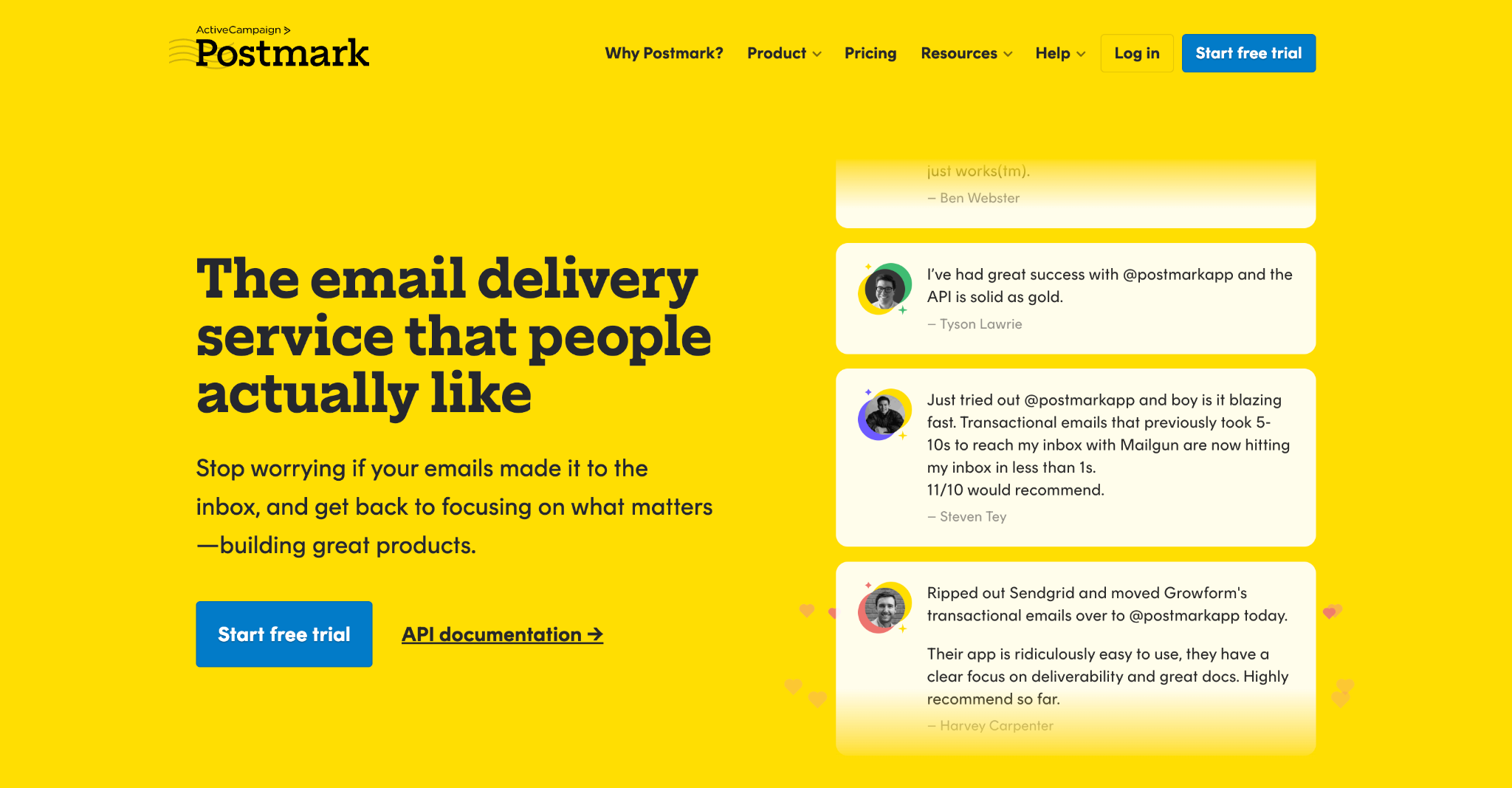
Postmark has one focus: get transactional mail to the inbox fast, keep the shared pool clean, and don't make the developer manage reputation isolation. If your product depends on magic-link auth or time-sensitive 2FA codes, that focus is exactly what you need.
Before any account goes live, Postmark runs a manual review. It adds a business day before you can send, but it also keeps shared IP pool neighbors clean, which is part of why placement rates hold up.
Message Streams isolate transactional, broadcast, and inbound traffic at the infrastructure level, not through IP pool configuration. Each send carries a stream ID and Postmark routes it accordingly. Streams are first-class API objects, not a workaround layered on top of shared infrastructure. SPF, DKIM, and DMARC are configured during account setup. Every bounce is automatically processed, categorized, and suppressed with no manual hygiene work required.
Official libraries cover Node.js, PHP, Python, Ruby, .NET, Java, and Go. Activity logs are retained for 45 days, longer than both Mailtrap and Amazon SES on standard plans. Webhooks cover delivery, bounce, open, click, and spam complaint events. Postmark is SOC 2 Type II certified.
Pricing: $15/mo for 10K emails, $60.50/mo for 50K, $138/mo for 125K. Dedicated IP adds $50/mo and is only available to accounts sending 300K or more emails per month.
Where it falls short: Cost climbs steeply past six figures. Dedicated IPs are locked behind 300K monthly sends. No permanent free tier.
Mailtrap and Postmark both separate transactional and bulk streams at the infrastructure level by default. A marketing send that triggers spam complaints doesn't touch the IP handling your password resets. SES leaves that separation to you through manual IP pool configuration.
DKIM rotation in Mailtrap happens automatically every month. Postmark and SES both require you to handle key rotation yourself. It's an easy step to skip, and it's a quiet source of deliverability problems when keys age out.
On the analytics side, Mailtrap includes drill-down reporting on all paid plans and Postmark includes analytics with 45-day log retention at every tier. SES gives you basic CloudWatch metrics; anything useful beyond that costs extra through the Virtual Deliverability Manager.
At low to mid volumes, SES is technically cheapest. But only if your team has the bandwidth to assemble the infrastructure around it. Teams that don't often find the real cost lands much closer to Mailtrap or Postmark than the per-email rate suggests.
| Volume | Mailtrap | Amazon SES | Postmark |
| 10,000 emails/mo | $15 | ~$1 | $15 |
| 100,000 emails/mo | $85 (incl. dedicated IP) | ~$10 + add-ons | ~$110 |
| 1,500,000 emails/mo | $750 | ~$100 + add-ons | $850 |
At low to mid volumes, SES is technically cheapest. But only if your team has the bandwidth to assemble the infrastructure around it. Teams that don't often find the real cost lands much closer to Mailtrap or Postmark than the per-email rate suggests.
For most development teams comparing SMTP providers for transactional emails, the decision comes down to one question: how much infrastructure are you willing to build?
Mailtrap is the strongest all-around pick for developers and product teams that need high deliverability without building surrounding infrastructure from scratch. Native stream separation, automatic DKIM rotation, and included analytics mean very little ongoing maintenance once you're set up.
Amazon SES is the right call for AWS-native teams with the DevOps capacity to handle bounce handling and delivery analytics on Lambda and SNS. The per-email cost is genuinely hard to beat, as long as you account for the engineering time honestly.
Postmark earns its higher price when delivery speed is the single priority. The infrastructure is solid, and the 45-day log retention is the best of the three. The steep cost curve past six figures is the main reason teams look elsewhere.
Whichever provider you choose, configure SPF, DKIM, and DMARC before your first production send. Sender reputation takes time to build and very little time to damage. A stale DNS record can suppress inbox placement with nothing in the logs to explain why.
Per email, yes. At $0.10 per 1,000 emails, SES undercuts the flat monthly pricing of both. The real comparison depends on whether you count the engineering cost of building bounce suppression, suppression lists, and analytics pipelines on top of SES. Teams that need those pieces (and most production apps do) often find the effective cost closer to the alternatives than the email rate suggests.
The technical work (domain reverification, DNS record updates, credential swaps, and test sends) typically takes one to three days. Moving to a new dedicated IP adds two to four weeks for warmup. Running old and new providers in parallel during that window keeps production traffic stable while the new IP builds its sender reputation.
 AI tools to find & convert leads.
  Send emails at scale