Card volume keeps climbing every year, and so does the pressure on the infrastructure behind it. According to Visa's official fiscal fourth-quarter and full-year 2025 earnings release, the network processed 257.5 billion transactions in fiscal 2025 – a 10% increase over the prior year, with cross-border volume growing even faster. Every one of those transactions has to pass through a routing decision – and that decision quietly determines whether a sale goes through or gets declined for no good reason.
That's where the comparison of static vs dynamic payment routing stops being a technical detail and starts affecting revenue directly.
Routing is the process that decides which acquirer or processor handles a given transaction. It sounds minor until a business notices its approval rate swings by ten or twenty points between markets, using the same provider and the same product.
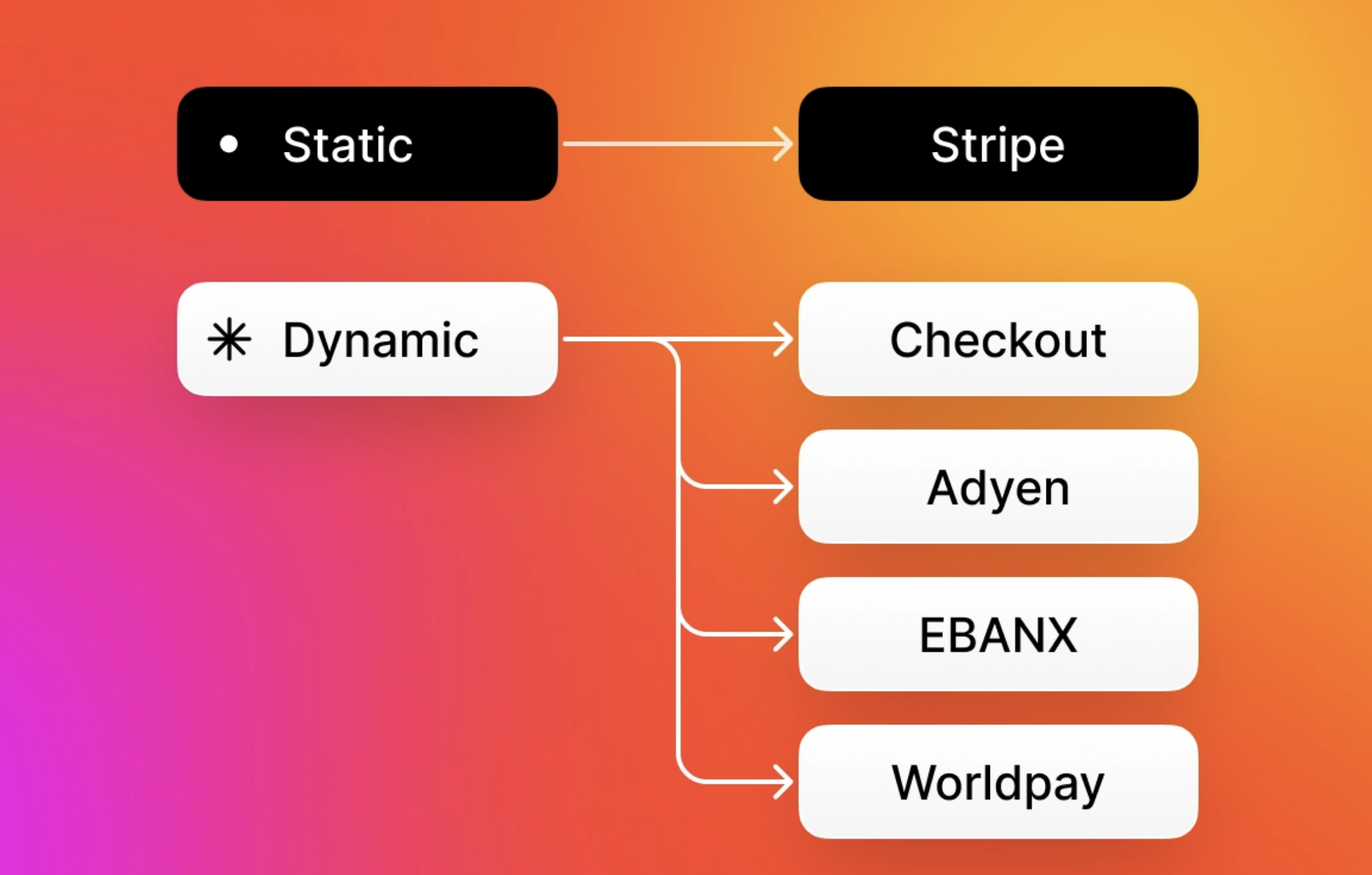
Static routing sends every transaction down one fixed path, set once and rarely touched afterward. A typical setup might route all Visa cards to one acquirer and all Mastercard cards to another, with no adjustment for card issuer, country, or real-time performance.
This approach is easy to configure and cheap to maintain. It also has a ceiling: performance is locked to whatever that single acquirer can deliver, regardless of whether it's the best fit for a specific transaction.
Dynamic payment routing makes a fresh decision for each transaction, in real time, based on live data rather than a fixed rule. The system typically evaluates:
Card type and issuing bank
Transaction amount and currency
Customer geography
Recent approval history by acquirer and corridor
The result is a routing choice tailored to that specific payment, made in milliseconds and invisible to the customer at checkout. Pro tip: dynamic engines get more accurate the more transaction history they have – a new market usually needs a few months of data before dynamic routing payments outperform a static setup.
The two approaches diverge across several practical dimensions, not just in how they're configured.
| Dimension | Static Routing | Dynamic Payment Routing |
| Decision timing | Set once, applied indefinitely | Made per transaction, in real time |
| Decline recovery | Limited – often no automatic retry | Automatic failover to another acquirer |
| Cost awareness | Fixed rate regardless of corridor | Selects lower-cost acquirer when possible |
| Adaptability | Manual reconfiguration required | Adjusts automatically as performance shifts |
| Best fit | Single market, low-to-moderate volume | Multi-market, subscription, high volume |
A few of these differences deserve a closer look, since they explain most of the performance gap businesses report after switching.
A decline under static routing is usually a dead end. The transaction fails, gets flagged for a manual retry, or is simply lost – there's no built-in logic connecting the reason for the decline to what happens next.
Dynamic routing changes that behavior directly. It reads the decline code and, for general or ambiguous declines, cascades the payment to a different acquirer immediately, recovering transactions that a static path would have written off.


Neither method is universally "better" – the right fit depends on scale, geography, and how much transaction history already exists.
Static routing remains a reasonable choice for a business operating in a single market with one acquirer and a predictable transaction mix. There's little geographic variance to manage, so the added complexity of dynamic payment routing wouldn't pay for itself yet.
It's also a sensible starting point in a brand-new market, simply because dynamic systems need historical data to calibrate their decisions.
Dynamic payment routing earns its cost as cross-border volume keeps outpacing domestic growth. Mastercard's own third-quarter 2025 earnings release reported cross-border volume growth of 15% on a local-currency basis, with switched transactions up 10% year over year – meaningfully faster than the growth of domestic volume in the same filing.
That gap matters for routing strategy. As a larger share of transactions crosses borders, more of them get evaluated by issuers that don't recognize the acquirer handling the payment, which drags approval rates down. A business processing a growing share of cross-border or subscription payments benefits from a system that routes each transaction to the acquirer most likely to be recognized as legitimate – something a fixed path simply isn't built to do.
Most mature payment stacks don't pick one method exclusively. They run static rules where performance is already predictable and dynamic logic everywhere conditions still shift.
In practice, this usually means:
Locking in negotiated, fixed rates with a local acquirer in a well-established priority market
Letting dynamic routing handle newer markets, seasonal spikes, or subscription renewals
Reviewing acquirer performance on a regular cadence rather than assuming a setup made a year ago still holds
This combination tends to outperform either extreme, since it applies certainty where it's earned and flexibility where it's still needed.
A short checklist tends to clarify the decision faster than a lengthy debate:
How many markets and acquirers are currently in use, and how much does approval performance vary between them?
Does the business depend on subscription renewals, where card issues accumulate over time?
Is there enough transaction history per market to let a dynamic system make informed decisions?
Businesses answering "one," "no," and "not yet" to those questions can reasonably stay on static routing a while longer. Businesses answering "several," "yes," and "plenty" are usually the ones where dynamic payment routing pays for itself within a single reporting cycle.
Is dynamic payment routing more expensive than static routing?
Not necessarily – dynamic routing often reduces overall processing costs by selecting the lowest-cost acquirer available for a given transaction. The setup and integration can require more engineering work upfront, but the ongoing cost per transaction is frequently lower, not higher, once the system is calibrated.
Can a business switch from static to dynamic routing without downtime?
Yes, this is typically done gradually rather than as a single cutover. Most providers allow a phased rollout, routing a small percentage of traffic dynamically first, then increasing that share as performance data confirms the switch is working as expected.
Does dynamic routing work for small businesses, or only large ones?
It works best once there's enough transaction volume and history to give the system something to learn from. A small business processing modest volume in one market usually sees limited benefit and may be better served by static routing until it expands.
How does dynamic routing affect compliance with authentication rules like SCA?
Dynamic routing paired with risk-based logic can apply authentication selectively, based on the actual risk profile of a transaction rather than a blanket rule. Low-risk transactions from familiar geographies can skip unnecessary friction, while higher-risk ones still trigger stronger authentication – keeping the setup compliant without slowing down every checkout.
What's the biggest risk of staying on static routing too long?
The main risk is a growing, invisible gap between approval rates across markets or card types that nobody notices until revenue is already being lost. Since static routing doesn't adapt on its own, performance issues tend to accumulate quietly rather than trigger an obvious alert.
 AI tools to find & convert leads.
  Send emails at scale