SE Visible by SE Ranking is the best generative engine optimization tool in 2026 for agencies reporting AI visibility to clients monthly, since any readout number opens to the stored response and the pages it cited. Other picks by fit: Peec AI for agencies reporting a few client markets, Profound for enterprise clients with strict security reviews, Semrush AI Visibility Toolkit for accounts whose SEO lives in Semrush, AthenaHQ for clients who want site actions shipped, and Writesonic for retainers that bundle content fixes. The table and cards below compare all eight, starting with SE Visible.
Fractl's data, reported by Digiday, shows marketers now route about 24% of search or content budgets to AI visibility. When a client funds a line that size, the monthly readout has to defend it. A score that can't open into evidence, a cause, and a plan loses the room. So I ordered these generative engine optimization (GEO) tools by the client questions each helps answer.
An agency needs four things from GEO software: the stored answer behind every number, the sources and competitors behind a change, a clear next action for each finding, and client-facing access, connectors, and exports.
I read each vendor's live pricing and product pages, then scored every tool against the three questions clients ask in a readout. No placement is sponsored.
The table lists the eight tools in card order, with entry-plan engines, the client question each answers best, client output, and published entry price.
| Tool | Entry-plan engines | Question | Client output | Entry price |
| SE Visible | ChatGPT, Gemini, AI Mode, AI Overviews | Show me the answer | Client access, Looker Studio, API | Free trial |
| Peec AI | 3 chosen models | Why did this move | Unlimited users | $95/mo |
| Otterly.AI | 3 of 7 | Show me the answer | Branded Looker Studio (partners) | $29/mo |
| Profound | ChatGPT, Gemini, AI Overviews (trial) | Why did this move | Unlimited seats, Enterprise SSO | Free trial; custom |
| Semrush AI Visibility Toolkit | ChatGPT, Google AI, Gemini, Perplexity | Why did this move | Inside Semrush | $99/mo/domain, annual |
| AthenaHQ | ChatGPT, Perplexity, AI Overviews, Gemini, Copilot | What are you doing about it | GA4, Search Console, CSV | Free; $295/mo |
| Writesonic | ChatGPT, Gemini, AI Overviews | What are you doing about it | Action Center trial (Growth) | $79/mo, annual |
| AirOps | ChatGPT (Solo), 10+ (Pro) | What are you doing about it | Content workflows | Not published |
In a client's AI visibility readout, the first follow-up is usually a request to see the actual answer. A score with no stored response behind it stalls the meeting. The readout needs repeated checks and the stored answer for each.
What the client asked: "Does ChatGPT say that every time?" Often it doesn't. In SE Visible's ChatGPT study, only 44% of prompts received the exact same sentiment classification across all five runs. One check is an anecdote.
When AI visibility shifts between readouts, the client wants the cause. A credible answer names which cited pages changed, which competitor took the slot, and in which engine and market it happened. GEO tools split here on whether they keep cited URLs and competitor names for every stored answer.
Some GEO tools add search data on those sources, such as page traffic and backlinks. That shows how much weight a new cited page carries before anyone asks.
The last question in a readout is the one that decides the renewal. A finding with no planned response reads as a status report, and clients don't renew status reports. Each gap needs an action with an owner: new content, a page fix, or a publication to pitch for a mention.
Answer engine optimization tools divide on this. Some turn a gap into a task or a content workflow the team can assign. Others stop at the report.
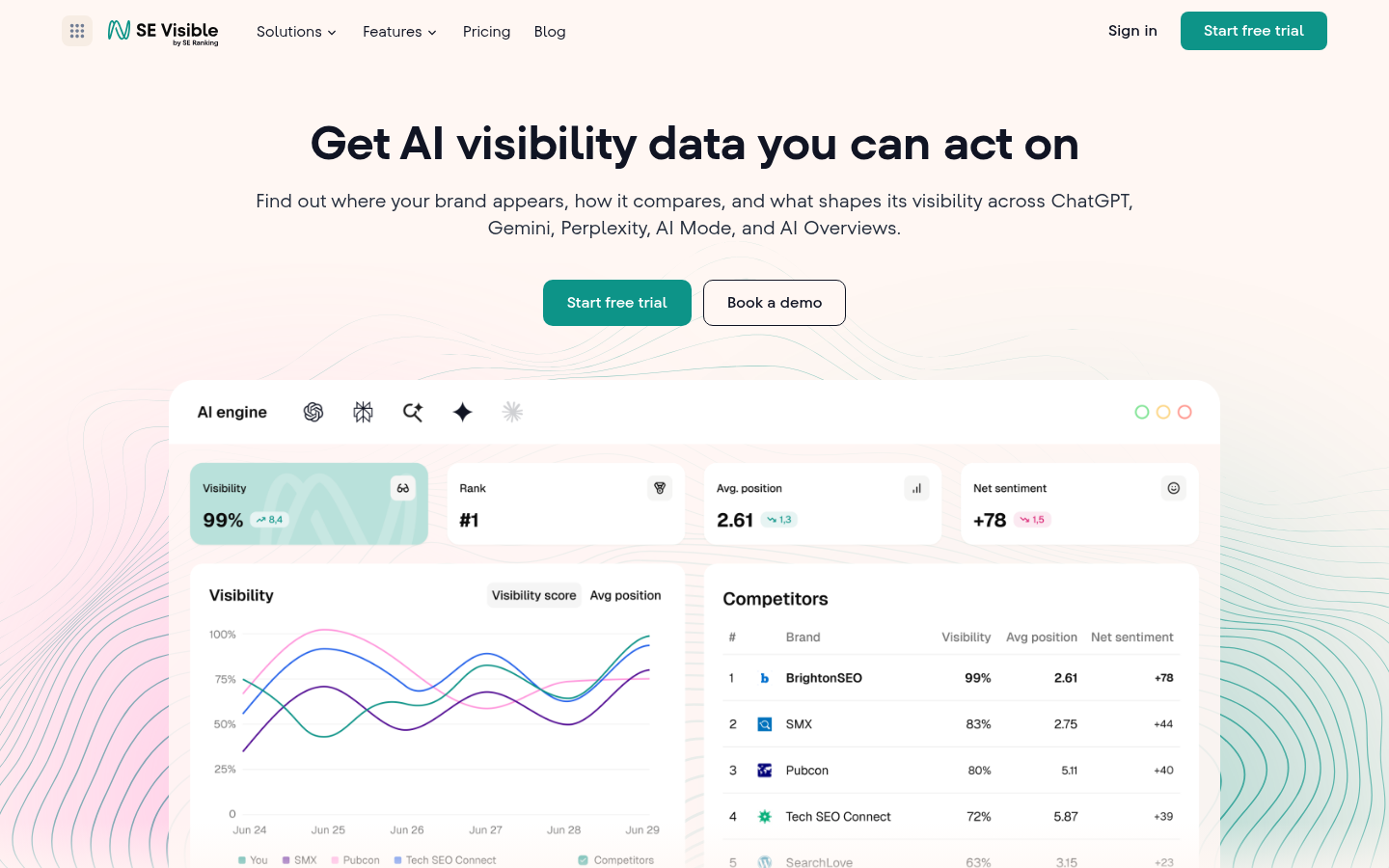
Ten minutes before a quarterly review, the account lead filters for the prompts where a rival overtook the client and reads the stored answers. SE Visible by SE Ranking is the AI visibility platform behind that prep, covering ChatGPT, Gemini, Google AI Mode, and Google AI Overviews with daily tracking by default.
Visibility score, share of voice, average position, and net sentiment each open into the response that produced them, unedited and tagged with engine, market, and date. Citations reports list the domains and URLs that answer leaned on, with domain traffic, DT, and backlinks, plus page traffic and whether the page links to the client.
Best for: agency account teams presenting AI visibility to mid-market and enterprise clients monthly.
Standout feature: The stored answer behind each number, paired with competitor benchmarking topic by topic. A drop reads as a named rival gaining ground, with the response that shows it.
Pros:
Cons:
Pricing: Plans are published on visible.seranking.com; API access is included on every plan, and a free trial is available.
At renewal: When the client asks to see the answer, the response, its sources, and the rival that replaced them are already on screen. Behind it sits a team with over a decade in search.
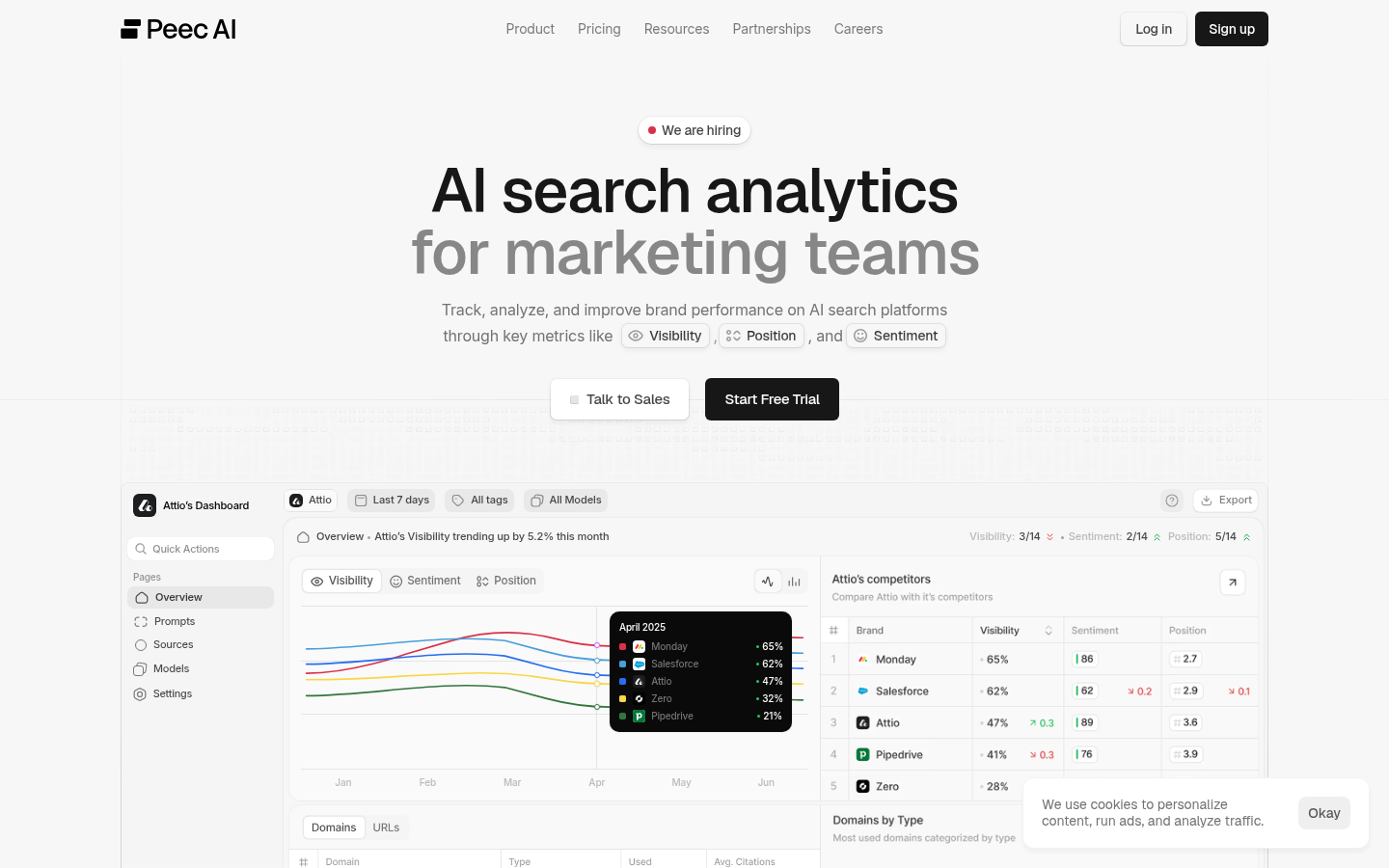
Peec AI suits clients reporting up to three markets, where prompt volume sets the plan.
Best for: agencies reporting a few client markets.
Standout feature: Pro and Advanced both cover three countries, so the jump from $245 to $495 a month buys prompt depth: 150 prompts become 350. Self-serve plans run three models; Enterprise opens unlimited prompts and countries, with up to 26 models.
Pros:
Cons:
Pricing: Starter $95/mo (50 prompts, 1 country), Pro $245/mo (150 prompts, 3 countries), Advanced $495/mo (350 prompts, 3 countries), Enterprise custom.
At renewal: "Why did this move" gets a market-by-market answer, up to three countries on self-serve. A fourth market or an extra model changes the bill.
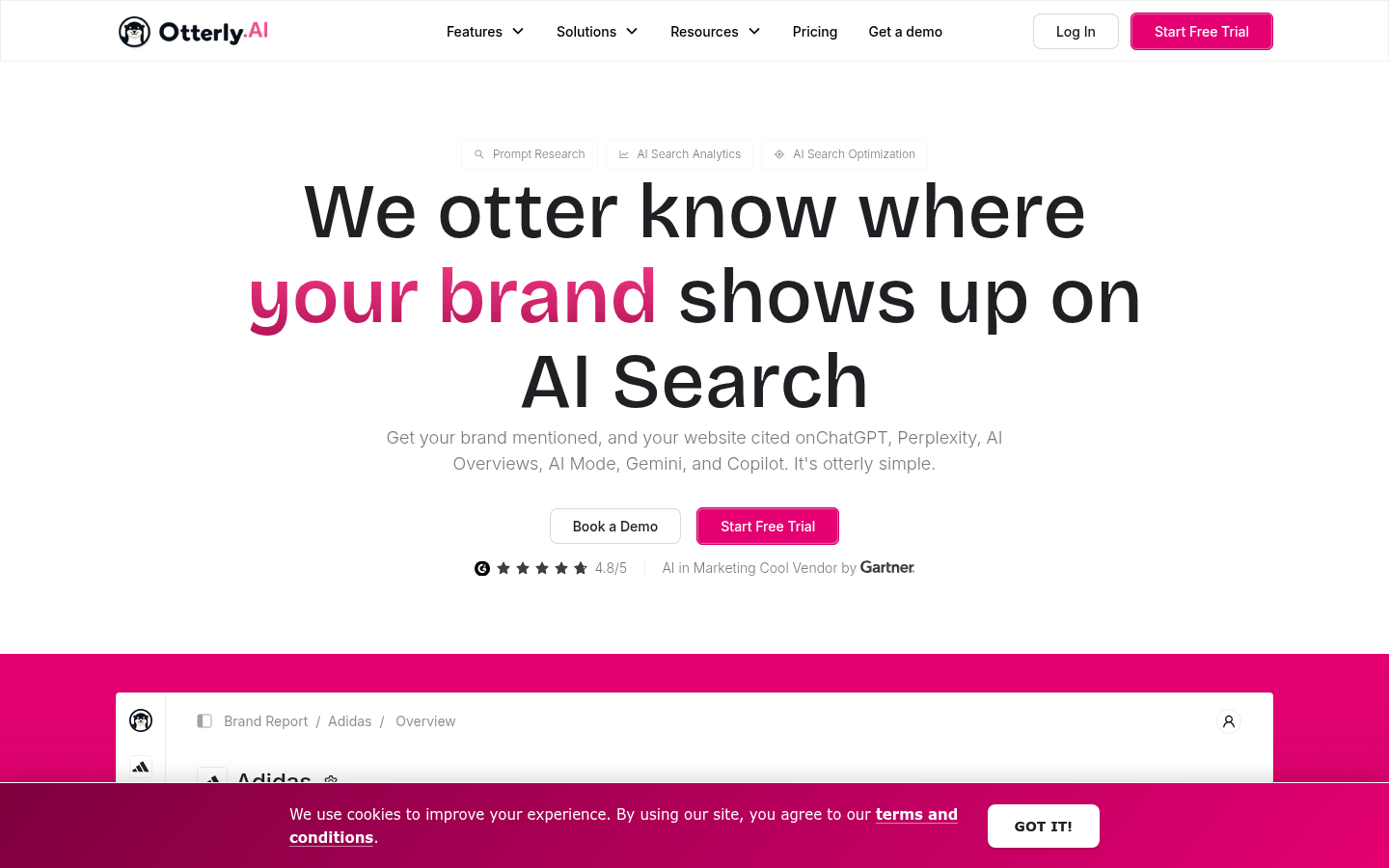
Otterly.AI covers a client's core prompts from a 20-prompt entry tier, with branded reporting for its agency partners.
Best for: agencies that want branded client reports on a smaller prompt set.
Standout feature: Agency Partners get custom branded Looker Studio reports, so the readout's AI pages arrive in the agency's design. Seats are unlimited.
Pros:
Cons:
Pricing: Lite $29/mo (20 prompts), Standard $189/mo (160), Premium $489/mo (535); Enterprise from 1,000 prompts.
At renewal: "Show me" lands on a report that already looks like the agency's own work. Its limit: the audit flags pages, but answering "what are you doing about it" stays the team's job.
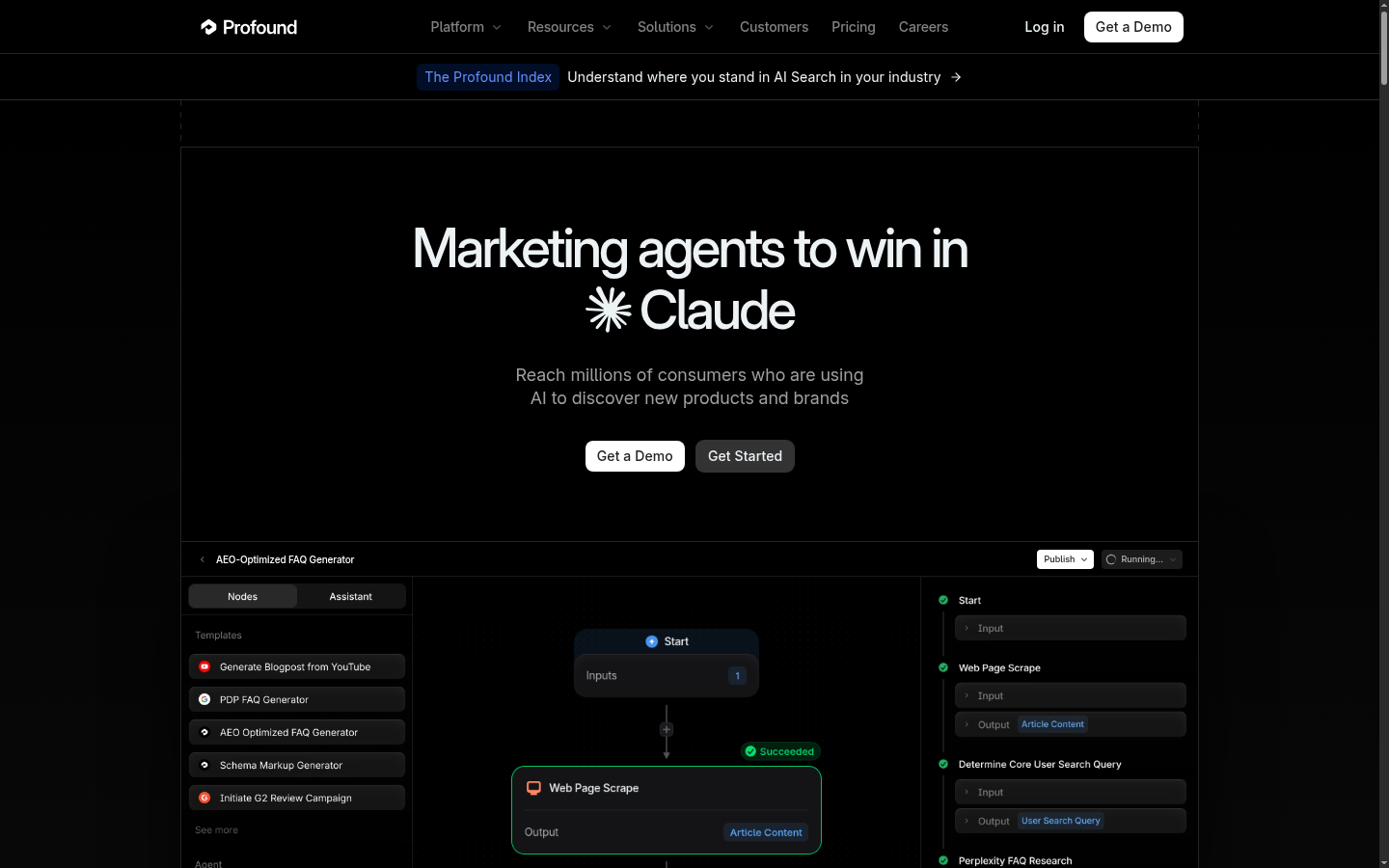
Profound lets an account team run a client's prompt set for a week before the enterprise contract reaches procurement.
Best for: enterprise clients with strict security reviews.
Standout feature: The free trial runs 50 prompts a day for 7 days on ChatGPT, Gemini, and Google AI Overviews, with Agents, Context Manager, and Profound Sheets switched on. Enterprise tracks up to 10 answer engines.
Pros:
Cons:
Pricing: Free 7-day trial at 50 prompts a day; Enterprise priced on request.
At renewal: Security-first clients get a "why did this move" answer. Finance, though, gets no full published price to plan next year against.
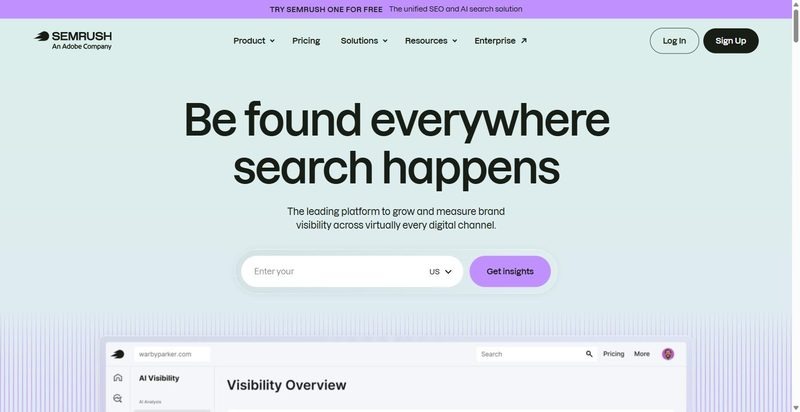
The Semrush AI Visibility Toolkit adds AI mentions to client accounts whose SEO reporting already runs through Semrush.
Best for: accounts whose SEO already lives in Semrush.
Standout feature: The plan reports brand mentions from ChatGPT, Google AI, Gemini, and Perplexity, with Competitor Research and Brand Performance in the same login. When a client asks who took the slot, the team compares both brands without leaving Semrush.
Pros:
Cons:
Pricing: $99/mo per domain, billed annually; 25 tracked prompts.
At renewal: Clients who already read their SEO numbers in Semrush get "why did this move" answered right there. The catch: 12 client domains mean 12 plans.
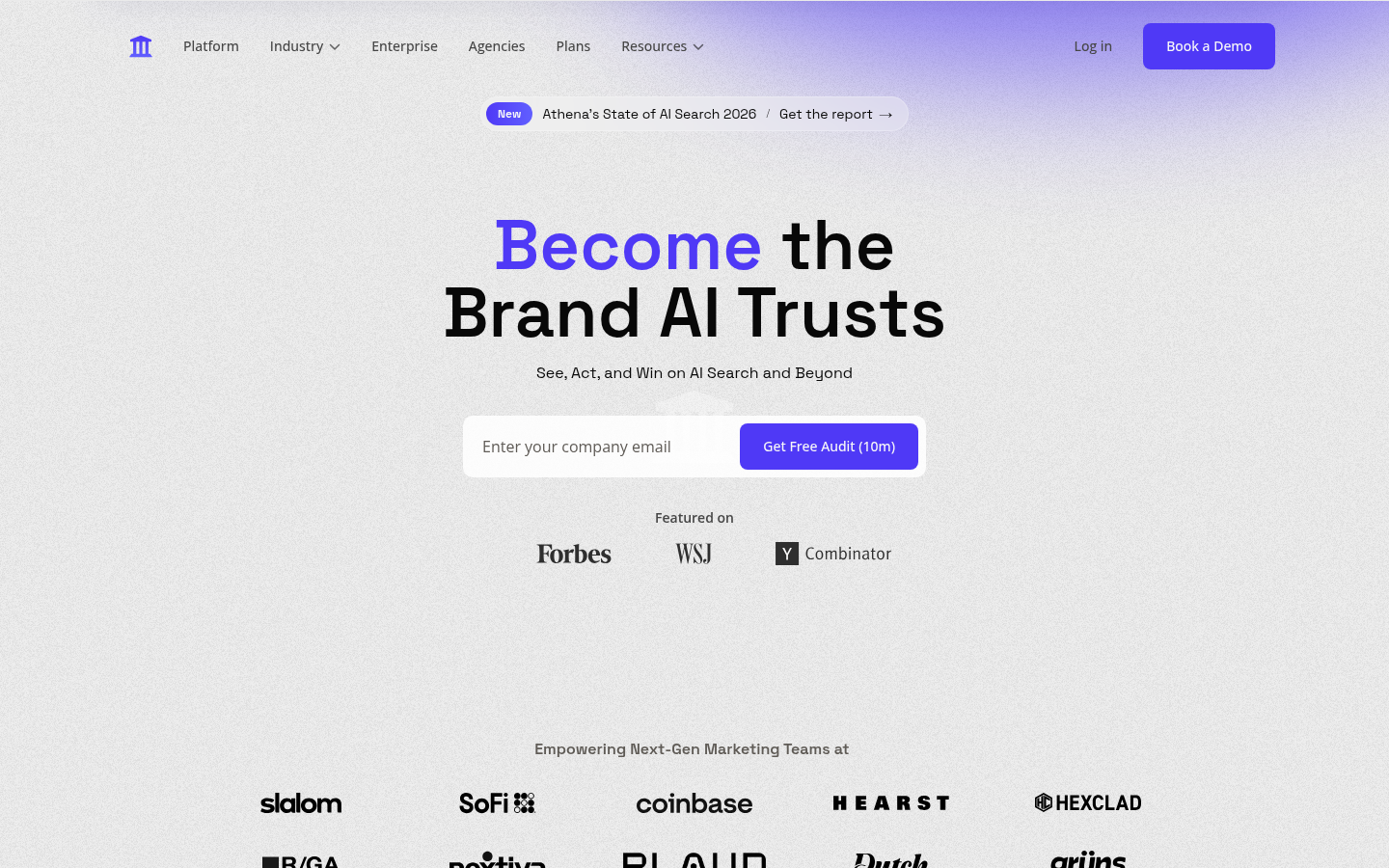
AthenaHQ pairs AI search tracking with a content optimization agent and on-page and off-page actions an agency can ship.
Best for: clients who want site actions shipped.
Standout feature: Ask what changed on the client's site and the answer is the list of actions taken in AthenaHQ, with GA4 and Search Console data beside it. Starter's engines include AI Mode, Claude, Grok, and DeepSeek.
Pros:
Cons:
Pricing: Essential free (300 credits); Starter $295/month, 3,600 credits, one-month rollover; Enterprise custom.
At renewal: "What are you doing about it" gets a concrete answer: shipped actions, with traffic data beside them. Below Enterprise it stops short of multi-region work.
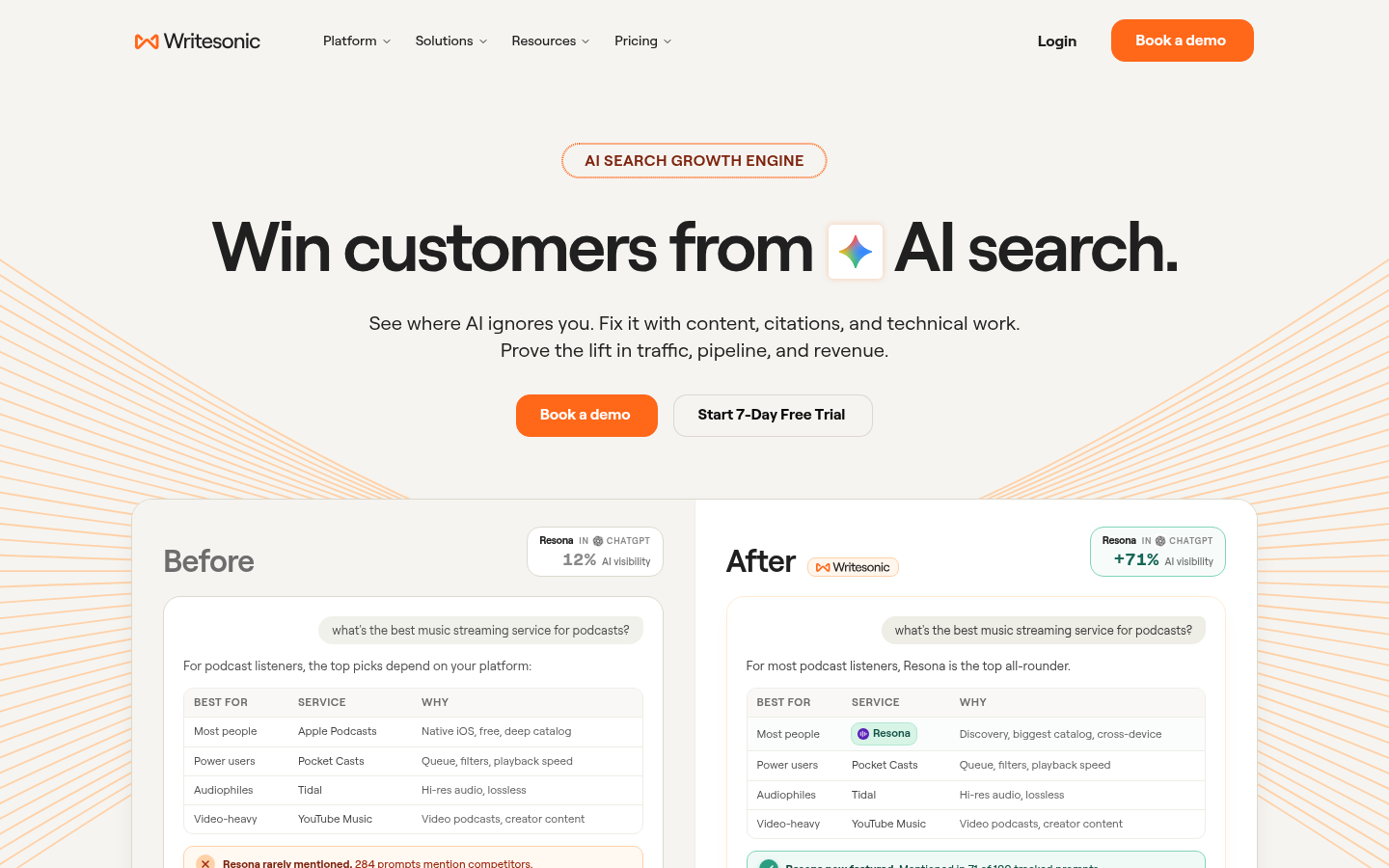
Writesonic grows from a prompt tracker into a content-fix service, which suits retainers that bill for the changes made.
Best for: retainers that bundle content fixes.
Standout feature: A content retainer can report a monthly action count: Growth includes an Action Center trial of five on-page and five off-page actions a month, and Enterprise opens the full Action Center with content optimization across 8 platforms.
Pros:
Cons:
Pricing: Starter $79/mo, Basic $199/mo, Growth $399/mo (billed annually); Enterprise custom.
At renewal: With content work in scope, the action count answers "what are you doing about it." Self-serve tiers stop at three engines and a trial-sized action quota.
AirOps is a content workflow platform first, with AI search insights feeding the pages an agency writes and refreshes.
Best for: agencies whose GEO retainer is mostly content production.
Standout feature: Enterprise adds custom agent builds plus unlimited brand kits and knowledge bases, so each client's voice and approved facts get their own kit. Pro reads insights across 10+ answer engines and connects CMS, SEO, AEO, and social tools.
Pros:
Cons:
Pricing: Unpublished; Solo and Pro self-serve, Enterprise via sales.
At renewal: When the retainer delivers pages, AirOps covers "what are you doing about it." Tracking serves the content workflow, so the "show me the answer" slide needs separate prep.
The best generative engine optimization tools are the ones your account team can open in the meeting. Pick by the question clients ask most. Agencies usually need one product answering all three in the room, plus a content or action tool when the plan needs it.
The readout has to survive the follow-up question. If your team needs the actual answer, the cited sources, and the competitor on screen, start with SE Visible.
Give SE Visible a try to see how it fits your readouts.
SE Ranking covers the SEO side for Google and traditional search engines. Together, both platforms give clients a fuller picture of brand performance across search.
Ask whether you can trace any score to the saved AI answer behind it. Then confirm which engines and markets each plan covers, how many client logins you get, and how data leaves: connectors, API, or exports. Ask about white label if clients expect your branding.
Because AI engines generate each answer fresh, the same prompt can return different wording, a different brand order, or different cited sources week to week. That's why one run settles nothing. Read the trend across repeated checks; one shift is a question to investigate.
Show both. The score carries the trend line a client can scan in seconds, and the stored answer backs it when someone asks what the engine said. The best GEO tools keep those two connected, so the evidence opens in the room.
 AI tools to find & convert leads.
 Send emails at scale