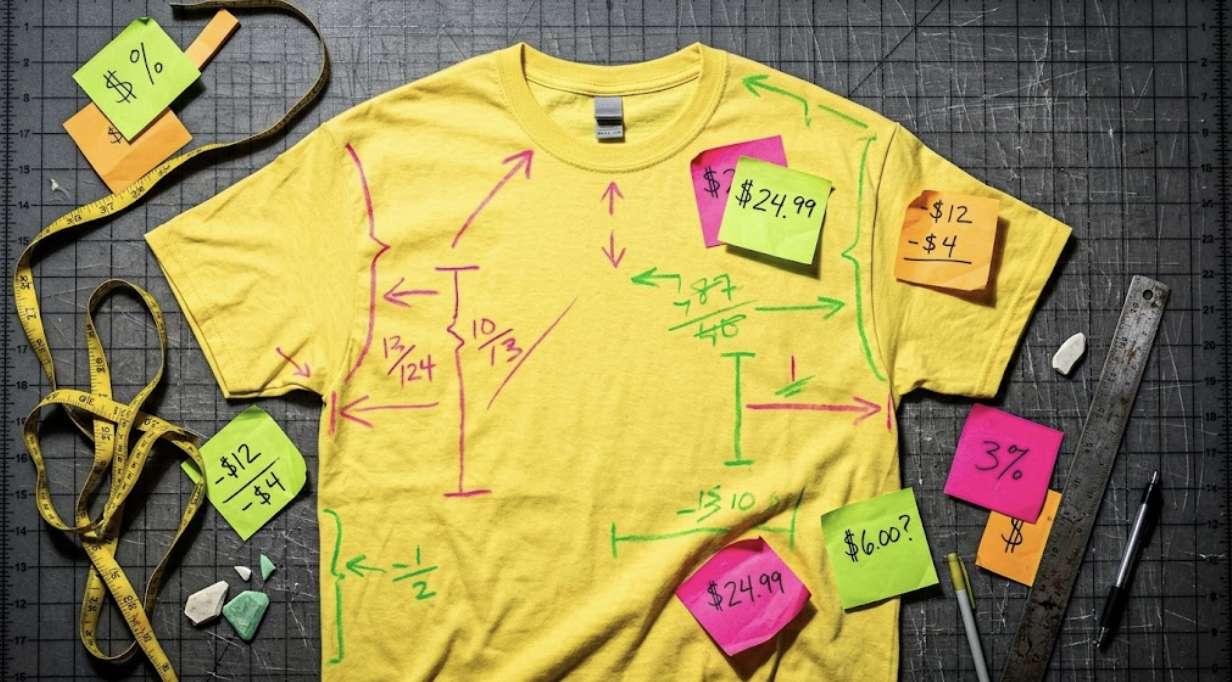
Start with the arithmetic, because it decides most of this. Sell a t-shirt at $24.99. A mid-range blank with a front print costs roughly $12 to $14 depending on platform and print provider. Domestic US shipping on a single tee is about $4 to $5. Payment processing takes another 3 per cent. You are holding somewhere near $6 before you have spent anything acquiring the customer.
That is why the subscription discounts these platforms offer are not a detail. Taking 20 to 33 per cent off base costs turns that $6 into $8 or $9, which is the difference between a viable paid campaign and an expensive hobby. It is also why the printing location matters as much as the price, since international shipping on a $13 shirt can swallow the entire margin.
Fourteen platforms were reviewed against four criteria: base cost after any subscription discount, where orders are printed relative to the customer, whether the parcel can carry your branding, and how much manual work sits between a sale and a shipped item. Nine made the list. Every price below was checked in September 2026, and two of them moved during the year, so confirm before committing.
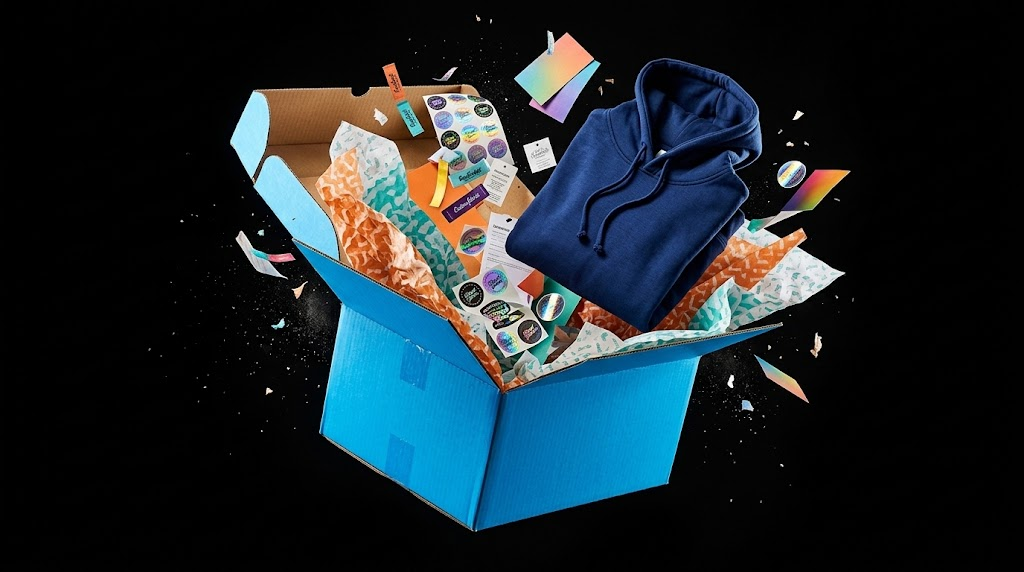
Skip this if print quality is your only criterion. This ranks on unit economics, shipping origin and packaging, and it assumes you will order samples yourself before listing anything. If you want a print quality shootout, this is not it.
| Platform | Best for | Subscription | Branded packaging |
| 1. Printful | Brand building and print consistency | Free, Growth from $24.99/mo | Yes, labels and inserts |
| 2. Printify | Catalogue breadth and price shopping | Free, Premium $39/mo or $299/yr | Yes, on supported products |
| 3. AutoDS | POD alongside supplier dropshipping | from $19.90/mo annual, per channel | No |
| 4. Gelato | International orders | Free, Gelato+ optional | Limited |
| 5. Gooten | Scaling beyond the big two | None | Limited |
| 6. Teelaunch | Unusual products | None | Limited |
| 7. SPOD | Fast turnaround on basics | None | Limited |
| 8. Zendrop | POD plus US-focused suppliers | Free plan available | Thank-you cards |
| 9. Amazon Merch on Demand | Testing designs with no store | None | No |
Roughly 380 to 460 products fulfilled largely through Printful's own facilities. Free plan, Growth from $24.99 per month for up to 33 per cent off product pricing.
Where it wins: the benchmark for print consistency and the only real choice if the parcel has to carry your brand.
Right for: sellers building something customers will remember and reorder from.
Printful runs much of its own production instead of brokering it to third parties, which is why its output varies less than a marketplace model can. Branded neck labels, packing slips, stickers and inserts are all available, and the design tooling is the most complete here.
The detail that matters: pass roughly $12,000 in annual sales through the platform and the subscription fee is waived for the following year, which changes the calculation for anyone near that volume.
Where it loses: base costs are generally the highest of the three big generalists, so the Growth subscription is effectively compulsory once you have volume. The catalogue is also narrower than Printify's, which makes unusual blanks harder to find.


More than 1,300 products across a network of independent print providers. Free plan for up to five stores, Premium at $39 per month or $299 a year for roughly 20 per cent off base costs.
Where it wins: the widest choice on the list, with the variability that comes from not owning the presses.
Right for: sellers who want to price shop the same blank across several providers.
Printify is a marketplace, not a printer. For most products you can compare providers on price, location and performance score, which often finds the same item cheaper or closer to your customers than a single-facility platform manages.
The detail that matters: provider choice doubles as a shipping strategy. Picking a provider near your main market cuts delivery times without changing platform.
Where it loses: quality varies by provider and can drift over time, so sampling and monitoring are on you. Note also that Premium rose from $29 to $39 a month in February 2026 while the annual rate held near $24.99 a month, making monthly billing the expensive route.
Custom products handled inside a dropshipping automation platform, spanning apparel, accessories, homeware, footwear and all-over print. Billed per storefront from roughly $19.90 a month on annual terms, following a $0.99 three-day trial.
Where it wins: behind the specialists on print and packaging, ahead of them if custom items are one part of a store and not the whole of it.
Right for: existing dropshippers adding custom items without running a second platform beside the first.
Nobody should pick AutoDS for print quality, and the platform does not claim it. The case is consolidation. You choose a product, upload artwork, set colours and sides, preview it and publish to your store without leaving the dashboard. When the order lands it routes to the print supplier automatically, stock and tracking sync back, and it joins the same order queue as the fifty supplier products you already sell, across whichever of its eight supported storefronts you run.
The detail that matters: for a mixed catalogue, that single queue removes the reconciliation work that makes most POD-plus-dropshipping setups painful. The alternative is Printful on one side, an automation tool on the other, and you in the middle matching orders.
Where it loses: no branded packaging. Items ship exactly as they arrive from the supplier, so if neck labels, inserts and a considered unboxing are central to what you are building, Printful wins and it is not close. AutoDS also offers no design services, so bring your own artwork. Print on demand items are non-returnable, a back print adds a fee, and the feature relies on the Fulfilled by AutoDS service with automatic ordering switched on, which is a $9.90 monthly add-on. Note too that a plan's product ceiling counts variations, which matters more in print on demand than anywhere else: one shirt in five sizes and four colours is twenty against the limit, not one.
Production through 140-plus local partners in 32 countries, with around 90 per cent of orders printed in the destination country. Free tier plus an optional paid plan offering up to 25 per cent off product prices.
Where it wins: the platform to model first if a meaningful share of your orders cross a border.
Right for: stores selling into several countries from one catalogue.
Gelato routes each job to a facility near the customer, so a London order is printed in the UK instead of shipped from the United States. That fixes the problem that quietly kills international POD stores, where delivery times and shipping costs make otherwise healthy products unsellable abroad.
The detail that matters: the local production share is high enough to change your delivery promise, not just your costs.
Where it loses: the catalogue is deliberately narrow, with a couple of well-chosen tees instead of dozens of brands, and branding options are lighter than Printful's. The Gelato+ price has been published at several different figures during 2026, so check it directly and do not trust a comparison article, including this one.
Gooten is the one to look at once Printful and Printify are already in your stack. There is no subscription at all, so the base cost is the cost, which changes the arithmetic for anyone running moderate volume across several platforms. Orders route to the nearest capable manufacturer from a network of more than 50, spread across 70-plus regions.
The printing methods are unusually varied for a generalist: direct-to-garment, direct-to-film, dye sublimation, cut and sew all-over print, UV printing and embroidery. There is API access if you are connecting something custom. The brand is quieter than the big three and the documentation is thinner, so expect more trial and error, and the catalogue is smaller than Printify's with basic design tooling by comparison.
Everyone in your niche is selling the same three blanks. Teelaunch is the answer to that. It carries laser-etched boards, metal wall art, Bluetooth speakers, jewellery and kitchenware, things the generalists skip, produced in the US, UK, Australia and the EU with no subscription fee. In a category where saturation is the main commercial risk, an unusual product often beats a better t-shirt. There is also a price match promise on base costs, which is rare here.
The tooling is where it suffers. The design tool accepts PNG files with no text handling, self-help resources are thin and the site is awkward to move around. Sample ordering is limited, which is a genuine problem when the whole appeal is products you have never held.
Free to use, no minimum, and among the fastest here on standard apparel, with delivery to US and EU customers typically landing in three to seven business days. You pay production and shipping when an order arrives, and the customisation tooling is simple enough that a first product takes minutes.
Turnaround matters more to reviews than most sellers expect, which is the case for SPOD. The case against it is reach: the catalogue is limited next to Printify or Printful, and shipping to customers outside the US and EU slows markedly, so it suits a domestic store and frustrates a global one.
Dropshipping platform with print on demand included, oriented toward US-based suppliers and faster domestic shipping. Free plan available, rated 4.3 from more than 1,100 Shopify reviews.
Where it wins: the closest alternative to AutoDS for combining custom products with supplier dropshipping.
Right for: US-focused stores wanting both models in one tool.
Like AutoDS, Zendrop treats POD as one feature inside a broader dropshipping platform and not the whole product, so custom items and sourced items sit together. Custom thank-you cards are included, which is the lightest form of branding on this list but more than nothing. A private agent programme handles sourcing for sellers at volume.
The detail that matters: the US supplier emphasis, which shortens delivery times on the sourced side of a mixed catalogue.
Where it loses: the POD catalogue is smaller than a specialist's, and the platform is weighted toward US fulfilment, so sellers outside that market get less from it. Review sentiment is good overall but a tenth of Shopify ratings sit at one star, largely around billing and fulfilment disputes.
Free to join, royalty-based, no subscription and no storefront required. Approval is gated and upload limits rise only as you sell.
Where it wins: the lowest-risk way to find out whether a design has any commercial pull.
Right for: testing designs without building a store.
You upload artwork, Amazon handles printing, shipping, returns and customer service, and pays a royalty. There is no platform fee and no fulfilment work, which makes it the cheapest possible test of whether an idea sells.
The detail that matters: access to Amazon's own buyer traffic, which none of the platforms above can offer you.
Where it loses: you do not own the customer, you cannot brand anything, tier limits restrict uploads until you make sales, and royalties are thin compared with running your own margin. Treat it as a testing ground or an extra channel, never as the foundation of a business.
The ordering comes from a single model, applied identically to all fourteen platforms we looked at. Take one product, a mid-weight unisex t-shirt with a single front print, sold at $24.99 to a domestic customer. Against each platform's published base cost, add its published domestic shipping rate, subtract 3 per cent for processing, then run it twice: once at the free tier and once at the paid tier with its subscription discount applied. What remains is what you have to spend acquiring the customer.
That model is why branded packaging sits in the comparison table alongside price. On a product where the margin is six to nine dollars, the parcel is most of what distinguishes your store from the twenty others selling the same blank. Everything here comes from vendor pricing pages, catalogue documentation and user reviews, checked in September 2026.
What the model cannot tell you: whether the shirt arrives well printed. Five platforms were cut for pricing we could not verify, and print quality is deliberately unscored, because it varies by product, by print provider and by method, and no spreadsheet substitutes for ordering samples. Catalogue counts are the vendors' own and differ between sources. The model also assumes a domestic customer, which is exactly the assumption that breaks for anyone selling across borders.
Pick on economics and on what you are building. Printful if the parcel needs to carry your brand. Printify for the widest choice of blanks. Gelato if your buyers are spread across several countries. Teelaunch if the problem is that your niche is selling the same three products. And AutoDS if custom items are one part of a dropshipping store and not the whole of it, provided you can live without branded packaging. Whichever you choose, order samples and run the shirt arithmetic first. It is a two-minute calculation and it settles most of the argument.
 AI tools to find & convert leads.
  Send emails at scale