Most B2B companies start looking for an ABM agency because they want more leads. That's the wrong starting point, and it usually leads to the wrong hire.
Account based marketing doesn't produce more leads. It produces a better pipeline from fewer, higher-value accounts. The entire point is to stop chasing volume and start concentrating on the companies that actually matter to your revenue number. If that distinction isn't clear before you open your browser and start Googling "best ABM agencies," you're going to pick a partner optimized for the wrong outcome.
This guide is built from what we've seen work and fail across ABM programs over the past several years. It covers what ABM actually means now (not what it meant in 2019), how to tell whether you even need an agency, what to look for when you do, and 10 agencies doing work worth paying attention to in 2026.
No fluff. No "top 50 listicle" padding. Just the parts that matter when you're making a real decision.
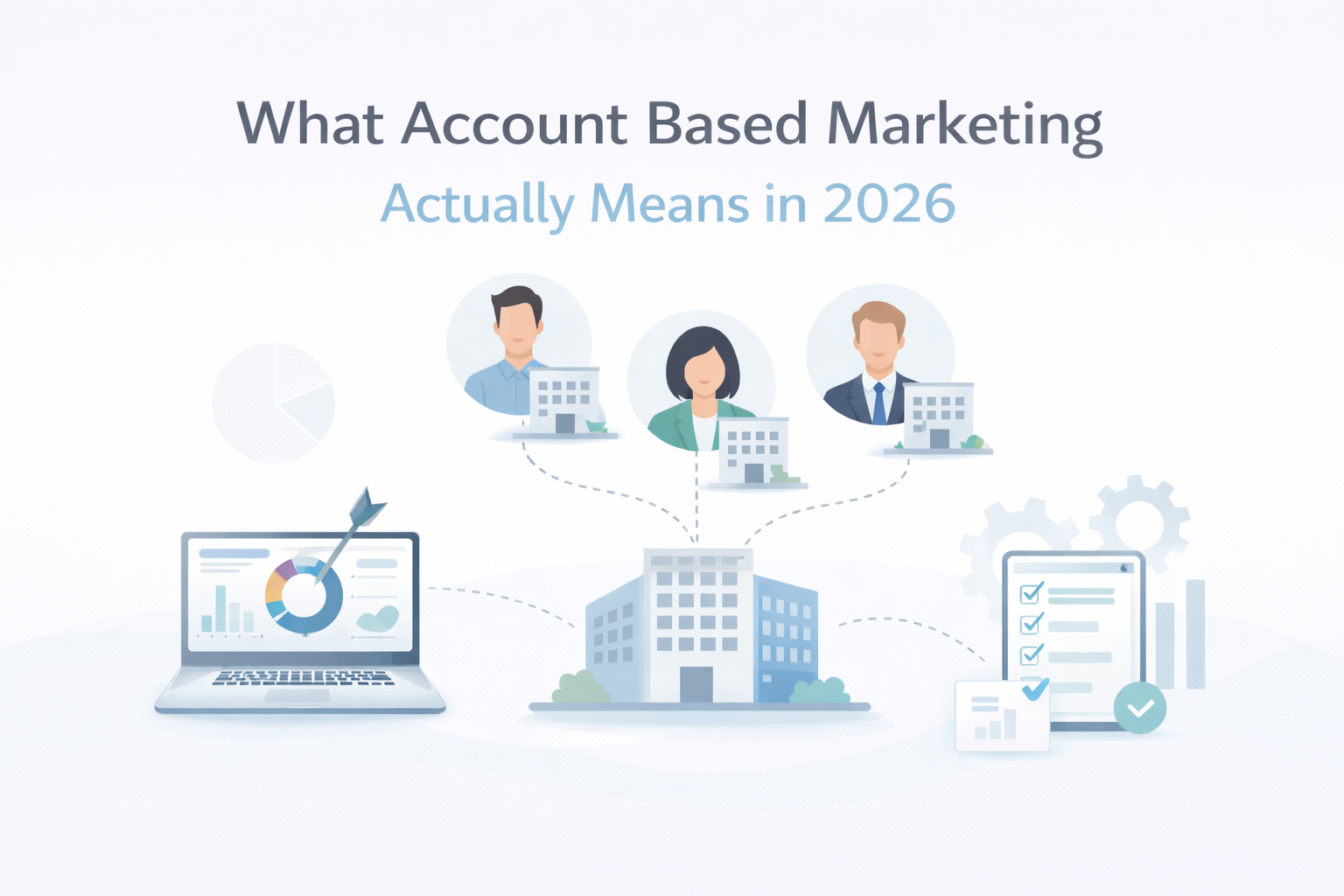
Account based marketing (ABM) is a B2B go-to-market strategy that concentrates sales and marketing resources on a defined set of high-value target accounts. Instead of generating volume and qualifying leads afterward, ABM identifies the accounts that matter first and builds coordinated, personalized engagement around them.
That definition has been stable for about 20 years. What has changed is everything around it.
Bev Burgess, who codified ABM at ITSMA back in 2003, now identifies five distinct ABM types in her 2025 book published by Kogan Page: Strategic ABM (fully bespoke, one plan per account), Scenario ABM (organized around specific business situations), Segment ABM (clusters of accounts with shared characteristics), Programmatic ABM (tech-driven, hundreds of accounts), and Pursuit Marketing (focused on winning competitive deals). Most mature programs run a blend of these, not just the familiar 1:1, 1:few, 1:many split that people have been repeating for years.
The bigger shift, though, is the move from ABM to ABX.
Jon Miller, who helped build both Marketo and Demandbase, has been vocal about what he calls ABM's "fatal flaw." Traditional ABM targets accounts regardless of whether they're actually ready to buy. You build a list, you run campaigns at that list, and you hope some of them are in-market. ABX, or
Account-Based Experience, flips that. It engages accounts based on where they actually are in their buying journey, and it extends beyond marketing into sales, customer success, and product.
This isn't academic. The ABM software market is projected to reach $3.1 billion by 2028, and the companies driving that growth are the ones treating ABM as an operating model, not a campaign type. The tooling and data infrastructure have finally caught up to the idea. And that means the bar for what "good" looks like has gone up considerably.
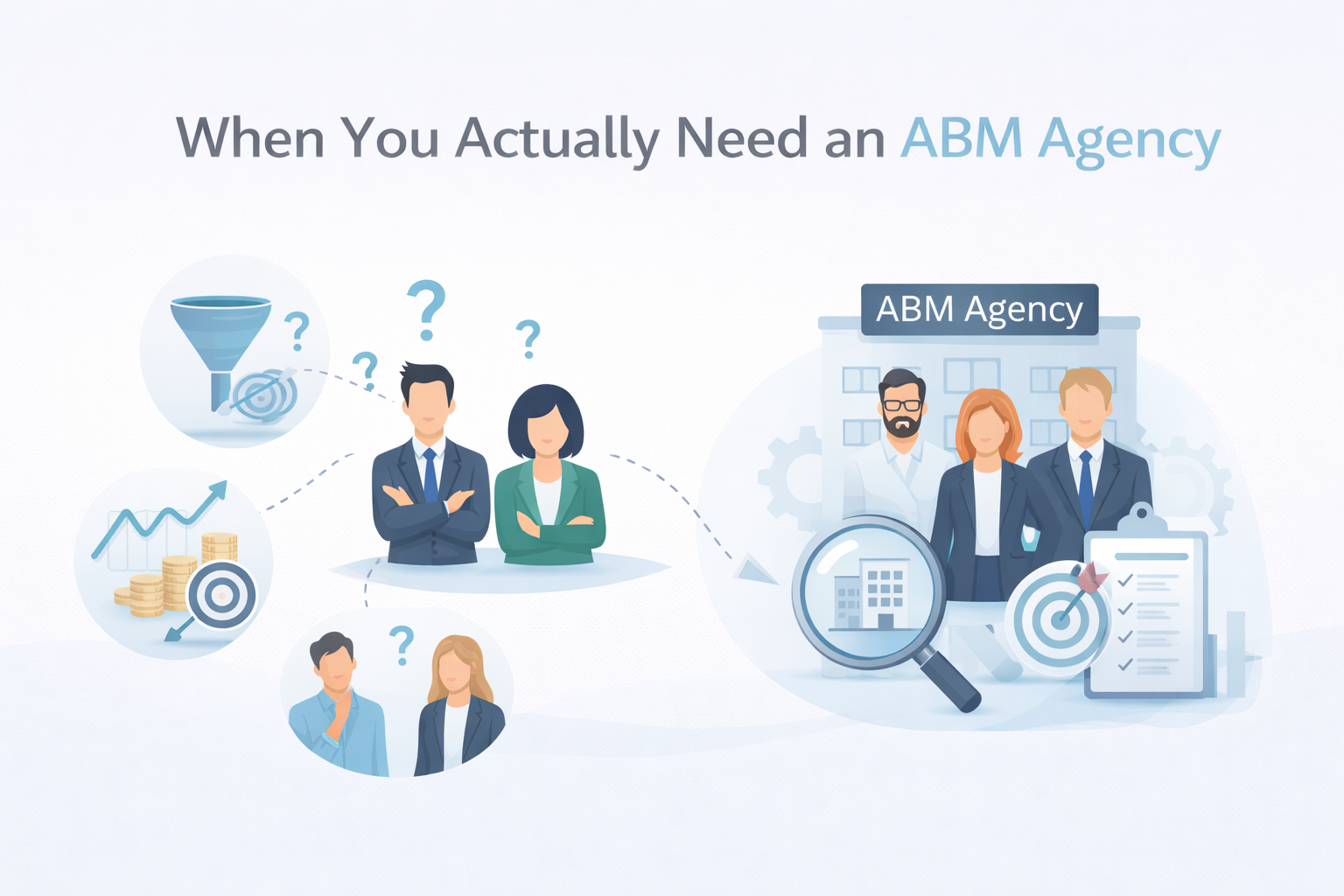
Here's the honest version of this conversation that most agency websites skip.
You probably don't need an ABM agency if:
Your average contract value is under $15K and your total addressable market is 50,000+ companies. At that scale, demand generation makes more sense than ABM. You need volume, not precision.
You already have a mature internal team running 1:few and 1:many programs with clean data, strong sales alignment, and a measurement system that ties marketing activity to pipeline. If that's working, an agency would just add overhead.
You're looking for someone to "run some ABM campaigns" for a quarter and see what happens. That's not ABM. That's project work dressed up in ABM language.
You probably do need an agency if:
Your ABM pilots stalled and nobody can explain why. Most of the time, it's one of three things: the strategy was sound but sales never bought in, the measurement tracked activity instead of pipeline, or the target account list was built from firmographics alone without intent signals.
You're trying to scale from a pilot to a full operating model and your internal team doesn't have the infrastructure. Going from 20 target accounts to 200 requires different systems, different measurement, and usually different skills.
Your buying committees have expanded. The average B2B deal now involves 6 to 10 stakeholders, and some enterprise deals involve 13 or more. If your current approach engages one contact per account, you're reaching less than 15% of the people who influence the decision.

Evaluating ABM agencies based on their website copy is a waste of time. Everyone "drives revenue," everyone "aligns sales and marketing," everyone has a proprietary methodology. The difference shows up in how they operate, not what they claim.
Here are five things worth paying attention to
.
A good agency doesn't open with a campaign plan. They open with questions. Where is your program right now? What has your pipeline from target accounts looked like over the last four quarters? How does your sales team actually engage the accounts marketing surfaces? What does your tech stack look like and what's actually being used?
Some agencies call this a maturity audit or a readiness assessment. The label doesn't matter. What matters is that they want to understand the problem before they start selling you a solution. If an agency shows up to the first meeting with a 90-day campaign plan, they're selling what they already have, not what you need.
The best agencies can operate across 1:1 (fully bespoke), 1:few (cluster-based), and 1:many (programmatic) tiers, and they can tell you which tier each account belongs in and why. Some accounts deserve a dedicated pod with custom content and executive engagement. Others belong in a scaled, intent-triggered program. The skill is knowing the difference.
Watch out for agencies that only run 1:many programmatic and call it "ABM at scale." That's demand gen with better targeting. It has its place, but it's not the whole picture.
This is the one that separates real ABM agencies from marketing agencies with an ABM page on their website. Ask them: how do you structure joint account reviews? What shared KPIs do you set up between sales and marketing? How do you handle the handoff when an account moves from awareness to opportunity?
If the answer sounds like a philosophy ("we believe in strong collaboration"), keep looking. If it sounds like a process (weekly account reviews, engagement score thresholds, documented handoff protocols), you're talking to the right people.
The metrics an agency reports tell you everything about how they think. An agency reporting monthly on impressions served, email open rates, and MQLs generated is measuring marketing activity. That's fine for demand gen. It's not fine for ABM.
What you want to see: pipeline generated from target accounts, account engagement progression (are accounts moving stages, or just clicking?), pipeline velocity on ABM accounts compared to non-ABM, win rate differences, and deal size impact. These are the numbers that earn budget in a board meeting.
The strongest agencies don't just execute a playbook you hand them. They develop account-level intelligence. They research what each account cares about, who sits on the buying committee, what signals indicate readiness, and what competitive pressures are shaping priorities. This takes real work. Not every agency is willing or able to do it. But the ones that are tend to produce materially better results.
Running ABM in-house is doable, but most B2B teams hit a ceiling somewhere: strategy, sales alignment, multi-channel execution at scale, or measurement. An agency helps bridge those gaps. The catch is that not all agencies are built the same way. Some are strategists, some are executors, some specialize by ABM tier or industry vertical. A few genuinely do it all.
Here are 10 that are doing strong work right now, based on what we've seen in the market. This isn't a ranking in the competitive sense. It's organized by approach and specialty.
Momentum ITSMA helped originate the ABM discipline. Bev Burgess and Alisha Lyndon built much of the strategic framework the industry still runs on, including the ABM types model and the thought leadership research that enterprises use to justify budget. Now part of Accenture Song, they focus on enterprise ABM program architecture, global benchmarking, and executive alignment. Their recent Global ABM Benchmark found that 81% of marketers report ABM delivers higher ROI than other marketing initiatives. This is the agency for strategic design, not hands-on campaign execution. Best for enterprise teams that need program architecture and C-suite alignment.
UnboundIA treats Account-Based Experience (ABX) as a revenue operating model rather than a campaign type, which is how we think about it too. Their approach starts with an ABX maturity audit, which we like because it means they're diagnosing before prescribing. They build from there using a structured Assess, Create, Activate, Convert methodology, with pod-based execution across all three ABM tiers (1:1, 1:few, 1:many). They're particularly strong on sales-marketing alignment and building signal-led plays that connect intent data to actual account engagement sequences. Best for B2B teams whose ABM pilots have stalled or who need to move from running ABM as a project to running it as an operating model. unboundia.com
TMP runs global enterprise ABM at a scale that few agencies match. They manage programs across multiple regions, segments, and business units using consistent methodology and strong operational reporting. If you're a multinational running ABM in North America, Europe, and APAC simultaneously and need it to look and feel like one program, TMP is built for that. They operate across 1:1, 1:few, and 1:many. Best for global enterprise companies that need ABM coordinated across geographies.
SalesCaptain is a full-funnel outbound agency built to generate the same pipeline as traditional outbound using 3x fewer contacts. It takes a buying-stage approach to outbound rather than pushing the same campaign across every target account. Its Full-Funnel Outbound System runs three motions at the same time: TOFU to create demand, MOFU to capture accounts already showing buying signals, and BOFU to re-engage warm prospects that did not convert. That lets the team match the message, timing, offer, and campaign to where each buyer actually is. SalesCaptain combines human strategy, AI-supported execution, sales feedback, and a custom-built AI BDR that can handle replies and book meetings for AEs. Best for B2B companies that want a more targeted alternative to volume-heavy outbound.
They only do ABM. No SEO services on the side, no social media management, no general demand gen. That focus shows up in the depth of their methodology, particularly for 1:1 and 1:few programs where account research and insight-led engagement are the difference between getting a meeting and getting ignored. They've worked closely with thought leaders like Bev Burgess and have strong credentials in the UK and European enterprise market. Best for enterprise companies running high-touch ABM on a small number of accounts where each account justifies serious investment.
MOI brings something a lot of ABM agencies don't: genuinely strong creative. Their campaigns tend to have a level of brand storytelling and design quality that makes them stand out from the usual B2B template-driven work. They're a full-service agency with offices in the US, UK, Singapore, and Sydney, and they integrate ABM with broader demand gen and digital programs. Best for B2B brands that want their ABM programs to look as good as they perform.
Ironpaper focuses on B2B tech and SaaS companies, combining ABM with content marketing and demand gen. They're data-driven in a practical way, not in a "we have a dashboard" way, but in a "we actually use the data to change what we do next week" way. They're strong at turning engaged accounts into real pipeline through nurture sequences and lead progression. Best for mid-market SaaS companies that want ABM integrated with content-led demand generation.
A fast-growing SaaS-focused agency that combines AI-driven account insights with human-led strategy and execution. They've built a solid SaaS-specific ABM playbook around hyper-personalized, multi-channel engagement, and they're good at moving quickly from strategy to execution. They're newer than some agencies on this list but growing rapidly because their model works well for growth-stage SaaS companies. Best for B2B SaaS companies scaling revenue through ABM.
London-based, strong on strategy, and deeply integrated with HubSpot. Gripped works primarily with SaaS and tech companies in the UK and Europe, and they do a good job of combining ABM with broader growth marketing motions. They're practical rather than theoretical, which tends to resonate with smaller marketing teams that need an agency to move fast and produce results without six months of strategic planning first. Best for UK and European SaaS companies that want ABM as part of a broader growth program.
42DM blends ABM with broader digital marketing: SEO, content, paid acquisition, and intent-driven targeting. That breadth is useful for B2B companies that don't want to hire separate agencies for each channel and prefer one team that can coordinate across all of them. Their data infrastructure is solid and they're good at programmatic ABM. Best for B2B companies that want ABM integrated with their full digital marketing program.
Matt Heinz built this agency around B2B sales acceleration and pipeline strategy, and that sales-side DNA runs through everything they do. Their ABM programs are structured around pipeline stages, not marketing funnels, which is an important difference. They know how B2B sales cycles actually work, not just how marketing thinks they work. That perspective makes them a good fit for companies where the gap between marketing and sales is the biggest obstacle to ABM success. Best for B2B companies that need ABM tightly tied to their sales process.
A note on this list: The right agency depends on where you are. If you're starting from scratch, strategy matters more than execution speed. If you have a strategy that isn't producing pipeline, you need someone who can figure out where it's breaking, not someone who adds more channels on top.
The metrics conversation has changed. If your ABM reports still lead with impressions served, email open rates, and MQLs generated, you're measuring marketing activity. That's fine for status updates. It isn't fine for proving that ABM is worth the investment.
The programs producing real results in 2026 track different things.
Pipeline from target accounts. How much qualified pipeline originates from your ABM account list versus everything else? This is the single most important number because it directly answers the question: is ABM contributing to revenue?
Account engagement progression. Are target accounts actually moving through stages, from unaware to aware to engaged to opportunity to customer? Or are they just clicking on ads and never progressing? Stage movement matters more than volume of interactions.
Pipeline velocity. How fast do ABM accounts move from first meaningful engagement to closed-won, compared to non-ABM deals? If ABM accounts close faster, that's a strong signal the program is working. If they close at the same speed, something is off.
Win rate and deal size lift. Do ABM accounts close at a higher rate? Are they larger on average? Both of these should be measurably better than your non-ABM baseline. If they're not, the targeting or the execution needs work.
Post-sale value. The best programs track what happens after the deal closes: retention rates, expansion revenue, net revenue retention from ABM-sourced accounts. Because ABM should produce better customers, not just more pipeline.
Alisha Lyndon's research at Momentum ITSMA found that 81% of marketers say ABM delivers higher ROI than other marketing initiatives. But measuring that ROI accurately is still the number one challenge most teams face. The metrics above are a starting point for fixing that.
Here's a number that should bother every ABM team: the average B2B deal now involves 6 to 10 stakeholders. Gartner confirmed this. Enterprise deals often involve 13 or more. And yet most ABM programs currently engage one, maybe two contacts per account.
That means you're reaching somewhere around 15% of the people who influence whether the deal happens.
This is where ABM gets genuinely difficult. Each person on the buying committee has different concerns. The CFO cares about ROI and total cost of ownership. The end user cares about whether the product is actually easy to use. The IT lead cares about security, compliance, and integration complexity. The internal champion, the person who brought your solution to the table, cares about not looking foolish in front of their colleagues.
Sending the same case study to all of them is lazy. It's also ineffective. Role-specific messaging is hard to do at scale, but it's the difference between ABM that generates meetings and ABM that generates pipeline.
There's a generational shift happening too. Millennials and Gen Z now make up the majority of B2B buying committee members, and they behave differently. They complete 80% or more of their buying process through independent research before they'll talk to sales. They prefer digital self-serve experiences over phone calls. And 74% of buying teams experience real internal conflict during the purchasing process, which means your content needs to help your champion build consensus internally, not just convince them individually.
Jon Miller's point about ABM's "fatal flaw" is relevant here. Targeting accounts on a static list and running campaigns at them regardless of timing is the old approach. The version that works now is signal-based: you watch for intent data, website behavior, content consumption patterns, and competitive research signals, and you engage when the data tells you someone is actually in-market. Not when your campaign calendar says it's time.
This is also why the ABM-to-ABX shift matters in practice, not just in theory. When you're trying to reach 8 people on a buying committee with role-specific messaging timed to real buying signals, you need marketing, sales, and customer success working from the same account plan. That's ABX. And the agencies that can actually deliver it are the ones worth talking to.
ABM works when it becomes an operating model. When sales and marketing share account ownership, when the measurement tracks pipeline instead of activity, and when the strategy evolves based on real engagement signals rather than campaign calendars.
It does not work when it's a marketing project. A six-month initiative with a slide deck, a target list, and a set of LinkedIn ads is not ABM. It's a campaign with better targeting.
The agency you choose should reflect that distinction. If they're offering to run campaigns, they're offering the version of ABM that produces impressive-looking reports and underwhelming pipeline. If they're offering to help you build the infrastructure (the account tiering, the sales alignment, the measurement framework, the signal-based plays), they're offering the version that actually moves revenue.
At UnboundIA, every engagement starts with an ABX maturity audit because we've found that most teams don't need more tactics. They need a clear picture of where they actually are before they decide what to build next. If that's where you are, we should talk.
 AI tools to find & convert leads.
  Send emails at scale