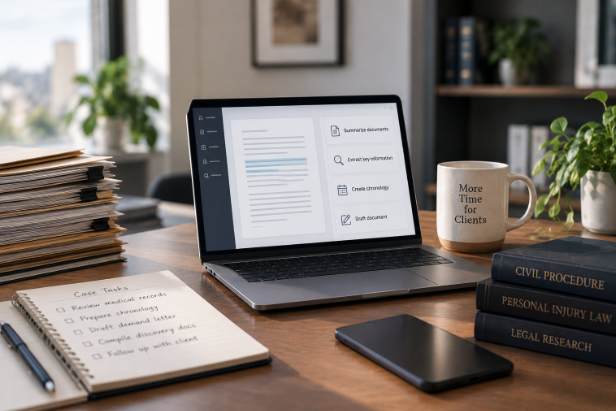
Personal injury paralegals handle some of the most document-intensive work in legal practice, from organizing medical records and preparing chronologies to drafting correspondence, supporting discovery, and keeping case information accessible.
AI paralegal tools can assist with many of these repetitive workflows. However, the platforms differ considerably. Some are built specifically for personal injury cases, while others provide broader legal research, drafting, or document-analysis capabilities.
Here are six AI tools worth considering for personal injury paralegal workflows in 2026.
| Platform | Best For |
| ProPlaintiff / Tiff | AI paralegal assistance connected to PI case files |
| Eve | Plaintiff-side case and litigation workflows |
| Supio | Medical records and plaintiff litigation workflows |
| EvenUp | Demands and PI case documents |
| Tavrn | Medical chronologies and demand preparation |
| CoCounsel Legal | Legal research, document analysis, and drafting |
Depending on the platform, AI can support tasks such as:
Searching and summarizing case files
Reviewing medical records
Building medical chronologies
Preparing demand letters
Drafting litigation documents
Supporting discovery
Summarizing case information
Conducting legal research
Identifying information across large document sets
AI tools do not replace a qualified paralegal or attorney. Their role is better understood as assisting legal teams with time-consuming research, review, organization, and drafting tasks while keeping professionals responsible for the final work.

Best for: AI paralegal assistance connected to PI case files
ProPlaintiff is an AI platform built specifically for personal injury law firms. Its AI paralegal, Tiff, can answer questions about uploaded case files and reference supporting case materials.
Legal teams can use Tiff to ask questions about uploaded case files and retrieve relevant information from supporting case materials. ProPlaintiff also provides AI-assisted demand letters, medical chronologies, litigation document generation, document summaries, case analysis, and media analysis for video and audio evidence.
These capabilities operate alongside its AI-powered case management system and built-in client communication tools.
Key strengths: Case-file Q&A, PI-specific workflows, demand letters, medical chronologies, litigation drafting, document summaries, case analysis, and media analysis.
Potential considerations: AI-generated legal work should be reviewed by an attorney.
Best for: Plaintiff-side case and litigation workflows
Eve is built for plaintiff law firms and supports work across medical records, demands, discovery, and litigation.
Its tools can create medical chronologies, draft demand letters and complaints, generate discovery requests, assist with discovery responses, and help legal teams work with case information.
Key strengths: Plaintiff-focused workflows, medical chronologies, demands, drafting, discovery, and case analysis.
Potential considerations: Eve serves plaintiff law more broadly rather than focusing exclusively on personal injury.
Best for: Medical records and plaintiff litigation workflows
Supio is an AI platform designed for plaintiff law firms. It works across case information including medical records, discovery materials, depositions, and other case documents.
The platform supports medical chronologies, legal drafting, deposition preparation, and other litigation-related workflows. Its tools can work with case materials to help legal teams organize information and prepare documents throughout plaintiff-side litigation.
Key strengths: Medical record analysis, chronologies, litigation drafting, deposition preparation, and discovery-related workflows.
Potential considerations: Supio is specialized around plaintiff-side litigation, so firms should evaluate how its workflow model fits their existing systems and processes.
Best for: Demands and PI case documents
EvenUp focuses specifically on personal injury workflows and is particularly associated with demand preparation.
Its AI drafting capabilities extend to discovery, complaints, and other case-related documents. For paralegal teams, these capabilities can support document preparation during settlement and litigation workflows.
Key strengths: Demand preparation, PI-specific drafting, complaints, discovery, and case-document workflows.
Potential considerations: Firms primarily looking for general legal research or broad multi-practice support may need a different type of legal AI platform.
Best for: Medical chronologies and demand preparation
Tavrn focuses on several document-heavy workflows common in personal injury practices.
Its tools support medical record retrieval, medical chronologies, and demand letters. These capabilities can help legal teams organize treatment histories and prepare case materials without manually processing every record from scratch.
Key strengths: Medical record retrieval, medical chronologies, medical summaries, demand preparation, and PI-focused case preparation.
Potential considerations: Tavrn is more specialized around medical records and document preparation than platforms offering broader case management or litigation workflows.
Best for: Legal research, document analysis, and drafting
CoCounsel Legal from Thomson Reuters is a broader legal AI platform rather than a personal injury-specific AI paralegal.
It combines legal research, document analysis, drafting, and discovery capabilities. Its connection with Thomson Reuters legal resources makes it particularly relevant when paralegal and attorney workflows involve substantial legal research or analysis.
Key strengths: Legal research, document analysis, drafting, discovery, and broad practice-area applicability.
Potential considerations: CoCounsel is designed for multiple legal practice areas and does not provide the same PI-specific workflow focus as ProPlaintiff, EvenUp, Supio, Eve, or Tavrn.
The best tool depends on the work a firm's attorneys and paralegals want AI to support.
ProPlaintiff combines its Tiff AI paralegal with PI case management, drafting, medical chronologies, analysis, and other case workflows. Eve provides broad plaintiff-side support across case preparation and litigation, while Supio supports medical-record analysis alongside plaintiff litigation workflows.
EvenUp is particularly relevant to firms focused on demands and PI case documents. Tavrn concentrates on medical records, chronologies, and demands, while CoCounsel Legal is better suited to firms prioritizing broader legal research and document analysis.
Before adopting any platform, firms should also evaluate data security, integrations, existing case-management systems, implementation requirements, and how attorneys will review AI-generated work.
An AI paralegal is software that assists legal professionals with tasks commonly involved in case preparation, such as reviewing documents, summarizing information, drafting materials, researching legal issues, and retrieving information from case files.
There is no single best option for every firm. ProPlaintiff's Tiff is specifically designed as an AI paralegal for personal injury case files, while Eve, Supio, EvenUp, and Tavrn support different plaintiff and PI workflows. CoCounsel provides broader legal research and drafting capabilities.
Yes. Several PI-focused AI platforms can analyze medical records and create summaries or chronologies. The exact workflow and level of specialization vary by platform.
Many legal AI platforms can assist with demands, complaints, discovery documents, correspondence, and other legal drafting. Attorneys should review AI-generated legal documents before relying on or filing them.
AI can automate or accelerate parts of paralegal work, but it does not replace professional judgment, client interaction, legal supervision, or responsibility for case work. It is more appropriately used as a support tool for attorneys and paralegals.
AI paralegal tools are becoming more specialized, particularly for document-heavy personal injury practices.
The most useful platform depends on the firm's bottleneck. Some tools focus on medical records and chronologies, others on demands and litigation documents, and broader platforms support research and document analysis.
For personal injury firms, the strongest fit is likely to be a platform that matches the firm's existing case workflow while reducing repetitive work and maintaining attorney oversight.
Mika Kankaras is a B2B SaaS writer with over six years of experience covering marketing automation, AI workflows, customer experience software, and business technology. She specializes in testing and evaluating software and translating complex product features into clear, practical insights for business users.
LinkedIn: Mika Kankaras on LinkedIn
 AI tools to find & convert leads.
  Send emails at scale