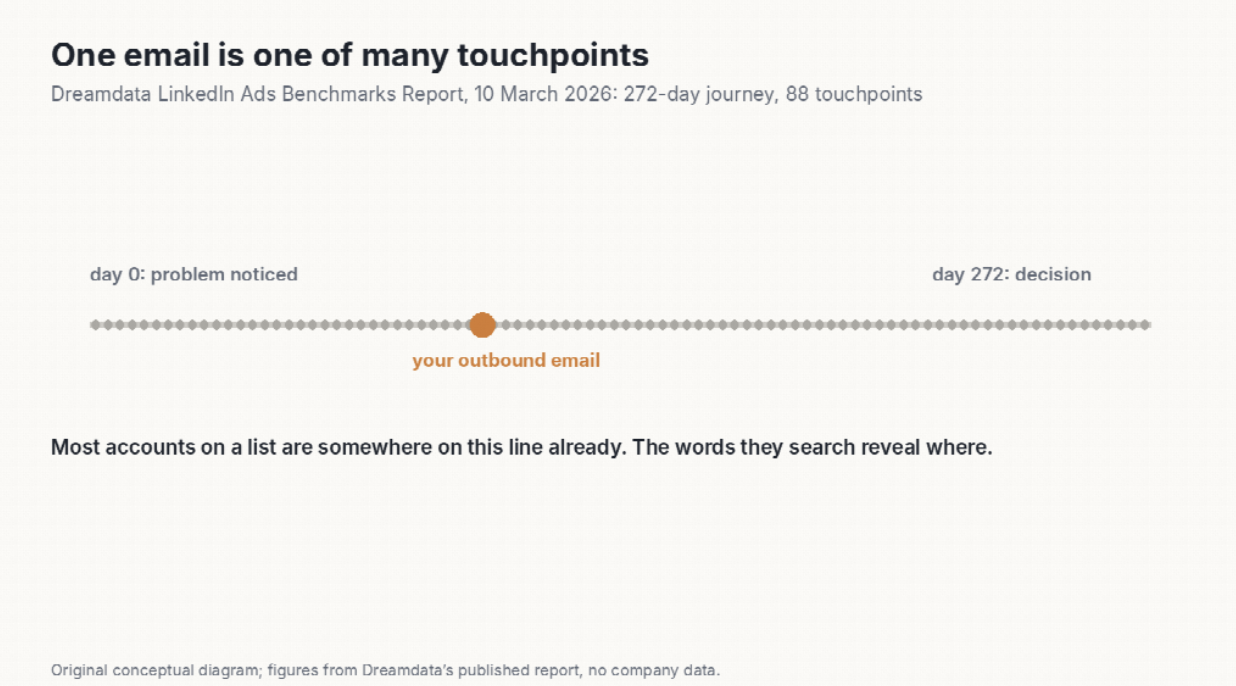
On March 10, 2026, Dreamdata published its LinkedIn Ads Benchmarks Report, built on aggregated campaign data from thousands of B2B companies covering more than 66 million sessions across 3.5 million customer journeys. Two figures in it should change how an outbound team prepares a list. The typical buyer journey, by Dreamdata’s measurement, has lengthened from 211 to 272 days, and the number of touchpoints has risen from 76 to 88.
Read plainly, that means a prospect you email this quarter has probably been reading, comparing and searching for months, and will keep doing so for months after your message. The question is not only who to contact. It is what they have been typing into a search box while they decided whether a problem like yours was worth solving.
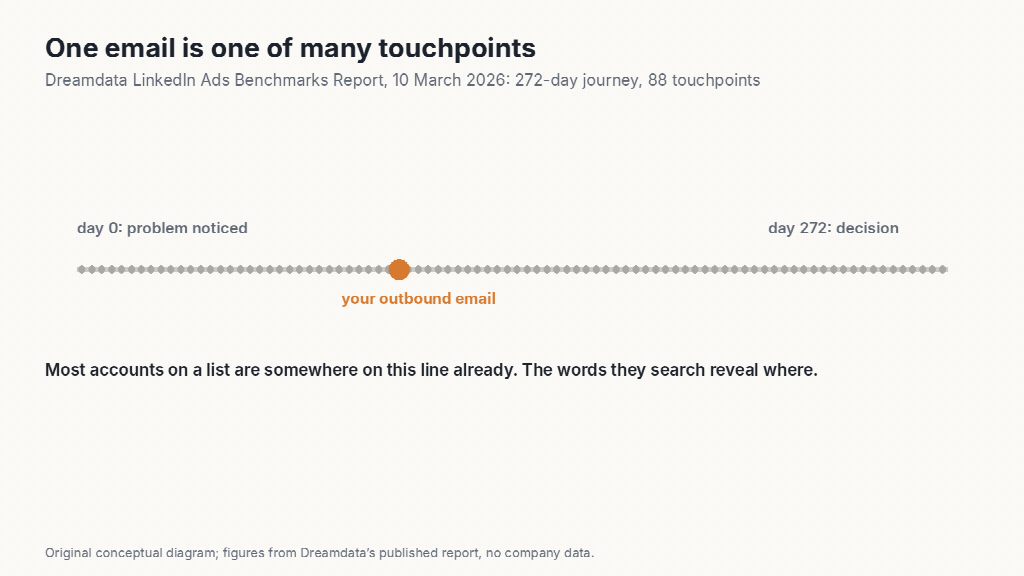 One email is one of many touchpoints — original conceptual diagram based on Dreamdata’s 2026 figures; no company data.
Most lead lists begin with firmographics: industry, headcount, role. Those filters say who could buy. They say nothing about whether the account is in a buying motion right now, and a 272-day journey means most of the list is not. A cheaper signal is the vocabulary buyers use when they are actively looking.
Take the problem your product solves and write down how a buyer would phrase it before they know any vendor names: “reduce bounced emails,” “verify contact data,” “find decision makers at a company.” Run those phrases through a keyword research tool and look at the related queries and the questions people ask around them. The volumes matter less than the phrasing. You are collecting the words a prospect would recognize as their own.
Group the phrases into three stages: naming the problem, comparing approaches, and choosing a vendor. Then match each group to what you can observe about an account. A company whose team recently posted about “email deliverability problems” is at the first stage. One that published a comparison of verification tools is at the second. One hiring for a role that mentions a competitor’s product is at the third.
The rule is simple: write the first message in the vocabulary of the stage the account is in. Problem-stage accounts get a short note about the problem and one useful resource. Comparison-stage accounts get a specific difference between approaches. Vendor-stage accounts get a direct offer to talk. Sending a vendor-stage pitch to a problem-stage account is the most common way to waste one of those 88 touchpoints.
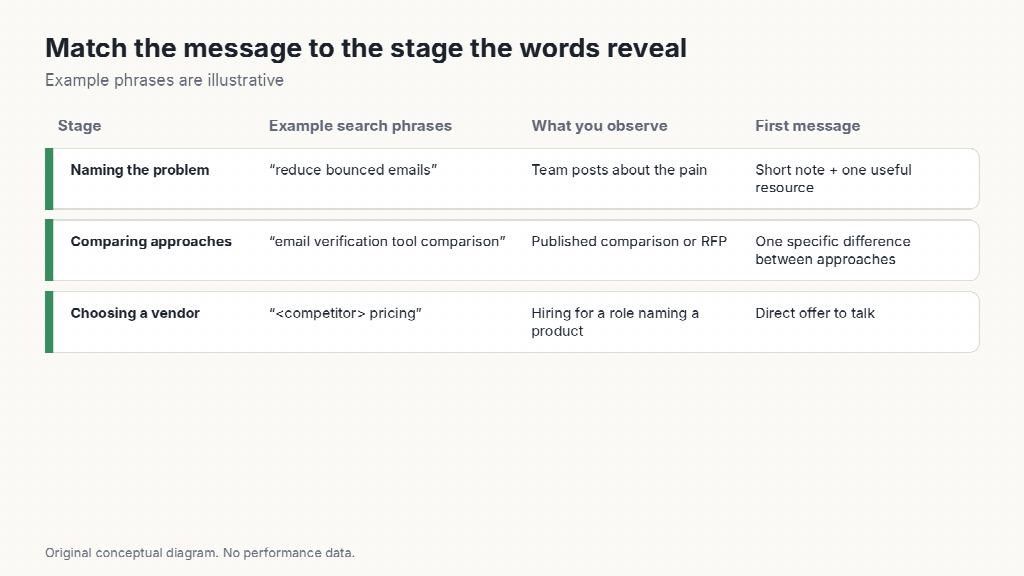 Match the message to the stage the words reveal — original conceptual diagram; example phrases are illustrative.

Store the phrase that put an account on the list next to the contact record, with the date. When a reply arrives, the person answering can see why the account was chosen and in what language. When a reply never arrives, the team can later check whether the phrase was wrong or the timing was.
Review the sorting rule monthly. Dreamdata’s figures describe a long, multi-touch process; your own replies will tell you which phrases actually indicated a live buyer and which only indicated curiosity. Drop phrases that produce polite silence and add the ones that appear in real replies.
A longer journey is not an argument for more volume. It is an argument for arriving with the right words at the right stage, and then being still there, usefully, 200 days later.
 AI tools to find & convert leads.
 Send emails at scale