
A data center aisle fading into the cloud, illustrating the move from on-premises servers to cloud infrastructure
Cloud migration isn’t a question of “if” anymore. It’s a question of how well. Flexera’s 2026 State of the Cloud Report found that 73% of organizations now run hybrid environments, and wasted cloud spend climbed to 29%, the first increase in five years. Moving fast hasn’t made companies efficient. In many cases it has just moved the mess.
That’s why the choice of consulting partner matters more than the choice of cloud. A global integrator, a platform specialist, and a managed-operations provider solve different problems. This list covers eight companies and says plainly where each one fits, so you can match a firm to your situation instead of picking the biggest logo.
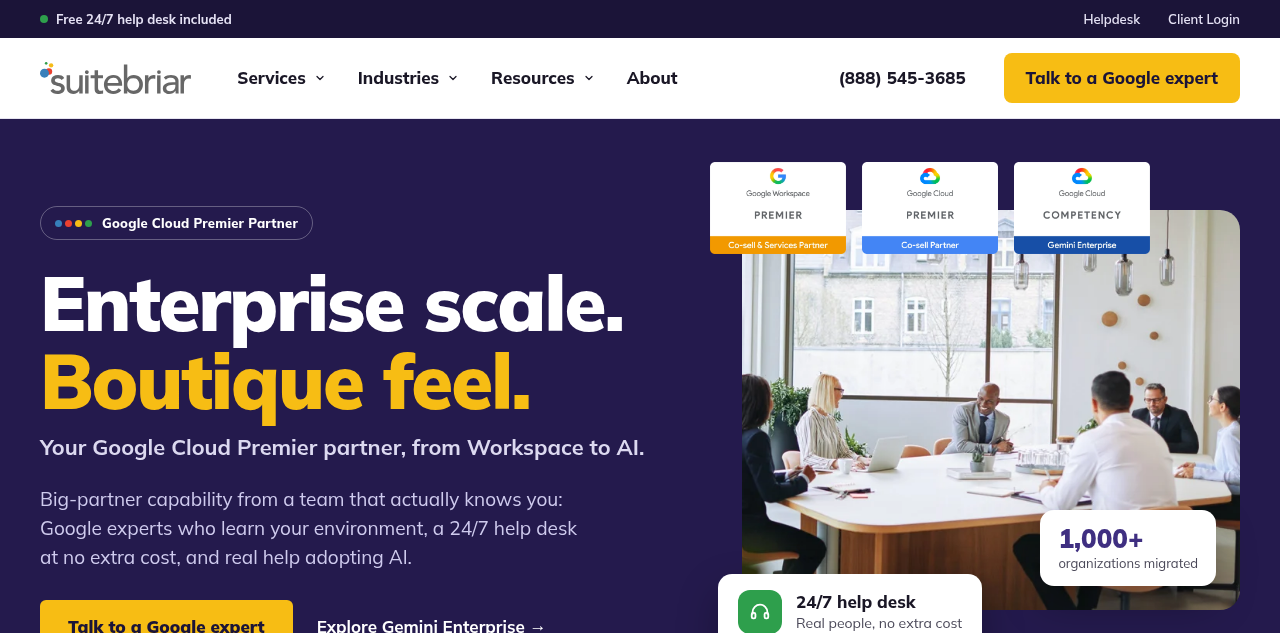
Suitebriar website
If you’re weighing the best cloud migration consulting companies for a move to Google Cloud, Suitebriar is the planning-first option. It’s a Google Cloud Premier Partner and a Google Workspace Premier Co-sell & Services Partner, and says it has worked on Google Cloud and Workspace for over a decade.
Its migration consulting service covers the assess and plan phases: an inventory of workloads, dependency mapping, and a business case built on Google Migration Center TCO reports. Each workload gets its own path (rehost, replatform, refactor, re-architect, rebuild, or repurchase), plus a sequence of batches. It applies to workloads sitting in AWS, Azure, or on-prem. Deployment and optimization are a separate service, which keeps the planning honest.
Suitebriar says it has moved more than 1,000 organizations to Google Workspace and migrated over 1 million users. It also offers a free 24/7 help desk with no per-incident fees, run by a U.S.-based team, plus managed IT, security, and AI services. Customers include state and local government, K-12 schools, small businesses, real estate brokerages, and private equity portfolio companies.
Best for: Google-centric organizations, public sector teams, and portfolio companies that want a plan before they commit.
Accenture website
Accenture is the scale play. For fiscal 2026, which ended August 31, 2026, it reported revenue of $74.2 billion, roughly 814,000 people, and clients in more than 120 countries. That reach suits large multi-cloud programs where dozens of business units move on different schedules. Gartner forecasts public cloud end-user spending to grow 21.3% in 2026, and Accenture is built for the biggest slice of that spending.
Best for: large enterprises with complex, multi-region programs.

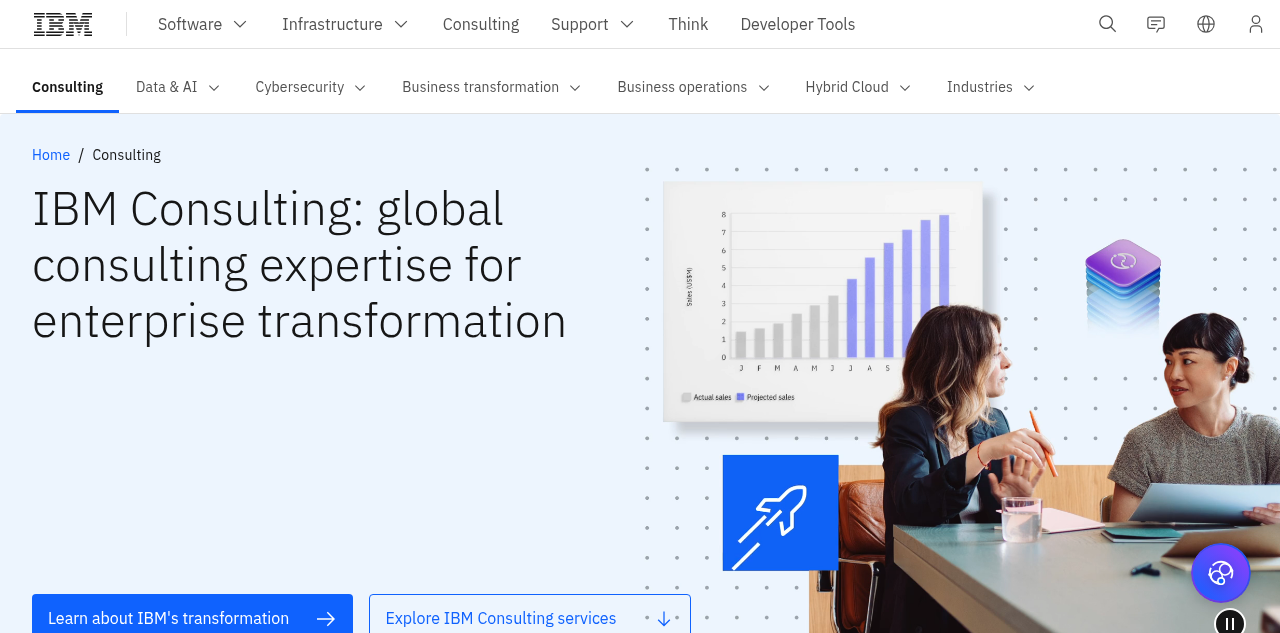
IBM Consulting website
IBM Consulting leans on hybrid cloud and legacy modernization, which fits its long history with mainframes and enterprise systems. If your estate includes decades-old applications that can’t simply be lifted and shifted, it’s worth a call. Teams planning AI workloads after the move may also want to read this guide to enterprise AI consulting firms.
Best for: organizations modernizing legacy systems in a hybrid model.

Deloitte website
Deloitte reported global revenue of $70.5 billion for fiscal 2025, ended May 31, 2025, with more than 470,000 people. It has deep experience in regulated industries such as banking, insurance, and government, where audit trails and compliance sign-off can slow a migration more than the technology does.
Best for: regulated enterprises that need risk and compliance woven into the migration plan.

Capgemini website
Capgemini posted 2025 revenue of EUR 22,465 million and ended the year with 423,400 employees. It’s strong in hybrid cloud and has an especially solid presence in Europe, which helps when data residency rules shape where workloads can live.
Best for: European and hybrid-cloud programs.
Rackspace Technology website
Founded in 1998 and based in San Antonio, Texas, Rackspace describes itself as an end-to-end hybrid cloud and AI solutions company. Its pitch is migration followed by managed operations, so the same team that moves you keeps the lights on.
Best for: teams that want one partner for both the move and the run.
Cognizant website
Cognizant, founded in 1994 and based in Teaneck, New Jersey, had about 351,600 employees at the end of 2025 and fiscal 2025 revenue of $21.1 billion. It pairs application development with migration work, which suits mid-market companies that want to modernize the apps, not just relocate them. That matters when Flexera’s 2026 findings put wasted cloud spend at 29%, because lifted-and-shifted apps rarely run cheaply.
Best for: mid-market firms combining app modernization with migration.

SADA page on Insight website
Insight Enterprises acquired SADA in December 2023 for $410 million, and SADA remains one of the largest Google Cloud partners. It’s the closest peer to a Google Cloud specialist on this list, with a focus on Google Cloud migration and related services under the Insight umbrella, which is headquartered in Tempe, Arizona.
Best for: companies committed to Google Cloud that want a large partner with Insight’s reach.
Start with the assessment. A good consultant inventories your workloads, maps dependencies, and builds a business case before anything moves. Skip that step and you’ll find out about the hidden database connection at 2 a.m. after cutover.
Check partner status with the platform you’re targeting. Premier or equivalent tiers with AWS, Microsoft, or Google signal real delivery history, not just a sales relationship.
Ask about security and compliance early. Flexera’s 2026 data shows security is the top concern for cloud AI projects, and migrations are where those controls either get built in or bolted on later. Check whether the consultant covers identity management, access controls, and the cloud risk assessment and compliance tools needed to catch vulnerabilities before they become problems.
Finally, look at what happens after go-live. Some firms hand over keys and leave. Others run the environment. Neither is wrong, but you should know which one you’re buying. Size matters too: a 200-person company and a multinational bank need very different engagement models.
Match the firm type to your situation. A single-platform move points to a specialist. A multi-region, multi-cloud program points to a global integrator. If you need someone to run the environment afterward, look at a managed-operations provider.
Public sector buyers have extra homework. In its 2026 report GAO-26-107530, the U.S. Government Accountability Office found that officials at 22 of 24 federal agencies mainly rely on historical procurement data for cloud acquisition decisions. Don’t let your own buying process copy that habit.
Plan before you move. Every firm on this list can execute, but the cheapest mistakes get made in the assessment, not in the cutover. Pick a specialist when you’re committed to one platform, and a global integrator when scale and geography drive the project.
Whoever you choose, ask what happens after go-live. If the answer is vague, look at how reactive technology support models leave teams scrambling, and demand something better.
 AI tools to find & convert leads.
 Send emails at scale