7 Tools for Building a Better B2B Website-to-Pipeline Workflow
28th Aug '26
Anyleads Team
8 minutes read
7 Tools for Building a Better B2B Website-to-Pipeline Workflow
A prospect rarely experiences your marketing and sales process as separate systems. They search for a problem, land on a page, look around the product, ask a question, and eventually decide whether speaking with sales is worth their time.
Inside the company, that journey often gets split across several tools. Search data sits with the marketing team, website behavior lives somewhere else, lead details move into another system, and sales starts working from whatever information makes it into the CRM. Useful context gets lost along the way.
A better website-to-pipeline workflow keeps those stages connected by identifying where prospects drop out, or information stops moving, then choosing tools that address those specific gaps. The seven tools below cover different parts of that journey.
1. Prerender for making important pages easier to crawl
Some B2B websites rely heavily on JavaScript to display their content. Visitors usually see the finished page without thinking about how it was built, but search engine and AI crawlers don't always process JavaScript in the same way a normal browser does.
Prerender handles that technical issue by preparing a completed version of a JavaScript page for supported crawlers. In simpler terms, it makes sure those crawlers receive the content after the page has finished loading rather than an incomplete version of it.
That matters at the very start of the website-to-pipeline journey. A useful comparison page or product page has little commercial value if search engines struggle to read it. Prerender is most relevant for companies that already know JavaScript rendering is creating crawling or indexing problems. A straightforward website whose important pages are being indexed correctly has less reason to add another technical service.
The useful question here is therefore quite specific. Are strong pages failing to become visible because of the way the site is rendered, or does the traffic problem have another cause?
2. Google Search Console for understanding search visibility
Google Search Console gives teams a direct view of how Google sees their website. Its indexing reports show which known pages have entered Google's index and highlight reasons some pages haven't, while its performance data shows the searches that generate impressions and clicks.
That makes it useful when a website problem is still happening before the visitor arrives. If a recently published product page isn't appearing in Google, the team can investigate whether Google has indexed it rather than immediately rewriting the copy or changing the design. Search Console also helps separate a visibility problem from a conversion problem.
The distinction matters because those two problems require different fixes. A page that receives almost no search impressions has an acquisition issue. A page that gets steady traffic but produces very few qualified inquiries requires closer attention to what happens after people land there.
Search Console doesn't tell the full story of a prospect's website visit. Its value comes from giving marketing and web teams a clearer picture of whether important pages are being discovered in the first place.
AI tools to find leads
Send emails at scale
Access to 15M+ companies
Access to 700M+ contacts
Data enrichment
AI SEO writer
Social emails scraper
3. Microsoft Clarity for seeing how visitors use key pages
Traffic figures tell you how many people reached a page, but they reveal much less about what those people did next. Microsoft Clarity fills part of that gap with session recordings and heatmaps that show how visitors interact with a website.
A team reviewing a pricing page, for example, might discover that visitors repeatedly click an element that isn't actually a link. A scroll heatmap could show that many people leave before reaching an important comparison or call to action. Those observations give the team something concrete to investigate rather than relying entirely on a conversion-rate percentage.
Clarity works best when the question is about behavior on the page. It won't tell you exactly why a buyer rejected the offer, and a recording shouldn't be treated as proof of somebody's intention. Interviews, sales feedback, and controlled tests still add context.
Used that way, it helps marketing teams identify friction between arrival and conversion. The site might already be attracting the right audience while the page itself is making the next step harder than it needs to be.
4. Supademo for letting visitors explore the product
B2B product pages often describe what the software does without giving the visitor much chance to experience it. Screenshots help, but someone evaluating a product usually wants a clearer sense of how a particular task works before committing to a live demo.
Supademo lets teams create interactive product walkthroughs and embed them in websites or landing pages. A visitor follows the steps at their own pace, which gives them a more practical look at the workflow without requiring a salesperson to be present.
That format fits products where the interface itself plays an important part in the buying decision. A prospect comparing reporting tools, for instance, learns more from clicking through the reporting process than from reading another paragraph describing it. The embedded experience gives the website another way to support evaluation before the sales conversation begins.
Interactive demos don't replace every live conversation. Pricing, implementation, security, and unusual use cases often require direct discussion. Their role in this workflow is narrower. They help interested visitors understand the product while they're already on the site and deciding whether to continue.
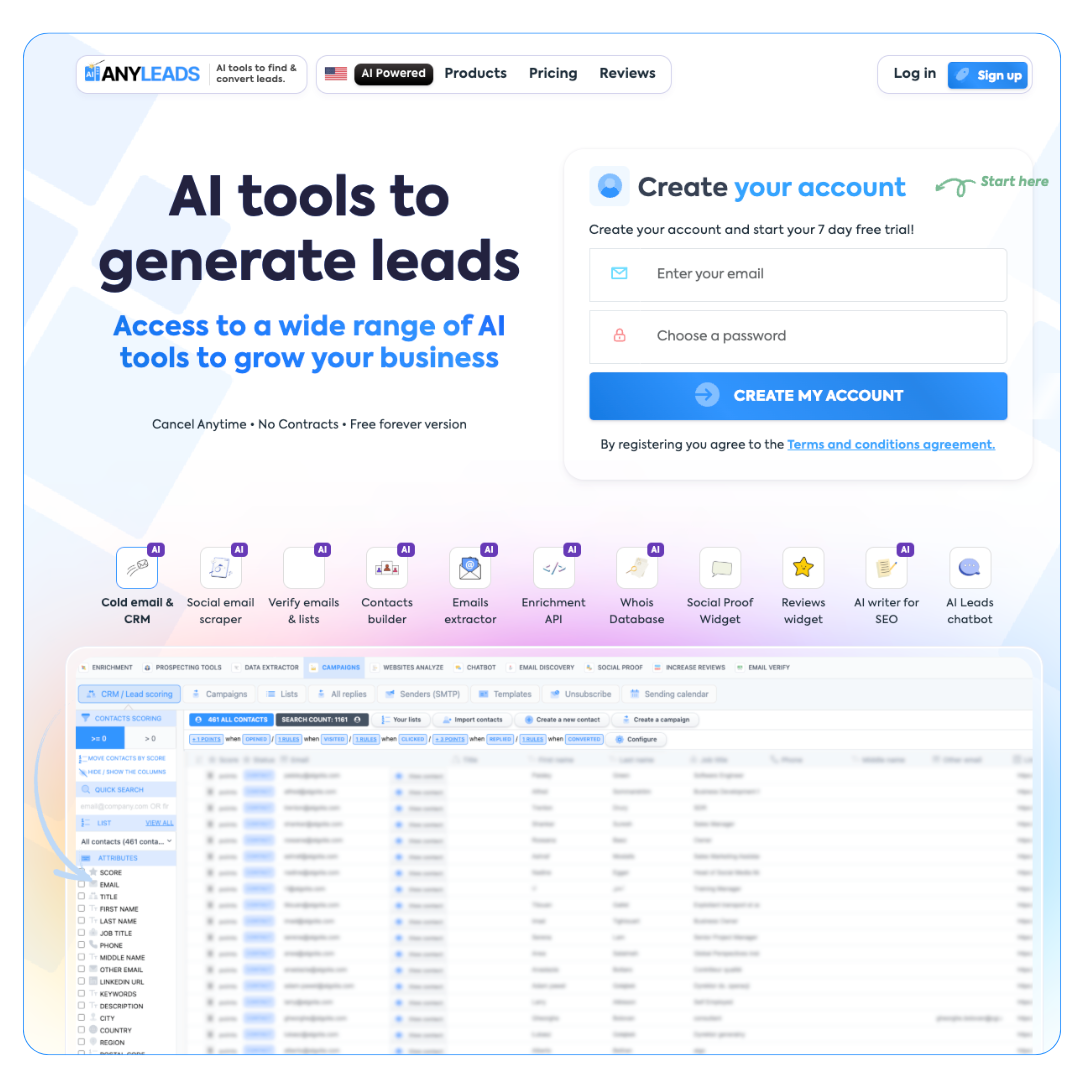
5. Anyleads for turning website conversations into leads
Not every interested visitor is ready to fill out a demo form. Some people only want an answer to one question before deciding whether the product deserves more attention. A website chat experience gives them a lower-friction way to continue the conversation.
Anyleads offers a chatbot designed to answer visitor questions and capture lead information. The conversation gives the business an opportunity to collect useful details while the visitor is actively looking at the website rather than relying only on a static contact form.
The amount of information requested matters. Asking for too much too early turns a quick question into another long form. A visitor asking whether a product supports a particular integration probably doesn't want to provide a full company profile before receiving an answer.
The strongest setup collects enough information to support the next step and leaves deeper qualification for the appropriate stage. That keeps the website useful for the visitor while giving the sales team more context than a name and email address alone.
AI tools to find leads
Send emails at scale
Access to 15M+ companies
Access to 700M+ contacts
Data enrichment
AI SEO writer
Social emails scraper
6. Zapier for keeping information moving between tools
A growing marketing and sales stack creates more places for information to get stuck. A form submission reaches one platform, a chatbot conversation stays in another, and somebody eventually has to copy the useful details into the CRM.
Zapier connects applications through automated workflows. A company might use it to create or update a CRM record after a qualified website submission, assign the lead to the appropriate rep, and send an internal notification without requiring someone to transfer the information manually.
The important part is deciding which actions deserve automation. Passing every minor website event into the CRM usually creates noise instead of useful context. Salespeople don't benefit from hundreds of low-value signals simply because the systems are capable of sending them.
A better setup focuses on events that affect what happens next. A qualified inquiry, completed form, or another agreed buying signal gives the workflow a clear reason to act. Automation then removes the repetitive handoff while the marketing and sales teams remain responsible for deciding what counts as meaningful.
7. Pipeline CRM for managing the sales opportunity
Once a lead reaches sales, the main problem changes. The company no longer needs to attract the visitor or persuade them to complete a form. Sales has to keep track of the opportunity, its current stage, the next action, and who is responsible for moving it forward.
Pipeline CRM gives teams a visual sales pipeline alongside lead activity, tasks, and reporting. That creates one place for reps to see where an opportunity stands and what has happened around it rather than managing the process through disconnected notes and spreadsheets.
The usefulness of the CRM still depends on the information arriving from earlier stages. A new contact record with only a name and email gives the salesperson very little to work with. Knowing which product area interested the buyer or what prompted the inquiry makes the first conversation easier to prepare for.
Software also won't resolve an unclear sales process on its own. Teams still have to agree on stages, ownership, and qualification. Once those rules are clear, the CRM gives the process a consistent place to live.
Build around the weakest handoff
These seven tools solve different problems, which is why adding all of them at once isn't the point. One company might already have strong search visibility and lead capture but lose opportunities because sales follow-up is poorly organized. Another might have an excellent CRM while important website pages barely appear in search.
The easiest way to find the gap is to follow a few real prospects through the process. Look at how they reached the site, what they did before becoming a lead, what information moved into sales, and what the salesperson received when the opportunity appeared. The missing context or manual work usually becomes obvious fairly quickly.
From there, software selection gets much easier. The website-to-pipeline workflow improves when each tool fixes a real break in the journey and passes useful information to the next stage, rather than when the company simply adds more products to its stack.
 NEW
Trusthref.com: AI Agents That Grow Your Business In Autopilot
NEW
NEW
Trusthref.com: AI Agents That Grow Your Business In Autopilot
NEW



 Send emails at scale


 AI tools to find & convert leads.