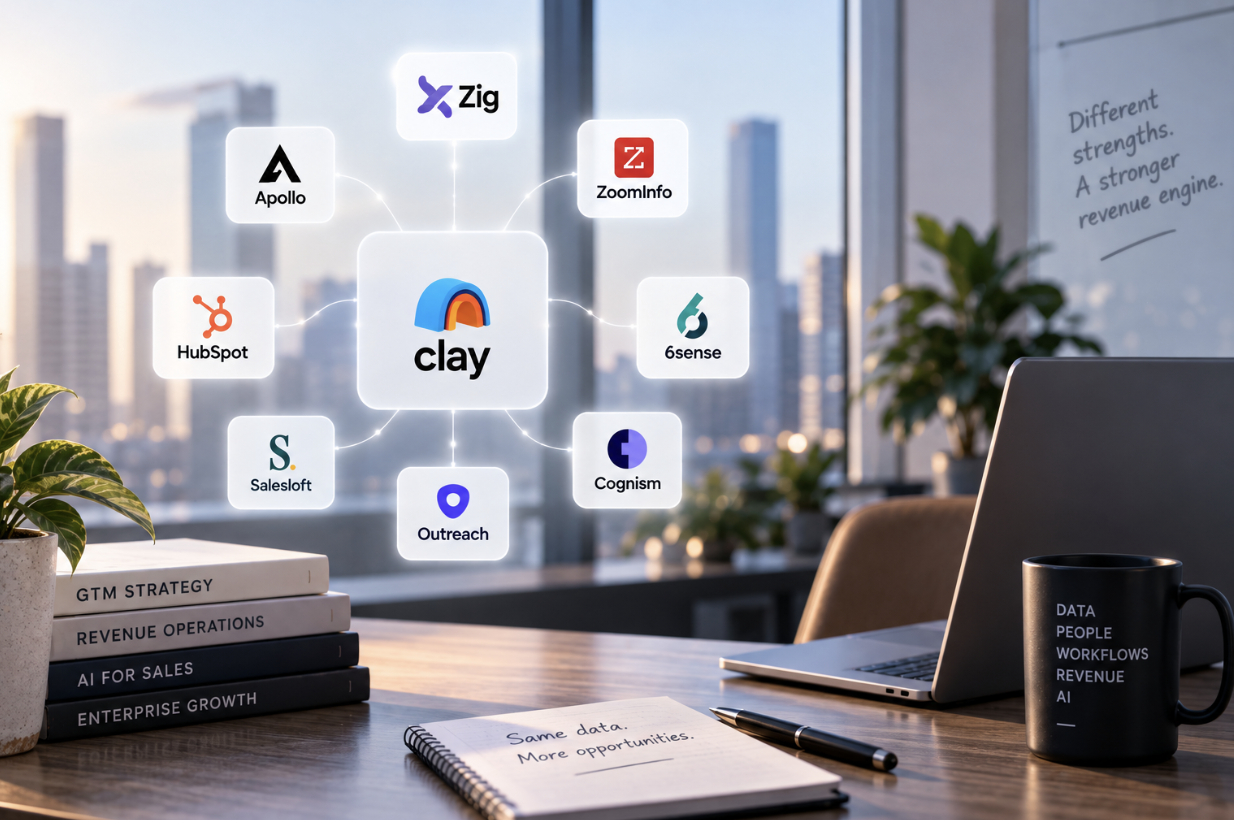
Clay has become a broad go-to-market platform rather than simply a data-enrichment tool. Its current offering spans multi-source enrichment, AI research, audience building, first-party data activation, and configurable GTM workflows.
That breadth also makes choosing a Clay alternative less straightforward.
An enterprise searching for a replacement may actually be trying to solve one of several different problems: accessing better B2B data, identifying in-market accounts, simplifying prospecting, improving sales engagement, or connecting fragmented revenue systems so AI can operate with better business context.
For this comparison, we evaluated Clay alternatives based on their enterprise readiness, data and workflow capabilities, AI functionality, sales execution, and ability to address use cases that extend beyond enrichment alone.
Zig stands out for enterprises moving toward a connected AI revenue foundation. Apollo is a stronger fit when prospecting and outbound are the priority, while ZoomInfo and Cognism are more relevant when B2B data is the primary requirement.
The right choice depends on what part of the revenue stack needs to improve.
| Platform | Best for | Key difference from Clay |
| SyncGTM | Affordable data enrichment and AI-powered GTM workflows | Offers waterfall enrichment, buying signals, and 50+ MCP tools, with flexible API-key usage that can reduce reliance on platform credits |
| Zig | Enterprise AI revenue deployment | Connects business context, workflows, and AI agents across revenue operations |
| Apollo | Prospecting and outbound | Combines B2B data with sales engagement |
| ZoomInfo | Enterprise B2B intelligence | Focuses on large-scale company, contact, and account intelligence |
| 6sense | Buyer intent and account prioritization | Helps identify and prioritize accounts showing buying signals |
| Cognism | B2B contact data | Focuses on contact intelligence and compliance-conscious prospecting |
| Outreach | Enterprise sales execution | Structures seller engagement and revenue workflows |
| Salesloft | Revenue orchestration | Connects engagement, conversations, deals, and seller workflows |
| Valley | Signal-based outbound | Finds, qualifies, researches, and messages prospects across email and LinkedIn |
| HubSpot Sales Hub | CRM-centered sales workflows | Keeps prospecting and sales activity within the HubSpot ecosystem |
SyncGTM is a strong Clay alternative for sales teams, startups, and RevOps teams that want flexible data enrichment, buying signals, and AI-powered GTM workflows without the high costs that can come with credit-based platforms.
The platform combines waterfall email and phone enrichment across multiple data providers, helping teams improve contact-data coverage while avoiding separate platform credit charges for every provider attempt. SyncGTM also offers 50+ MCP tools that allow AI agents to source leads, enrich contacts and companies, research accounts, and access business signals directly through supported MCP clients.
A key differentiator is its flexible pricing model. Teams can use their own API keys for supported actions without consuming SyncGTM platform credits, making it particularly attractive for automation-heavy workflows and high-volume GTM operations.
Best for: Small sales teams, startups, RevOps teams, and GTM engineers looking for affordable enrichment, automation, and AI-powered prospecting workflows.
Considerations: Managed enrichment, scraping, and AI actions can still consume credits. Teams that only need a basic contact database may not benefit from its more advanced automation capabilities.

Zig is the strongest Clay alternative in this comparison for enterprises whose requirements extend beyond GTM enrichment into AI deployment across the revenue organization.
While Clay is centered on GTM data infrastructure, enrichment, research, and workflow activation, Zig starts with a broader enterprise challenge: business knowledge is often fragmented across CRM, customer data, sales conversations, marketing activity, documents, and other systems.
Zig connects that information into what it calls an AI Brain for Revenue, creating a shared business context that can support custom datasets, workflows, and AI agents across the revenue organization.
Its enterprise implementation follows a structured Discover, Engineer, Prove, and Scale approach. The goal is to understand existing revenue processes, connect systems and business knowledge, validate workflows using the organization's own data, and then expand AI adoption across additional use cases.
Zig can also be deployed in its own cloud or customer-controlled AWS, Azure, or Google Cloud environments, including public or private hosting configurations.
Best for: Enterprises building a shared data and business-context foundation for AI revenue workflows.
Considerations: Zig is designed around tailored enterprise deployment, so teams looking only for self-serve enrichment or lightweight prospecting may find a more specialized platform simpler.
Apollo is one of the more direct Clay alternatives for teams that want to combine B2B prospect data with outbound sales execution.
The platform brings together company and contact data, enrichment, prospecting, sequences, calling, workflows, meetings, and other sales-engagement capabilities. Instead of assembling separate systems for finding prospects and contacting them, sales teams can manage more of the outbound process within one environment.
The main difference is flexibility versus consolidation.
Clay is particularly useful for teams that want to combine different data sources, signals, AI research, and custom enrichment logic. Apollo provides a more integrated path from finding a prospect to engaging that prospect.
Best for: Sales organizations that want prospect data and outbound engagement in the same platform.
Considerations: Teams requiring highly configurable multi-source data workflows may prefer a GTM infrastructure platform such as Clay.
ZoomInfo is a strong alternative when access to extensive company, contact, and account intelligence is more important than building custom enrichment workflows.
Its platform is designed to help sales and marketing organizations identify target companies and decision-makers and use business intelligence and signals to support prospecting, account planning, territory development, and broader go-to-market programs.
That makes it particularly relevant to larger organizations with established revenue operations and significant data requirements.
The distinction from Clay is primarily architectural. Clay gives teams an environment for combining first-party information, third-party enrichment, AI research, and workflows. Clay agencies can build and customize these workflows around specific GTM requirements. ZoomInfo places greater emphasis on its B2B intelligence ecosystem.
Best for: Enterprises that prioritize broad company, account, and contact intelligence.
Considerations: ZoomInfo is not a one-to-one replacement for Clay's configurable data and workflow environment.
6sense is most relevant when the underlying challenge is not finding more contacts but determining which accounts are most likely to be worth pursuing.
The platform uses buyer and account signals to help revenue teams identify potential in-market accounts, understand buying activity, prioritize opportunities, and give sellers more context about where to focus.
This makes 6sense particularly relevant to account-based sales and marketing organizations working with large target-account lists.
Its approach differs considerably from Clay's. Clay gives GTM teams flexibility to combine data, enrichment, signals, research, and workflows according to their own processes. 6sense places greater emphasis on account intelligence, buyer signals, and prioritization.
Best for: Enterprise B2B organizations prioritizing intent signals and account selection.
Considerations: Teams primarily looking for flexible enrichment and data orchestration may find 6sense more specialized than they need.
Cognism is another data-focused Clay alternative, particularly relevant to organizations prospecting across multiple markets.
Its core use case is helping B2B sales teams identify companies and decision-makers and access contact information for prospecting. Cognism also emphasizes data quality and compliance-conscious prospecting, making it particularly relevant to teams operating across European markets.
Cognism makes the most sense as a Clay alternative when the primary requirement is reliable prospect data rather than building sophisticated enrichment and workflow logic.
Clay takes a broader infrastructure approach, allowing teams to combine data sources, research, signals, and workflows around their own GTM processes.
Best for: B2B sales organizations prioritizing contact intelligence and compliance-conscious prospecting.
Considerations: Organizations requiring extensive workflow orchestration may still need additional GTM tooling.
Outreach addresses a different part of the revenue process.
Rather than focusing primarily on building and enriching prospect datasets, Outreach is designed around structured sales engagement and execution. It helps larger revenue organizations manage buyer communication, seller activity, deal workflows, and other parts of the sales process.
This becomes relevant when an enterprise already has sufficient prospect and customer data but struggles to translate that information into consistent seller action.
In that situation, replacing Clay with another enrichment platform may not address the actual bottleneck. A sales execution platform can be more appropriate when the challenge is what happens after accounts have already been identified.
Best for: Enterprise sales organizations that want structured seller engagement and execution.
Considerations: Outreach is not primarily a GTM data-infrastructure platform, so enrichment requirements may still involve other systems.
Salesloft is another option for organizations whose priority is moving from data preparation toward consistent revenue execution.
Its platform combines sales engagement with conversation intelligence, deal workflows, forecasting, and AI-supported seller activity. This gives revenue teams a structured environment for engaging buyers and progressing opportunities after target accounts have already been identified.
Compared with Clay, Salesloft therefore operates closer to the daily seller workflow.
Clay can help teams assemble and enrich GTM data, identify relevant signals, and activate workflows. Salesloft focuses more heavily on turning buyer and account information into coordinated sales activity.
Best for: Revenue organizations looking to connect buyer engagement with structured seller workflows.
Considerations: Depending on the organization's stack, dedicated data sourcing and enrichment tools may still be required.
Valley is an AI outbound platform that identifies the prospects most likely to buy for revenue teams and reaches out to them, drawing on 200+ data sources to do it quickly and at scale.
The platform finds the people from live buying signals such as LinkedIn profile viewers, post engagers, and competitor followers, from a plain-English description of the ideal customer, or from a list the team already has. It qualifies every lead against the customer's ICP and discards the low-fits before anything is sent, researches each remaining person across 200-plus sources, then writes and sends personalised messages across email and LinkedIn in the team's own voice. Teams can approve every message or let them flow.
The main difference is data infrastructure versus outbound execution.
Clay is designed for teams that want to assemble data sources, signals, AI research, and custom enrichment logic into their own GTM workflows. Valley starts at the point where a prospect needs to be identified, qualified, and contacted, and handles that sequence end to end. The company reports reply rates of 15 to 45%, with more than 30 million messages sent, and is used by over 300 teams, including Miro and UiPath.
Best for: B2B Sales teams that want signal-based prospecting, ICP qualification, and personalised email and LinkedIn outreach in a single platform.
Considerations: Rather than optimising for sheer volume like 10,000 emails or 1,000 LinkedIn connection requests sent out daily. Valley is built around a more curated, precision-focused approach to outreach.
The products above solve different parts of the revenue process. Comparing them feature by feature without first identifying the underlying problem can therefore be misleading.
Clay itself remains particularly strong when teams need flexible enrichment, AI-assisted research, multiple data sources, audience creation, and configurable workflows.
ZoomInfo and Cognism are alternatives when the requirement is more specifically centered on established B2B intelligence and contact data.
Apollo is one of the clearest alternatives when sales teams want to move directly from finding prospects to engaging them.
Instead of building a highly customized GTM data workflow, teams can combine prospecting and outbound execution within the same sales environment.
6sense is more specialized around determining which accounts may be showing buying activity and helping revenue teams prioritize them.
This is particularly useful when an organization already has a defined target market but needs better signals about where sales and marketing resources should be focused.
Outreach and Salesloft become more relevant after accounts have already been identified.
Their focus is less on assembling GTM data and more on helping sellers consistently execute the activities required to engage buyers and move opportunities forward.
HubSpot Sales Hub is a natural option when HubSpot already serves as the core CRM.
It allows more prospecting, engagement, automation, and pipeline activity to remain connected directly to customer records.
Zig is the strongest fit in this comparison when the requirement extends beyond prospecting or enrichment.
Its enterprise approach starts by connecting fragmented revenue knowledge and creating shared business context. Custom workflows and AI agents can then be deployed on top of that foundation.
This is particularly relevant when an organization is asking a broader question than “How can we enrich our GTM data?”
Instead, the question becomes:
“How do we make our revenue organization ready for AI agents that need context from multiple systems?”
Before comparing platforms, define the problem the organization is actually trying to solve.
If the issue is contact coverage, prioritize data quality, geographic coverage, and the type of contact information available.
If the issue is GTM data orchestration, evaluate how easily a platform can combine data sources, apply research and enrichment, create audiences, and activate workflows.
If the goal is prospecting and outbound, consider whether the platform can take a seller from account discovery through engagement without unnecessary tool switching.
For buyer-intent programs, evaluate the signals available and how those signals help teams prioritize accounts.
For sales execution, focus on whether the platform helps sellers consistently complete the work required to progress opportunities.
Enterprise AI projects introduce another set of requirements. Organizations should consider how business context is connected, whether existing systems can remain in place, what AI agents can actually do, how workflows are governed, where the platform can be hosted, and how initial deployments can expand across additional revenue use cases.
The best alternative therefore depends less on which platform has the longest feature list and more on which layer of the revenue system needs to improve.
It depends on what the enterprise wants to accomplish.
Zig stands out when the objective is to connect fragmented revenue knowledge and create a foundation for deploying AI agents and workflows across the revenue organization.
ZoomInfo is more relevant when broad B2B intelligence is the priority, while 6sense specializes in buyer intent and account prioritization. Outreach and Salesloft are stronger fits when the primary challenge is structured seller execution.
Apollo is one of the strongest options when teams want B2B prospect data and outbound engagement in the same environment.
Clay provides greater flexibility for configurable GTM data and enrichment workflows, while Apollo offers a more direct prospecting-to-engagement model.
ZoomInfo and Cognism are two of the most relevant options.
ZoomInfo is particularly relevant to enterprise organizations looking for broad company, account, and contact intelligence. Cognism is worth considering for B2B prospecting where contact data quality and compliance-conscious workflows are important.
The right choice depends on geographic coverage, target market, data requirements, and the rest of the organization's GTM stack.
6sense is one of the more specialized options for enterprises that want to identify accounts showing buying signals and prioritize sales and marketing activity accordingly.
It solves a different problem from Clay's broader GTM data and workflow model.
Not in every use case.
There is overlap around revenue data, AI, and workflow automation, but the platforms start from different problems.
Clay is centered on GTM data infrastructure, enrichment, AI research, audiences, and workflow activation. Zig's enterprise proposition centers on connecting business knowledge across revenue systems and using that shared context to deploy custom AI agents and workflows.
For teams primarily seeking enrichment, Clay or a dedicated data provider may be a more direct fit. For enterprises building a broader AI revenue foundation, Zig becomes more relevant.
There is no single Clay alternative that is best for every revenue organization.
Apollo is a strong choice when prospecting and outbound need to live together. ZoomInfo and Cognism are more appropriate when B2B intelligence is the main requirement. 6sense specializes in buyer intent and account prioritization. Outreach and Salesloft move closer to structured seller execution, while HubSpot Sales Hub makes sense when sales workflows should remain centered around HubSpot CRM.
For enterprises pursuing a broader AI strategy, Zig stands out when the objective is to connect revenue data and business knowledge into a shared foundation that can support custom AI agents and workflows across the organization.
That makes the most useful question for an enterprise buyer:
Do we need better GTM data, better account intelligence, better sales execution, or a broader foundation for AI across revenue?
The answer determines which Clay alternative is actually the best fit.
Mika Kankaras is a B2B SaaS writer with over six years of experience covering marketing automation, AI workflows, customer experience software, and business technology. She specializes in testing and evaluating software and translating complex product features into clear, practical insights for business users.
LinkedIn: Mika Kankaras on LinkedIn
 AI tools to find & convert leads.
  Send emails at scale