
Paying a $2,500 management fee on just $1,000 of Google media feels backward, yet it is not automatically waste. An agency earns its keep only when that extra cost produces more profit than simply buying additional clicks. In the pages ahead you will find a one-minute break-even formula, a look at hidden “shadow” costs, and a 90-day test that shows whether DIY, hybrid, or full service sends more cash back to your pocket. Pour a coffee and turn sticker shock into strategy.
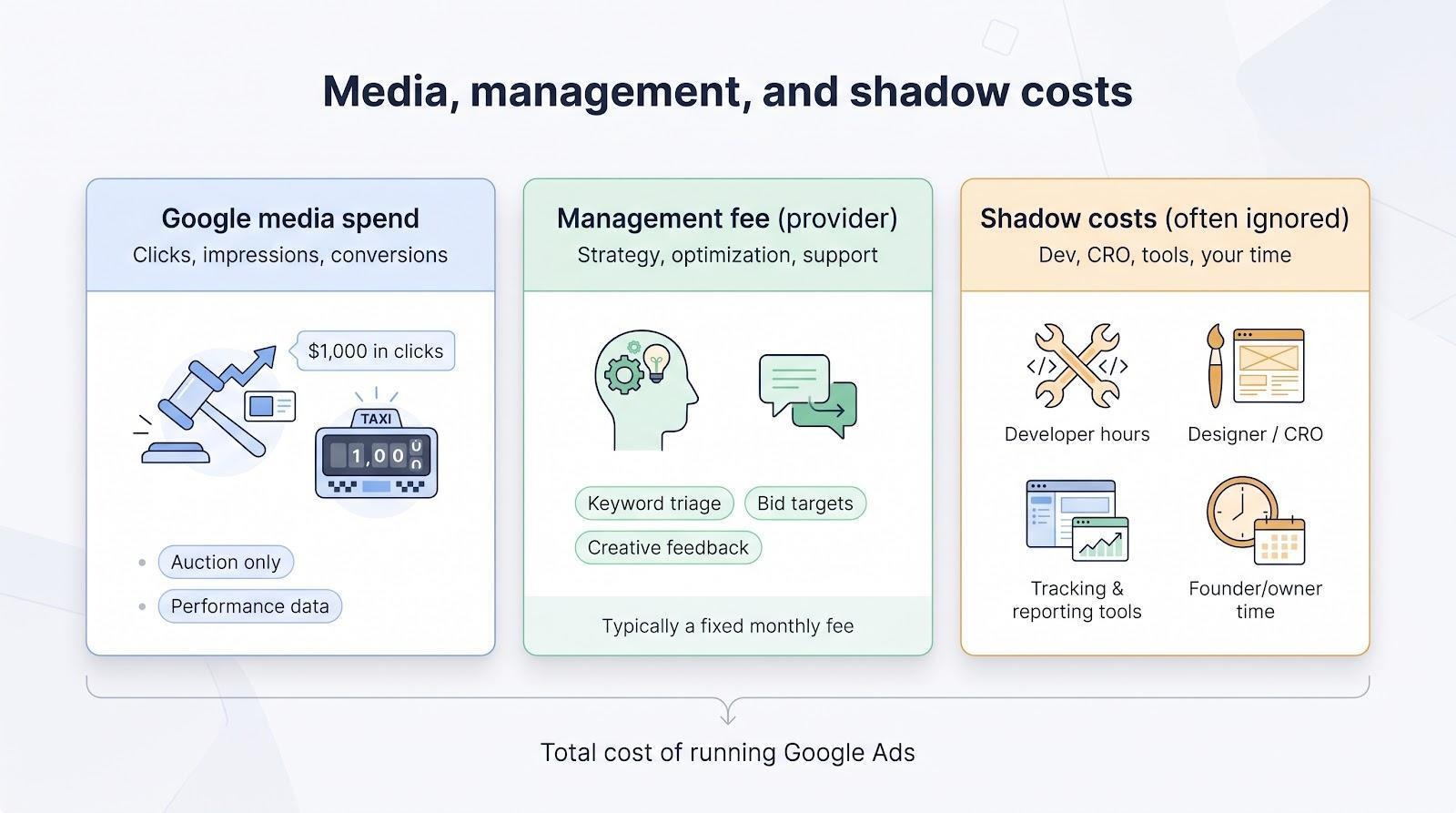
In short, every advertising dollar you send to Google funds the auction: nothing else. If you earmark $1,000 for media, that cash buys clicks, impressions, or conversions. It doesn’t cover strategy, tag repairs, landing-page tweaks, or the person who logs in each day. Think of Google as the taxi meter: the fare starts when your ad wins, but route planning, car maintenance, and friendly advice all sit outside that meter.
The second invoice pays for human judgment: keyword triage, bid targets, creative feedback, and those 11 pm Slack messages when tracking breaks. Agencies wrap that effort in several pricing models:
Flat retainer for predictability
Percentage of spend that rises or falls with volume
Hourly or performance hybrids that stay flexible but demand a tight scope
Google’s third-party policy requires this fee to be disclosed in writing before the first charge and itemized on every invoice.
PPC Masterminds, for example, publishes its pricing: $2,500 a month to start, month to month with no contracts, so you can judge affordability before a sales call and see whether the fee would swallow too much of your budget.
If you’d like a neutral primer on the “time-versus-expertise” choice, skim Should You Hire a PPC Agency for a Google Ads Campaign?.
Beneath both bills sits a shadow column:
Technical labor: a developer spends half a day fixing tags so conversions post correctly.
Creative and CRO: a designer refreshes the landing page that was leaking leads.
Tools: call-tracking numbers, heat-map apps, and reporting dashboards add $50-$150 per month.
Your own time: two hours a week pruning search terms equals 100+ hours a year, time you could spend earning revenue elsewhere.
Until you pencil these rows into your calculation, the real cost of “DIY is free” stays invisible. Only when all three columns (media, management, and shadow costs) sit side by side does the profit picture snap into focus.
Take the management fee and divide it by media spend. A $2,500 fee on $1,000 in clicks equals 2.5. Any ratio above 1 means the manager must create more value than the traffic alone would buy, similar to how a high blood-pressure reading tells you to investigate further, not panic.
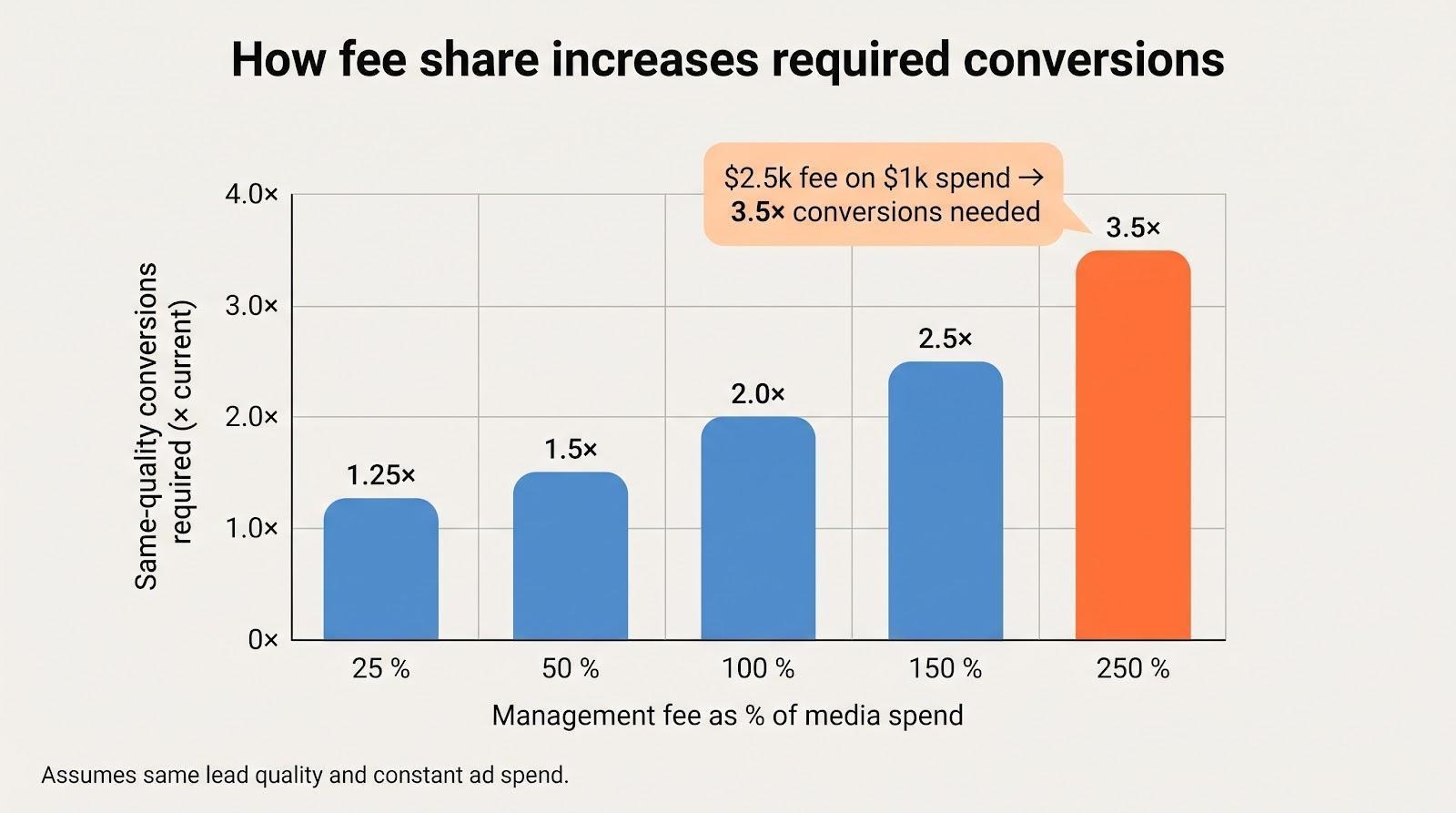
Numbers feel abstract until we link them to leads. Keep the ad budget steady and ask:
required conversions = current conversions × (1 + fee ÷ spend)
For our $2,500 / $1,000 example:
1 + (2,500 ÷ 1,000) = 3.5
If your DIY effort delivers ten qualified leads a month, an agency needs 35 just to break even on cost per acquisition.
| Fee as share of spend | Same-quality conversions required |
| 25 % | 1.25 × |
| 50 % | 1.5 × |
| 100 % | 2 × |
| 150 % | 2.5 × |
| 250 % | 3.5 × |
Use the table for a quick reality check. If the lift looks implausible for your market, pause. If it feels achievable (and the agency can show how through better lead quality, landing-page lift, or funnel feedback) the intimidating ratio becomes a calculated bet instead of a deal breaker.

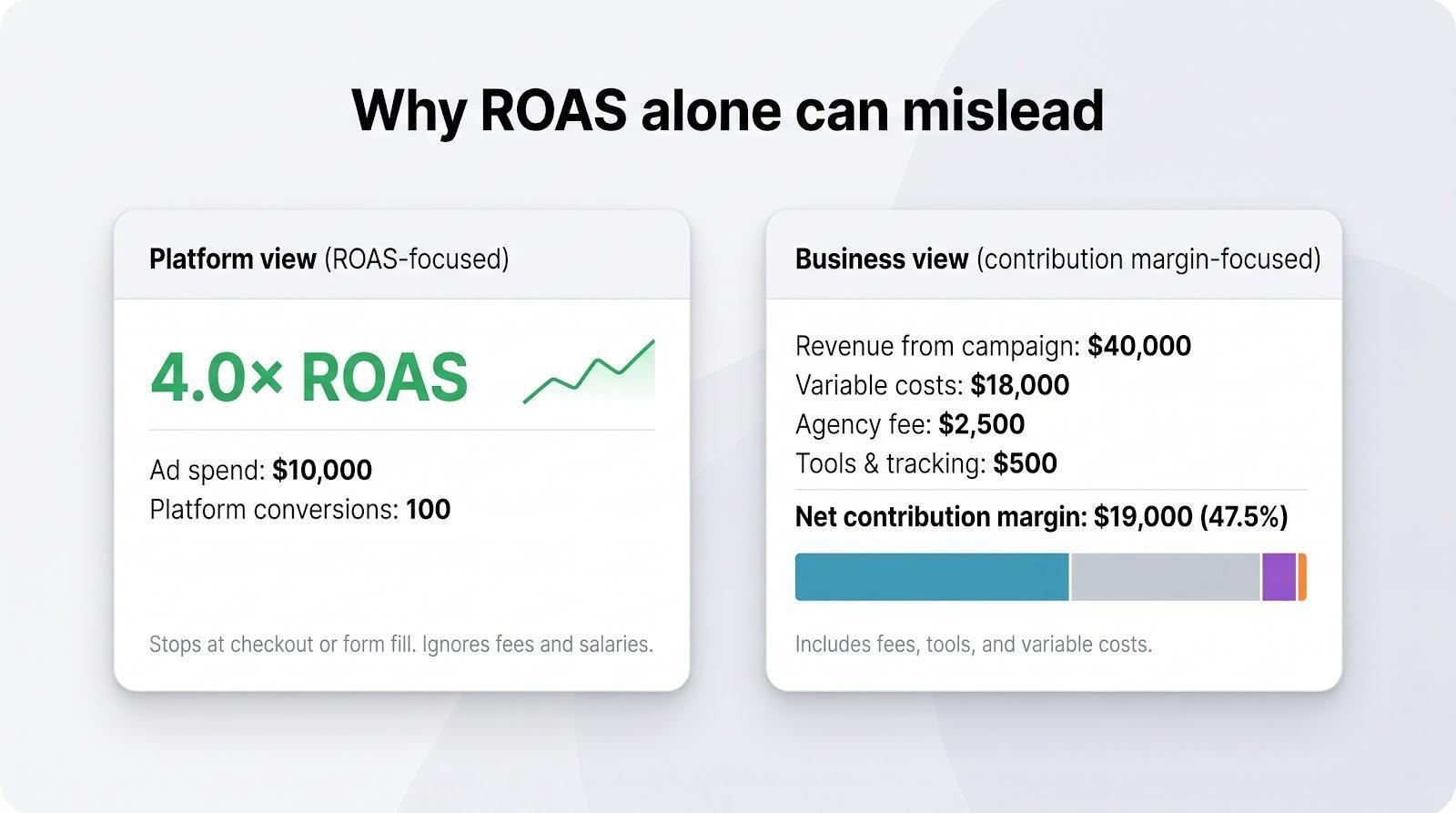
Google shows return on ad spend (ROAS) right in the interface, so a report that turns $1 into $4 feels like victory. The catch: platform ROAS stops at the checkout page or form fill, ignoring landing-page spend, call-tracking fees, salaries, and that agency retainer.
Consider two real benchmarks. WordStream’s 2026 benchmark puts the average cost per lead at $66.69, while a B2B dataset from Metadata shows $524 per CRM lead. Same click, wildly different business value. The gap is why finance teams care about contribution margin (gross profit after variable costs), not ROAS.
First, recap the term: contribution margin = revenue minus variable costs.
Now plug it into a two-step test:
Net agency cost
: fee + extra tools + creative, minus the value of time you free up
Incremental revenue needed
: net agency cost ÷ contribution-margin percentage
Example: You keep 70 percent margin on a first-year SaaS deal. The agency fee is $2,500. You’ll spend $500 on extra tools but reclaim $1,000 of billable hours.
Net agency cost = 2,500 + 500 minus 1,000 = $2,000
$2,000 ÷ 0.70 = $2,857 in fresh, booked margin each month. Anything above that turns green on your P&L, with no wishful ROAS required.
Keep the math visible during scoping calls, and both sides will know exactly which revenue target belongs to whom.
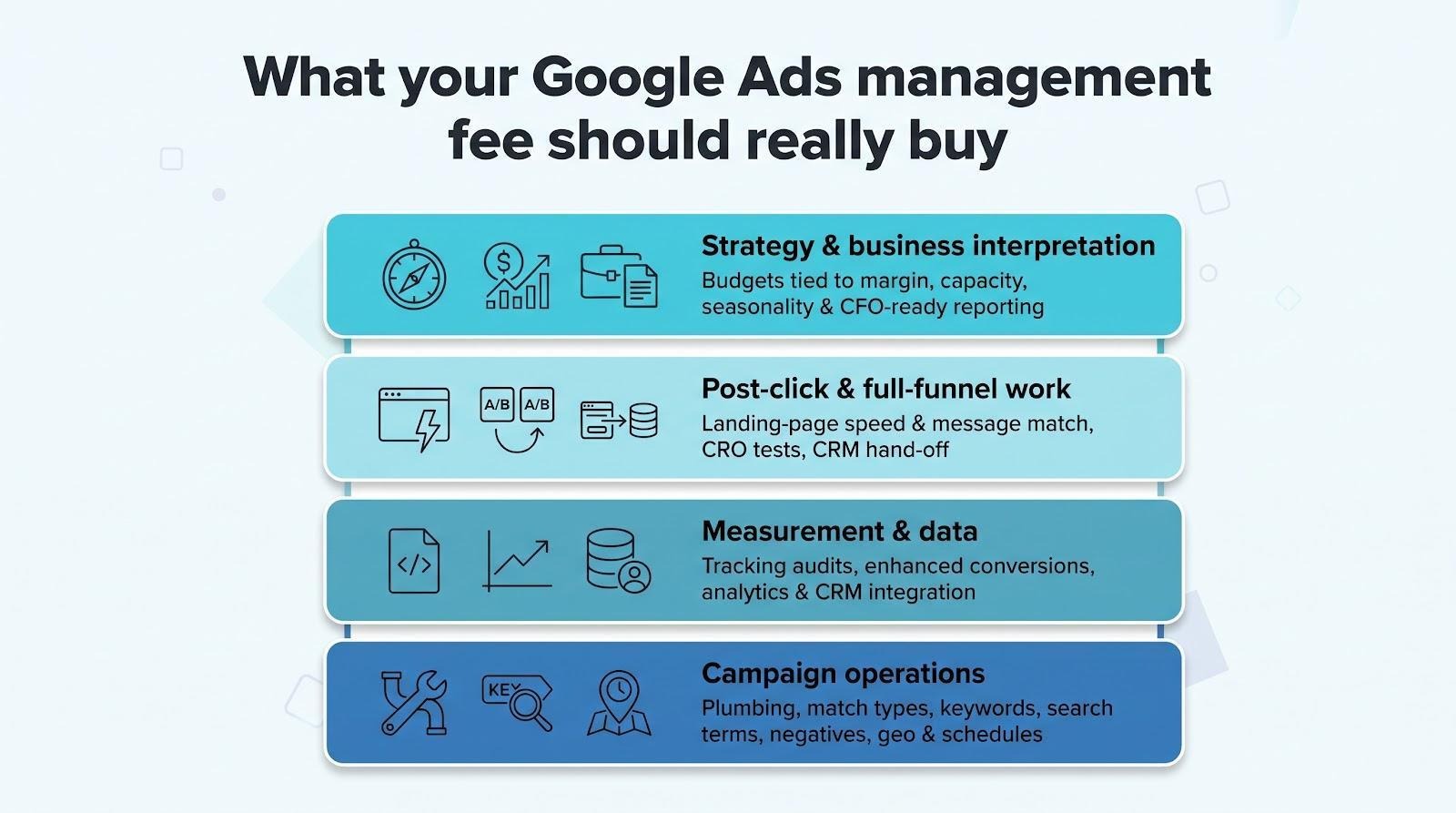
A good agency starts with plumbing, keeping money from leaking out of the account. That means:
Choosing match types that match real intent
Grouping keywords so each ad speaks to a single theme
Reviewing the search-terms report every week and adding negative keywords to block irrelevant queries (according to Google Ads support)
Bid targets move with fresh data, not hunches. Location settings keep ads out of regions you cannot serve, and schedules align spend with the hours your team can answer the phone. When Google suggests a “recommendation,” a human checks whether it serves the strategy or only the algorithm.
With these controls in place, the account becomes a living machine that spends every dollar on purpose, and no amount of fancy reporting can compensate if this foundation is missing.
Great campaigns run on clean signals. The numbers behind each click must tell the truth.
Audit the plumbing. Confirm every tag fires on the right page, enable enhanced conversions for leads to recover lost matches, and bridge Google Analytics with ad spend. A quarterly audit keeps drift at bay.
Feed the algorithm smarter goals. Count qualified leads, not every form fill, and import closed-won revenue so Smart Bidding learns which clicks sign contracts, not just complete forms.
Layer richer signals. Call recordings, CRM stages, and gross-margin values expose keywords that look cheap but never convert, and surface small ad groups quietly printing profit.
With truth in the data, reports move from “so what?” to here’s why, with pipeline, payback, and contribution replacing mere clicks and cost.
The click is only a handshake; revenue depends on what happens next.
Landing-page speed and message match. A page should load in under three seconds: Google has reported that 53 percent of mobile visits are abandoned when a page takes longer than that. Clear headlines, a matching offer, and a form that can be finished in seconds keep paid traffic from bouncing.
Continuous conversion-rate optimization. Headlines, images, and calls to action rotate on a test calendar so the highest-converting version stays live, not merely the prettiest.
Seamless CRM hand-off. Leads route straight into the CRM with source tags intact. Sales knows which campaign sparked each call and can report back when a deal closes. That feedback loop teaches Smart Bidding which keywords create customers, not curiosity.
When an agency owns this turf, ads, design, and sales pull toward the same margin goal, with no finger-pointing required.
Tactics keep the engine running; strategy decides when to press the accelerator and when to pump the brakes.
A senior strategist looks past keywords to cash flow. They tie budgets to contribution margin, trim bids when warehouse capacity is tight, and push harder when the pipeline dips below target. Seasonality, competitor launches, and promo calendars all guide those calls. If a rival drops a 20 percent discount, the strategist may ease off brand terms and redeploy spend into non-brand queries that capture net-new demand.
Broader economics matter too. Gartner found marketing budgets held flat at 7.8 percent of company revenue in 2026, so every dollar now fights for proof of short-term value. A good strategist turns platform noise into CFO-ready clarity: “pipeline advanced by $400 K, payback steady at three months,” not “impressions up ten percent.”
Without that steering wheel, even a perfectly tuned campaign can speed toward the wrong finish line and still lose the race.
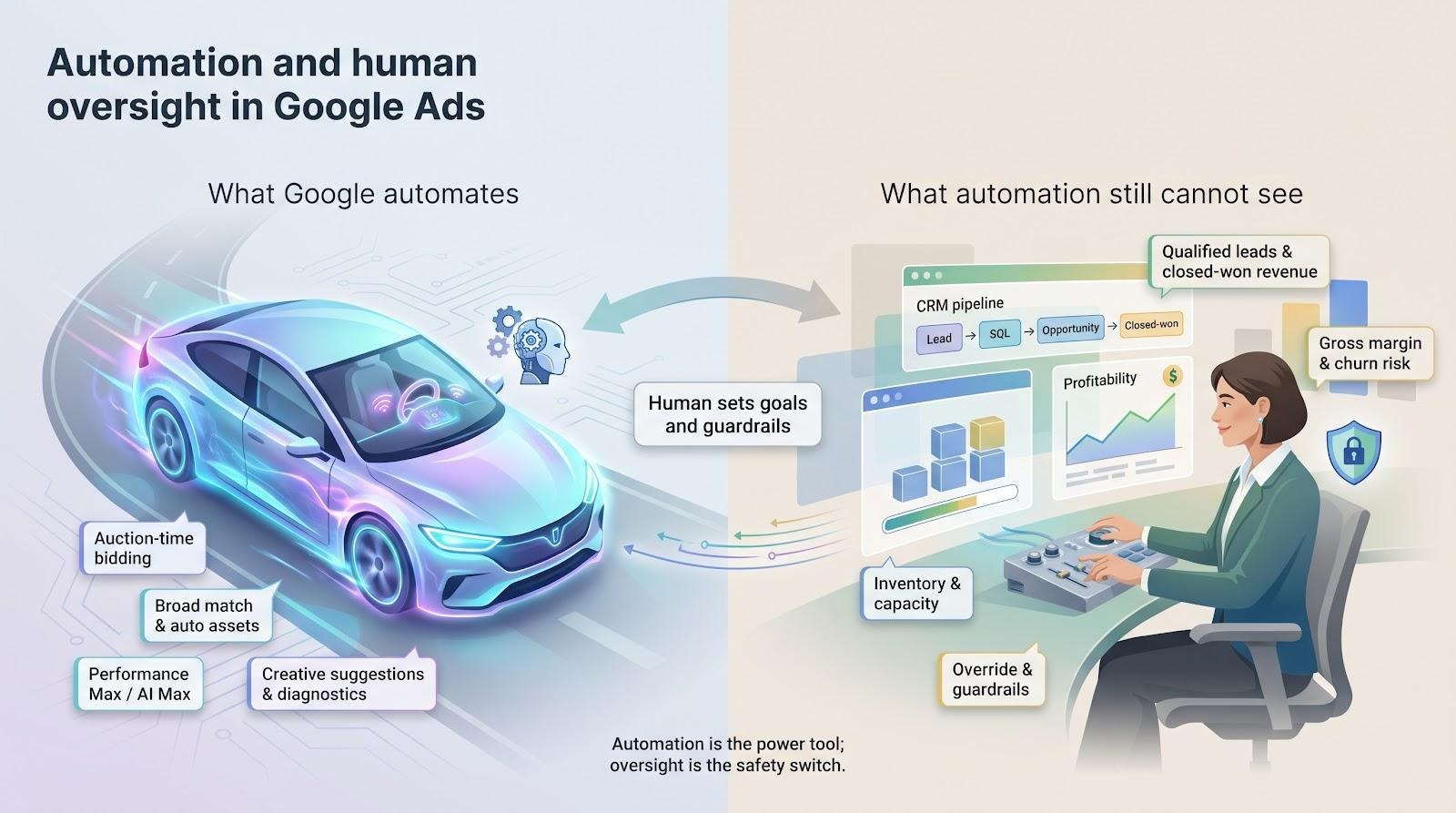
Google has removed much of the mechanical work:
Auction-time bidding adjusts every impression in milliseconds.
Campaign-level broad match and automatically created assets catch synonyms you never thought to add. Campaigns using them began auto-upgrading to AI Max in September 2026.
AI Max / Performance Max spreads your budget across Search, YouTube, Display, Maps, and Discover without separate setups.
Creative tools draft headlines and stitch assets, and diagnostics flag broken tags or policy issues before you spot them.
In short, you can click Start and the platform will drive on its own. A self-driving car still needs a destination and someone ready to grab the wheel when the road changes.
The models do not know which CRM leads pass qualification, churn in year two, or carry higher gross margin. They do not track inventory gaps or a sales rep calling in sick. Provide vague or broken conversion goals, and Smart Bidding may double low-value form fills while high-value demos stall.
That blind spot is where human oversight earns its fee: auditing data, importing closed-won revenue, setting channel and search-term guardrails, and deciding when to override the algorithm. Automation is the power tool, oversight is the safety switch.
Small budgets and long sales cycles create a numbers desert. At WordStream’s 2026 average CPC of $5.42, $1,000 buys about 185 clicks. In a B2B-only sample the average CPC climbs to $9.76, so the same money might buy barely 100 clicks, often just two CRM leads and one proposal weeks later. That trickle leaves Smart Bidding hungry for feedback and makes it hard to see whether the keyword, the ad, or the offer needs work.
Low volume also amplifies noise. One closed deal can flip cost per acquisition from awful to amazing overnight, while a single bot form can double “lead” counts and train the algorithm to chase the wrong traffic.
The cure pairs patience with richer signals:
Import qualified-lead and closed-won data so Google optimizes for revenue, not form spam.
Widen the date window before judging results. Two to three sales cycles beat one month of noise.
Run experiments longer and pause nothing until patterns, not spikes, appear.
Skip these steps and you risk killing good ideas, or scaling bad ones, on a handful of clicks.
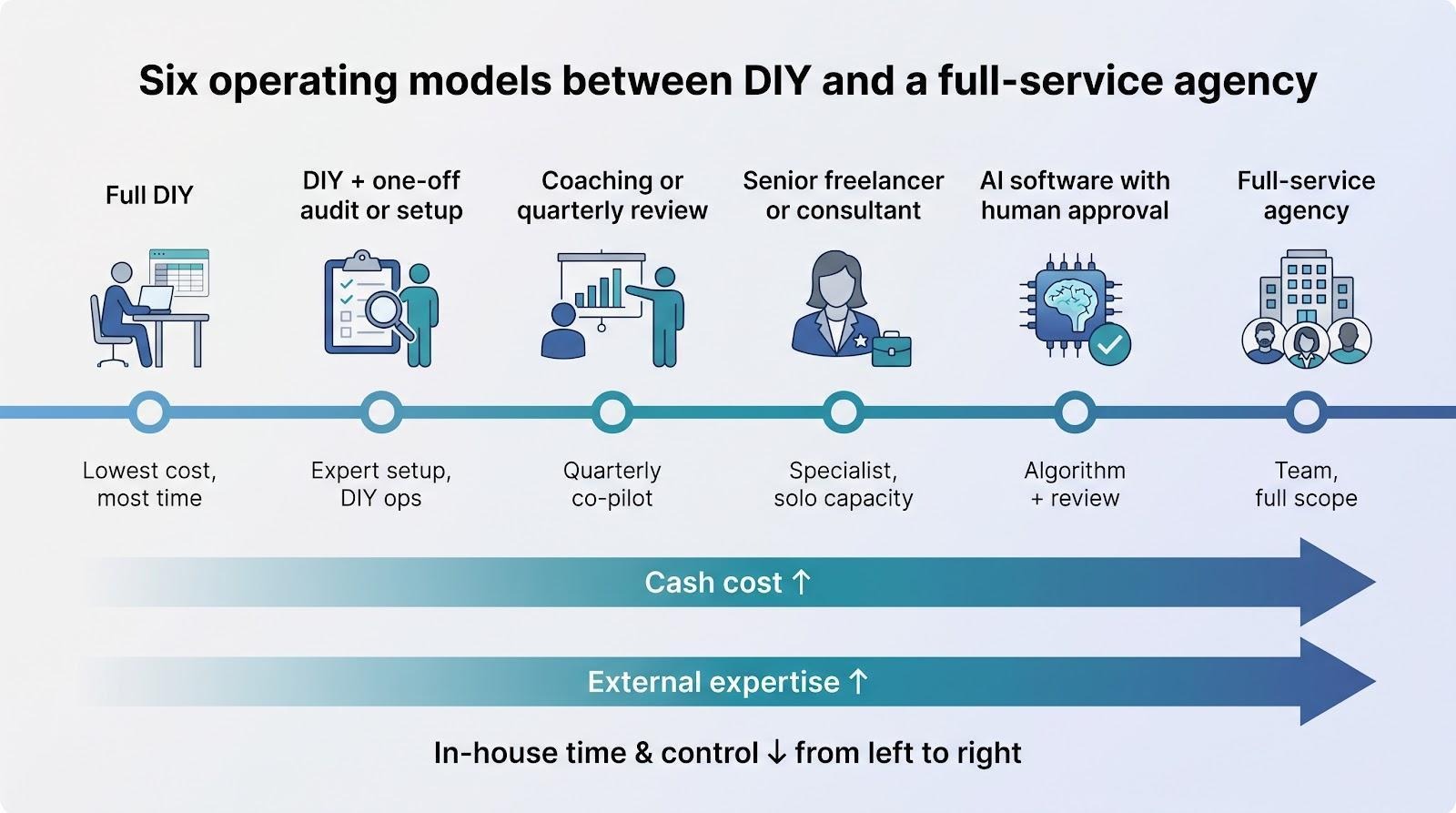
You log in, build the campaigns, and chase every metric yourself. Cash burn stays low, mostly Google media plus a few low-cost tools, but weekly search-term sweeps, bid checks, and reports can swallow 2-4 hours. Best when the offer is simple, the budget modest, and someone on the team enjoys spreadsheets.
Hire a specialist to wire the account (tracking, structure, keyword map), then run it in-house. Up-front spend rises, ongoing cost drops to near zero. Ideal when technical debt, not daily optimization, is the roadblock.
You stay at the wheel but invite a co-pilot every 30-90 days. A coach audits change history, flags creeping waste, and hands you a prioritized task list. Works for lean teams that execute but value senior guardrails. Discipline is mandatory: advice unused is money wasted.
A solo pro supplies depth without agency overhead. Perfect for complex funnels or tight compliance. Capacity is the catch: one holiday can stall momentum, so document credentials and access as insurance.
Algorithms adjust bids and shuffle creative for a low-hundreds-per-month SaaS fee, but they still rely on solid conversion data and regular human check-ins. Treat the tool as a junior analyst: tireless, fast, blind to nuance.
An all-inclusive team handles strategy, execution, tracking, CRO, and reporting for a $2 k-plus monthly retainer. Best when multichannel complexity or high stakes exceed internal bandwidth, but only with a written scope, change logs, and reports tied to contribution margin.
Each model trades cash for time and control for expertise. Slide your business along that spectrum until the incremental profit clears the incremental cost.
DIY is not a badge of courage; it is a business call. It wins when the calendar, the math, and your team align.
You are probably safe to keep management in-house when:
The account is small and focused, one offer, one market, maybe a remarketing layer.
Conversion tracking already works and landing pages load fast.
Someone on payroll can block two focused hours a week to prune search terms and review budgets.
Each new customer nets only a modest margin, so handing 30 percent of that to a manager feels steep.
You are still in proof-of-concept mode and need to confirm paid search demand before adding costs.
Quick readiness check: score yourself four “yes” answers to green-light DIY:
Reliable conversion tracking in place?
A protected weekly review slot you will keep without fail?
One incremental customer worth less than the minimum agency fee?
Account limited to a handful of products and locations?
Miss even one, and the hidden cost of errors, policy violations, brand-safety slips, or weeks of wasted spend, can dwarf the fee you hoped to avoid. DIY works best when simplicity, time, and economics all agree; otherwise, consider light external help.
If one closed deal covers months of fees, the ratio matters less than the upside. A cybersecurity vendor that nets $15 k per contract can pay a $3 k monthly fee on $2 k in media and still profit by winning a single extra customer every two months.
Some niches punish mistakes fast. Some legal keywords cost more than $50 per click, and a disapproved financial-services ad can pause campaigns for days. In high-stakes territory, expert oversight works like insurance: the retainer is tiny next to a week of wasted spend or a compliance fine.
A $2.5 k “management fee” that includes landing-page design, CRO tests, and CRM integration may replace three vendor invoices. Add the hidden developer hours those tasks require, and the pure media-management slice often shrinks.
If your billable rate is $400 an hour, freeing ten hours a month unlocks $4 k of revenue potential. Calculate it:
billable rate × hours you would spend = hidden DIY cost.
When that figure beats the quote on your desk, outsourcing is the cheaper move.
Bottom line: contribution margin, risk exposure, bundled scope, and recovered time can all justify a fee that dwarfs ad spend, provided those gains are written into the engagement and measured against real revenue.
A smart review starts with money, moves to people, digs into data, and ends with ownership. Use the questions below to test whether the agency’s profit model, workload, and reporting discipline will really grow your profit.
Which fee model do you use: flat, percentage, hourly, performance, or hybrid?
Does the fee rise automatically with budget, or is there a cap or declining tier?
Who must approve budget changes? Never sign a blank check that lets “the algorithm” raise spend unilaterally.
What setup, software, or creative costs sit outside the retainer?
How are exit fees handled?
Write down every answer. Ambiguity today becomes an unexpected cost tomorrow.
Who works in my account day to day (name, title, LinkedIn)?
How many accounts does each operator manage? (10-15 is common; more than 30 can lead to dashboard skimming.)
Who covers holidays and sick days?
What does a normal week of activity look like?
How will I see that work? (Change history, annotated dashboards, shared task board.)
What counts as a conversion: form fill, qualified lead, or closed deal?
How do qualified leads and revenue flow back into Google (enhanced conversions, offline uploads, CRM connector)?
Can your report tie spend to pipeline and contribution margin?
How do you separate brand from non-brand performance?
What happens to tracking when the site or CRM changes?
Strong answers treat measurement as a product, not an afterthought.
Will campaigns run in a client-owned Google Ads account?
Who controls billing, Merchant Center, Analytics, and Tag Manager?
Is there a written hand-over clause that guarantees all data and creatives remain ours?
How is login security enforced (2FA, named-user access)?
What is the disconnect process if we part ways?
Google lets advertisers unlink any manager account, but you must hold admin rights first, according to Google support.
A Partner badge means the agency (a) managed $10 k+ in 90-day spend, (b) kept an optimization score above 70 percent, and (c) met certification quotas, according to Google support. It signals familiarity, not mastery. Ask whether the badge holders are the ones who will touch your account and whether revenue goals outrank the optimization score that keeps the badge shiny.
Guaranteed results on the sales call
Agency-owned account with no client admin access
Reports focused on clicks, light on revenue
Automatic fee increases tied to spend without caps
Sales rep cannot name the day-to-day operator
“Proprietary AI” with no human explanation
Two strikes, and you have the cheapest optimization available: choose another provider.
Act like a scientist, not a gambler. Pull the last 60-90 days of data before the agency changes a setting:
Media spend, platform conversions, qualified leads, opportunities, won deals, contribution margin
Brand versus non-brand split (so brand clicks do not mask progress)
Every current conversion definition, “lead” in Google Ads may equal “prospect” in Salesforce
Soft factors: seasonality, promo codes, inventory, sales capacity
Internal hours spent on ads, pages, and reporting (these convert to recovered margin later)
Month one builds runway, not ROI. Expect:
Tracking audit and written conversion goals
First search-term scrub, budgets aligned to margin targets
Change-history notes showing deliberate edits, not shotgun bid bumps
A two-sentence test plan that states hypothesis, metric, and timeline
Now execution meets revenue:
Promised tests live (ad copy, landing-page variants, fresh negatives)
Budget pacing explained, with reasons for throttles or accelerations
CRM feedback importing qualified leads or closed-won value, if zero then pause
Loom or annotated dashboard walk-through proving a human is steering
Look for trends, not anecdotes:
Qualified-lead cost flat or falling while volume rises
Pipeline per ad dollar up; if sales cycles run long, use demos or SQLs as leading indicators
All-in CAC versus the break-even target you set on day 0 (include owner-time savings and tool costs absorbed)
Confirm process discipline: active change logs, weekly search-term reviews, and reports that explain anomalies and next steps.
Score it:
Green, metrics up and process solid, scale.
Yellow, process strong but metrics lag, adjust offer or creative then retest.
Red, data messy or costs worse, exit with baseline restored.
A 90-day sprint is long enough for Smart Bidding to finish learning and short enough to cut losses. Treat it as a mutual audition; both sides leave wiser, whether they stay married or part as friends.
You now have the numbers, warning lights, and operating models. Use the four levers below to find your best starting point.
Fee-to-spend ratio: Is the fee below, equal to, or above your media budget?
Account complexity: One product in one region, or ten products across three continents?
Contribution per customer: Does one sale cover pizza, or payroll for a month?
Internal time and skill: Can someone in-house spare two focused hours a week and enjoy the work?
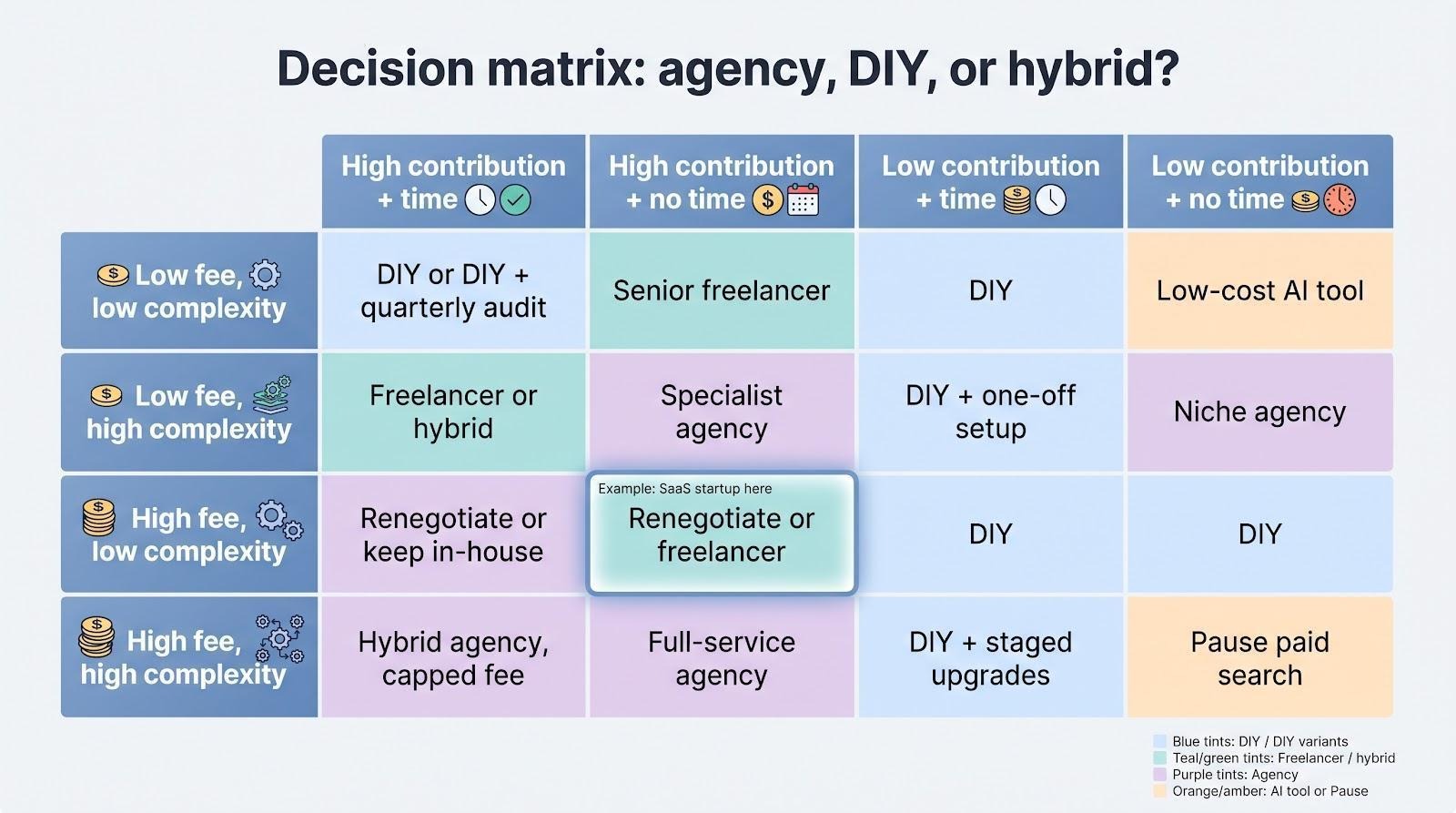
Pick the row that matches ratio plus complexity, then read across to the column that fits your contribution and time reality.
| Ratio and complexity | High contribution + time | High contribution + no time | Low contribution + time | Low contribution + no time |
| Low fee, low complexity | DIY or DIY + quarterly audit | Senior freelancer | DIY | Low-cost AI tool |
| Low fee, high complexity | Freelancer or hybrid | Specialist agency | DIY + one-off setup | Niche agency |
| High fee, low complexity | Renegotiate scope or keep in-house | Renegotiate or freelancer | DIY | DIY |
| High fee, high complexity | Hybrid agency with capped fee | Full-service agency | DIY + staged upgrades | Pause paid search |
Example: A SaaS startup pays a high fee on a simple account but has no internal time and high contribution per customer. Row 3, column 2 suggests renegotiating the fee or hiring a seasoned freelancer before defaulting to DIY.
If every path ends in DIY, revisit the hidden owner-time cost. If they all say “agency,” shop for a provider who meets the measurement standard you just learned. The matrix does not decide for you; it narrows noise into a clear, testable next step.
Is it normal for a Google Ads fee to exceed my ad spend?
Yes, especially on budgets under $3 k a month. A high ratio simply raises the performance bar; it can be rational when the fee fixes tracking, runs CRO tests, or unlocks strategy media alone cannot buy.
What percentage of spend should management cost?
There is no universal rate. Agencies use flat retainers, declining-tier percentages, hourly blocks, or hybrids. Compare any quote against scope, workload, and contribution margin, not a “10-20 percent” folklore number.
Is $1,000 a month enough for Google Ads?
Sometimes. At WordStream’s 2026 average CPC of $5.42, a grand buys about 185 clicks; in B2B datasets closer to $9.76 it funds barely 100 clicks. Fewer clicks mean slower learning, so give the campaign a longer runway.
Can I manage Google Ads myself?
DIY works when tracking is clean, the offer is simple, and you can guard two focused hours every week. Miss any one, and hiring at least audit-level help is usually cheaper than fixing months of drift.
Is it better to spend the fee on more clicks?
Not if the bucket leaks. Unfixed tracking and weak landing pages simply multiply waste. A good manager often lowers cost per qualified lead enough to beat the extra media you could have bought.
Can AI replace an agency?
AI now handles bids and assembles creative, but it still relies on the conversion signals, exclusions, and guardrails a human sets. Think of AI as muscle; strategy remains the mind.
How long should I give a new agency?
Ninety days. Month 1 proves foundations, month 2 shows controlled execution, and month 3 reveals commercial direction, which leaves room for Smart Bidding to finish learning.
Should an agency own my Google Ads account?
No. Keep the account under a company-controlled admin login and grant the agency manager access. That way you retain history, audiences, and billing control if you ever switch providers.
Does Google Partner status guarantee results?
It means the agency managed at least $10 k in 90-day spend, kept an optimization score above 70 percent, and met certification quotas, not that it will grow your revenue. Vet the specific operator, scope, and measurement plan.
What happens if performance tanks during the contract?
A solid agreement sets weekly communication, written milestones, and a 30-day out clause. If the agency misses those checkpoints, pause or exit; do not wait for a full term to end.
A management fee that outweighs ad spend is not madness, it is math. Split the Google invoice from the provider’s, add the hidden “shadow” costs, and calculate the conversion lift or incremental contribution the fee must unlock. Then choose the lightest operating model that can meet that number without gambling owner time or customer trust.
Sometimes the best fit is a lean DIY setup with a quarterly coach, and other times it is a full-service team sprinting past tracking landmines while you close deals. The right answer flexes with fee ratio, funnel complexity, customer value, and the hours you can spare.
Run the 90-day test, guard your data ownership, and judge every provider, human or AI, by revenue rather than vanity metrics. Do so, and the next “fee-bigger-than-spend” quote will trigger a calculator, not sticker shock.
 AI tools to find & convert leads.
 Send emails at scale