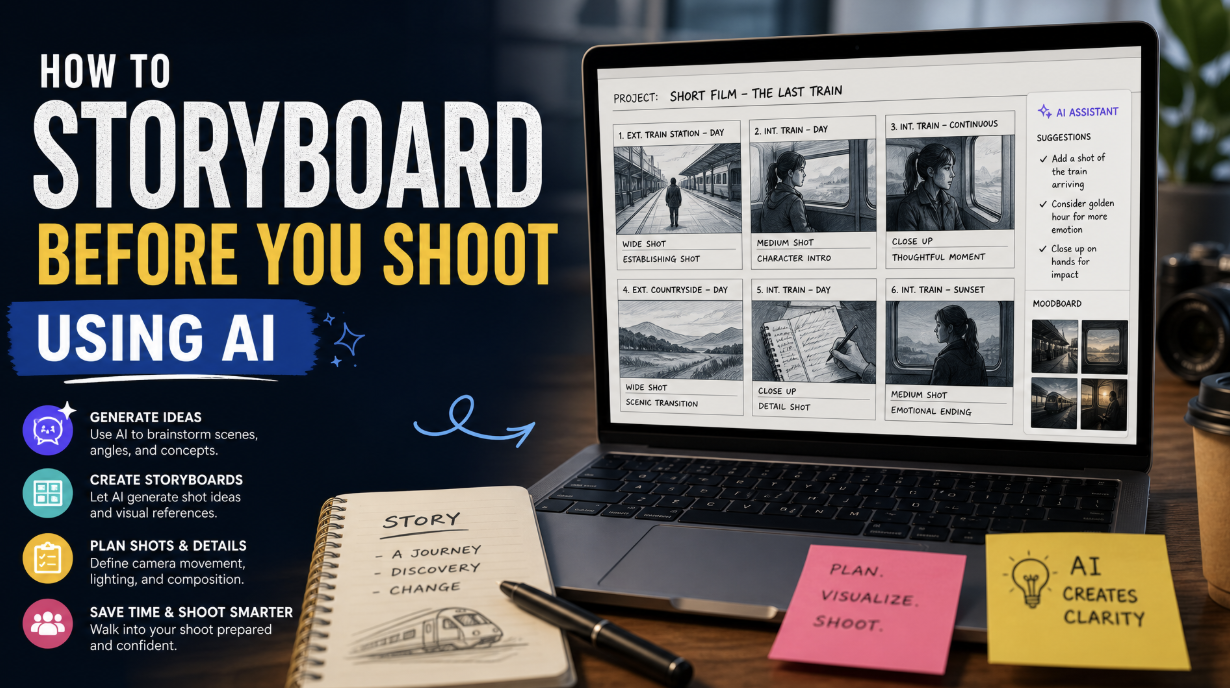
The whole point of a storyboard is to spend an hour finding a problem that would otherwise cost a full shoot day to discover. A blocking choice that doesn't work, a shot that doesn't cut cleanly into the one before it, a scene that needs a location the budget can't cover, all of it is cheap to fix on paper and expensive to fix with a crew standing around waiting. AI has changed how fast a team gets from a finished script to a storyboard worth reacting to, but the underlying discipline, catching problems before they're expensive, hasn't changed at all.
A decision changed at the storyboard stage costs almost nothing: a redrawn panel, a reworked shot list, maybe an hour of someone's time. The same decision discovered on set costs the day rate of everyone standing around while it gets sorted out. That math hasn't shifted just because storyboards can now be generated faster, it's still the reason storyboarding exists as a step at all.
What's changed is how much of that first pass a script alone can now produce, and how quickly a rough plan can go from idea to something a director, DP, and crew can actually look at together.
The fastest storyboards now come directly from a script rather than from a blank canvas a person fills in panel by panel. A script already contains most of what a storyboard needs, who's in a scene, where it happens, what happens in it, and a tool that reads that script directly can identify scenes and characters automatically rather than requiring each one to be manually described from scratch.
This matters most for a script with many scenes or a large cast, where manually re-describing every character and location for every panel is exactly the kind of repetitive work a script-aware tool removes.

A storyboard that can't hold a character's look consistent from one panel to the next stops being useful the moment a crew tries to use it to plan continuity. If a protagonist looks like a slightly different person in panel twelve than panel one, the storyboard is communicating the wrong thing about what the finished scene should actually look like.
This is where a real reference mechanism matters, not just prompting a generator fresh for each panel, but locking a character or location's appearance once and carrying it forward automatically. invideo agent is built around exactly this kind of persistence: a character or location established early in a project stays consistent across every later shot that references it, which matters just as much at the storyboard stage as it does once a project moves into full generation.
Not every shot in a script deserves the same amount of storyboard attention. A simple dialogue exchange between two people rarely needs detailed blocking. A stunt, a crowd scene, an unusual camera move, or anything with a real safety or budget risk attached genuinely does. Spending the same effort on every panel regardless of risk wastes exactly the time a storyboard is supposed to save.
A practical rule of thumb: if getting a shot wrong on set would cost real time or money to fix, it's worth a storyboard panel. If it wouldn't, a line in the shot list is often enough.
A storyboard that gets approved and then set aside, with production starting fresh from the script again, wastes the specific work that made it valuable in the first place. The characters, locations, and shot decisions a team agreed on during storyboarding should be the same ones the production actually uses, not a reference that gets reinterpreted once real work begins.
This is the specific gap invideo agent closes for a production planning to generate its footage rather than shoot it practically: a storyboard's characters, locations, and camera decisions live inside the same project context that carries into full generation, routing each shot to whichever of its 200+ integrated models fits that particular moment, including Veo 3.1, Sora 2, Kling 3.0, Seedance 2.5, Runway, PixVerse, Hailuo, WAN, Recraft, GPT Image 2.0, and Nano Banana. Camera Controls let a director lock a specific move during the storyboard stage itself, a decision that then carries through rather than being reconfigured once production starts.
A storyboard that never gets looked at by anyone besides the person who made it tends to surface its problems on set instead, exactly the expensive discovery the whole process exists to avoid. Getting frame-level feedback from a director, DP, or client, with comments attached to the specific panel they apply to rather than a general note, is what actually catches a disagreement while it's still cheap to resolve.
Storyboarding before a shoot still comes down to the same basic trade it always has: spending a small, cheap amount of planning time to avoid a large, expensive discovery later. What AI changes is how fast that planning pass happens, generating a script-aware, character-consistent first draft in minutes rather than days, and, for a production generating rather than practically shooting its footage, how directly that planning carries into the finished result instead of being redone from scratch once production begins.
The discipline that actually makes a storyboard useful hasn't moved: matching the level of detail to the actual risk of each shot, keeping characters and locations recognizable panel to panel, and getting real feedback before committing a shoot day to the plan. The tools just make it cheaper to do that discipline properly.
 AI tools to find & convert leads.
  Send emails at scale