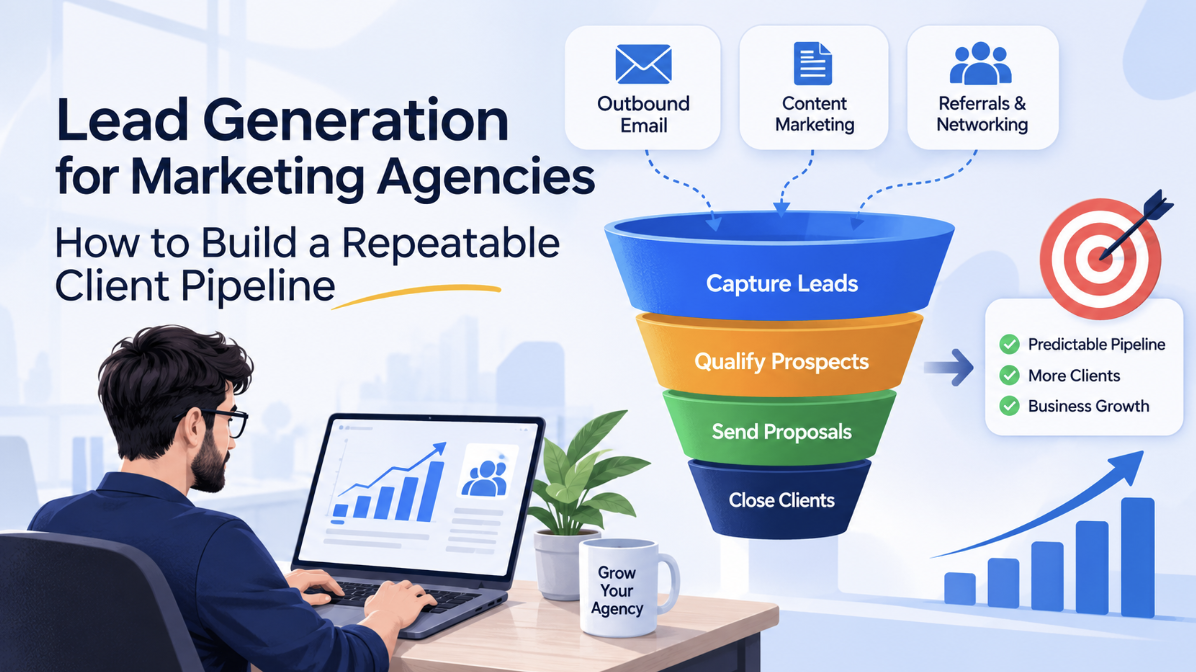
Most agencies don't have a lead generation problem. They have a lead generation system problem. One month brings five solid calls from a referral spree, the next month brings nothing, and the owner ends up doing outbound again instead of running the agency. A repeatable pipeline fixes that whiplash by replacing one-off bursts of effort with a process that produces a predictable number of qualified conversations every month, regardless of who on the team is doing the work.
Here is how agencies that have stopped treating lead gen as a feast-or-famine activity actually structure it.
Generic agencies competing on "we do marketing" lose to specialists almost every time a prospect compares options. The fastest way to build a repeatable pipeline is to pick a niche where you can point to results, then build every piece of outreach around that proof.
This doesn't mean permanently narrowing your business. It means choosing one vertical (dental practices, HVAC companies, personal injury law firms) or one service (local SEO, paid social for ecommerce) to lead with in your messaging for the next two or three quarters. Prospects in a specific niche respond better to case studies that look like their own business than to generic "we grew a client 40% in 90 days" claims, which read as interchangeable and are also the kind of unverifiable stat that makes buyers skeptical in the first place.
Agencies that get stuck relying on referrals alone tend to have built only one channel. A repeatable pipeline usually rests on three, each feeding the others over time.
Outbound with real research.
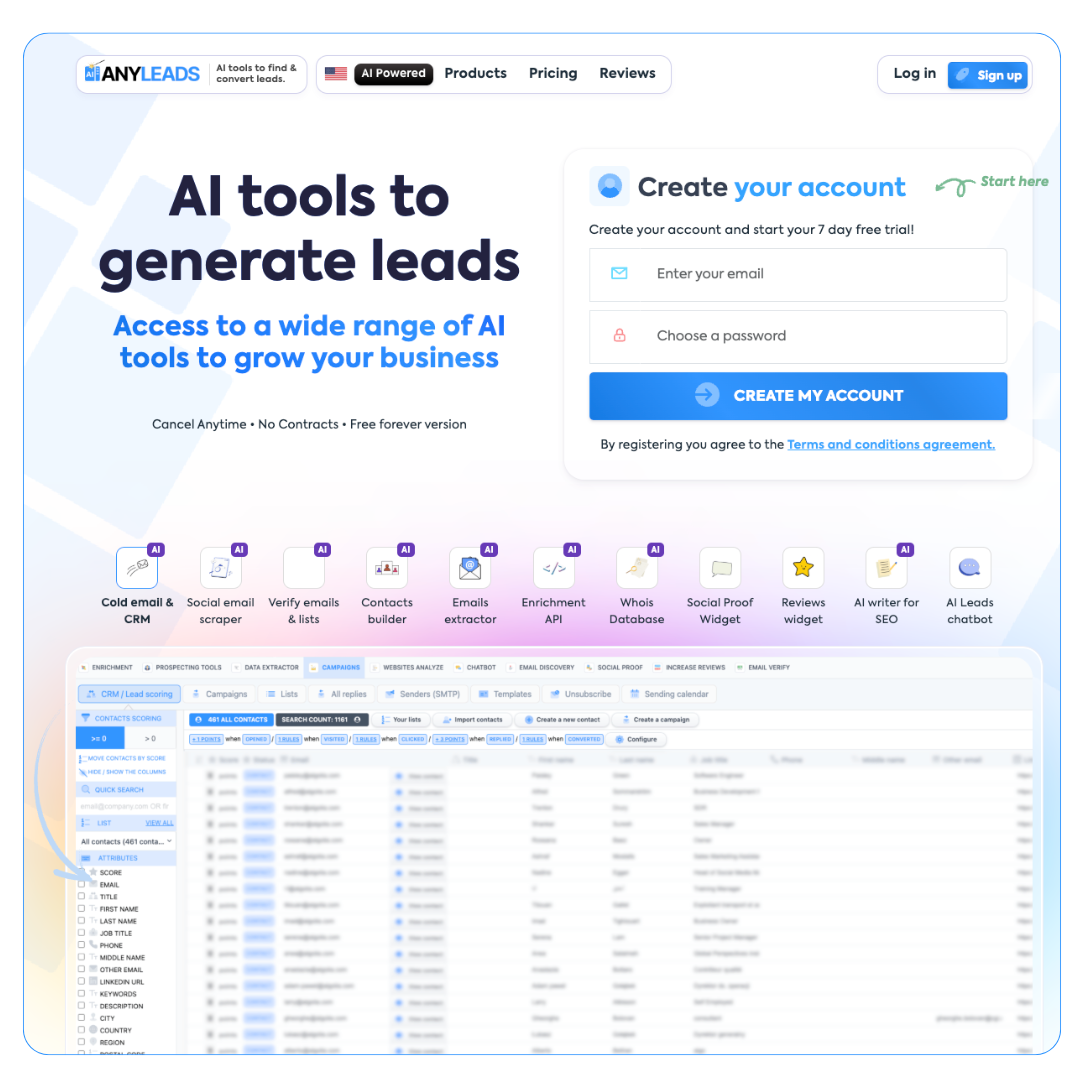
Cold outreach still works, but mass-blasted templates with no context get ignored or reported as spam. Agencies that get replies tend to send fewer, better-researched messages: referencing a specific page on the prospect's site, a review pattern you noticed, or a competitor move. Tools built for cold email at scale, like the ones Anyleads itself provides, are useful here, but the research step is what separates a 1% reply rate from something worth doing daily.
Content that targets buyer-stage keywords.
Not every blog post needs to rank for a broad term. Agencies get more mileage from content built around comparison and decision-stage searches ("[niche] marketing agency pricing," "how to choose a PPC agency for [industry]") because the person searching that phrase is closer to hiring than someone reading a generic listicle. Google's own guidance on helpful content is a reasonable baseline to check this kind of page against before publishing.
Warm network activation.
Past clients, partners, and even vendors are an underused channel. A simple quarterly check-in asking for one introduction, paired with a one-page case study they can easily forward, produces more qualified leads per hour of effort than almost anything else on this list. The key is making the ask specific: "do you know another clinic owner who'd want this" converts far better than "let me know if you hear of anyone."

A pipeline gets unpredictable fast when "lead" means anything from a form fill to a signed contract. Agencies that report consistent numbers to their own leadership tend to define stages tightly:
Inquiry – filled a form, replied to an email, or booked a call, but not yet qualified.
Qualified – confirmed budget range, decision timeline, and that they're not already locked into a contract elsewhere.
Proposal sent – scope and price are in front of them.
Committed – verbal or signed agreement.
Without these stages, a founder can feel like the pipeline is full when it's actually stuffed with inquiries that will never close. Tracking stage-to-stage conversion rates over a few months tells you exactly where the bottleneck is: too few inquiries means a top-of-funnel problem, lots of inquiries but few qualified means a targeting or offer problem, and plenty of qualified leads that don't close means a proposal or pricing problem.
This is also where a shared CRM pipeline view earns its keep. When every team member logs calls and moves deals through the same stages, the agency owner can see conversion rates by stage instead of guessing from memory. A visual pipeline that the whole team actually updates is far more useful than a spreadsheet nobody maintains past week two, mostly because it removes the friction of manual entry and shows stalled deals automatically.
The biggest leak in most agency pipelines isn't the top of funnel, it's follow-up. A prospect asks a question, gets a slow reply, and moves on to a competitor who answered faster. Studies on response time consistently find that speed to first contact strongly affects conversion, and HubSpot's research on the topic (worth reading for the methodology even if you don't use their tools) is a commonly cited reference point for why agencies build automated acknowledgment sequences.
The fix isn't replacing the human conversation, it's automating the parts that don't need a human: a form fill triggers an instant confirmation email, a missed call triggers an SMS with a booking link, a lead that's gone quiet for ten days gets a check-in. None of this closes the deal, but it keeps the lead warm long enough for a real conversation to happen. Agencies running this kind of sequence inside their CRM rather than through disconnected tools tend to lose fewer leads to slow response times simply because the follow-up fires the moment the trigger happens, not whenever someone remembers to check a shared inbox.
Agencies often build sophisticated reporting for clients but track their own lead gen in a loose, informal way. That double standard eventually catches up with you: you can't tell a client "trust the process and give it 90 days" with a straight face if you've never applied the same discipline to your own pipeline.
A minimal monthly review should cover: inquiries by source, qualified rate, proposal-to-close rate, and average sales cycle length. None of this needs to be elaborate. The point is catching drift early, like a channel that used to produce qualified leads but has quietly stopped, before three months go by and the owner is wondering why the calendar is empty again.
Agencies that rely on one platform for most of their leads (a single ad account, one referral partner, one cold email domain) are exposed to sudden drops they can't control: an account suspension, an algorithm change, a referral partner who gets acquired. The agencies with the steadiest pipelines usually run two or three channels simultaneously at a modest level rather than one channel at full throttle, because losing one source still leaves the others producing.
This also applies to reputation. A prospect doing due diligence on an agency almost always checks reviews before a call happens. Agencies that treat review generation as part of the pipeline, not an afterthought, tend to close qualified leads faster simply because the social proof is already handled before the sales call starts.
It's tempting to measure pipeline health purely by lead volume, but the actual goal is predictability. An agency that knows it will get roughly 15 qualified conversations a month, consistently, can hire, plan capacity, and quote pricing with confidence. An agency that gets 40 one month and 3 the next is running on luck, even if the average looks fine on paper.
Building that predictability takes longer than running a single cold email blast or boosting a few posts, but it's the difference between an agency that scales deliberately and one that's perpetually one slow month away from a cash flow problem.
 AI tools to find & convert leads.
 Send emails at scale