Identifying the right person is only half the battle. Even after you have their name, you still need a working email address, a verified phone number, and enough background information so your message doesn't come across as just another cold approach that ends up in their inbox. That's precisely where prospecting tools can help – and in fact, most sales teams are currently overwhelmed by the number of choices available.
If you are building or rebuilding your outbound stack, this guide covers what matters most – namely, which tools address specific problems and how they fit together. Let's go on with it.
Broadly, a prospecting tool helps you do one or more of these things:
Get the contact information for those who fit your ideal customer profile.
Make sure those contacts are genuine and reachable.
Track signals that suggest someone is ready to buy.
At least the first few points of contact should be automated.
All of these jobs already existed. The difference now is that AI does much of the heavy lifting. Today's prospecting tools are capable of scanning thousands of profiles, guessing and checking emails, and even preparing the first message, all in just a few clicks.
Even before automation and AI, you need clean, accurate data. That's where lead enrichment platforms come in, doing modest, unshowy but essential work.
Here's the general workflow most teams follow:
Discovery – this feature lets you identify companies and people that fit your target profile.
Extraction – pull contact details from social profiles, company websites, or public sources.
Verification – verify that the email address or phone number is genuine and active.
Enrichment – add context: for example, the job title, company size, funding stage, and any recent hires.
Sync – all that information is pushed into your CRM, so sales representatives won't have to switch between five browser tabs.
Each step has its own category of prospecting tools, and most teams end up using a few rather than sticking to a single all-in-one platform.
These tools guess a person's business email address and then verify it using their name and the company's domain. While some tools claim accuracy rates above 95%, keep in mind these figures can vary depending on how strict the testing is, so it's reasonable to stay skeptical. In real-world use, what matters more is how well the tool works on your actual target list than what it claims on its marketing page.
The structured information – such as job title, length of service, location, and mutual connections – taken from LinkedIn profiles by means of scraping is fed directly into the personalization process, because a message that mentions someone's most recent promotion or new position has a completely different effect when compared with a generic one.
A problem is that when you're scraping at scale, you quickly hit rate limits. On platforms such as LinkedIn, the number of requests you can make from a single IP address within a short period is limited, and this bottleneck is exactly what makes it difficult for teams scraping hundreds of profiles each day. For this reason, many teams use proxy websites to spread requests across multiple IP addresses and avoid throttling or temporary blocks during their campaign.
Emails sent to invalid addresses bounce, and each return can erode your sender reputation with companies such as Gmail and Outlook. Over time, this damage means even legitimate messages are more likely to end up in the spam folder.
A few habits keep this under control:
Check it at the time of collection, not months afterward.
You should recheck older lists before a major campaign, since the contact database's accuracy decreases over time.
Monitor bounce rates weekly, not just when a campaign fails.

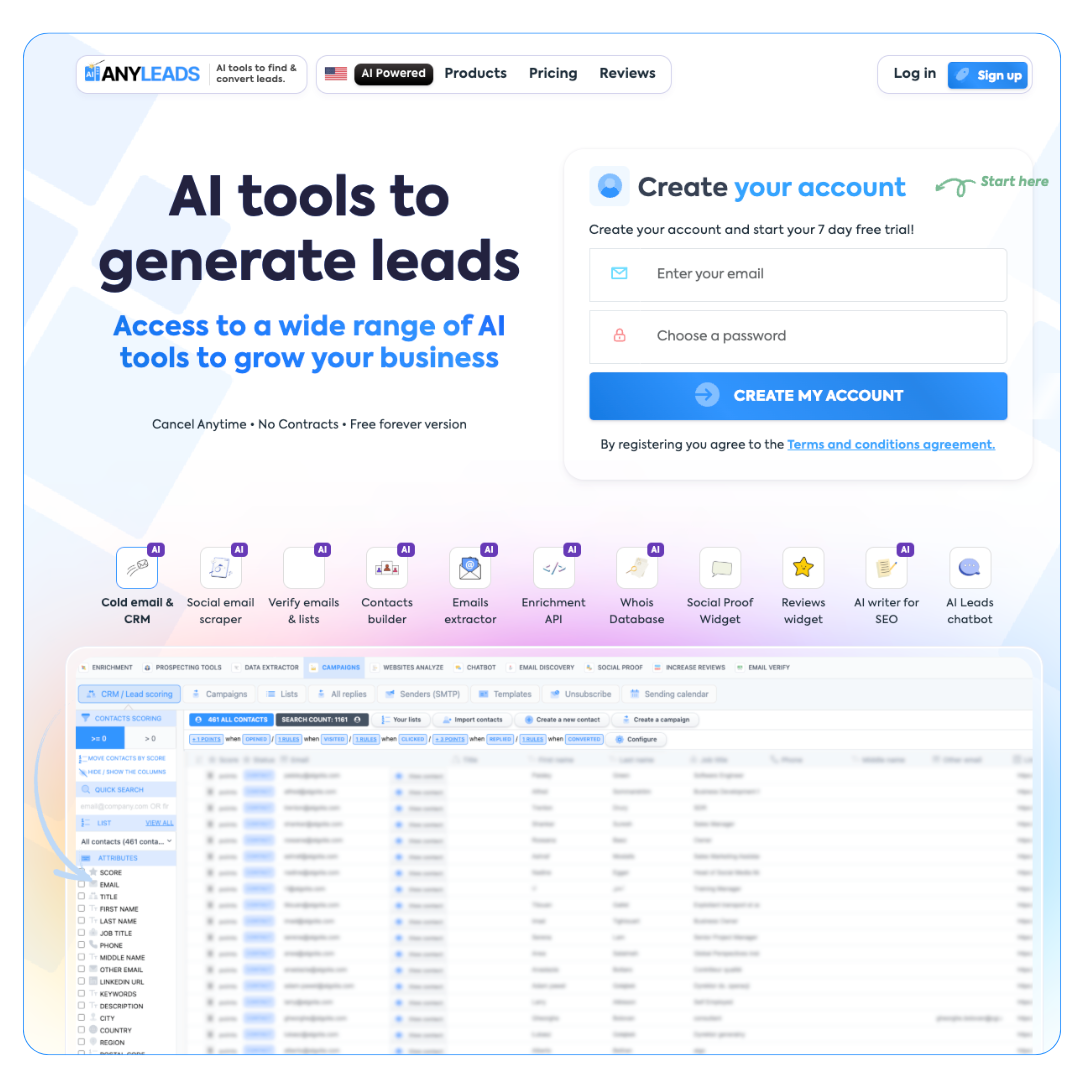
AI shows up in prospecting in a few concrete ways, rather than as one magic button:
| Function | What AI Adds |
| Lead scoring | Ranks accounts by fit and buying signals |
| Message drafting | Suggests personalized openers based on scraped information |
| Data enrichment API | Auto-fills missing fields like title, industry, or company size |
| Reply detection | Flags interested replies so reps respond faster |
Since so many platforms vie for the same budget, choose based on what you need, not the number of features. Here are some simple questions:
Does it sync smoothly with your CRM? If CRM data syncing relies on manual exports, it contradicts the idea of automation.
To what extent is B2B contact discovery effective in your particular market? A tool that performs well for U.S. SaaS companies may be inadequate for finding contacts in the European manufacturing sector.
How accurate is the actual verification? Get a trial batch and check the bounce rate yourself rather than relying on the figure in the headline.
Does it help deliver outbound emails successfully, or does it only help you find contacts? While some tools offer just the data, others do actually get your emails into the inbox.
The next stage is outreach. With automation prospecting tools, you can create sequences, monitor opens and replies, and carry out follow-ups automatically. Sales intelligence software takes it a step further by incorporating indicators such as recent funding, large-scale hiring, or technology changes that suggest the company is worth prioritizing right now.
The combination matters more than either element alone. Even if the enrichment data is excellent, the sequence will still perform poorly if it is clumsy and generic. On the other hand, if the sequence is beautifully personalized but is based on out-of-date or wrong contact data, it will fail to convert. Automated outreach is a good starting point if you want to develop this approach step by step.
Even if you have the right prospecting tools, they won't be able to cure a weak offer or a market that isn't clearly defined, but they will help you avoid the far more typical issue of spending time on generic outreach. Start with clean enrichment, add verification, then let AI-assisted sales prospecting tools handle the repetitive tasks, so your team can focus on conversations that actually lead to closed deals.
Keep testing, keep improving your stack, and don't hesitate to replace a tool if it stops being worthwhile. Continuous adjustment distinguishes teams that have a tech stack from those that actually achieve conversions with it.
 AI tools to find & convert leads.
  Send emails at scale