Top 7 Storyclash Alternatives with Built-In CRM and Outreach Automation
16th Sep '26
Anyleads Team
20 minutes read
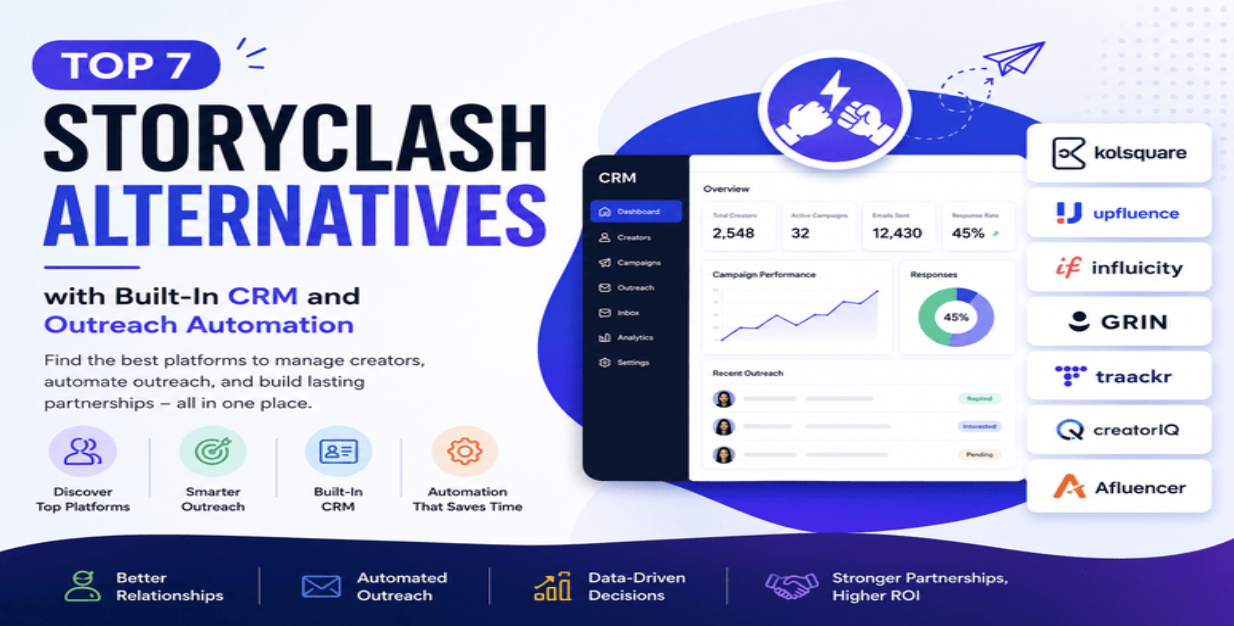
Top 7 Storyclash Alternatives with Built-In CRM and Outreach Automation
Storyclash has a CRM. What it does not have is a way to work that CRM at volume. Outreach is email-only, mass personalised sending arrives at the Growth tier for 999 euros a month, and there are no automated multi-step sequences, no DMs and no follow-up logic that fires when a creator goes quiet. Reviewers regularly report that in-platform messaging does not work reliably. So the pipeline you built inside a genuinely excellent discovery tool ends up being worked from a mailbox, with a spreadsheet tracking who replied.
That is the specific gap this list addresses. Every platform below pairs a real influencer CRM with outreach you can actually automate: sequences that send, follow up, and stop on reply without anyone touching them. Several also close the other gaps Storyclash leaves open, since a CRM is only as useful as what you can do from it, which usually means gifting, affiliate tracking and paying creators without leaving the platform.
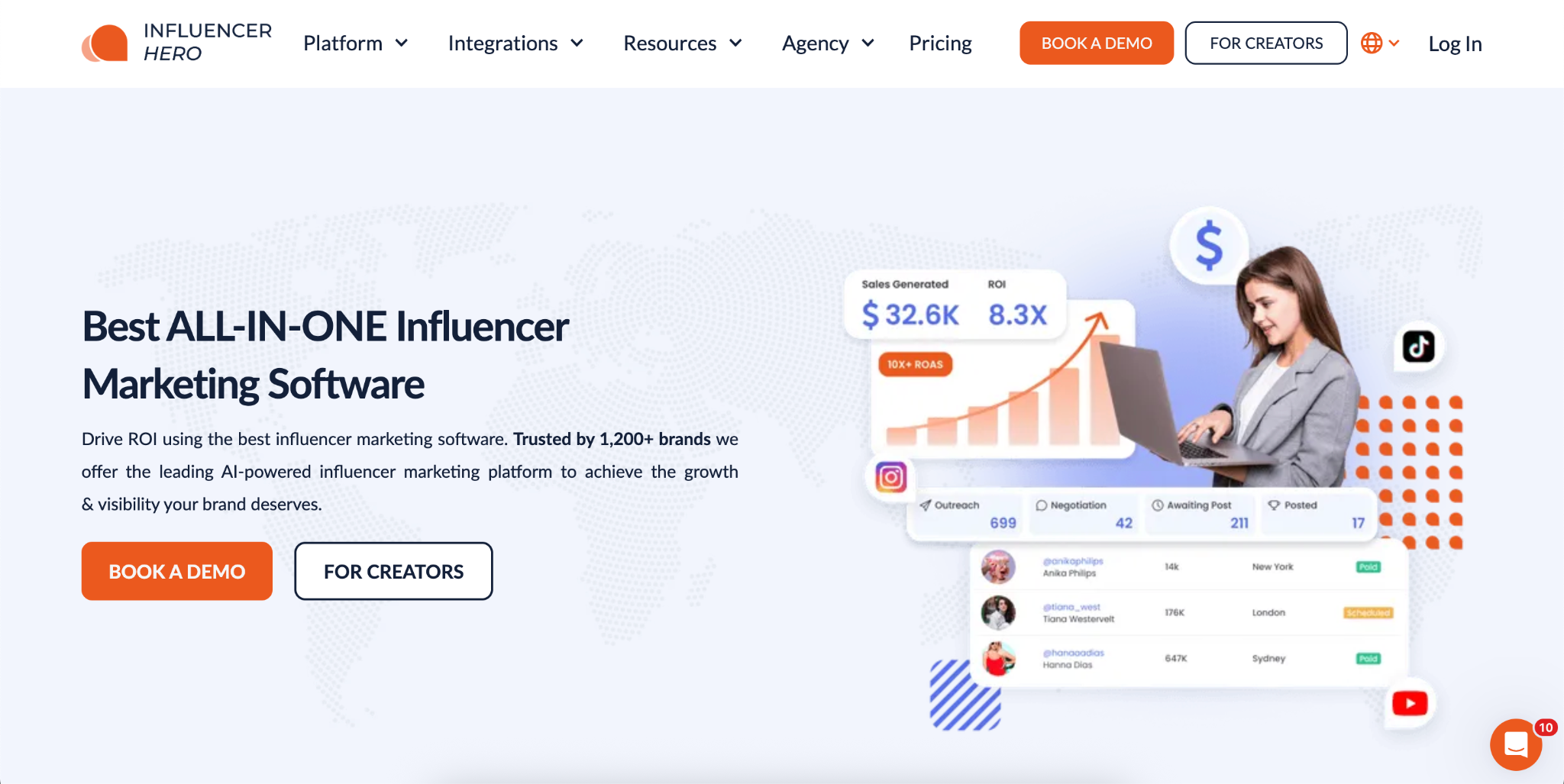
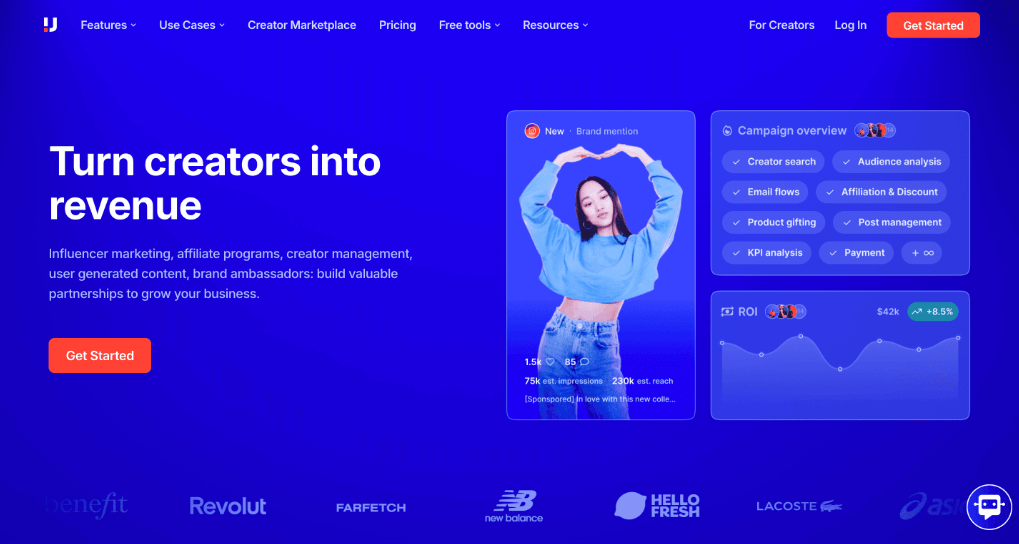
Leading the list is Influencer Hero, which runs a three-layer CRM with rules-based automation on top of AI-personalised drip sequences that average a 43% response rate, across a 450M+ creator database and a three-month contract rather than a twelve-month one.
Influencer Hero
Modash
GRIN
Upfluence
Sprout Social
Traackr
CreatorIQ
Why Brands Are Looking For Storyclash Alternatives
Storyclash is excellent at finding creators and measuring what they publish. The reasons teams shop around cluster around what happens once a creator is in the pipeline:
No Automated Sequences: Outreach is single-send email. There are no multi-step follow-ups, no reply detection and no DMs, so chasing non-responders is manual work someone has to remember to do.
Mass Outreach Is Gated To Growth: Personalised bulk email does not appear until the 999-euro tier. The 499-euro entry plan gives you a CRM and in-platform email and little way to work either at volume.
Unreliable In-Platform Messaging: Reviewers repeatedly report that messaging inside the tool does not work dependably, which pushes conversations into personal mailboxes and out of the shared record.
The Pipeline Stops At Agreement: There are no creator payments, no gifting or shipping workflow and no affiliate management, so a deal that closes in the CRM gets fulfilled and paid somewhere else.
Instagram-Only Discovery At Entry: TikTok discovery arrives at Growth, so on the entry plan the CRM only ever fills with creators found on one platform.
Twelve-Month Minimum, No Trial: Every tier requires an annual commitment billed in euros, with demo-only evaluation, so there is no way to test the outreach workflow before signing.
What Counts As Outreach Automation
The phrase gets used loosely, so it is worth defining before comparing tools. A platform that genuinely automates outreach should do all of the following:
Multi-Step Sequences: Not one bulk send, but a scheduled series that keeps following up until the creator responds or the sequence ends.
Reply Detection: The sequence stops automatically when a creator answers, so nobody receives a follow-up to a message they already replied to.
Personalisation At Scale: Merge fields are table stakes. The better systems generate opening lines from a creator's recent content.
A Shared Inbox: Replies land inside the platform against the creator record, not in one person's personal mailbox.
Deliverability Controls: Sending spread across working hours, domain warm-up and spam scoring, so volume does not cost you your domain reputation.
CRM Write-Back: Every send, open and reply updates the creator's stage in the pipeline automatically.
Judged against that list, Storyclash offers mass personalised email from the Growth tier and nothing further. Three widely recommended alternatives fall short too, which is why they are not on this list: HypeAuditor and Meltwater are intelligence platforms that expect you to bring your own outreach system, and Influencity has no in-platform inbox at all, sending through a connected external account so replies land outside the tool.
AI tools to find leads
Send emails at scale
Access to 15M+ companies
Access to 700M+ contacts
Data enrichment
AI SEO writer
Social emails scraper
Storyclash Overview
Storyclash is a content-first influencer marketing platform that finds and evaluates creators by what they publish rather than what their profile claims, using AI and image recognition across millions of content pieces. You can search with free text, a reference image or a product URL, then widen with lookalike discovery. Founded in Linz, Austria, it leads the DACH market and was acquired by Kolsquare in January 2026, joining a group serving more than 2,000 brands across 180 countries. Samsung, Adidas, Mercedes, Audi and John Lewis all appear on its customer list.
Its standout capability has no equivalent anywhere on this list: a rolling twelve-month archive of Instagram Stories, viewable and downloadable long after they expire. The competitor brand check is similarly strong, mapping which creators rivals work with and how those relationships develop. OMR Reviews rates it 4.7 out of 5 across 295 reviews and names it a leader in social media monitoring, which is an accurate description of where its strength lies. G2 gives it 4.4 out of 5 from 102 reviews with no one-star ratings.
Where it stops is relationship management at working scale. The CRM stores creators and campaigns, but the entry plan at 499 euros a month searches Instagram only, and mass personalised email does not appear until Growth at 999 euros. There are no automated sequences, no DMs, no creator payments, no gifting workflow and no affiliate management. Every tier carries a twelve-month minimum with no monthly option and no free trial. For a monitoring brief that is a fair trade. For a team contacting hundreds of creators a month, the working surface is missing.
Best Storyclash Alternatives With CRM And Outreach Automation
1. Influencer Hero
Influencer Hero treats the CRM as the centre of the product rather than a place to store names. It runs on three layers: a campaign manager holding configuration, AI personalisation and daily sending volume; campaign boards giving a visual pipeline with customisable columns and automatic stage progression; and deal pages that centralise each creator's communications, logistics, performance and content in one record. Rules-based triggers do the administrative work, generating a Shopify discount code when a contract is signed, or moving a deal forward automatically when a reply, shipment or published post is detected. Outreach sits directly on top: automated drip sequences with AI-generated opening lines drawn from a creator's last three posts, A/B testing, and a spam-score tool that spreads sending naturally across working days. The stated average response rate is 43%.
Best for: Teams contacting creators at volume who want the pipeline, the messaging and the payout in a single system.
Pricing:
Standard: $649/month, or $454/month billed annually ($5,452/year), 1,000 outreach/mo
Pro: $1,049/month, or $734/month billed annually, 5,000 outreach/mo and 3 seats
Business: $2,490/month, or $1,743/month billed annually, 10,000 outreach/mo and 8 seats
Three-month minimum on every tier; Custom and Agency plans offer unlimited outreach
Standout features:
Three-Layer CRM: Campaign manager, visual campaign boards and per-creator deal pages, with automatic stage progression.
AI-Personalised Drip Sequences: Opening lines generated from a creator's last three posts, with A/B testing and ChatGPT-assisted replies.
Rules-Based Automation: Triggers that issue discount codes, advance deal stages and flag tasks as To Do, Waiting, Overdue or Follow Up.
Deliverability Controls: A spam score from 1 to 10 with sending spread naturally across workdays at a recommended 30 to 50 a day.
Gifting And Payouts From The CRM: Shopify product gifting and a Stripe-backed payout manager operated directly from the creator record.
There is no free plan and the entry price is $649/month, so this is built for a continuing program rather than a single campaign. UGC rights management is manual, there is no paid-ad whitelisting, and it offers nothing comparable to Storyclash's Stories archive or competitor brand check, which is why some teams run both.
2. Modash
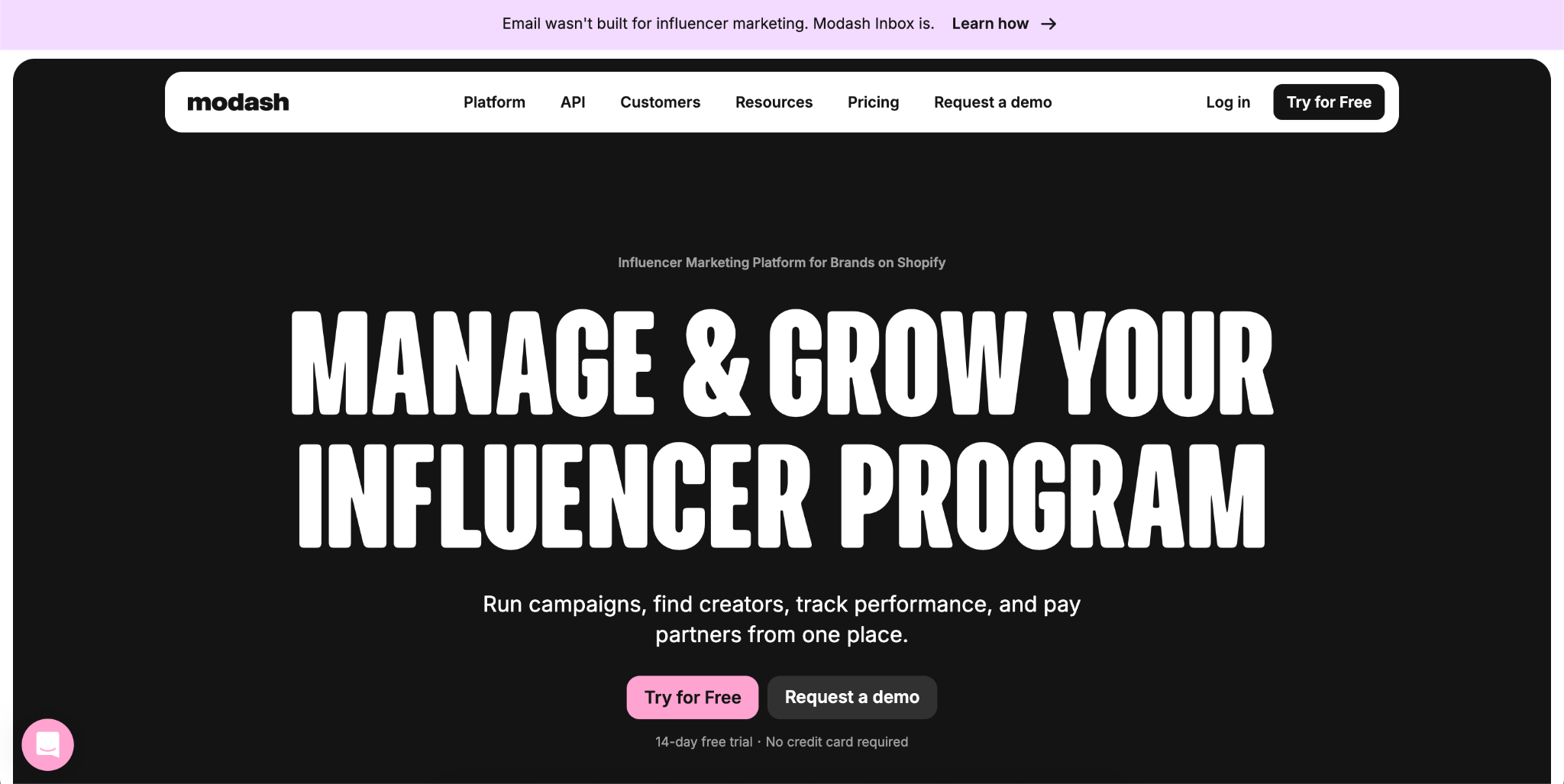
Modash rebuilt its CRM around the sourcing workflow, and the outreach layer sits neatly on top of it. Sequences send from your own domain rather than a shared platform address, which protects deliverability and means replies look like they came from a person. They stop automatically when a creator answers, and everything writes back into the platform so the pipeline reflects reality without manual updating. Underneath sits a 380M+ creator database across Instagram, TikTok and YouTube with all four search modes on both paid tiers, plus influential-fans discovery that surfaces creators already following your brand. Shopify-synced discount codes, gifting and affiliate tracking cover the campaign side, and payments carry no fee up to $10,000 a year.
Best for: Lean teams that want sourcing, sequencing and tracking in one place without an enterprise contract.
Pricing:
Essentials: $199/month billed annually ($2,388/year), or $299/month month-to-month
Performance: $499/month annually ($5,988/year), or $599/month month-to-month
Enterprise from around $14,700/year
14-day free trial with no credit card, including 20 profiles and 6 creator emails
Standout features:
Sequences From Your Own Domain: Automated follow-ups that auto-stop on reply, with everything tracked in-platform.
380M+ Profiles, Four Search Modes: AI, text, lookalike and handle lookup across Instagram, TikTok and YouTube on every paid plan.
Influential Fans: Surfaces creators who already follow the brand, which is the warmest possible outreach list.
Payments Without A Flat Fee: No charge on combined payments and affiliates up to $10,000 a year, then 5% above.
A Real Free Trial: 14 days, no card, against Storyclash's demo-only evaluation.
Modash is discovery-led at heart, so its CRM is lighter than a dedicated campaign suite and bigger programs eventually outgrow it. eCommerce support is Shopify-only, there is no content licensing and no paid-ads whitelisting, and Essentials limits you to 300 opened profiles and 150 email unlocks a month.
3. GRIN
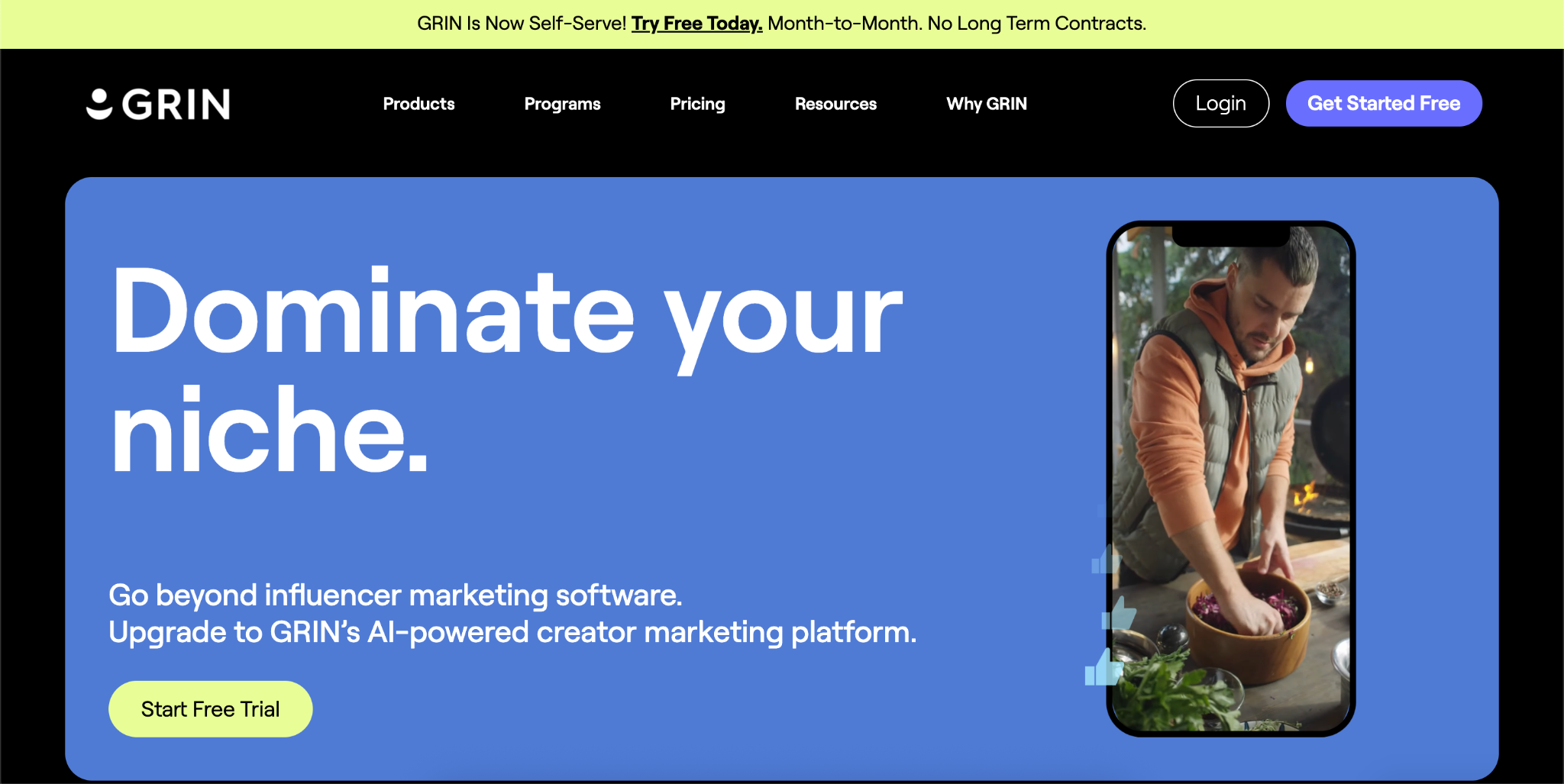
GRIN pairs its creator CRM with automated email and, unusually for this category, lets you start for nothing. There is a free forever tier, billing is month-to-month with no minimum and no required sales call, and the entire commercial model is the opposite of a twelve-month euro commitment. The CRM itself, branded GRIN Classic, is a genuine campaign workspace covering relationships, conversations and deliverables, and it connects to the execution machinery GRIN is really known for: product seeding, shipping and fulfilment, discount codes, affiliate links, creator payments and 1099 handling, wired natively into Shopify, WooCommerce, BigCommerce and Magento. Gia, its AI assistant, runs on a monthly credit allowance across every plan.
Best for: eCommerce brands that want a working CRM plus gifting and payouts, on terms they can leave at any time.
Month-to-month with no annual contract and no minimum commitment
Standout features:
GRIN Classic Campaign Workspace: A hands-on creator CRM covering relationships, conversations and deliverables.
Free Tier With No Trial Clock: No card and no sales call, so evaluation costs nothing and has no deadline.
Native eCommerce Fulfilment: Gifting, shipping, discount codes and sales tracking across four eCommerce platforms.
Payments Including 1099s: Automated creator payouts and tax handling, which Storyclash cannot do at any tier.
Free Affiliate Hub: Affiliate links and commission management without moving up a plan.
The caveat matters on this particular list: GRIN Classic, the CRM workspace itself, only appears from the Growth plan at $500/month and caps active creators at 100 there. Starter at $200 buys AI assistance rather than the full workspace, so the free and entry tiers do not deliver the CRM this article is about. GRIN also publishes no database size and works from an opt-in creator network, so discovery variety is thinner than a search-led tool.
4. Upfluence
Upfluence combines an influencer relationship manager with bulk email campaigns and automated follow-up sequences, and adds a sourcing route nothing else here offers. Live Capture identifies which of your existing customers are already creators using first-party Shopify and Amazon data, so the CRM starts populated with people who have already bought from you rather than strangers from an index. The Jaice AI assistant supports matching and campaign work across a 12M+ creator database, dual Shopify and Amazon tracking delivers real revenue attribution, and affiliate management, gifting automation and bulk payments complete the workflow. Pricing is modular and charged as a fixed platform fee rather than a percentage of creator sales.
Best for: eCommerce brands that want to build a creator pipeline from their own customer base and track revenue precisely.
Pricing:
Search and Contact module: around $478/month
Full platform with all three modules and one seat: around $1,276/month
Additional seats $79/month each
Twelve-month minimum contract; no public pricing, no free plan, no free trial
Standout features:
Live Capture: Turns existing customers into creator prospects using your own first-party eCommerce data.
IRM With Bulk Sequences: Relationship management paired with bulk email and automated follow-ups.
Dual Shopify And Amazon Attribution: Revenue tracking across your own store and the marketplace.
Affiliate And Gifting Automation: Discount codes, commission tracking and bulk payments handled in-platform.
No Revenue Share: A fixed fee for the modules you buy rather than a cut of creator-driven sales.
Upfluence swaps one annual commitment for another, with a twelve-month minimum, no public pricing, no free plan and no free trial, so evaluation runs through sales just as it does with Storyclash. Modular pricing gates capability too, since a single module will not run a full program, and reviewers cite a steep learning curve and occasional location-data inaccuracy.
5. Sprout Social
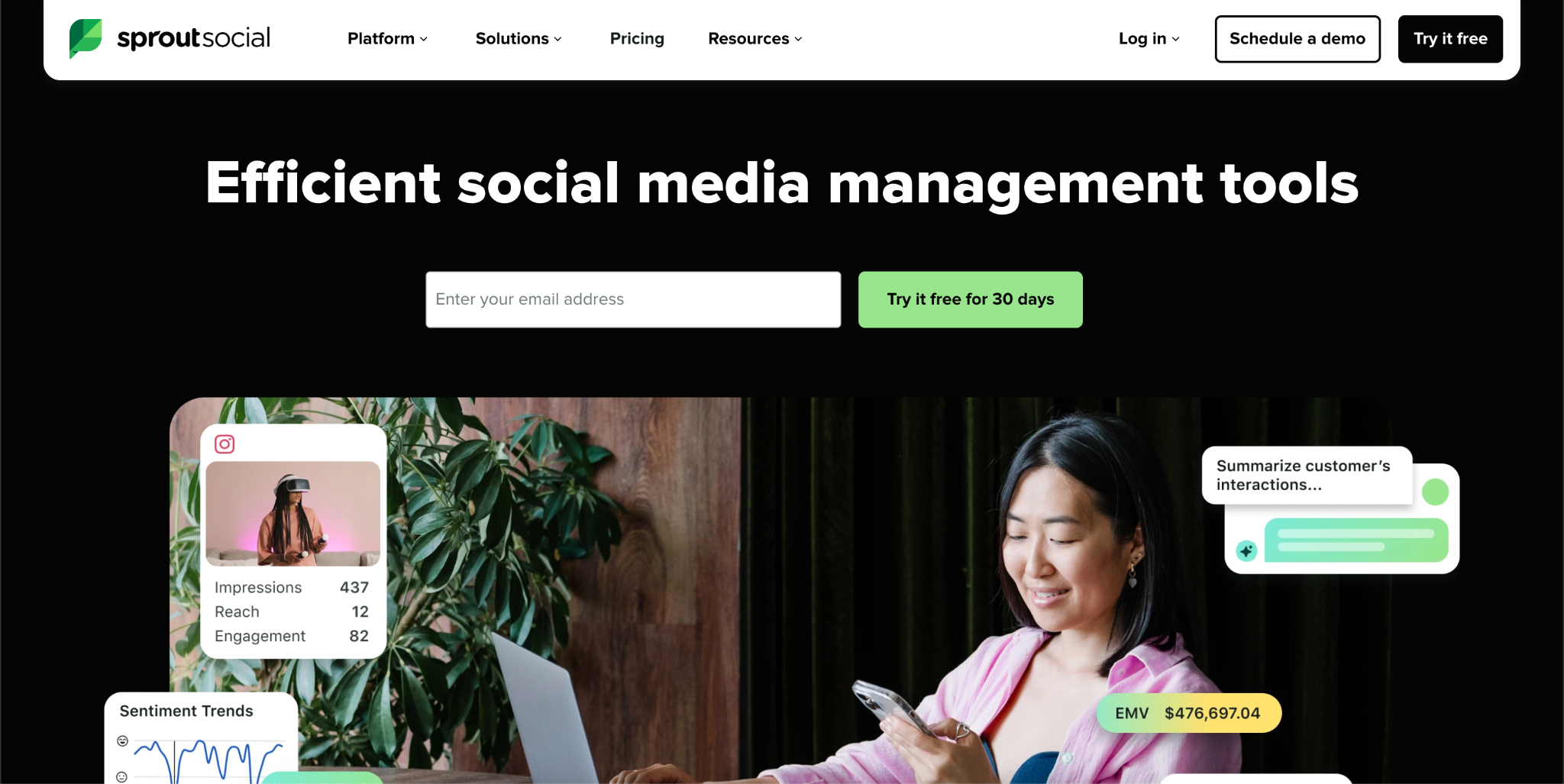
Sprout Social's influencer marketing module is built on Tagger Media, which it acquired in 2023, and it is the natural fit for teams who want creator outreach living beside the rest of their social operation. Outreach integrates directly with Gmail and Outlook, so sequences send from the mailbox the team already uses, and a content approval workflow routes drafts through the right people before anything publishes. Discovery filters are high precision, AI brand fit and safety scoring screens creators against reputational risk, and benchmarking with EMV analytics covers measurement. Shopify integration handles gifting. For an organisation already standardised on Sprout for social management, the influencer layer slots into existing process.
Best for: Social media teams that want influencer outreach and approvals inside the platform they already run.
Pricing:
The influencer marketing module is a separate purchase, quote-only, with a required demo
It is not included in any base Sprout Social plan
Core social management seats are reported at $199 to $499 per seat per month depending on tier
Annual contracts with auto-renewal; no month-to-month option
Standout features:
Gmail And Outlook Outreach: Sequences send through the team's existing mailboxes rather than a separate platform address.
Content Approval Workflow: Structured review and sign-off before creator content goes live.
AI Brand Fit And Safety: Automated screening of creators against brand suitability and reputational risk.
Benchmarking And EMV Analytics: Competitive benchmarking and earned media value reporting alongside campaign metrics.
One Platform For Social And Influencer: Creator work sits beside scheduling, publishing and listening rather than in a separate tool.
The module is quote-only and sold separately from base Sprout plans, so the real total is the module plus per-seat social licences, and contracts are annual with no monthly option. It also lacks UGC licensing and offers nothing like Storyclash's visual content search, so a team switching specifically for content-led discovery will find this a different kind of product.
6. Traackr
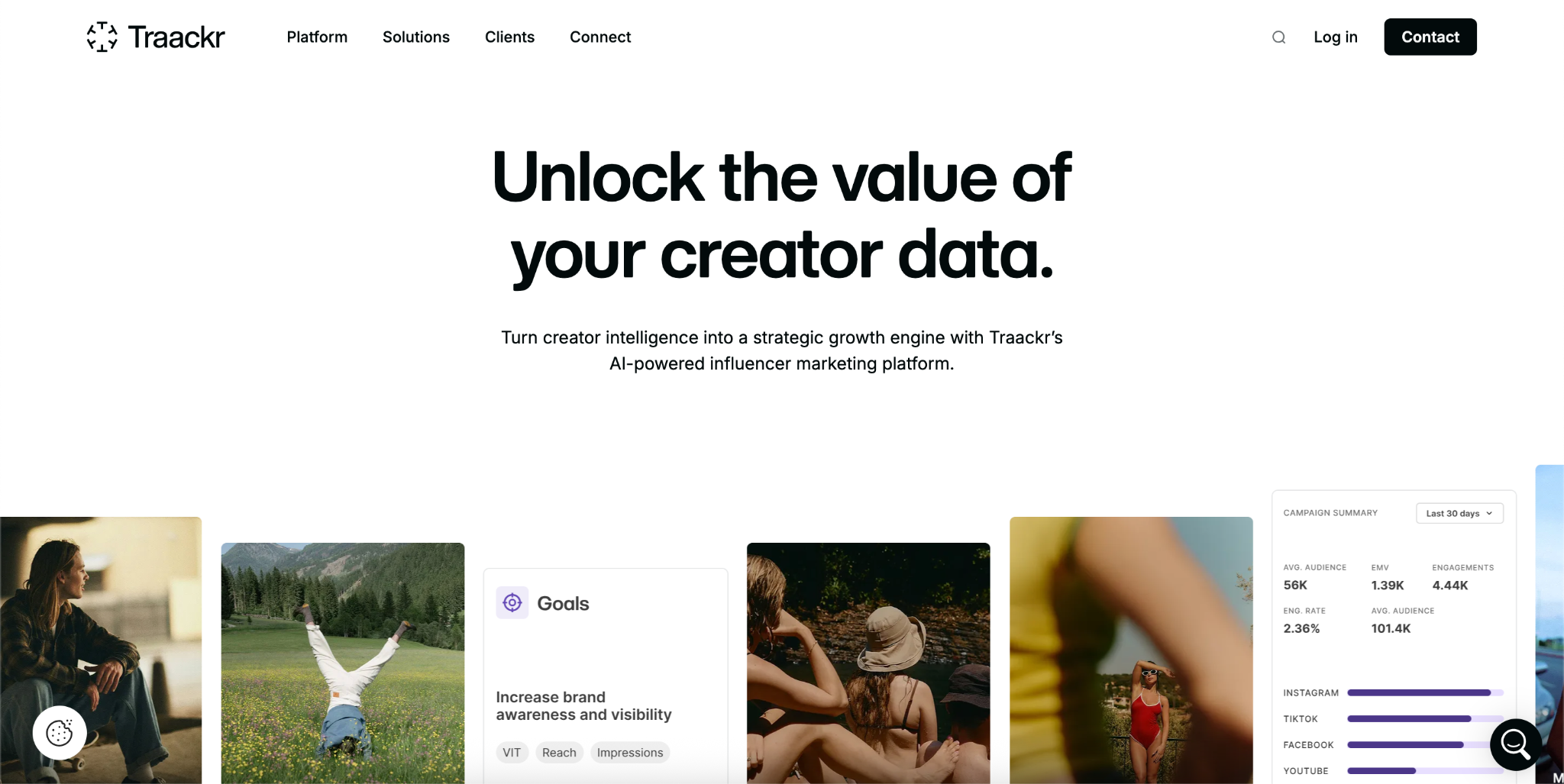
Traackr is the measurement-led option, and its CRM is built for teams managing long-running creator relationships across multiple markets. Shared notes and email syncing keep an entire team's history against each creator record, and dynamic outreach templates handle personalised contact at scale. What distinguishes it is the analytical layer wrapped around the pipeline: the Brand Vitality Score measures brand influence over time, cost-per-metric modelling covers CPC, CPM, CPV and CPE, and budget optimisation and global market benchmarking help allocate spend across regions. Gifting management with delivery tracking rounds out the workflow. If Storyclash appealed because of reporting rigour, this is where that instinct scales.
Best for: Enterprise teams managing creator relationships across multiple markets who need spend efficiency measured precisely.
Pricing:
Standard from $32,500/year, or from $40,500/year with Benchmarking, minimum 5 users
Plus from $55,000/year, or from $63,000/year with Benchmarking, minimum 10 users
Annual upfront only, with no monthly billing at any tier
A four-week trial is reported on request
Standout features:
CRM With Shared Notes And Email Sync: A team-wide relationship history against every creator record.
Dynamic Outreach Templates: Personalised contact at scale, driven from creator and campaign data.
Brand Vitality Score: A composite measure of reach, impact and audience trust tracked over time.
Cost-Per-Metric Modelling: CPC, CPM, CPV and CPE analysis with budget optimisation across markets.
Gifting With Delivery Tracking: Product seeding managed and tracked inside the platform.
Traackr carries enterprise pricing and an enterprise learning curve, with annual upfront billing, a five-user minimum and no monthly option anywhere in the range. Its 6M+ database is among the smaller pools here, micro-influencer discovery is limited, and reviewers report technical glitches, sync delays and demographic accuracy issues on niche platforms. It is comfortably overkill for a simple gifting or affiliate program.
7. CreatorIQ
CreatorIQ pairs a talent CRM with unified campaign management, and its distinguishing quality is data provenance. Roughly 15M creator profiles come through first-party API integrations with Meta, TikTok and YouTube rather than inference from scraped content, which is the strongest available answer to the demographic accuracy complaints that follow content-led platforms. Customisable workflows carry briefs, approvals, contracts and multi-stage pipelines, SafeIQ handles fraud and brand-safety screening, auto-collected UGC arrives with usage rights tracked against it, Creator Connect provides branded inbound application pages, and integrated payments include IRS-compliant tax documentation. For a large organisation with governance requirements, it is the most complete system here.
Best for: Global brands and agencies that need first-party data accuracy, governance and workflow control at scale.
Pricing:
Quote-only and annual, with no monthly plans at any tier
Entry-level contracts run $30,000 to $59,500+ per year
Median reported contract around $39,250 per year
Per-seat pricing and setup fees, plus a payout fee after the first $100,000 paid to creators
Standout features:
First-Party API Data: Profiles pulled directly from Meta, TikTok and YouTube rather than inferred from content.
Talent CRM With Custom Workflows: Briefs, approvals, contracts and multi-stage pipelines configured to your process.
SafeIQ Brand Safety: Fraud detection and reputational screening built for regulated environments.
Payments With Tax Documentation: Integrated creator payouts including IRS-compliant paperwork.
Creator Connect Application Pages: Branded inbound pages routing applications straight into the pipeline.
CreatorIQ is workflow-driven rather than sequence-driven, so teams wanting automated drip messaging should check that specifically during a demo. It is quote-only and annual with no free trial, aimed at organisations with seven-figure influencer budgets, affiliate tracking needs manual setup, there is no native gifting, and onboarding is long.
Cost Comparison At A Glance
Starting prices, contract terms and the shape of each platform's outreach automation. For context, Storyclash offers mass personalised email from its Growth tier at 999 euros a month, with no automated sequences at any price:
Platform
Starting Price
Contract
Outreach Automation
Influencer Hero
$649/mo ($454/mo on annual)
3-month minimum
AI drip sequences, 43% response
Modash
$199/mo annual ($299 monthly)
Monthly or annual
Sequences from your own domain
GRIN
Free tier; Starter $200/mo
Month-to-month
Automated email, CRM from Growth
Upfluence
~$478/mo module; ~$1,276/mo full
Annual, 12-mo min
Bulk email with follow-ups
Sprout Social
Quote-only; core seats $199-$499/seat/mo
Annual only
Gmail and Outlook outreach
Traackr
From $32,500/yr (min 5 users)
Annual only
Dynamic templates, email sync
CreatorIQ
Quote-only; $30,000-$59,500+/yr
Annual only
Workflow-driven, not sequences
Enterprise platforms are quote-gated, so those figures are best-available reported ranges rather than published rates.
AI tools to find leads
Send emails at scale
Access to 15M+ companies
Access to 700M+ contacts
Data enrichment
AI SEO writer
Social emails scraper
Final Thoughts
Storyclash earns its reputation on intelligence. The twelve-month Instagram Stories archive has no equivalent on this list, the competitor brand check genuinely reveals how rivals build their creator rosters, and OMR reviewers rate it 4.7 out of 5 across 295 reviews. Teams that rely on those capabilities often keep it running regardless of what else they adopt.
The constraint is what happens between finding a creator and publishing a post. A CRM without sequencing, reply detection or a shared inbox is a list, and working a list at volume means leaving the platform. Add the absence of gifting, affiliate management and creator payments, and the operational half of the program ends up distributed across a mailbox, a courier account and a spreadsheet.
Which alternative fits depends on where your program sits. If you are contacting creators at volume and want the pipeline, the messaging and the payout in one place, Influencer Hero and Modash are the most direct answers, with Modash offering a real trial first. If execution matters more than search, GRIN's free tier and native fulfilment let you start immediately. If you sell through Shopify or Amazon and want to recruit from your own customer base, Upfluence's Live Capture is genuinely differentiated. If your influencer work belongs beside the rest of your social operation, Sprout Social keeps it there. And if you are operating across markets with governance requirements, Traackr and CreatorIQ bring the measurement and data provenance to match. Agencies running programs at scale, such as NC Media Group, frequently pair a discovery-led tool with a CRM-led one so outreach and reporting stay in step across many client campaigns at once.
FAQs
1. Does Storyclash have a CRM?
Yes, and it ships on the entry plan alongside in-platform email. What it does not include is outreach automation: there are no multi-step sequences, no reply detection and no DMs. Mass personalised email arrives at the Growth tier for 999 euros a month, and reviewers report that in-platform messaging does not always work reliably, so contacting creators at volume generally means working from a mailbox.
2. Which Storyclash alternative has the strongest outreach automation?
Influencer Hero, on the available evidence. It runs automated multi-step drip sequences with opening lines generated from a creator's last three posts, A/B testing, deliverability controls including a spam score and naturally spread sending, and a stated 43% average response rate, all writing back into a three-layer CRM. Modash is the closest alternative at a lower price, with sequences that send from your own domain and stop automatically on reply.
3. Can these alternatives also handle gifting and creator payments?
Most of them can, which Storyclash cannot at any tier. Influencer Hero gifts through Shopify directly from the CRM and pays creators through a Stripe-backed payout manager. GRIN automates seeding, shipping, discount codes and payouts including 1099s. Modash offers in-platform payments with no fee up to $10,000 a year, Upfluence supports bulk payments, and CreatorIQ includes payments with tax documentation.
4. Why are HypeAuditor, Influencity and Aspire not on this list?
Because this list is specifically about pairing a CRM with genuine outreach automation, and none of the three clears that bar. HypeAuditor is an analytics and authenticity platform that expects a separate outreach system. Influencity has no in-platform inbox at all, sending through a connected external email account so replies land outside the tool with no native sequences. Aspire runs a strong end-to-end workflow but leans on outside tools for outreach drafting. All three are excellent at what they do and appear on broader Storyclash alternative lists for good reason.
5. Do any of these avoid annual contracts?
Three of the seven. GRIN bills month-to-month with no minimum and a free tier, Modash sells both monthly and annual with a 14-day free trial, and Influencer Hero runs on a three-month minimum rather than twelve. Upfluence, Sprout Social, Traackr and CreatorIQ all require annual agreements, as Storyclash does.
6. What should I ask for in a demo?
Four things settle it quickly. Ask whether sequences are genuinely multi-step and whether they stop automatically on reply. Ask where replies land, since a shared in-platform inbox and a personal mailbox are very different operationally. Ask what deliverability controls exist, because sending at volume without domain warm-up and spam scoring will cost you your sender reputation. And ask which tier the CRM actually appears on, since capability gated one plan above the price you were quoted is the most common source of surprise in this category.
 NEW
Trusthref.com: AI Agents That Grow Your Business In Autopilot
NEW
NEW
Trusthref.com: AI Agents That Grow Your Business In Autopilot
NEW



 Send emails at scale


 AI tools to find & convert leads.