LIMITED SPOTS
All plans are 30% OFF for the first month! with the code WELCOME303
LIMITED SPOTS
All plans are 30% OFF for the first month! with the code WELCOME303

LIMITED SPOTS
All plans are 30% OFF for the first month! with the code WELCOME303
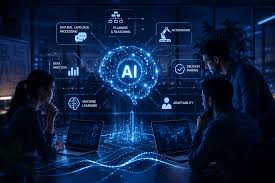
Business process automation is moving beyond rule-based workflows and scripted RPA. In 2026, companies are using AI agents to handle multi-step tasks, reason across systems, process unstructured data, and take action inside tools like CRM, ERP, ITSM, HR, finance, and customer support platforms.
But not every AI agent vendor is ready for enterprise automation. A true AI agent development service should be able to integrate with existing systems, produce audit trails, measure performance against business KPIs, and keep agents reliable as models, data, and workflows change.
This guide compares the top AI agent development services for business process automation in 2026, based on production experience, integration depth, compliance readiness, verified reviews, proprietary platforms, and measurable client outcomes.
An AI agent development service is defined by its ability to build systems that reason, plan, and take action across enterprise systems. It is not defined by the ability to demo a chatbot. That distinction matters because most of what calls itself "AI agent development" is actually chatbot development with a shinier label.
HSO frames the difference cleanly: a chatbot waits for you to ask, while agentic AI can autonomously plan, decide, and execute multi-step tasks. Think of a chatbot as a conversation and an agent as a conversation that can also take action. LeewayHertz puts the RPA contrast the same way: compared to rigid, rule-based systems like Robotic Process Automation, AI agents offer significantly more flexibility and adaptability, making them suitable for wider applications.
A real BPA agent has to do four things at once. It has to integrate with the system where the work actually happens. It has to produce audit trails a compliance team will accept. It has to be measurable against a baseline KPI. And it has to keep working when the foundation model provider updates the model underneath it.
Counterargument worth answering: many enterprises succeed with off-the-shelf RPA and never need an AI agent partner. True, for narrow rules-based workflows with stable inputs. The moment the workflow includes variability, unstructured inputs like emails, PDFs, or tickets, or requires reasoning across systems, RPA breaks. Take Azumo's Angle Health engagement: the RFP-to-quote workflow was too unstructured for traditional RPA because incoming Zendesk tickets carried unstructured attachments, non-standard census data, and free-text requirements. LLM-powered agents cut the process from 45 minutes to 5 minutes, a 90% cycle time reduction that no scripted RPA workflow could deliver.
The ranking weights production track record, integration surface area, SOC 2 or equivalent compliance, verified third-party reviews, and named client outcomes with quantified metrics over headcount and marketing presence.
Six axes drove the ordering:
Production BPA agents actually shipped, not just client demos or pilots.
Named integration surface area across Salesforce, SAP, Oracle, ServiceNow, Dynamics 365, Power Platform, or custom platforms.
SOC 2 Type II, HIPAA, GDPR, or ISO 27001 compliance where the vertical requires it.
Verified Clutch, G2, or DesignRush ratings above 4.5.
Named enterprise clients with quantified BPA outcomes: cycle time reduction, cost savings, accuracy metrics.
Published proprietary methodology or accelerator platform.
The simplest test for whether a vendor crosses the line from agency to enterprise partner is whether they can produce telemetry from their own AI systems in production. Azumo's AI Receptionist is the reference point here: 1.7-second median response time, 76% of conversation turns completed in under 2 seconds, zero downtime since deployment, and 512 measured conversation turns to back the numbers up. That is what "eat your own dog food" looks like when it is real.
Counterargument worth addressing directly: review scores are gameable. Fair point, but any single signal is gameable. Firms have to satisfy multiple independent signals at once: verified reviews, published telemetry from their own systems, and a third-party audited security certification. Satisfying all three is much harder to manufacture than satisfying any one of them.

These eight firms represent the strongest combinations of production BPA experience, integration depth, and verified delivery for buyers in 2026. The range is deliberate. A CTO evaluating BPA agent development in 2026 is not choosing from a single category. They are weighing a US-nearshore SOC 2 specialist like Azumo against a Microsoft-only Copilot Studio partner like HSO, or deciding whether SoftServe's NVIDIA Elite Partnership is worth the enterprise billing rate over a 30-person boutique like Markovate.
The order moves from mid-market and production-telemetry-first firms to enterprise-scale integrators. This is deliberate. It reflects "how similar is the buyer's use case to the firm's sweet spot," not "who is objectively best." A $10M multi-country Dynamics rollout belongs with HSO or SoftServe. An 8-week production PoC with a measurable KPI belongs with Azumo, HatchWorks, or Markovate.
Azumo is best for mid-market and enterprise BPA buyers who need custom AI agents built and shipped into production in US time zones at nearshore cost. Azumo sits inside the Anthropic Claude Partner Network, holds SOC 2 certification, and has been building production AI since 2016, before the current agent wave made it commercially obvious.
Founded in 2016 in San Francisco by Chike Agbai, Azumo runs distributed development teams across 20+ countries with a strong Latin America presence. The company has shipped more than 300 successful production deployments and more than 100 production AI systems since 2016.
Engineering differentiators:
Model-agnostic multi-vendor stack: OpenAI, Anthropic Claude, LLaMA, Google Gemini, DeepSeek, Mistral, Cohere, Qwen, Grok, orchestrated via LangGraph, CrewAI, and Microsoft AutoGen.
Proprietary Valkyrie platform providing unified REST API access to any model, image generation, and speech models.
RAG hallucination control that reduces rates from 15–20% with a base LLM to under 5% across most enterprise use cases.
Enterprise integration depth across Salesforce, SAP, Oracle, ServiceNow, and custom internal platforms.
SOC 2 certified, HIPAA-ready, GDPR and CCPA compliant, AES-256 end-to-end encryption.
Department-level AI agent practice covering Customer Support, Finance, HR, Legal, Marketing, Operations, Procurement, and Sales.
Production case studies with telemetry:
Angle Health: LLM-powered RFP-to-quote automation cut cycle time from 45 minutes to 5 minutes, a 90% reduction.
AI Receptionist (Azumo's own production phone line): 1.7-second median response, 76% of turns under 2 seconds, 512 measured turns, zero downtime.
Meta: GenAI enterprise search across 3.5 million+ supplier records with a 40%+ precision improvement.
NGL oil and gas alarm management agent: reduced false alarms by more than 70% and improved operator response times by over 40%.
Centegix: computer vision plus OCR license extraction with 80%+ field detection and text extraction accuracy.
Proof points: 4.9 verified rating across Clutch and DesignRush, 150% net retention, 100+ customers, and a 3.2+ year average client engagement. Recognized as a Top AI Development Company by Clutch, The Manifest, and DesignRush, and named a Hot Vendor for AI by Aragon Research.
Trade-off: Azumo does not offer a 50-country Microsoft-Dynamics-native rollout capability. For buyers whose BPA lives entirely inside Microsoft Copilot Studio and Dynamics 365, HSO is the answer. For buyers who need model-agnostic BPA agents in US time zones with production telemetry, Azumo is.
HatchWorks AI is the only firm on this list to have rebranded its entire company around AI. When ChatGPT launched in November 2022, HatchWorks pivoted the whole organization, retraining teams and re-engineering delivery around its proprietary Generative-Driven Development™ methodology.
Founded in 2016 in Atlanta by Brandon Powell, HatchWorks operates integrated US and nearshore Agile teams across 4 countries and 2 continents with 51 to 200 employees. The proprietary Generative-Driven Development™ (GenDD) methodology is a repeatable path from idea to production that blends AI, agents, and engineering. HatchWorks also offers a paid GenDD Training Workshop that equips client engineers to implement the methodology in-house.
Full BPA service stack: AI Strategy and Roadmap, Data Engineering and Analytics, AI-Powered Software Development, AI Engineering Teams, and Agentic AI Automation.
Named production case studies:
Aero Star Aviation AVA: AI platform surfacing aircraft maintenance history from Corridor so technicians can prepare, diagnose, and resolve work orders faster. Built to address mechanic shortages and capture tribal knowledge.
Diebold Nixdorf: software redesign and modernization.
Meerir AI-powered airspace decision support platform MVP ingesting ADS-B Exchange air traffic data.
Food company loyalty solution that reached 20% of target enrollments within the first two weeks of deployment.
Proof points: Named #1 AI Services Company by Clutch and Inc. AI Power Partner. Named to the Top 100 Enterprise Software Development Companies of 2025 by Techreviewer.co in November 2025. Projects range from $125,000 to $10 million, minimum project size $25,000+.
Trade-off: HatchWorks AI's 51 to 200 employee footprint means it does not have the geographic reach or multi-jurisdictional compliance depth of a global integrator like Itransition or SoftServe. Best for scaling companies where methodology and speed matter more than global rollout capability.
LeewayHertz has published the deepest content library on AI-for-business-process-automation of any firm on this list, and its ZBrain Builder platform is a genuine agentic AI orchestration layer, not just a marketing skin over a services line.
Led by CEO Akash Takyar with 15+ years in operation, LeewayHertz has partnerships with over 30 Fortune 500 companies including Siemens, 3M, P&G, and Hershey's, and serves clients including ESPN, NASCAR, McKinsey, and Pearson.
Engineering differentiators:
Multi-framework agent development using CrewAI, AutoGen Studio, and TaskWeaver.
Model-agnostic ZBrain platform supporting GPT-5.2, Claude, Gemini, Llama 4, Grok 3, and Mistral.
ZBrain Builder platform with 200+ prebuilt data connectors integrating across cloud services, collaboration platforms, databases, and enterprise systems.
Multi-agent orchestration via Agent Crew with built-in evaluation suites, guardrails, and real-time observability.
Department-specific agent catalogs for Sales, Human Resources, Finance, IT Operations, Customer Service, and Marketing.
Named production case studies:
Fortune 500 manufacturing company LLM-powered machinery troubleshooting integrating static machinery data and dynamic safety policies.
Switzerland-based wine e-commerce with a GPT-4-powered custom LLM app featuring personalized recommendations, multilingual support, and real-time availability checks.
Scrut LLM-powered compliance app streamlining access to compliance benchmarks and audit data.
AI-powered medical assistant with healthcare NLP for diagnostic workflows.
Proof points: Verified Clutch reviews above 4.7 and rankings across AIM Research 2026 GenAI provider lists, RTS Labs' 2026 ranking, and Master of Code Global's 2026 enterprise AI list.
Trade-off: LeewayHertz's rate premium is real versus offshore alternatives, and much of their positioning content is written for SEO discovery. The actual engineering rigor lives in ZBrain Builder and the department-specific agent catalogs, not the surrounding blog volume. Buyers should evaluate the platform capabilities, not the blog headline count.
Markovate is the San Francisco boutique on this list, a 30-person AI consulting and development team that has productized more BPA-shape solutions than most firms 10x its size.
Based at 388 Market Street, the firm has 30+ AI consultants and developers and has delivered 65+ AI projects across healthcare, insurance, real estate, construction, legal, retail, and finance.
Engineering differentiators:
Agentic AI development stack: autonomous data analysis agents, order management agents, AI sales agents, AI voice agents.
Proprietary agent catalog: AI Blueprint Classifier (CAD to BOM extraction), AI Takeoff Software (construction cost estimation), AI Voice Agent, Agentic AI Assistant, AI Interview Agent.
HIPAA-compliant healthcare AI delivery.
Reported client outcomes across engagements: up to 70% time savings, 99.5% accuracy, and 2X revenue growth.
Named production case studies:
American manufacturer ERP AI agent automating customer order management, inventory tracking, and order tracking with 95% order accuracy.
Apparel and fashion client AI recommendation plus computer vision plus demand forecasting delivered a 20% increase in sales conversions, 30% reduction in inventory waste, 40% reduction in manual catalog tagging time, and 35% improvement in customer engagement.
Healthcare insurance provider risk assessment tool with transaction anomaly detection.
IT services client real-time risk scoring system aggregating data from multiple sources.
Proof points: 12 Clutch reviews with strong verified ratings and flexible pricing including fixed-cost plans.
Trade-off: Markovate's 30-person team is a real constraint. For a 12-month, multi-country BPA rollout, this is the wrong choice. For a focused BPA project with a bounded scope and a measurable KPI, Markovate's proprietary agent catalog is unusually strong for a boutique.
Simform is a 1,000-engineer Microsoft-heavy digital engineering shop that made a real commitment to production agentic AI in 2025 with its proprietary ThoughtMesh accelerator and dedicated Agentic AI practice.
Founded in 2010 in Ahmedabad, India, with US offices, Simform is led by CEO Prayaag Kasundra and CTO Hiren Dhaduk. The firm employs 1,000+ engineers, holds CMMI Level 3 certification, and is a Microsoft Azure Expert MSP, a distinction held by fewer than 105 companies among 400,000+ Microsoft partners.
Engineering differentiators:
ThoughtMesh proprietary accelerator with reusable patterns for agent orchestration, enterprise knowledge grounding, evaluation, and governed deployment.
Multi-framework agent stack: LangChain, AgentGPT, Auto-GPT, BabyAGI, Microsoft Azure AI, AWS Bedrock, GCP Vertex AI, Microsoft Power Platform.
Agentic readiness assessment and process intelligence audit that identifies where delays, rework, and decision bottlenecks occur.
Sector-specific agentic AI systems for fraud detection, AML monitoring, payment risk scoring, patient engagement, claims automation, and churn reduction.
Named production case studies:
Manufacturer RFQ system cloud migration integrated with multiple ERP systems reduced quotation turnaround time by 70%.
InsightVault™ Azure-hosted LLM platform cut analysis effort by 80%.
EV truck charging operator Azure data platform delivering real-time analytics with 99.99% uptime.
Supply chain intelligence platform with 40% fewer connectivity disruptions.
Hospitality kiosk-based retail platform with Microsoft Fabric reducing dashboard load times from minutes to seconds.
Proof points: 85 Clutch reviews, recognized by ISG and Everest Group, named to AIM Research Top GenAI Service Providers 2026. Notable clients include Pepsico, Sony Music EMI, and Nxt-ID.
Trade-off: Simform's 1,000+ engineers are based in Ahmedabad. For US or EU buyers on time-sensitive BPA projects, this means planning around 10 to 12-hour time zone gaps and the 24-hour decision loops that follow. Simform is priced and paced for enterprise Microsoft-heavy work, not boutique-speed iteration.
Itransition is the 25-year-old global integrator on this list, with 3,000+ engineers across 40+ countries, with a Microsoft-focused enterprise stack, and a recent AI agent practice built on that foundation.
Founded in 1998, headquartered in Decatur, Georgia, Itransition is led by Alex Demichev, CEO since 2015. The firm was named #1 among Top AI Software Development Companies in the UK for 2026 by CEO Monthly.
Explicit BPA positioning from the site: "We design copilots and fully autonomous agents to handle repetitive business tasks like data handling and customer service." The AI service catalog covers autonomous software agents for marketing campaign planning, order processing, and support case resolution.
Engineering differentiators:
25+ years in operation.
Microsoft-focused enterprise stack: Dynamics 365 (CRM and ERP), Power Platform, Azure AI.
Enterprise vertical depth across healthcare, finance, manufacturing, retail, insurance, software and hi-tech, and professional services.
Microsoft Dynamics 365 partner recognized in the Dynamics 365 Partner Directory by ERP Research.
Named production case studies:
Large insurance provider GenAI knowledge-base agent integrated with policy documentation so insurance agents get natural-language summaries with source links.
US pharmaceutical multinational: 12+ years managing a cloud data suite with 500 million patient records.
Global fashion retailer predictive BI plus real-time recommendation plus computer vision delivered 8% higher conversions and a 50% reduction in infrastructure costs.
The Economist DevOps optimization saved the publisher $50K annually on infrastructure management.
TradeStops investment portfolio platform serving 30,000+ North American investors.
Proof points: 40 Clutch reviews, FinTech Global recognition for WealthTech leadership, and named to the Dynamics 365 Partner Directory by ERP Research.
Trade-off: Itransition does not publish granular telemetry from its own AI systems the way Azumo, HSO, and SoftServe do. For a buyer whose selection criterion includes "show me the metrics from your own production agents," Itransition's strength is scale and vertical depth, not own-system transparency.
HSO is the Microsoft-native BPA specialist on this list. If your business process automation lives inside Dynamics 365, Copilot Studio, or Power Platform, HSO's depth is difficult to match. The firm holds all six Microsoft Cloud Partner Designations, is a Microsoft Inner Circle partner, and was awarded the Microsoft Frontier Partner Badge for advanced Cloud and AI capabilities.
With 30+ years in business, HSO positions itself explicitly for agentic BPA: "AI development is moving beyond chatbots and copilots into agentic systems that autonomously execute multi-step business workflows. HSO builds these next-generation AI agents using Microsoft Copilot Studio and Azure AI Foundry".
Engineering differentiators:
Microsoft-only stack: Azure AI Foundry, Copilot Studio, Azure OpenAI, Microsoft Fabric, Dynamics 365, Power Platform.
AI Envisioning Labs and AI Jumpstart program deliver production-ready proof of concept in weeks.
Proprietary agent portfolio deployed inside Microsoft 365, Dynamics 365, and Teams: Time Entry Agent, PayFlow Agent, Order Management Agent, Expense Entry Agent, Customer Service Agent, Proposal Automation Agent.
Accelerate AI Agent Platform enabling secure deployment and governance of role-based AI agents inside the client's Azure tenant.
Microsoft 365 Copilot pricing depth: $30 per user per month for enterprise plans, Copilot Studio external deployments starting at $200 per month, Copilot Cowork at $0.01 per credit.
Named production case studies:
Techion AI-powered image analysis transformed traditional testing at global scale.
Chemonics Dynamics 365 deployment quoted directly by Executive VP Eric Reading.
Alfen, Intergamma, MegaGroup Trade Holding, and Bouwmaat European enterprise Dynamics customers.
Proof points: Named Major Contender in the Microsoft D365 Services PEAK Matrix® Assessment 2023 by Everest Group. 10-week Dynamics 365 implementation delivery model.
Trade-off: HSO does not do model-agnostic multi-vendor work. If your BPA project needs Claude, Gemini, or open-source LLaMA alongside Azure OpenAI, HSO is the wrong choice. If your project lives entirely in Microsoft, HSO is arguably the strongest partner on this list.
SoftServe is the article's largest-scale enterprise BPA player, a 10,000-person global integrator with an NVIDIA Elite Partnership and a multi-year Google Cloud strategic partnership focused specifically on agentic AI and next-generation data initiatives.
Founded in 1993 by Taras Kytsmey and headquartered in Austin, Texas, and Lviv, Ukraine, SoftServe employs 10,331 people as of May 2026 and has 30+ years of operational experience across high tech, financial services, healthcare, life sciences, retail, energy, and manufacturing.
SoftServe's own framing on the state of enterprise AI: 78% of enterprises use AI, yet only 7% have scaled it. The challenge is not the technology but the operating model.
Engineering differentiators:
NVIDIA Elite Partner.
Google Cloud multi-year strategic partnership signed April 2025 with access to Google Agentspace, Gemini Enterprise, and Vertex AI.
Named a Challenger in the 2024 Gartner® Magic Quadrant™ for Custom Software Development Services.
AWS APN Premier Services Partner and 2020 Google Cloud Partner of the Year Award for Machine Learning.
Focused agent or copilot with evaluation harness and guardrails in 4 to 6 weeks.
Gemini Agentic Launchpad: 3 agents in 30 days.
Proprietary agent products: QA Agent, Content Creation Agent, and CV Agent that automates CVAT annotation workflows via natural language, cutting annotation effort by 50%.
Named production case studies:
Krones, a global process manufacturer, fluid simulations built with Ansys, CADFEM, Microsoft, and NVIDIA.
Drug Discovery Gen AI Solution built with NVIDIA Blueprints at AWS re: Invent 2024.
Gen AI Retail Shopping Assistant product launch in January 2025.
Proof points: Independent survey research across 600+ IT leaders in 9 countries underpins SoftServe's operating-model data.
Trade-off: SoftServe is a 10,000-person global integrator, so it is priced and paced accordingly. Small or scope-bounded BPA projects typically do not receive executive attention. Buyers with $500K to $5M BPA budgets and a multi-year roadmap are the right fit. Buyers with $50K PoCs are better served by the smaller specialists on this list.
Integration is the variable most BPA buyers underweight during vendor selection. It is also the variable that most reliably determines whether a shipped agent stays in production or gets quietly abandoned in month 9.
The pattern from enterprise AI adoption research is consistent: when AI is implemented as a standalone tool rather than embedded in CRM, ERP, or line-of-business systems, adoption rates stay under 10 to 20% of target users. A BPA agent that does not integrate with the system where the work actually happens is a productivity tool at best, not automation.
The eight firms take different integration postures, and the differences matter for procurement:
HSO: Deep Microsoft-only integration across Dynamics 365, Power Platform, Copilot Studio, and Teams with pre-built agents.
Simform: Heavy Azure and Microsoft depth with the ThoughtMesh accelerator providing reusable orchestration patterns.
Itransition: Microsoft-focused with a Dynamics 365 partnership.
LeewayHertz: 200+ prebuilt data connectors in ZBrain Builder plus a model-agnostic architecture.
Azumo: Custom integrations across Salesforce, SAP, Oracle, and ServiceNow with SOC 2 governance.
SoftServe: Multi-hyperscaler integrations across NVIDIA, Google Cloud, AWS, and Azure at global scale.
HatchWorks AI: GenDD-methodology-driven integrations with US and nearshore delivery.
Markovate: Focused agent-catalog integrations across ERP, HR interview, and construction blueprint workflows.
Counterargument worth answering: off-the-shelf tools like Microsoft Copilot handle 80% of internal productivity workflows without a custom integration. True for narrow productivity use cases like email drafting, meeting summaries, and document search. It breaks the moment BPA moves into proprietary data, regulated workflows, or processes that create competitive differentiation. A RAG agent querying underwriting rules has data residency requirements. An HR agent has role-based permissions. An AI receptionist has to write back to your CRM.
Practical test for buyers: ask any vendor on this list to describe their integration surface area explicitly. Named connectors, named platforms, named workflows they have integrated with, not "we support any system." If the answer stays abstract, the integration story is not real.
Mistakes Buyers Make When Choosing an AI Agent Development Service
Even the right firm on this list will fail for the wrong buyer, which is the final point worth making before the decision.
Five failure modes come up repeatedly:
Vague problem definition. "We need an AI agent" is not a brief. "Reduce claims processing average handle time by 30% within six months" is a brief. Without a measurable KPI tied to a business outcome, no vendor can price the work or ship against a target.
Ignored data readiness. BPA agents fail on unstructured or ungoverned data. Every firm on this list can build to a spec, but almost none can manufacture a data foundation on the buyer's behalf and still be accountable for it. SoftServe's independent research reports 73% of teams struggle with data prep for AI.
Integration as an afterthought. From the H2 above: standalone tools produce 10 to 20% adoption. If the CRM, ERP, or ITSM integration is not in scope from day one, the agent will not be used in month six.
No monitoring plan. A team that does not run monitoring on its own systems will not build monitoring into yours. Vendors who cannot describe their own agent monitoring stack cannot build one for a client either.
Set-and-forget after deployment. BPA agents drift. Foundation models get updated. Business rules change. Without a retraining and monitoring plan, an agent that shipped in month 1 is producing quiet errors by month 12.
Counterargument worth answering: these failures are the vendor's responsibility. A genuinely good AI agent firm should identify a weak brief, a data problem, or a missing integration plan and refuse the engagement. Partly true. The willingness to challenge a vague brief and insist on an integration plan is itself a selection signal. But ultimately the buyer owns the business case, the data, and the process ownership. A vendor can flag a weak data foundation. Only the buyer can fix it.
Before signing with any firm on this list, run a paid 4-week discovery against a single BPA use case with a measurable baseline. That is the cheapest procurement filter available and it separates the vendors who ship from the ones who present.
Require the vendor to ship a working BPA agent PoC against your real data, not synthetic data and not a demo environment.
Write a monitoring, retraining, and drift-detection clause into the SOW: who owns it, what triggers a retraining cycle, and how performance is measured against the original baseline.
If a vendor resists any of those three requirements, move on. That resistance is the signal.
The cheapest filter you will ever apply in BPA vendor procurement is the one you apply before you sign. If Azumo's production track record and telemetry map to your use case, start a conversation. If your project lives entirely in Microsoft Dynamics, HSO is the right first call. Either way, ask for the metrics before you ask for the proposal.
Choosing an AI agent development service comes down to execution, not positioning. The right partner should understand the business process, connect the agent to the systems where work happens, define clear success metrics, and support monitoring after deployment.
Azumo, HatchWorks AI, LeewayHertz, Markovate, Simform, Itransition, HSO, and SoftServe each serve different buyer needs, from focused BPA pilots and nearshore AI engineering to Microsoft-native automation and enterprise-scale agentic AI programs.
Before signing, buyers should test one real workflow in a paid discovery, require a working PoC against real data, and include monitoring, retraining, and drift-detection responsibilities in the SOW. The strongest vendor is not the one with the broadest AI claims. It is the one that can ship a reliable agent and keep it useful in month 18.
 AI tools to find & convert leads.
  Send emails at scale