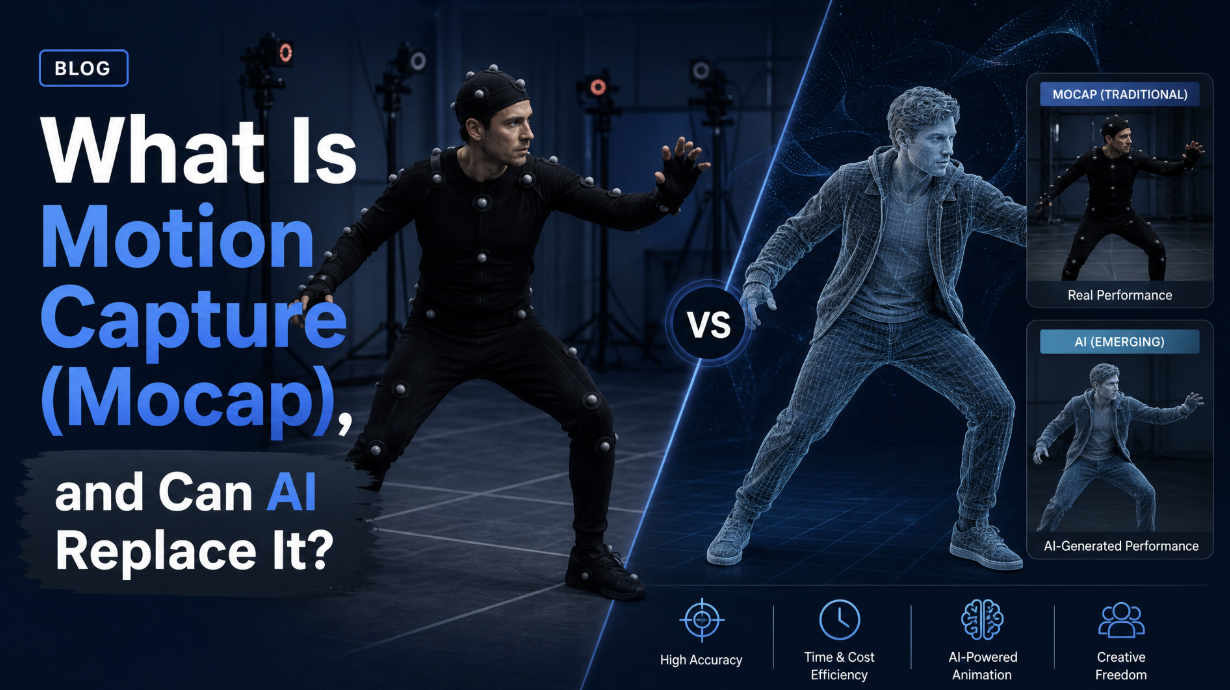
Motion capture is the process of recording a real performer's movement and translating it into data that can drive a digital character, an animated film's hero, a game's NPC, a virtual influencer's gestures. For most of its history, that process required specific, expensive equipment: reflective markers on a suit, a calibrated array of cameras tracking those markers, and a technician running the whole session. AI has introduced a genuinely different way to get similar data, and the honest answer to whether it replaces the traditional approach is: for a lot of real-world use, yes, and for the hardest cases, not entirely yet.
Classic optical motion capture works by placing reflective or LED markers at specific points on a performer's body, joints, limbs, sometimes the face, and surrounding them with a ring of calibrated infrared cameras. Each camera tracks the markers' positions in 3D space, and specialized software triangulates that data into a skeletal animation that can be applied to a digital character. Inertial suits work differently, using accelerometers and gyroscopes sewn into a wearable garment rather than external cameras, trading some precision for portability outside a fixed capture volume.
Both approaches share the same basic requirements: dedicated hardware, a trained operator, and either a fixed studio space or specialized wearable equipment. That's what made mocap, for most of its history, something only well-funded productions could access regularly.
Markerless capture uses computer vision and machine learning to estimate a performer's skeletal pose directly from ordinary video, a phone, a webcam, a standard camera, with no markers, no suit, and no specialized capture volume required. The model has learned what human joints and movement look like from a massive amount of training data, and it applies that learned understanding to infer 3D pose from 2D footage, sometimes from a single camera, sometimes from a synchronized multi-camera setup for greater precision.
The practical difference this makes is access: a session that once required a booked studio and trained technicians can now happen with a tripod and a phone, processed in the cloud rather than requiring specialized on-site software.


For a large share of real-world use, markerless AI capture is now a legitimate, direct replacement. Multi-camera markerless setups using consumer hardware, several tripod-mounted phones, for instance, produce skeletal data that vendors position as comparable to commercial optical systems for many standard movements. Single-camera setups from a webcam or phone go further still on accessibility, trading some precision for a session that costs nothing beyond the camera already in someone's pocket.
The specific tasks where this replacement is genuinely solid: standard human locomotion, walking, running, basic gestures, single-performer capture without extreme occlusion, and any project where the budget or timeline never included a real optical stage in the first place. For the significant number of productions in that category, markerless AI capture isn't a compromise, it's simply a better fit than a traditional rig ever would have been.
The honest gap shows up in the hardest cases: very fast or complex motion, scenes with heavy occlusion where a performer's body parts block each other from camera view, fine finger and hand detail, and capture involving many performers in close physical contact. A calibrated optical system's fixed camera array and physical markers still resolve these situations more reliably than a model estimating pose from video alone, since the markers provide unambiguous tracking points a computer-vision model has to infer instead.
This gap is real but has been narrowing steadily. What counted as a hard limitation for markerless capture two years ago is often handled adequately today, and the trend line points toward that gap continuing to close rather than staying fixed.
It's worth separating one more thing from this comparison: AI-assisted physics posing, tools that generate believable motion, a fall, a stunt, an impossible movement, without capturing any real performance at all. This isn't a replacement for motion capture so much as a different tool entirely, useful specifically when the motion needed is too dangerous or physically impossible to capture from a real performer regardless of which capture method is available.
Neither traditional mocap nor its AI-based alternative solves what happens once a captured performance needs to become part of a finished video: does the resulting character stay visually consistent across every scene, does the camera work around it feel deliberate, does it composite believably into the rest of a project. invideo agent doesn't capture motion itself, but a persistent context engine holds a captured character's visual identity consistent across every shot once that performance is part of a larger project, and Camera Controls apply a deliberate move around it. The platform routes each shot to whichever of its 200+ integrated models fits that particular moment, including Veo 3.1, Sora 2, Kling 3.0, Seedance 2.0, Runway, PixVerse, Hailuo, WAN, Recraft, GPT Image 2.0, and Nano Banana, so a captured performance, from a traditional rig or an AI-based alternative, can sit inside a finished, consistent film rather than staying an isolated clip.
Motion capture is fundamentally about turning a real performance into usable animation data, and AI hasn't replaced that goal so much as it's added a second, far more accessible way to reach it. For most standard human movement captured by a single performer without extreme occlusion, markerless AI capture is a genuine, direct replacement for a traditional rig, and for a huge number of productions that never had rig-level budgets to begin with, it's not a compromise at all. For the hardest cases, fast complex motion, heavy occlusion, fine hand detail, multiple performers in close contact, a calibrated optical system still holds a real precision advantage, though that gap keeps narrowing.
The more useful question for most creators isn't whether AI has fully replaced traditional mocap everywhere. It's whether the specific motion a project needs falls into the large, well-covered majority AI now handles well, or the shrinking minority that still benefits from the equipment mocap was always built around.
 AI tools to find & convert leads.
  Send emails at scale