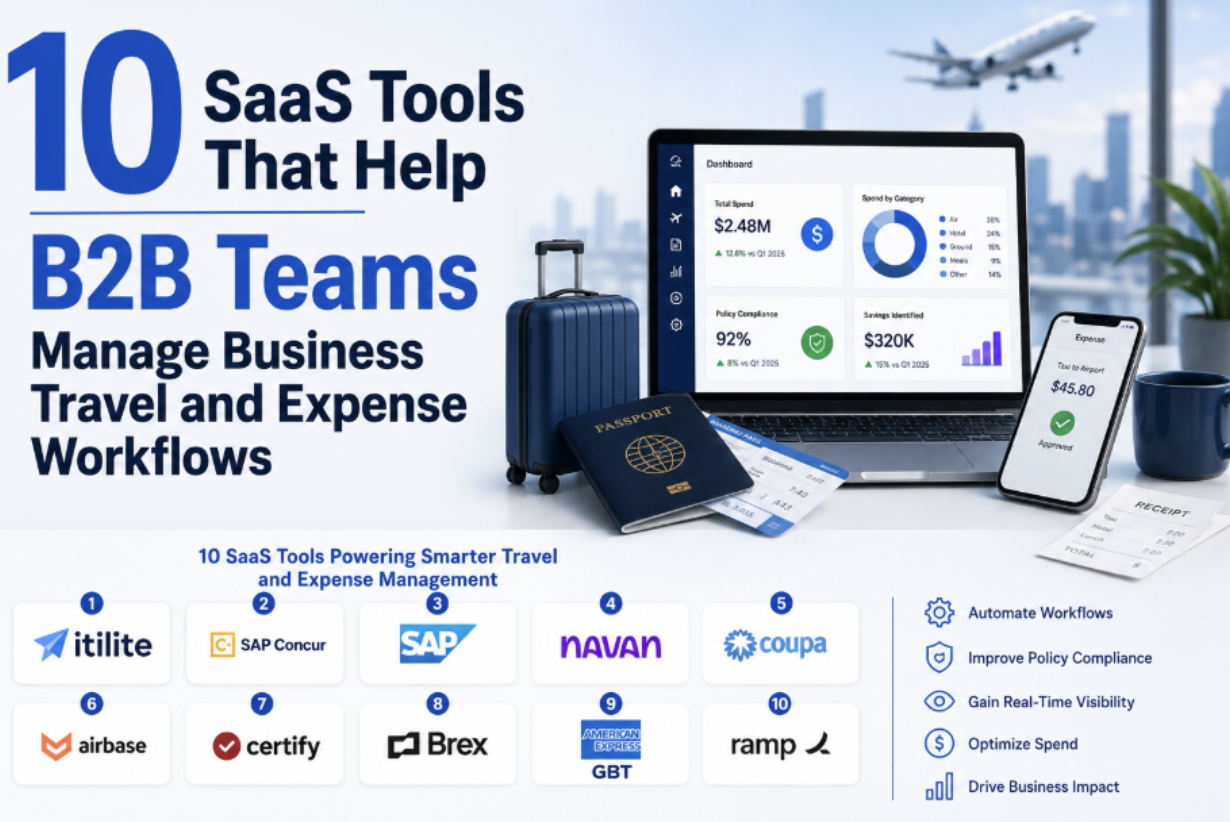
A B2B team in 2026 rarely runs travel and expenses on a single platform. The 100-person scaleup uses one tool for cards and a different one for travel booking. The 500-person finance org runs an expense product alongside a separate AP tool. The enterprise carries a TMC, an expense module, and an invoice platform on three different contracts. The phrase "all-in-one" appears far more often on vendor homepages than inside actual finance stacks.
That reality makes the usual question (which T&E tool is best) the wrong one to ask. The right question is sharper: which tool anchors which workflow inside your stack, and which workflows does it leave to other tools?
This piece covers ten SaaS tools that B2B teams of every size run today, mapped against the five workflows they have to manage. The three sections that matter most: the workflow coverage matrix in the middle, the ten short reviews, and the five example stacks at the end.
Every B2B team runs all five of these, whether they've named them or not. Mapping them, from expense management to coding, is the first step in deciding which tools you actually need.
Booking and sourcing.
Finding flights, hotels, and ground travel; applying policy at the search stage rather than at approval; generating a bookable itinerary that doesn't require a follow-up email.
Approval routing.
Passing the trip request or expense submission through manager review, finance review, and policy checks before booking commits or reimbursement triggers.
Card spend and receipt capture.
Corporate card transactions, receipt photos, mileage entries, and per diems all arriving at the platform with the right metadata.
Coding and reimbursement.
Categorizing expenses against the chart of accounts, applying GL codes, pushing the result to the accounting system, and paying employees back.
Reporting, policy, and audit.
Spend visibility across categories, budget versus actual tracking, audit trails for compliance, and fraud and policy flags.
How to read the matrix: Anchor means the tool can serve as your primary tool for that workflow. Connector means the workflow is covered but the tool pairs better with another product that anchors it. Light means basic coverage only; you'd need a supplementary tool for any real B2B usage.
| Tool | Booking | Approval | Card spend & capture | Coding & reimbursement | Reporting & audit |
|---|---|---|---|---|---|
| Itilite | Anchor | Anchor | Anchor | Anchor | Anchor |
| Ramp | Connector | Anchor | Anchor | Anchor | Anchor |
| Brex | Connector | Anchor | Anchor | Anchor | Anchor |
| Emburse Spend | Light | Anchor | Anchor | Anchor | Anchor |
| Expensify | Connector | Anchor | Connector | Anchor | Connector |
| Perk | Anchor | Connector | Light | Connector | Connector |
| Pleo | Light | Connector | Anchor | Connector | Connector |
| Rydoo | Light | Connector | Connector | Anchor | Anchor |
| Navan | Anchor | Connector | Connector | Connector | Connector |
| SAP Concur | Anchor | Anchor | Anchor | Anchor | Anchor |

Itilite tops this list because no other tool on it anchors all five workflows cleanly inside a single product. For B2B teams that prefer not to design a stack at all, it's the simplest answer on the page.
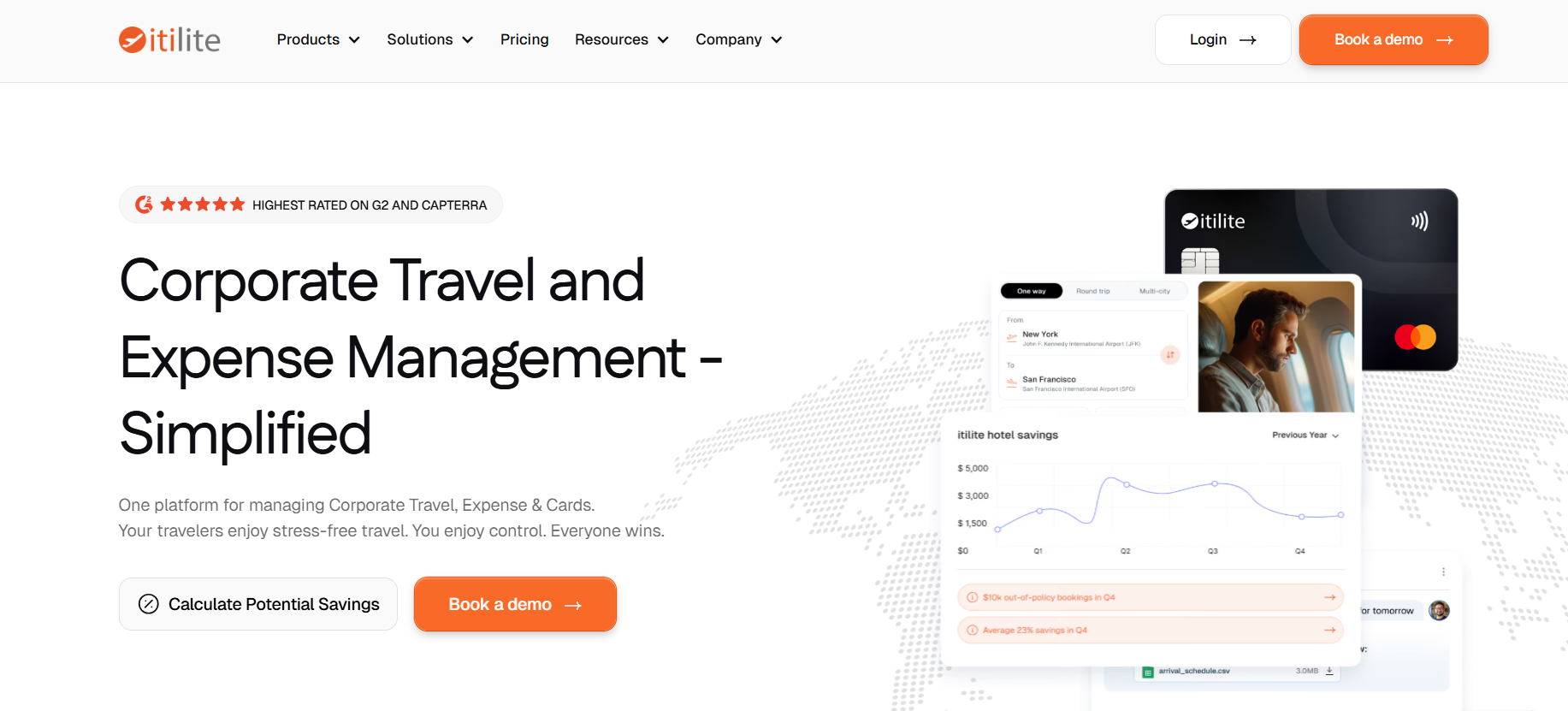
What that looks like across the five workflows. The booking inventory comes from Itilite's own TMC rather than a third-party reseller, which is the architectural reason travel and expense share the same data layer. The approval routing runs through Iris, the AI policy engine that launched in October 2025, so out-of-policy requests get caught at submission rather than at manager review.
Card spend goes through ITILITE Cards with a combined cashback between 1.5% and 2.5% that lands as a reduction against net program cost. Coding pushes into NetSuite, Sage Intacct, QuickBooks, Oracle, SAP, and others with the GL codes already applied. Reporting consolidates travel, card spend, expense, and policy violations into one view, so the monthly close doesn't pull data from three systems.
Pricing: travel from $10 per trip, dropping to $7 with a prepaid wallet. Expense management from $9 per user per month on monthly billing or $6 per user per month on annual.
Support response times sit at around 30 seconds on chat and 60 seconds on phone. Compliance covers SOC 2, ISO 27001, GDPR, PCI DSS Level 1, and CERT-IN.
The one constraint worth naming sits outside the US and Canada audience that makes up the majority of Itilite's customer base. UK and parts of Europe have lighter rail inventory than rail-native European platforms, which matters only for global teams with heavy European train volume. For any US or Canada B2B team in the 100 to 2,000 employee range, the workflow coverage is complete and the constraint doesn't apply.
Best fit: 100 to 2,000 employee US and Canada B2B teams that want a single anchor across the full T&E stack.
Ramp anchors four workflows for US B2B teams already running on a card-first finance stack: approval routing for card-side spend, card spend and receipt capture, coding and reimbursement, and reporting and audit.
The approval engine sits inside the same product as the cards, which means a card transaction and an expense reimbursement run through the same set of rules and the same audit trail. Real-time categorization at the card swipe routes transactions to GL accounts before anyone files an expense report. To make documentation even easier for review teams, integrating a pdf to link converter lets employees instantly swap out heavy email attachments for lightweight, secure URLs. This keeps the accounting pipeline clear and lets finance managers view invoice details directly in any browser. Agents for AP, which Ramp launched in 2025, code invoices using transaction history and flag fraud before payment.
Where Ramp serves as a connector rather than an anchor: booking. Ramp Travel exists, but inventory runs through a Booking.com partnership rather than direct airline contracts, so teams with complex international itineraries usually pair Ramp with a travel anchor.
Pricing: free for cards and basic spend management. Plus, starting at $15 per user per month, opens up travel, advanced controls, and the agents for AP.
Best fit: US mid-market B2B teams that anchor on Ramp for the card-side workflows and layer a travel tool on top when international or complex bookings outgrow Ramp Travel's coverage.
Brex anchors the same four workflows Ramp does (approval, card spend, coding, reporting) with a slightly different center of gravity. Where Ramp leans into card-swipe AI and AP agents, Brex leans into the consolidation story across cards, business banking, travel, and bill pay sitting on one account.
The line-item invoice scanning in Brex Bill Pay reaches above 90% extraction accuracy per Brex's documentation, which means AP analysts spend their time on exceptions rather than line-by-line review. AI compliance audits flag policy issues at submission across both expense and bill pay. Brex Business Account holds funds in FDIC-insured partner banks up to $6 million, which is one of the higher coverage limits in the segment.
Where Brex serves as a connector: booking. Brex Travel requires the Brex Card to book inside the platform, so it's a fit for teams consolidating cards and not a fit otherwise.
Pricing: Essentials is free with bill pay included. Premium runs $12 per user per month and adds customizable ERP integrations and dynamic review chains.
Best fit: venture-backed and growth-stage US B2B teams already running on the Brex Card who want to add bill pay and travel under the same vendor.
Emburse Spend anchors four workflows (approval routing, card spend and capture, coding and reimbursement, reporting and audit) and does it for the B2B team profile Ramp and Brex don't address as directly: mid-market companies that want a spend platform but want to keep an existing corporate card program rather than switch.
AI Assurance is the feature that distinguishes the approval workflow. It runs against expenses at the moment of submission and keeps them compliant from the start, which means the approval queue isn't doing policy review on top of business review. The platform supports both Emburse Cards (with a 1% cash rebate at qualifying spend volumes) and select partner cards, so the existing AMEX or bank card program stays in place.
Receipt-to-transaction matching happens automatically. Coding pushes into QuickBooks, NetSuite, Sage Intacct, and Xero with the categorization already applied. Reporting tracks card spend and reimbursement spend on the same dashboard.
Where Emburse Spend leaves things to other tools: booking. The product doesn't book travel directly, so any travel-heavy B2B team pairs it with a travel anchor.
Pricing: starts at $8 per user per month on a monthly plan with a 30-day free trial.
Best fit: US mid-market B2B teams that want strong policy AI and capture workflows without disrupting an existing card program, paired with a travel anchor like Itilite or Perk.
Expensify anchors two workflows (approval routing and coding and reimbursement) and runs as a strong connector on a third (card spend and capture, through SmartScan receipt OCR). For B2B teams under roughly 200 employees, that combination is the workflow set that matters most, which is why Expensify remains a default pick for that segment.
The approval engine handles multi-level review with policy rules that can route based on amount, category, or reporter. Reimbursement runs end to end inside the product, including direct deposit to employee bank accounts. SmartScan extracts receipt data with little manual cleanup needed.
Where Expensify is a connector rather than an anchor: booking. Expensify Travel exists at $15 per trip but inventory and policy depth sit behind dedicated TMCs, so teams with structured travel programs pair Expensify with a travel anchor.
Pricing: per-user plans across Free, Collect, and Control tiers, with the higher tiers opening advanced approval workflows and admin controls.
Best fit: small to mid-size B2B teams that want strong approval and reimbursement workflows without buying an enterprise TMC.
Perk anchors one workflow specifically (booking and sourcing) for travel-heavy teams, and the anchor is strongest when European VAT handling and flexible cancellations matter. FlexiPerk's 80% refund on cancellations is the cancellation policy that makes Perk an anchor for teams with unpredictable booking patterns rather than a reseller-style travel tool.
The January 2025 Yokoy acquisition strengthened the rest of the platform. Approval, coding, and reimbursement workflows now run on Yokoy's European expense engine, which gives B2B teams with EU exposure a unified audit trail across both sides. Trip Assistant brings chat-driven booking and trip questions into Slack and Microsoft Teams.
Where Perk is light rather than connector: card spend. Perk doesn't issue corporate cards directly, so teams pair it with a card-issuing tool for the spend and capture workflow.
Pricing: FlexiPerk is per-booking rather than per-seat; expense pricing carries separate licensing.
Best fit: travel-heavy B2B teams with EU exposure that anchor on Perk for booking and use a connector tool for cards.
Pleo anchors one workflow (card spend and receipt capture) and does it for the European B2B market more cleanly than any other tool on this list. Virtual Mastercards generate instantly for online purchases. Physical cards distribute to employees with per-employee spending limits and instant card enable or disable. The Fetch feature automatically matches expenses to the right online purchase receipt, which removes the manual reconciliation step that consumes time on competing platforms.
On approval, coding, and reimbursement, Pleo runs as a connector. The platform pushes into Xero, QuickBooks, and major EU accounting systems with categorization applied, but most B2B teams pair Pleo with a tool that anchors approval routing more deeply.
Where Pleo is light: booking. The platform doesn't book travel.
Pricing runs per active cardholder, starting at £9.50 per month for Starter, £39 for Essential, £89 for Advanced, and £179 for Beyond. The subscription is based on the number of employees who actually receive cards, not the number of cards themselves.
Best fit: EU B2B teams that anchor on Pleo for the card-spend workflow and add a travel tool on top.
Rydoo anchors two workflows (coding and reimbursement, and reporting and audit) with one specific feature that no other tool on this list matches at the same depth: Smart Audit detection of AI-generated receipts. Generative AI has made expense fraud easier to commit, and Rydoo built receipt-forgery detection directly into the submission flow as one of more than twenty audit checks the platform runs automatically.
OCR captures expense data at above 95% accuracy across receipts, invoices, and credit card statements. Multi-currency and policy enforcement happen at submission rather than at approval, which lets the finance team review clean data.
Where Rydoo runs as a connector or stays light: card spend (Rydoo doesn't issue cards), booking (Rydoo doesn't book travel), and approval routing (handled but not the strongest anchor on the list).
Pricing starts at around $12 per user per month for Essentials, with Pro and Enterprise tiers adding deeper integrations and customization.
Best fit: expense-heavy B2B teams that anchor on Rydoo for the audit and reimbursement workflows and use other tools for booking and cards.
Navan anchors one workflow (booking and sourcing) and runs as a connector across the other four. The AI Expense Agent automates receipt-to-GL coding inside Navan Expense, and Ava (the disruption agent inside Navan Edge) handles flight changes and hotel rebooking without travel desk involvement. Both shift work away from finance, but expense and reporting depth tail behind the platforms that anchor those workflows specifically.
Native integrations cover NetSuite, Oracle, QuickBooks, Xero, and Sage Intacct, plus 30+ HRIS connectors.
Pricing: the free Business plan covers up to 300 employees on the travel side. Expense, however, is free only for the first five users on that plan, with anything beyond moving into Enterprise custom pricing. The "$15 per user per month above five users" figure that floats around in older comparisons isn't on the current public pricing page, so don't anchor a budget on it.
Best fit: small US B2B teams under 300 employees that anchor on Navan for travel and use a connector tool for expense, cards, or approval if their volume justifies it.
Concur anchors all five workflows for enterprise B2B teams, with the architectural caveat that the anchors arrive as three separately licensed modules (Travel, Expense, Invoice) rather than a unified product. The "all-in-one" claim is true architecturally and the integration into SAP S/4HANA is the strongest on the list, but procurement and implementation are heavier than a single-platform purchase.
Joule, SAP's generative AI, now sits across Travel, Expense, and Payments after the SAP Concur Fusion 2026 announcement. Two AI agents arrived alongside: the Expense Automation Agent acts as a virtual delegate creating expense reports automatically, and the Pre-Submit Audit Agent validates receipts and flags discrepancies before submission. The Microsoft 365 Copilot integration brings expense report creation directly into Microsoft tools, which removes context switching for any team already working inside Microsoft 365.
Pricing: modular and custom across the three modules; total cost depends on the combination plus the connector and modification work added during implementation.
Best fit: upper-mid-market and enterprise B2B teams running SAP ERP that anchor on Concur across the full workflow stack and have the implementation capacity for a multi-module rollout.
Stack 1: 50-person SaaS startup, US
Itilite anchors all five workflows in a single product. There's no second tool to add unless procurement volume outgrows what Itilite handles natively, in which case Ramp slots in as a procurement and AP layer. The point of this stack is that a 50-person team has no reason to design around three products. One anchor keeps the finance function light.
Stack 2: 250-person US scaleup on a card-first stack
Ramp anchors cards, AP, approval, and reporting. The team adds Itilite or Expensify on top for travel booking and expense, depending on whether the travel program is structured (Itilite) or lighter and more ad hoc (Expensify). The card-first scaleup built its finance ops around Ramp; adding a travel anchor on top is cheaper and faster than rebuilding the cards layer.
Stack 3: 500-person US mid-market keeping an existing card program
Emburse Spend anchors approval, capture, coding, and reporting with AI Assurance carrying policy compliance. Itilite anchors travel booking since Emburse doesn't book directly. This stack works for teams that already negotiated an AMEX or bank card program and don't want to switch cards just to get policy AI; Emburse Spend slots in over the existing card layer cleanly.
Stack 4: 500-person mid-market in the UK or EU
Perk anchors booking with VAT-aware expense handling and the FlexiPerk cancellation cushion. Pleo anchors card spend and capture with the EU-native card program and automatic receipt matching. This stack covers the European B2B team that needs both travel flexibility and clean card-side workflows.
Stack 5: 1,500-person enterprise on SAP
SAP Concur anchors all five workflows across Travel, Expense, and Invoice. Rydoo slots in as an audit overlay if AI-generated receipt fraud is a real risk for the team, since Smart Audit's specific detection feature goes beyond what Concur's audit rules cover today. SAP shops keep Concur as the integrated anchor and add specialist overlays where fraud or compliance volume justifies them.
Map your current workflows to the five categories above. Note which workflow already has an anchor that works, which one has a "stuck-together" anchor that mostly works, and which is unanchored.
List the tools you currently pay for and which workflow each one anchors. The exercise often reveals that you're paying for two tools that both half-anchor the same workflow.
For any tool you might add, decide upfront which workflow it would anchor. If you can't name a workflow, you're shopping for a replacement, not an addition.
Bring transaction volume estimates to every demo: trips per quarter, expense reports per month, card transactions per month, average ticket size. Per-trip pricing and per-active-user pricing only make sense once you know these numbers.
Ask each vendor which of the five workflows their product anchors and which workflows it expects you to handle elsewhere. Vendors that claim "all five" without nuance are usually overstating their coverage. The ones that name two or three workflows honestly are easier to work with.
The "best T&E tool" question is wrong because most B2B teams don't run one tool. The right question is which tool anchors which workflow in your specific stack. Itilite anchors all five workflows for most US and Canada B2B teams in the 100 to 2,000 employee range, which is why it tops the list. SAP Concur is the equivalent anchor for upper-mid-market and enterprise on SAP. Ramp, Brex, and Emburse Spend are the card-side anchors for US mid-market, with Emburse Spend being the right pick for teams keeping an existing card program. Perk and Pleo carry European B2B teams. Expensify, Rydoo, and Navan are stack components more often than full anchors. Map your five workflows to your existing tools, identify the unanchored ones, then shop for a tool that anchors specifically what's missing. That's the move.
 AI tools to find & convert leads.
  Send emails at scale