Over the last few years, the rules of digital marketing have been, and continue to be, written anew rapidly by platforms like LinkedIn, Instagram, TikTok, and X. Yet, despite these paradigm shifts, email marketing continues to be as relevant and effective as ever.
Targeted engagement, permission-based ownership of contact lists, and incredibly high ROIs– these are some of the factors that tip the scales in favor of email. And thus, naturally, agencies remain strongly committed towards designing and executing their email marketing campaigns.
That said, email production is no walk in the park. As many as 62% of email marketers spend about two weeks designing a single email. And let’s not forget– that first email is not the finishing line; it is merely the foundation. Next, you’ll be producing dozens, even scores of emails per month, depending on what your client’s requirements are; at the same time, you’ll be called upon to maintain consistency and quality across them all. Now, imagine doing this at scale, for multiple clients; this is exactly where most agencies start unravelling. But worry not, you don’t have to meet the same fate. All you need to do is introduce this one thing to your email design and production workflow– modular email templates.
Email creation is a time-consuming process; without a set system in place, agencies simply cannot cater to the needs of their multi-client roster. This is where modular email templates come into the picture.
Every email marketing campaign goes through these fundamental stages: design, approval, development, testing, and execution. While producing your first campaign, you’ll be picking up new insights across each of these stages. But by the time you reach, say, your tenth campaign? Not the case anymore, right? That’s why treating every single campaign as an entirely new production effort is not sustainable for agencies.
Rather than being caught up in the mechanics of the production process, agencies need to divert their attention to the qualitative factors of their campaigns– creativity, messaging, demographic targeting, and the like. This is only possible once they can streamline the entire email production process. And to do so, they need to adopt modular email design.
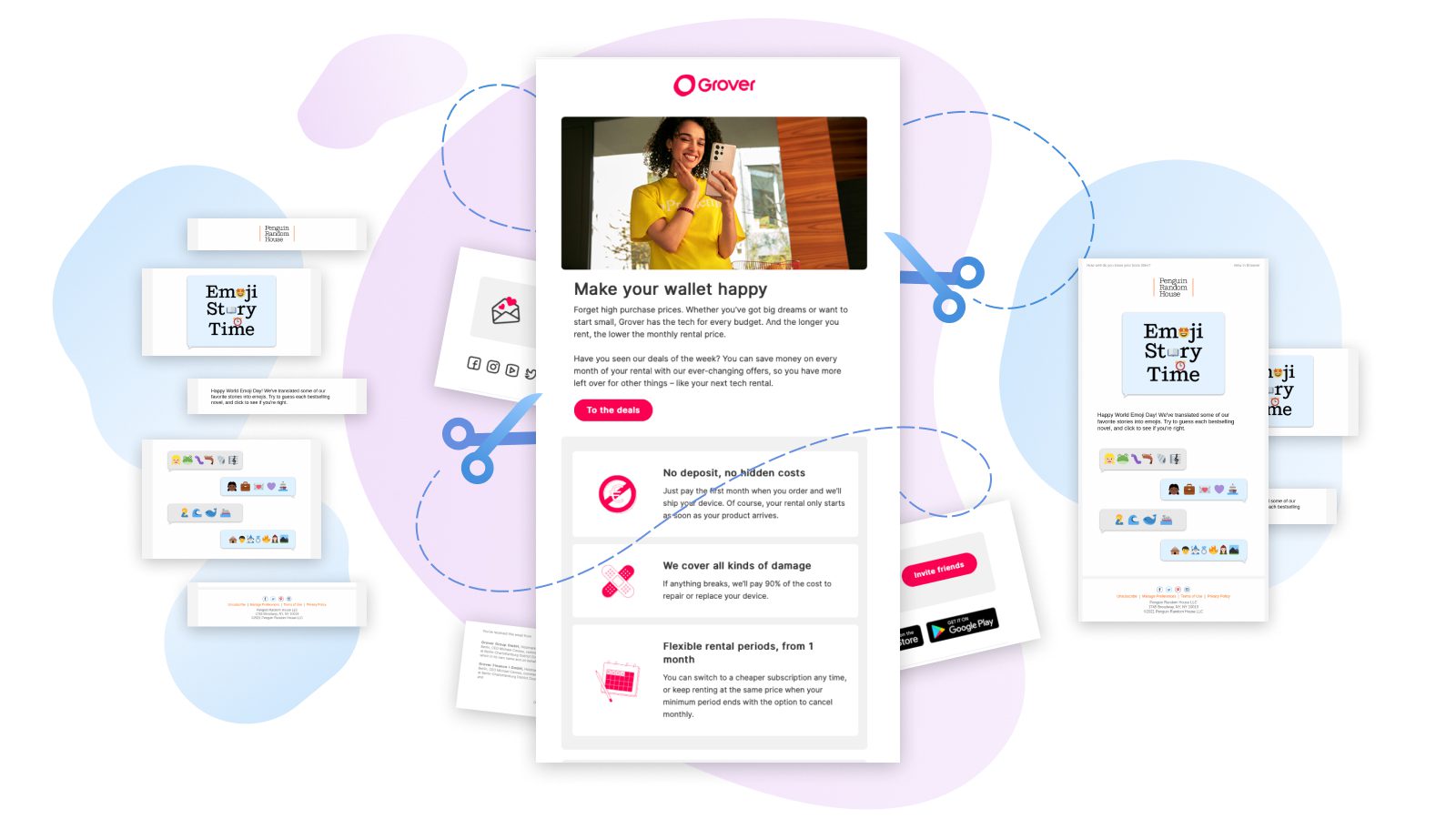
Functioning as reusable, pre-constructed, purpose-specific atomic blocks, modular email templates ensure you’re not going back to square one with every new campaign that you’re building. Instead of writing new code repeatedly, all you’re now doing is assembling standardized components, each of which adheres to an approved and fixed design language. Select the components you need, define their hierarchy, and build your email; yes, that’s how easy things become!
Now that we understand the importance of modular email design, let's look at what goes into building and managing modular email templates.
Every agency has a diverse roster of clients– e-commerce, fashion, healthcare, finance, IT, entertainment, manufacturing; it runs the entire gamut. In such a scenario, attempting to create a single-purpose modular email template will simply end up being an exercise in futility. Instead, agencies should strive toward determining their building blocks– a core set of modules that will be used by all clients irrespective of the niche they belong to.
The average modular email template should ideally have the following building blocks:
Once you have built your master modular template, the next step involves identifying the elements you most frequently use across campaigns for your clients. Of course, certain blocks, such as the header and the footer are going to be a part of all templates; no debate there. But when it comes to certain other modules, say, the product grid, the promotional block, or testimonials, the consensus may vary depending on what your client’s specific requirements are.
The best way to go about this is to take stock of the kind of emails you send out most regularly. And what kind of goals are you trying to accomplish with these emails? Accordingly, you can identify the blocks that are best-suited to these objectives and configure your modular templates with clarity.
Testing is non-negotiable in the modular email design workflow. Gmail, Apple Mail, Outlook– your modular email templates should render perfectly across all these clients. Now, how do you go about testing? Let’s take a look:
The whole point of adopting modular email design is to scale up your email production and delivery without stretching yourself thin. So it is quite important that your modular email template system grows over time. Start small; build a library with a handful of elements, comprising, say, 6-8 building blocks, and a couple of master templates. But over time, with repeated auditing, feedback, and refinement, you must look to scale up your library and set up a system that caters to a diverse set of clients.


Brand consistency, quality control, reduced costs, and faster email production– the benefits of modular email templates are endless! As your client roster grows over time, you must adopt a system that can not only keep up with the increasing workload but which will also ensure that you fulfil your clients’ expectations every single time without fail; and that is modular email design.
 AI tools to find & convert leads.
 Send emails at scale