A marketing agency can increase website traffic, generate inquiries, and improve brand visibility. But if those activities aren't producing qualified sales opportunities, your business may be spending money without making meaningful progress.
The right marketing agency should complement your existing sales process, not operate separately from it. That means understanding your target customers, coordinating inbound and outbound marketing, and measuring success through actual business opportunities rather than traffic and impressions alone.
Here's how to evaluate marketing agencies and build a more effective lead generation system.
Choosing a marketing agency starts with defining your ideal customer, identifying gaps in your current lead generation strategy, and evaluating potential partners based on their ability to produce measurable results.
Key takeaways:
Define qualified leads before evaluating agencies or launching campaigns.
Combine outbound prospecting with SEO, paid advertising, and other relevant acquisition channels.
Compare agencies based on services, industry experience, and verifiable client results.
Make sure marketing leads flow directly into your customer relationship management (CRM) system.
Measure qualified meetings, sales opportunities, and acquisition costs rather than traffic alone.
Establish clear responsibilities for lead qualification, follow-up, and reporting.
Your sales process should influence agency selection because marketing is only effective when the leads it generates are relevant, qualified, and properly followed up.
Consider a B2B software company targeting operations directors at businesses with 50 to 500 employees.
An agency might generate hundreds of inquiries through Google Ads, but those inquiries provide limited value if most come from students, job seekers, or businesses that cannot afford the software.
Before hiring an agency, establish:
Your ideal customer profile, including industries, company sizes, and locations.
The job titles and decision-makers your sales team needs to reach.
Your typical deal size and average sales cycle.
The criteria that distinguish a qualified opportunity from a general inquiry.
Your monthly budget and target cost per qualified lead.
These details give prospective agencies a clear picture of what successful lead generation should accomplish.

Inbound marketing and outbound prospecting can work together by creating demand through search and advertising while proactively reaching potential customers who have not contacted your business.
Search engine optimization (SEO), Google Ads, and educational content help businesses reach people actively researching problems, solutions, or potential vendors.
A prospective customer searching for "enterprise inventory management software" may already be evaluating products.
An effective inbound strategy helps that buyer discover your company, understand its offering, and take the next step.
Outbound prospecting allows sales teams to identify companies that match their ideal customer profile without waiting for those companies to discover their website.
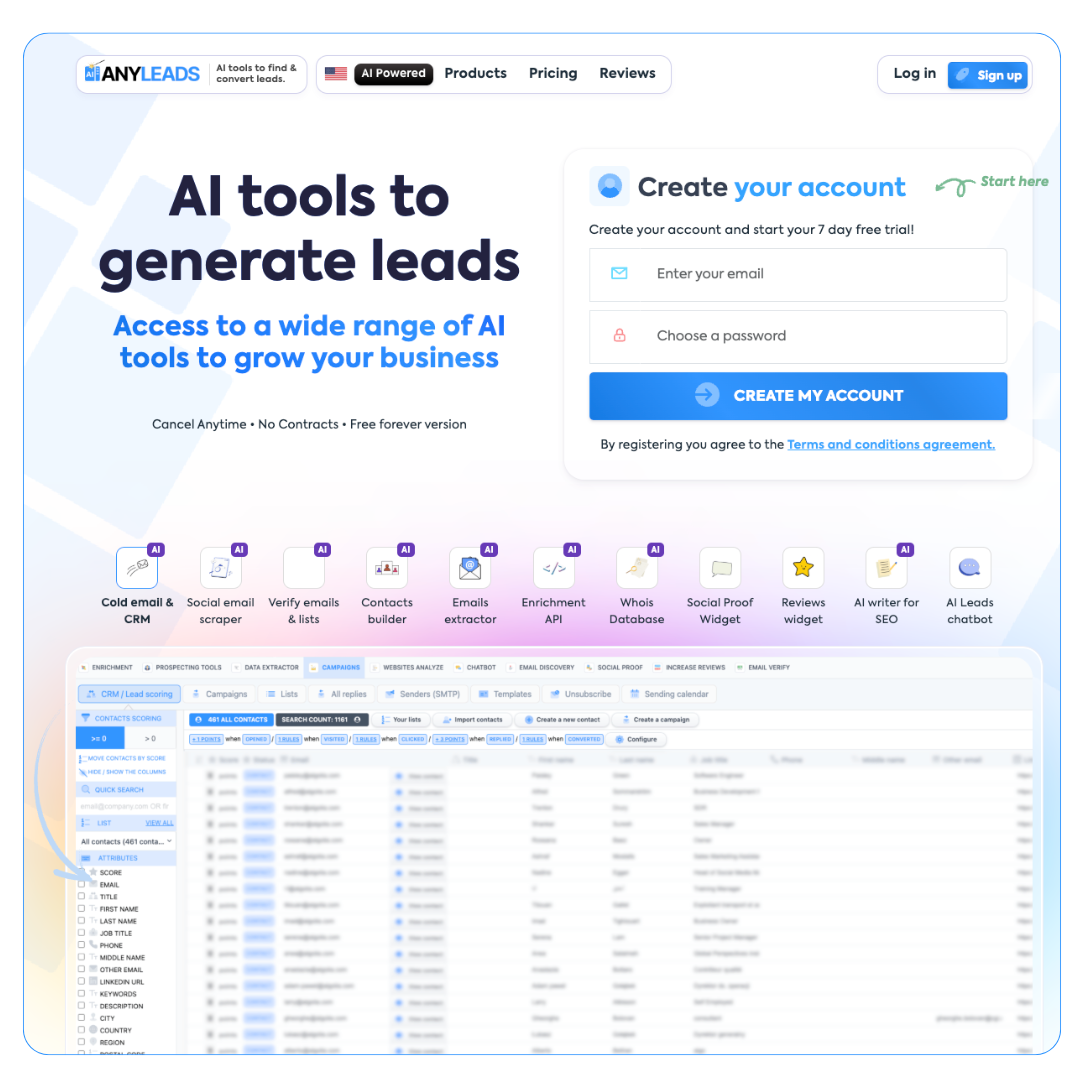
For example, a business might use Anyleads to find professional contact information, enrich prospect records, and organize targeted email sequences.
Instead of contacting thousands of unrelated businesses, sales representatives can prioritize accounts based on company characteristics and likely purchasing needs.
The strongest approach connects both channels. An agency develops search visibility and attracts interested prospects, while the sales team uses targeted outreach to introduce the business to additional potential customers.
Finding suitable marketing agencies begins with comparing providers by their actual service offerings, relevant experience, and approach to measuring results.
Rather than searching only for the highest-rated agency, businesses can use specialized resources such as The Best Marketing Agencies directory to explore providers across SEO, AI-search optimization, Google Ads, and other marketing categories.
A structured comparison helps narrow the search to agencies offering services that align with your current growth objectives.
For example, a business already generating substantial website traffic but receiving few inquiries might need conversion optimization rather than additional advertising.
Another company with strong outbound sales performance but limited organic visibility may benefit from technical SEO and content development.
The key is identifying the business problem before selecting the service provider.
Evaluating an agency's experience requires looking beyond its marketing claims and examining its actual services, relevant projects, customer feedback, and reporting methods.
An agency profile can provide useful preliminary information, but it should not replace direct verification.
For example, the SEO Rank Media agency profile identifies SEO, AI-search visibility, and Google Ads among the company's service offerings. It also provides links to external review sources and additional company information.
This type of profile can help a prospective client determine whether a provider's capabilities align with its needs before requesting a consultation.
However, businesses should still ask agencies for relevant examples of completed work, explanations of their methodology, and evidence supporting performance claims.
A provider offering several marketing services is not necessarily the right choice for every company. Industry familiarity, transparent communication, and execution capabilities deserve equal consideration.
Agency-generated leads should enter a centralized CRM system where sales teams can track their sources, qualification status, follow-up activities, and eventual outcomes.
Without this connection, businesses may struggle to determine which marketing channels are producing valuable opportunities.
A practical process looks like this:
A prospect discovers the business through search, paid advertising, or direct outreach.
The prospect submits an inquiry, responds to an email, or schedules a meeting.
The lead enters the CRM with its source recorded.
Available contact information is verified and enriched.
The sales team qualifies the opportunity and begins follow-up.
The outcome is recorded and used to improve future targeting.
Using Anyleads' contact enrichment and automated email sequence capabilities can help organize prospecting and follow-up alongside agency-managed acquisition campaigns.
Both teams should agree on lead ownership, duplicate handling, and how sales feedback will influence campaign targeting.
Marketing agency performance should be evaluated through metrics that connect marketing activity to qualified sales opportunities and revenue.
Website visits and advertising clicks can indicate visibility, but they do not establish whether a campaign is profitable.
Useful performance indicators include:
| Metric | What it measures |
| Qualified leads | Prospects matching your agreed customer criteria |
| Cost per qualified lead | Marketing expenditure divided by qualified leads |
| Meetings booked | Prospects who schedule sales conversations |
| Meeting-to-opportunity rate | The percentage of meetings that become legitimate opportunities |
| Customer acquisition cost | Total acquisition costs divided by new customers |
| Revenue from acquired customers | Sales revenue associated with marketing-generated customers |
An agency and sales team should review these numbers together.
If advertising produces many inquiries but few qualified conversations, the issue may involve targeting, campaign messaging, or the landing page.
If qualified prospects rarely become customers, the company may need to examine its pricing, sales process, or offer.
Businesses using outbound email must account for applicable marketing and privacy laws, regardless of whether campaigns are managed internally or by an agency.
In the United States, the Federal Trade Commission's CAN-SPAM compliance guidance explains that the law covers commercial business-to-business email, not just consumer marketing.
Requirements include accurate sender information, nondeceptive subject lines, a valid postal address, and a clear way to opt out of future commercial messages.
Businesses should also ensure their prospect data practices comply with other applicable privacy and marketing regulations.
Hiring an outside agency does not automatically transfer these legal responsibilities away from the business.
Before signing an agreement, ask questions that establish whether the agency understands your commercial objectives and can collaborate with your sales team.
Which industries and customer segments have you worked with?
How do you define and measure qualified leads?
What services will your team perform directly?
How will leads and attribution data reach our CRM?
Can you provide relevant, verifiable examples of results?
What reporting will we receive each month?
Who owns the campaign assets, data, and advertising accounts?
How will you adjust campaigns based on sales feedback?
Clear answers make it easier to compare proposals and avoid paying for activities that do not contribute to business growth.
Choosing a marketing agency should be about building a more effective customer acquisition system, not simply increasing marketing activity.
The best fit depends on your business goals, existing sales capabilities, target customers, and the specific marketing functions that need improvement.
Combining professional marketing services with organized prospecting, accurate contact data, and consistent follow-up creates a more coordinated approach to generating qualified B2B opportunities.
For businesses looking to strengthen the prospecting side of that process, Anyleads offers tools for finding professional contacts, enriching lead data, and automating targeted email outreach. Explore its capabilities to help connect your marketing efforts with a more organized and measurable sales pipeline.
 AI tools to find & convert leads.
 Send emails at scale