LIMITED SPOTS
All plans are 30% OFF for the first month! with the code WELCOME303
LIMITED SPOTS
All plans are 30% OFF for the first month! with the code WELCOME303

LIMITED SPOTS
All plans are 30% OFF for the first month! with the code WELCOME303
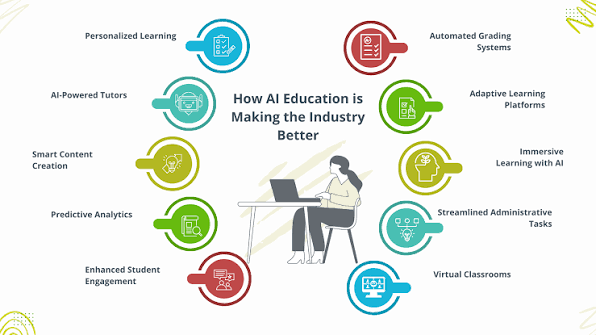
Artificial intelligence has become one of the most influential technologies of the modern era. From automating business workflows and improving customer support to generating content and analyzing data, AI is changing how people work, communicate, and learn.
Education is no exception.
Students today have access to AI-powered tools that can explain complex concepts, generate practice questions, summarize lengthy chapters, translate technical terms into simple language, and even create personalized study plans. What once required hours of searching through textbooks or online forums can now be accomplished within minutes.
Yet the true value of AI in education extends far beyond speed. Its greatest strength lies in personalization—helping students learn according to their own pace, strengths, and academic goals.
As educational institutions, teachers, and learners continue adopting AI-powered technologies, personalized learning is becoming more accessible than ever before. However, technology works best when combined with human expertise, critical thinking, and meaningful academic support.
Personalized learning is an educational approach that adapts instruction to the unique needs of each student instead of expecting every learner to follow the same pace or teaching style.
Traditional classrooms often have limited flexibility because teachers must cover the curriculum for an entire class. While this approach works for many students, others may need additional explanations, more practice, or different teaching methods.
AI helps bridge this gap by providing learning experiences tailored to individual progress.
Students can revisit topics multiple times, practice at their own speed, and receive recommendations based on their performance rather than following a rigid schedule.
Artificial intelligence analyzes patterns in student performance to deliver customized learning experiences.
Depending on the platform, AI can:
Recommend practice questions based on weak areas
Adjust lesson difficulty automatically
Track learning progress over time
Provide instant explanations
Suggest revision schedules
Generate quizzes for self-assessment
Identify knowledge gaps before examinations
Instead of treating every learner identically, AI helps create a more individualized educational journey.

One of AI's biggest advantages is speed.
Rather than waiting days for assignments to be graded, students often receive immediate feedback.
Instant feedback allows learners to:
Correct mistakes quickly
Reinforce correct concepts
Build confidence
Prevent misunderstandings from becoming long-term habits
This continuous feedback loop supports more effective learning.
Unlike traditional classrooms, AI-powered educational tools are available around the clock.
Students can study:
After school
During weekends
While commuting
Before examinations
At their own convenience
This flexibility encourages consistent learning and makes education more accessible for students with different schedules.
Modern education increasingly values self-directed learning.
AI empowers students to:
Research unfamiliar topics
Generate summaries
Create revision notes
Practice coding
Solve numerical problems
Review previous mistakes
These capabilities encourage learners to become more independent while taking greater responsibility for their academic progress.
Despite remarkable advances, AI has important limitations.
Artificial intelligence can generate explanations, but it cannot always recognize why a particular student remains confused.
Learning is not simply about receiving information.
Students often need:
Encouragement
Motivation
Personalized examples
Real-time discussion
Emotional support during difficult topics
Experienced teachers and tutors adapt explanations based on conversation, body language, previous learning experiences, and individual goals.
These human qualities remain essential components of successful education.
Rather than replacing educators, AI is becoming an excellent companion to personalized tutoring.
Many students first use AI to review concepts independently before seeking expert guidance for more challenging topics.
For learners studying engineering, mathematics, computer science, programming, and related STEM disciplines, My Engineering Buddy provides personalized one-to-one online tutoring and homework help designed around each student's academic goals. Tutors adapt explanations according to the learner's pace while helping students apply theoretical concepts to real academic problems.
Physics is another subject where conceptual clarity is especially important. Students looking for focused support in mechanics, electromagnetism, thermodynamics, optics, or modern physics can benefit from My Physics Buddy, which specializes in personalized online physics tutoring for school and university learners.
Together, AI-powered study tools and individualized tutoring create a balanced learning environment that combines technology with human expertise.
Teachers remain at the heart of education.
AI simply helps them become more effective by reducing repetitive administrative work.
For example, AI can assist with:
Preparing quizzes
Generating lesson summaries
Tracking student performance
Creating personalized assignments
Identifying struggling learners
This allows educators to spend more time teaching, mentoring, and interacting with students.
Although AI offers tremendous opportunities, several challenges remain.
AI-generated responses are not always correct.
Students should verify important information using trusted educational resources.
Overreliance on AI may discourage independent problem-solving.
Students should use AI as a learning assistant rather than simply copying answers.
Not every learner has equal access to high-speed internet, modern devices, or premium AI platforms.
Improving digital accessibility remains an important educational priority.
Artificial intelligence works best when combined with reliable educational resources.
Combining trusted educational content, AI-powered study tools, and expert tutoring often produces stronger academic outcomes than relying on any single method alone.
The future workplace will increasingly require people who can work alongside intelligent technologies.
Students need more than subject knowledge.
They also need:
Critical thinking
Creativity
Problem-solving
Communication
Adaptability
Digital literacy
Lifelong learning habits
Personalized education supported by AI helps develop these skills while preparing learners for rapidly changing careers.
Artificial intelligence will continue making education more adaptive, interactive, and accessible.
Future learning platforms may provide even better personalization through:
Smarter learning analytics
Voice-based tutoring
Virtual laboratories
Immersive simulations
AI-assisted assessments
Real-time performance tracking
However, meaningful education will continue to depend on human interaction, curiosity, and mentorship.
Technology can accelerate learning, but educators remain essential for helping students build confidence, think critically, and apply knowledge in real-world situations.
Artificial intelligence is transforming personalized learning by making education more flexible, accessible, and responsive to individual student needs. From instant feedback and adaptive lessons to intelligent study recommendations, AI is helping learners take greater control of their educational journeys.
At the same time, successful learning still depends on guidance, encouragement, and meaningful interaction with experienced educators. The most effective approach combines the efficiency of AI with the adaptability of personalized tutoring and trusted educational resources.
As technology continues to evolve, students who learn to use AI thoughtfully—while developing strong analytical and problem-solving skills—will be well prepared for success in both higher education and the modern workplace.
 AI tools to find & convert leads.
  Send emails at scale