The deal closes. Someone posts the celebration in the team channel, the forecast updates, and everyone moves on to the next opportunity. The customer, meanwhile, is left waiting.
Usually nobody has dropped the ball. The rep assumed onboarding had picked it up. Onboarding was waiting on the signed contract. Finance was never told the payment terms were non-standard. By the time someone notices, the customer has spent their first fortnight as a paying account learning that your company moves more slowly than your sales process suggested.
In most organisations, the sales-to-customer success handoff isn't really a defined process. It runs on assumptions about who picks up what. Below are the seven moments it's made of, and a view on which ones are worth automating.
The handoff carries three costs, and most teams only track the first.
Time to value is the visible one. The customer starts paying from the signature date but gets nothing back until their first real outcome, and that gap sets expectations for everything that follows.
Early churn risk is harder to see. Renewal conversations tend to be shaped by the first thirty days more than by month eleven. A customer who spent their opening weeks chasing your team for login credentials has formed a view that's difficult to shift later, however well the rest of the engagement goes.
Rework is the third. When context doesn't travel with the deal, delivery teams either rebuild it from scratch or discover a commitment that nobody recorded. Take a hypothetical case: a rep agrees to a custom integration to close the deal, and mentions it verbally on a call. The delivery team finds out three weeks into an onboarding scoped without it. Building the integration is rarely the expensive part. Most of the cost sits in the renegotiation that follows, and in whatever margin gets given away to settle it.
Reps usually get the blame for a poor handoff, which doesn't help much, because the failure here is structural.
You can see pipeline and MRR. Most teams cannot see how long a closed deal takes to become a working customer, or where it stalls along the way. It's hard to improve a process that nobody measures, since there's no way of telling whether it's getting better or worse.
Compensation stops at closed won, and attention tends to follow compensation. This is less a comment on salespeople than on incentive design working as intended. At the point a deal is marked won, the person holding the most context about it has the least reason to keep carrying it.
Very little of what shapes an onboarding ever reaches the CRM, which asks for deal value and close date rather than for payment-term concessions, or the difference between the stakeholder who signed and the one who'll use the product, or the competitor also under evaluation. When that person changes role or leaves the business, the context goes with them.


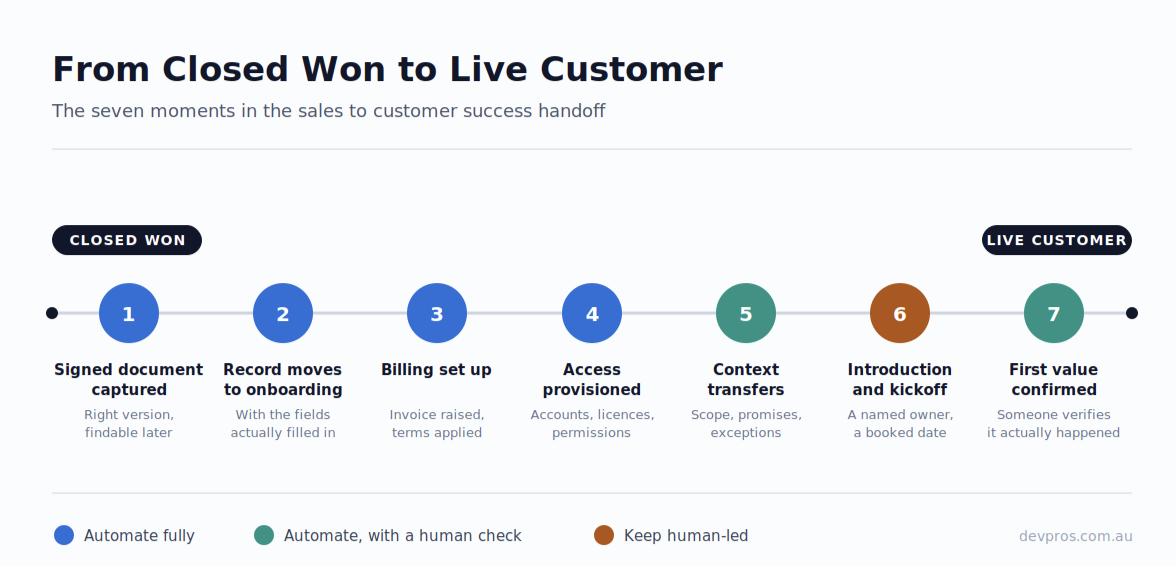
Every handoff is made up of the same seven moments, named or not, and each has a characteristic way of going wrong.
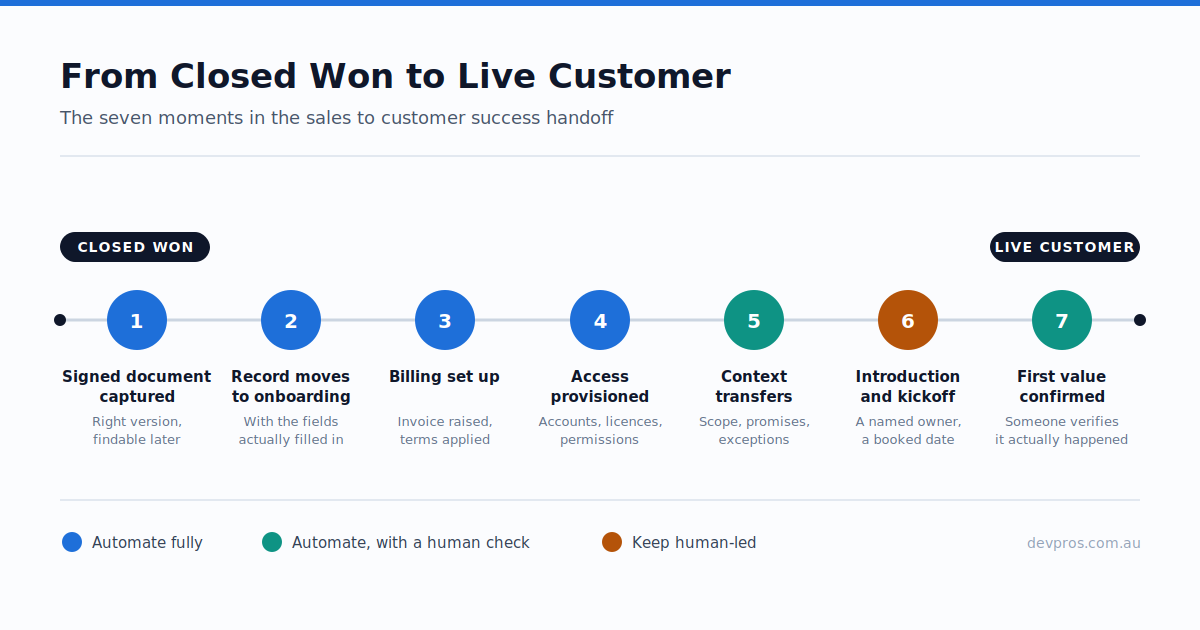
The seven moments in the sales to customer success handoff, and which of them to automate.
1. The signed document is captured. The final countersigned version lands somewhere findable, rather than in an inbox or a downloads folder. Failure mode: six months later, nobody can produce the version that was signed.
2. The record moves. The deal becomes an onboarding record with the relevant fields populated. Failure mode: the record transfers but half the fields are blank, so the delivery team opens by asking questions the customer already answered during the sale.
3. Billing is set up. The invoice is raised, the terms are applied, and the subscription or payment schedule is provisioned. Failure mode: the first invoice arrives late or with the wrong figures, which colours how the customer reads everything that follows.
4. Access is provisioned. Accounts, licences, environments and permissions are ready before anyone needs them. Failure mode: the kickoff call gets scheduled before access is sorted, so the kickoff becomes a call about access.
5. Context transfers. Whatever was promised, scoped, discounted or excluded during the sale is written down and handed over deliberately. Failure mode: the scenario described earlier, where verbal commitments never reach the people expected to deliver on them.
6. The introduction happens. A named person on your side is introduced to a named person on theirs, with a kickoff date in a calendar. Failure mode: a generic welcome email from a no-reply address, which tells the customer that nobody in particular has been assigned to them.
7. First value is confirmed. Someone checks that the customer has completed the first meaningful action, rather than checking that instructions were sent. Failure mode: nobody complains, so onboarding is assumed to have worked, when in practice the customer may be stuck and not bothering to say so.
These seven aren't the same kind of work, and treating them as though they were is a common reason handoff projects stall.
Moments one to four are mechanical. Document capture and filing, record creation with mandatory fields, billing triggers, and provisioning requests are all rule-driven steps, and a system will execute them more consistently than a person managing six other deals at the same time. Escalation timers help too, surfacing anything stuck past a threshold, along with a status view so the process stops being invisible.
The remaining moments need judgment. Moment six is a relationship rather than a task, and automating the introduction removes most of what makes it work. Moment five needs a person to supply the context, even where a system captures and routes it afterwards. Exception handling, scope disagreements, and anything written in your company's voice should stay with someone who can weigh up the situation.
One way to draw the line is to let systems move work between people, while people decide what happens to it. Most well-designed AI workflow automation works on that basis, with routing, triggers, and escalation running underneath, humans placed at the points where a decision is required, and a record kept of who approved what.
You don't need a project for this, just an afternoon.
Time your last ten deals. Measure the days from closed won to first confirmed value for each one, using real deals rather than an estimate. The spread between the fastest and the slowest is usually more informative than the average.
Name an owner for each of the seven moments. Write the seven down and put a person's name beside each. Anywhere you find yourself writing a team name, or "it depends", you have an unowned gap, and that's normally where the delay is sitting.
Automate the longest unowned gap first. Not the most irritating one, or the one someone raised last week, but the one costing the most time. Repeat the timing exercise a quarter later and you'll have a figure that shows whether the change worked.
Most attempts to fix this start with a recurring sales-to-CS sync. These help for a month or two, then attendance drops off, because a standing meeting is a workaround for a process that was never properly defined.
Defining it is largely a matter of naming the seven moments and deciding, for each one, whether it needs a system, a person, or both. Four can run without anyone thinking about them, two need a person with a system behind them, and one needs a person. Teams that work through this generally find the celebration in the team channel is followed by a customer who's up and running, rather than one still waiting to hear from somebody.
Who should own the sales-to-customer success handoff?
One named person per moment, rather than one person for the whole process or a team collectively. Where a sequence is owned collectively, steps tend to fall between people. The most common working model has the account owner staying accountable through moment five, with a named onboarding or CS owner picking up moments six and seven.
What should a handoff checklist include?
It should cover the signed document and where it lives, the commercial terms including anything non-standard, commitments made during the sale, the named stakeholders and which of them will actually use the product, provisioning requirements, and the first value milestone you're aiming for.
How long should the sales-to-customer success handoff take?
The mechanical portion, moments one to four, should complete within a day of the deal closing, since it's rule-driven work with no real reason to queue. How long the full sequence takes depends on what you sell, so it's more useful to measure your own figure and watch whether it moves than to chase a benchmark somebody else published.
 AI tools to find & convert leads.
  Send emails at scale