A mobile-friendly website already handles much of what an app needs to do: browsing, booking, reading, or checkout. The best website to mobile app converters wrap that site in an iOS and Android app, so you avoid a separate native rebuild. Choosing one means comparing what you pay, what needs configuring, and who handles publishing.
Below are five of the best website to mobile app converters for stores, publishers, membership sites, and service businesses. We compare previewing, navigation, push notifications, presentation controls, and publishing responsibilities, with SiteTo.App as our top pick.
SiteTo.App is our top pick for reusing an existing website, with phone previewing and both platforms at USD 87.35/month per app.
Median.co suits native-integration requirements when you have web-development help.
AppMySite offers app-specific presentation controls, including CSS overrides and hiding HTML elements.
Appilix offers one-time purchasing, with regular Standard prices of USD 119 for Android or USD 149 for iOS.
webtoapp.design suits owners seeking publishing guidance, with subscription limits based on active users and notifications.
We reviewed official product, documentation, pricing, and review pages for this comparison. This was desk research: we did not create accounts, make purchases, complete builds, or submit apps. The experience sections below describe our assessment of those materials.
Our criteria were website and CMS reuse, previewing sign-in and checkout, navigation and branding controls, push-configuration responsibilities, store-account ownership, and clarity about upfront, recurring, and publishing costs.
Apple's Guideline 4.2 requires utility beyond a repackaged website. No converter guarantees approval. Budget separately for Apple's standard USD 99 annual developer membership and Google's USD 25 one-time registration; Apple regional pricing and qualifying waivers can differ.
| Tool | Best fit | Pricing model | Who submits |
| SiteTo.App | Website reuse, preview first | USD 87.35/month per app, both platforms | Business, own accounts |
| Median.co | Native integrations | Activation plus annual fee after 12 months | Not established in our research |
| AppMySite | Presentation controls | Monthly, yearly, or lifetime | Business, own developer accounts |
| Appilix | One-time purchasing | Per-platform or combo purchase | Business on Standard; Premium adds publishing service |
| webtoapp.design | Publishing guidance | Subscription tiers | Owner with guidance; Enterprise adds done-for-you publishing |

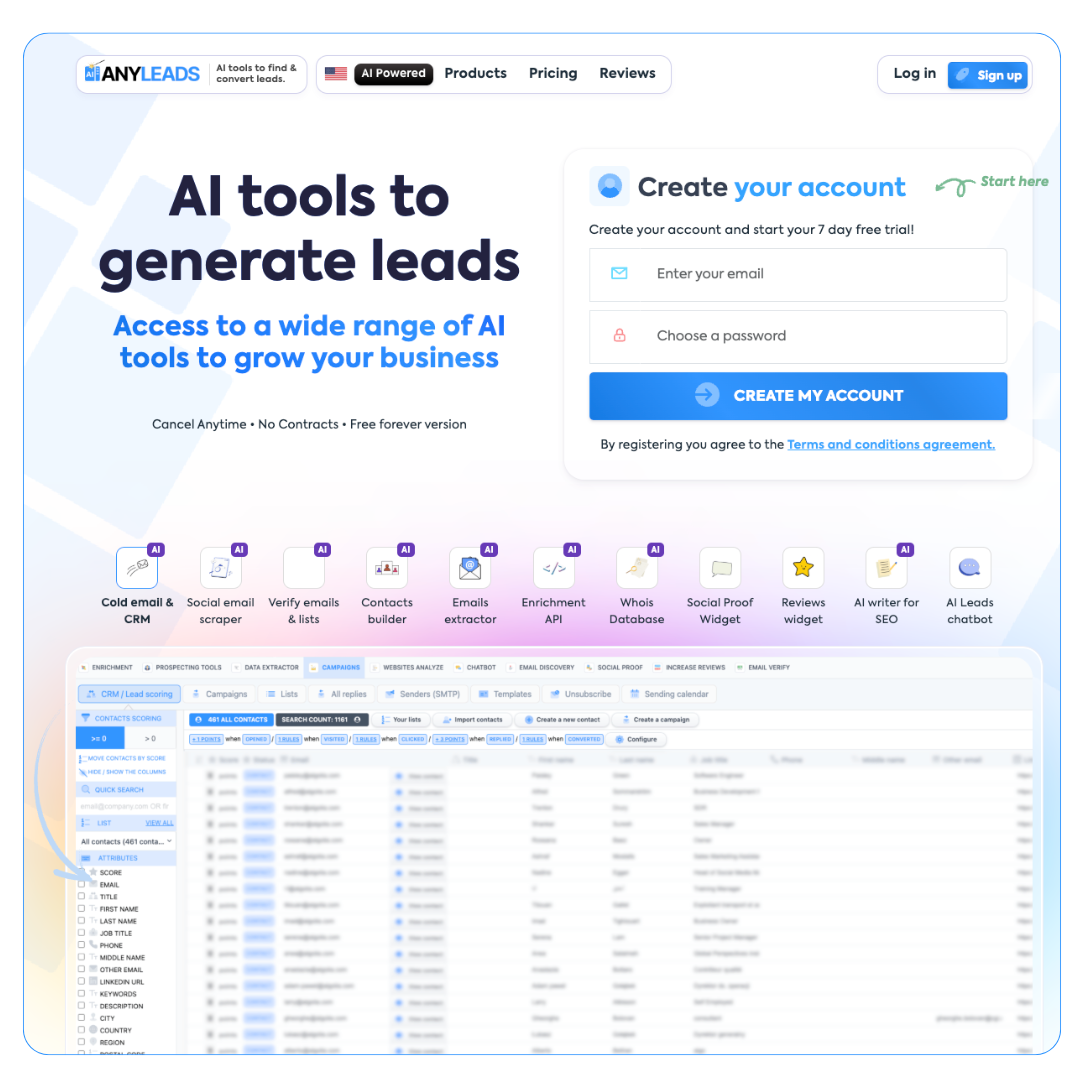
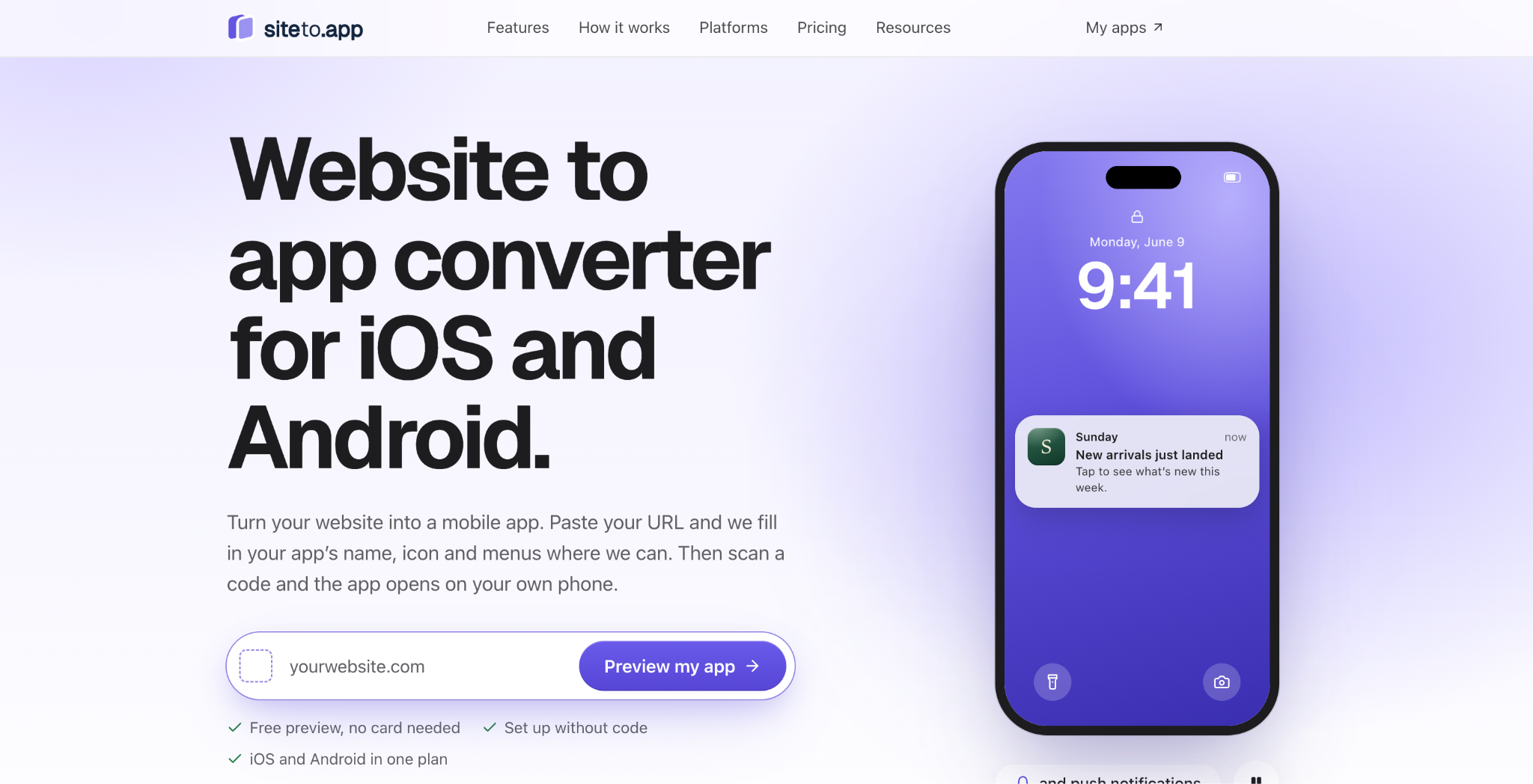
Best for businesses and publishers keeping an existing mobile-friendly website and adding an app around it.
Reuses your website and CMS, with Shopify, WordPress, WooCommerce, Wix, and Webflow among the platforms listed
Free phone preview for checking mobile layout and customer journeys
Firebase push through your own project
iOS delivery to TestFlight, plus Android APK or AAB output
Your business owns its store listings and publishes through its accounts
Your website's mobile quality carries into the app
External authentication and payment flows need checking in preview
Store submission and Firebase configuration remain your responsibility
We put SiteTo.App first because its documented workflow starts with the website you already maintain and a phone preview. Its guide lists checks for sign-in, checkout or booking, external links, uploads, and mobile layout, although a working preview doesn't establish full compatibility.
Firebase push needs your configuration files and credentials, plus Apple notification setup for iOS. Developers can integrate the optional JavaScript SDK for page titles, navigation badges, and native sharing; those enhancements aren't automatic.
The standard list price is USD 87.35/month per app, including iOS and Android. The no-credit-card website preview is separate from the 7-day subscription trial. Developer accounts, store fees, website hosting, and paid third-party services are excluded.
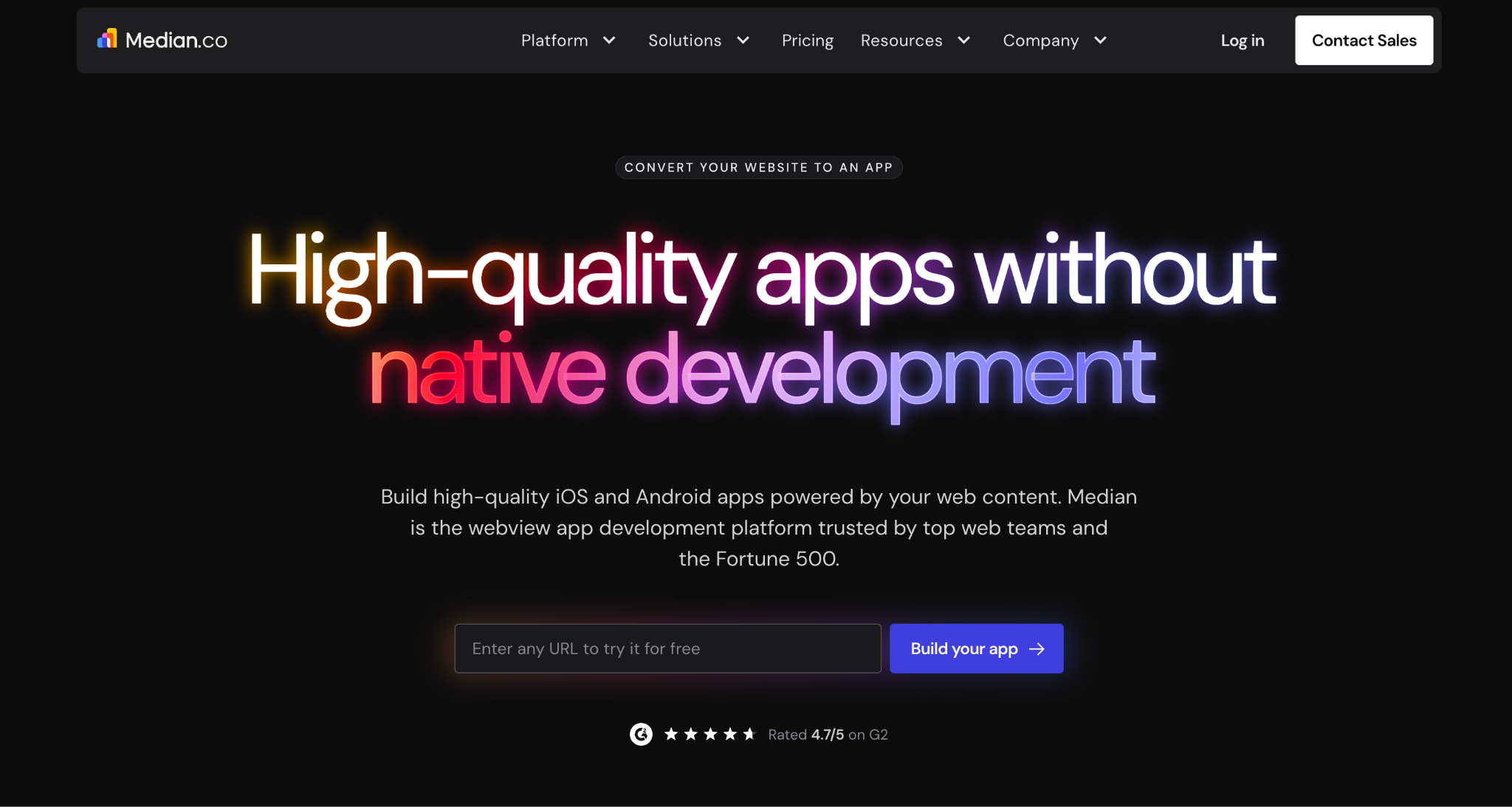
Best for businesses with web-development help and a specific native-integration requirement.
JavaScript Bridge connects website code with native actions and navigation
OneSignal and Firebase Cloud Messaging plugins
Social login and biometric authentication plugins
Firebase Analytics among the plugins in its library
Free carries a watermark and is limited to a solo developer
Starter adds an annual fee after the first 12 months
Plugin allowances vary by tier; the library is not included in every plan
Median.co takes second place for businesses whose requirements include integrations such as biometric authentication. Its JavaScript Bridge requires implementation in your website code, so owners should plan for developer involvement. Its release notes record the Firebase Cloud Messaging plugin's public release on August 25 for Android and October 14 for iOS.
Reviewers give it 4.7/5 on G2 from 43 reviews. We treat ratings as context, not comparable test scores across review platforms.
Starter costs USD 229 to activate, followed by USD 179/year beginning after 12 months. Plus lists USD 990 activation and USD 669/year thereafter, and permits up to five native plugins, including Plus-library choices. Prices are in USD, exclude tax, and are not monthly billing quotations.
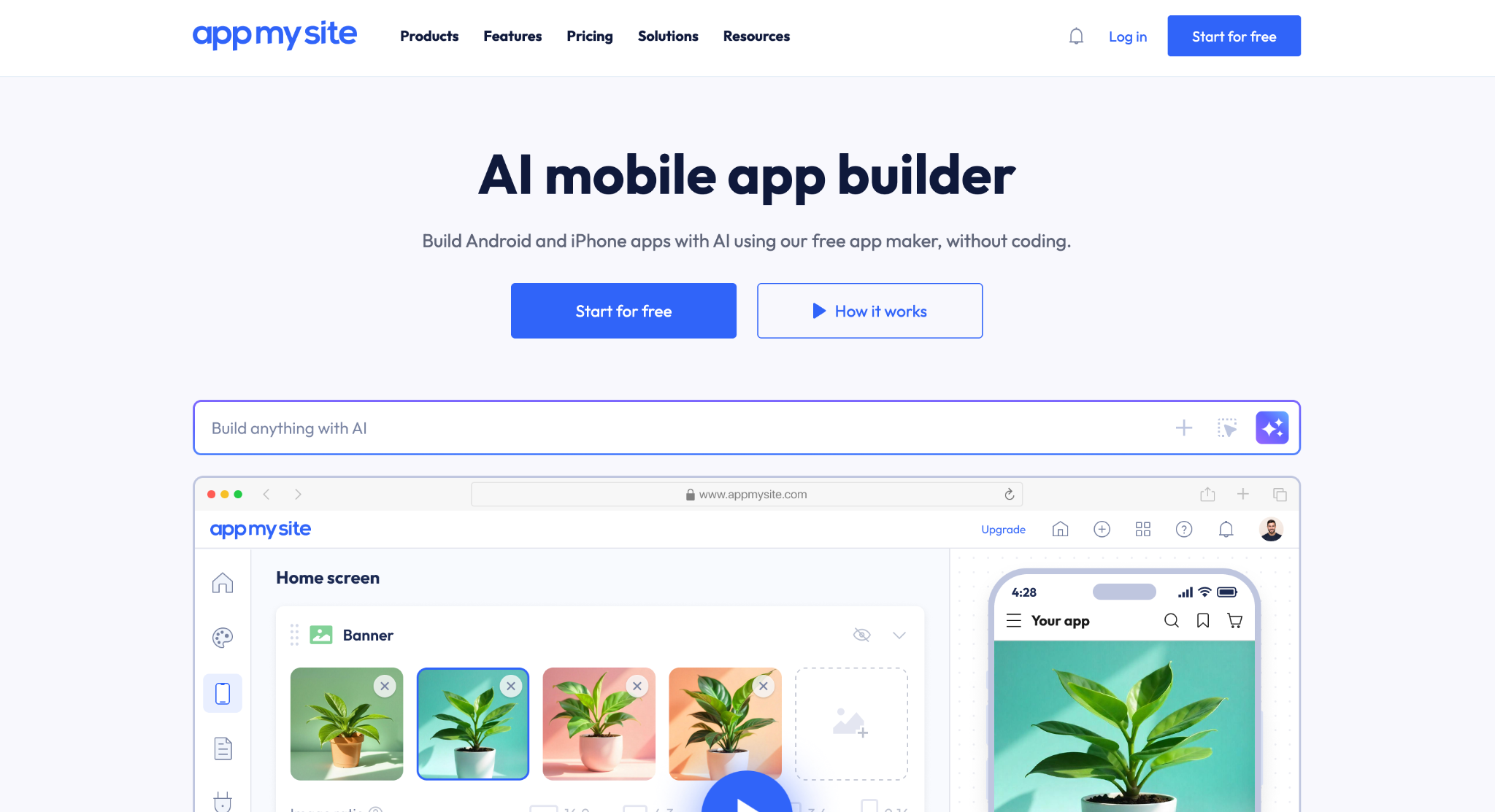
Best for owners who want app-specific presentation controls.
Website sync keeps content current
CSS overrides adjust the appearance of app web views
Selected HTML elements can be hidden by class or ID
OneSignal push notifications that can link to a specific destination in the app
Free and Starter are Android-only
iPhone support starts at Pro, USD 129/month with monthly billing
Build-affecting changes can require rebuilding or resubmitting
AppMySite ranks third for its controls over how website pages appear inside the app. CSS overrides and element hiding let owners adjust presentation, while its product updates cover keeping users signed in when they open a web view. Those controls warrant a close look, but the iPhone tier and rebuild requirements belong in the budget discussion.
It holds 4.4/5 on Trustpilot from 299 reviews. That review snapshot does not establish compatibility with a particular checkout or login flow.
The free tier covers one Android app with Google Play support. Monthly billing is USD 69 for Android-only Starter, USD 129 for Android-and-iPhone Pro, and USD 249 for Premium. Annual billing equivalents are USD 49, USD 99, and USD 199 per month, paid yearly. Lifetime options are also listed. Paid plans add unlimited rebuilds; the free tier does not.
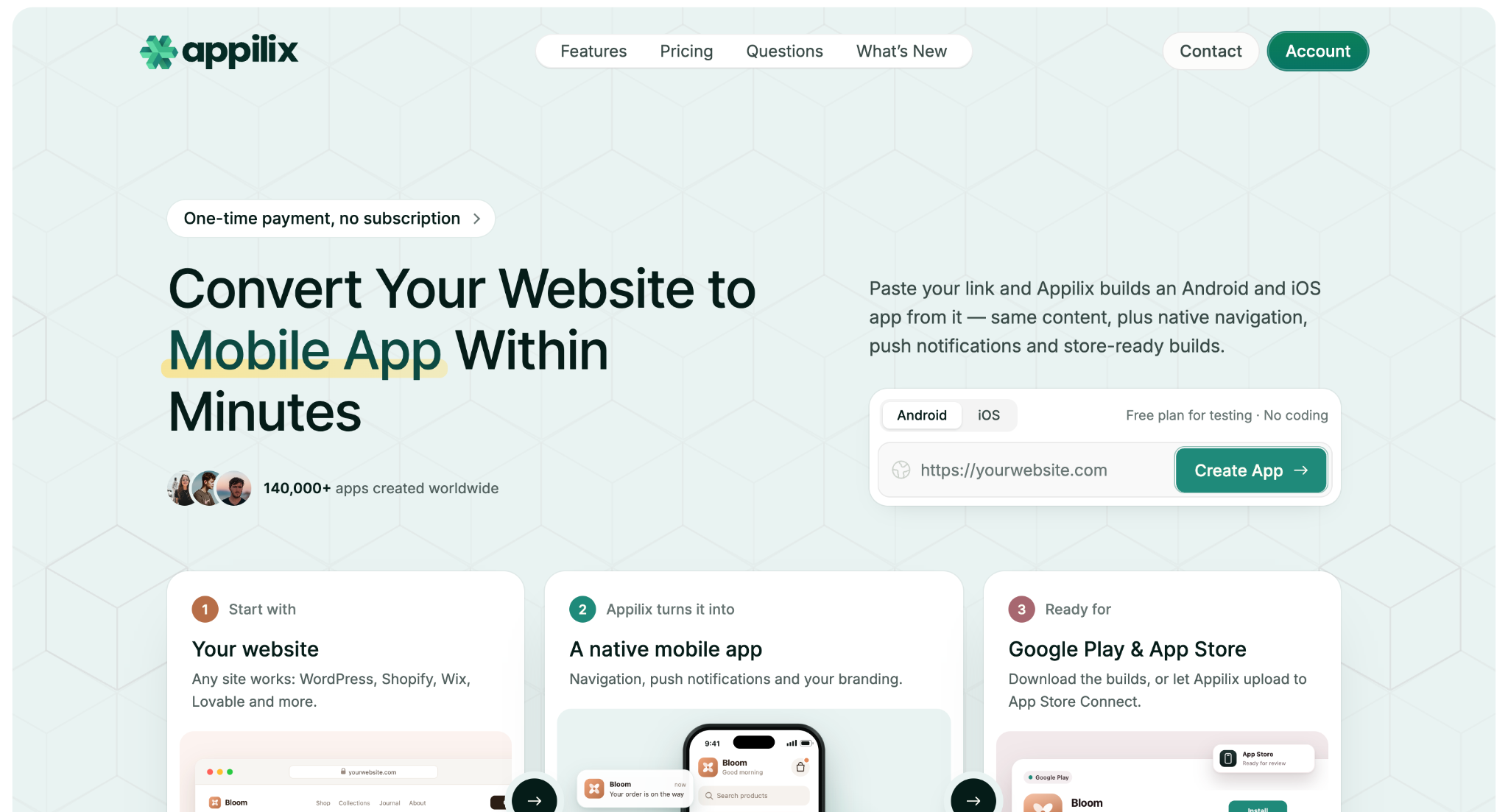
Best for owners who prefer a one-time software purchase.
Live-content sync from your website
Firebase push notifications
Navigation drawer or bottom tabs with custom branding
CSS and JavaScript injection
Paid Standard and Premium plans list unlimited rebuilds and users without Appilix branding
The 15-day trial limits rebuilds and users
Content loads live from your website, so the app needs an internet connection
Publishing service is included in Premium, not Standard
Appilix earns its place through one-time purchasing. Standard's regular USD 229 combo price gives owners a software cost to compare with recurring subscriptions. Its listed integrations include AdMob ads.
It carries 4.8/5 on Trustpilot from 97 reviews. We would still check the actual website's requirements before choosing a plan.
Regular one-time Standard prices are USD 119 for Android, USD 149 for iOS, and USD 229 for the combo. Premium's regular prices are USD 229 for Android, USD 269 for iOS, and USD 439 for the combo, including publishing service. Store-account fees remain separate.
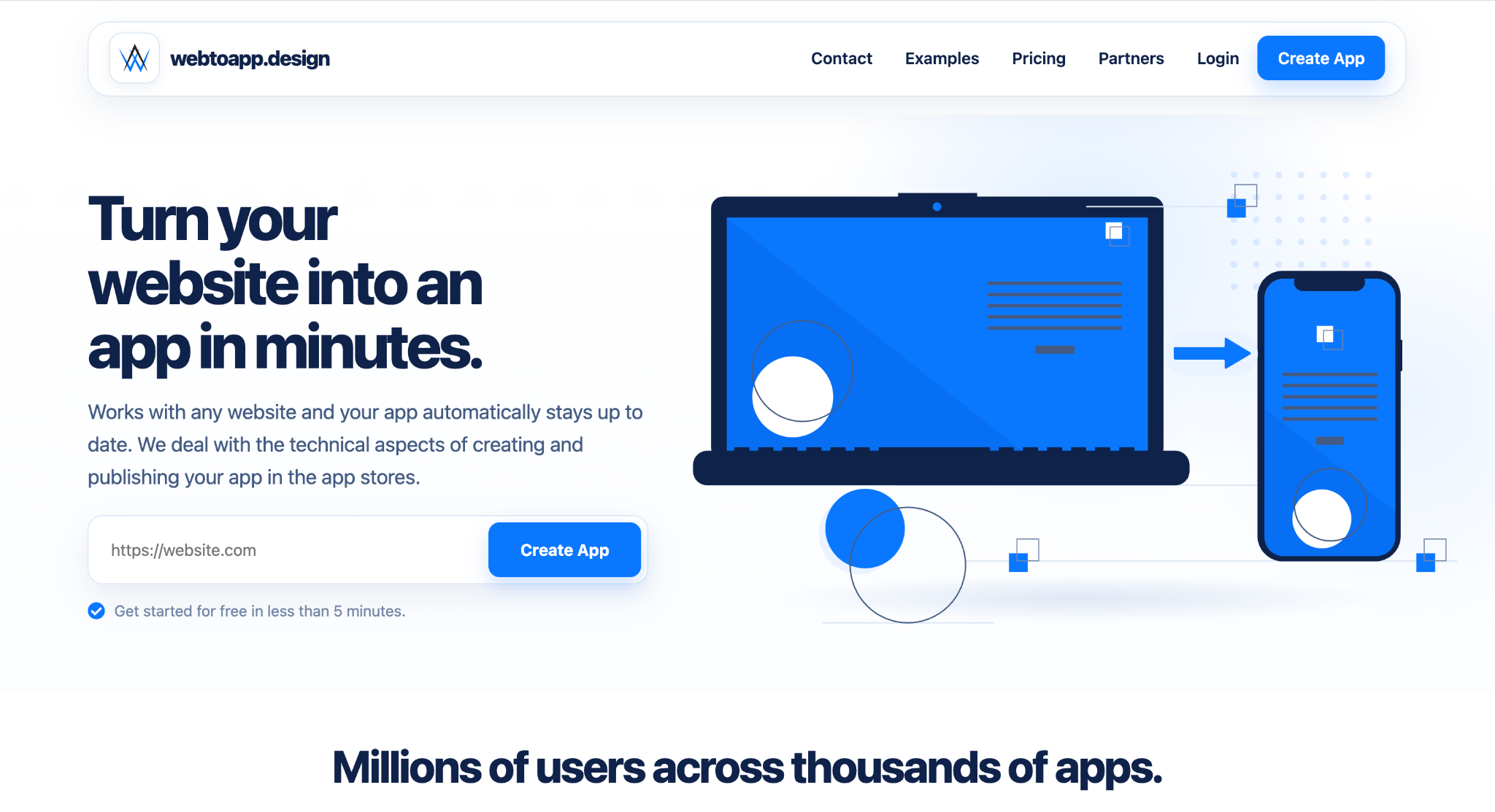
Best for owners who value guidance through app-store publishing.
Guided support through the publishing workflow
App content reflects the current website
Individualized push through website-stored tokens and an API on push-enabled plans
Monthly active-user caps start at 250 on Small
Push allowances are five per month on Medium and 100 on Large
Done-for-you publishing is listed on Enterprise, not every plan
webtoapp.design rounds out the list for first-time publishers seeking procedural guidance. It describes a guided process, backed by resources and support, for working through Apple's and Google's developer consoles. Store review still belongs to Apple and Google, and individualized push requires backend integration rather than automatic customer segmentation. That backend work matters if you plan targeted push notifications for product updates or order status.
It holds 4.2/5 on Trustpilot from 52 reviews. We considered that alongside the documented publishing workflow and plan limits.
Small allows 250 monthly active users. Medium allows 2,500 users and five push notifications per month; Large allows 25,000 users and 100 notifications. Enterprise lists unlimited users and notifications plus done-for-you publishing. A 14-day trial is shown for all plans except Enterprise. Subscription amounts did not render on the pricing page, so we cannot quote a verified starting price.
SiteTo.App is our top pick among website to mobile app converters for adding an app around a working mobile website. Its preview-first workflow provides a useful starting point for checking customer journeys, and its standard subscription covers iOS and Android.
Consider Median.co when native integrations justify developer involvement, AppMySite for presentation controls, Appilix for one-time purchasing, or webtoapp.design for publishing guidance. Before committing, check sign-in, checkout, navigation, notification setup, and total costs against your actual website. Our research did not include testing those journeys.
AppMySite's free tier covers one Android app. Median.co's Free plan carries a watermark and a solo-developer restriction. SiteTo.App offers a free website preview, separate from its 7-day subscription trial.
These services reuse website content. Your mobile layout and customer journeys still need checking in the app environment.
Budget for store developer accounts, website hosting, and any paid third-party services your setup requires.
No converter guarantees approval. Apple's Guideline 4.2 requires utility beyond a repackaged website. Navigation and push features do not determine the review outcome.
 AI tools to find & convert leads.
 Send emails at scale