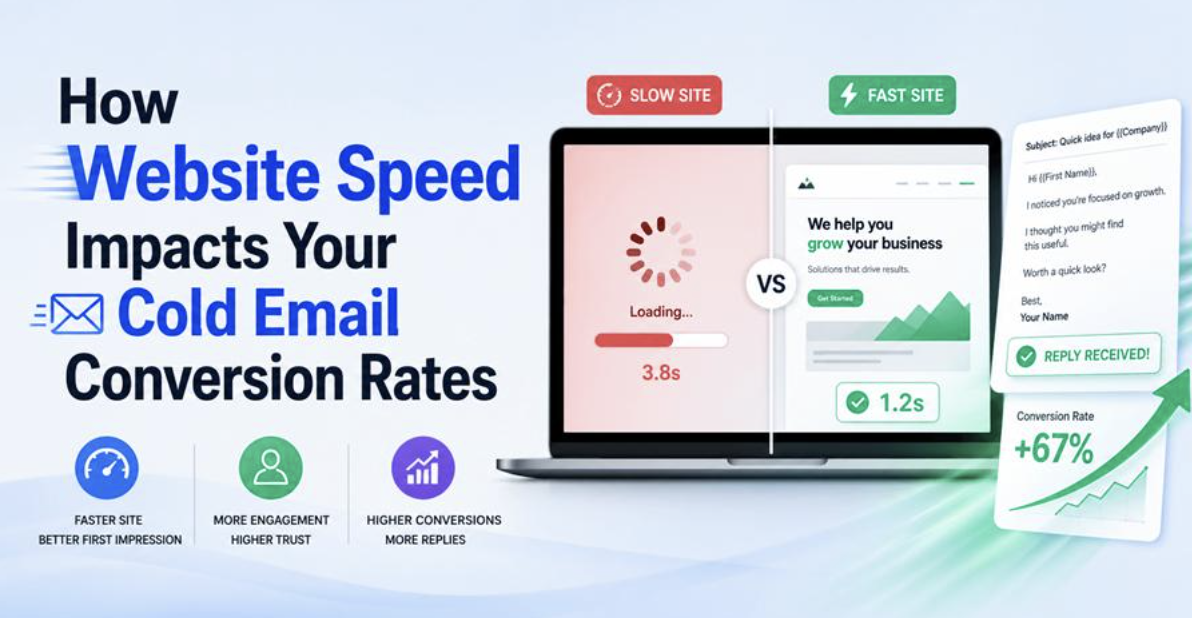
You’ve spent hours writing the perfect hook. You finally craft an effective cold email that cuts through the noise, lands in the primary inbox, and gets the prospect to click. Then… nothing. They wait three agonizing seconds for a white screen to render, lose their patience, and close the tab.
A slow website just killed your hard-earned lead. In 2026, where user attention spans are measured in milliseconds and web performance standards are stricter than ever, developers and marketers must realize that website speed isn't just an SEO vanity metric. It’s the rigid backbone of your entire outbound pipeline. You might absolutely nail your cold email outreach, but if your landing page takes longer than 2 seconds to load, your bounce rate will skyrocket, draining your campaign’s ROI.
This guide breaks down the technical intersection of server infrastructure and sales pipelines. We’ll explore exactly how page load times dictate your success in converting high-quality leads, the technical bottlenecks holding you back, and the architectural shifts required to fix them.
What it is: The direct correlation between your website's technical load time (measured in milliseconds) and the percentage of cold email recipients who successfully complete a desired action (conversion).
Key Metrics: Time to First Byte (TTFB), Largest Contentful Paint (LCP), and First Input Delay (FID).
Who it's for: Technical marketers, front-end developers, and revenue operations (RevOps) teams managing outbound infrastructure.
Current Status: In 2026, sub-second load times are the baseline expectation. B2B buyers operate heavily on mobile devices, making edge-delivered, hyper-optimized pages a necessity.
To understand why speed matters, you have to look at the anatomy of a click from a cold prospect. Unlike returning visitors or organic searchers who have high intent, cold email recipients have low initial trust and zero existing cache.
When a prospect clicks the link in your email, their browser has to perform a DNS lookup, establish a TCP connection, and negotiate a TLS handshake before any data is even transferred. For a returning user, DNS results and TLS sessions might be cached. For a cold lead in a different geographic region, this sequence takes time.
If your server takes another 800 milliseconds to process the request (TTFB) and another 2 seconds to download render-blocking JavaScript, that lead is already gone. Cold prospects are inherently skeptical. Any friction especially technical latency validates their subconscious desire to hit the "back" button and return to their inbox.
Tech readers expect data, and the performance benchmarks for 2026 paint a stark picture:
The 1-Second Rule: Sites that load in 1 second experience conversion rates up to 3x higher than sites that load in 5 seconds.
Abandonment Threshold: According to recent industry surveys, 53% of mobile users will abandon a page if it takes longer than 3 seconds to load.
The Post-Click Drop-off: Teams often see a 20-30% discrepancy between "Link Clicks" recorded in their email sending tool and actual "Sessions" in Google Analytics. This gap is almost entirely composed of users who clicked but bounced before the analytics script could even fire.


One of the most critical elements of a fast landing page is caching. Content Delivery Networks (CDNs) store copies of your site closer to the user. However, cold email campaigns often target diverse geographic regions simultaneously.
When a prospect from a new region clicks your link, the CDN edge node closest to them might not have a cached version of your page. This triggers a "cache miss," forcing the request to travel all the way back to your origin server. The result? A terribly slow initial load time for your most crucial targets.
This is why setting up a cache warmup strategy is non-negotiable for serious outreach campaigns. By proactively sending artificial requests to your CDN edge nodes before launching your campaign, you ensure that every asset is stored in memory globally. If you aren't sure how to warm up your website's cache, you are essentially playing Russian roulette with your first few dozen clicks in any new geographic territory.
If your conversion rates are bleeding out post-click, one of these three architectural flaws is likely responsible:
Marketers love data, which means landing pages are often bogged down by heavy client-side scripts: tracking pixels, session recording tools (like Hotjar), and live chat widgets.
If these scripts are placed in the <head> of your document without defer or async attributes, the browser will halt rendering the page until they are downloaded and executed.
Using a massive hero image or an autoplaying video might look great in Figma, but it’s a death sentence for mobile users on 4G networks.
Failing to use modern image formats (like AVIF or WebP) or neglecting to implement responsive srcset attributes guarantees a poor Largest Contentful Paint (LCP) score.
If your backend relies on a bloated monolithic database querying system to serve a simple landing page, your Time to First Byte (TTFB) will suffer. Choosing the right API search solutions makes pulling data simpler. It works best when landing pages are static (SSG) and come straight from an edge network.
Ready to stop wasting your leads? Implement this optimization checklist to align your infrastructure with your sales goals.
Transition to Edge Computing: Move your landing pages away from centralized origin servers. Frameworks like Next.js or Astro, combined with edge networks like Vercel or Cloudflare Pages, allow you to serve static HTML to users in milliseconds, regardless of where they are in the world.
Implement Aggressive Preloading: Use <link rel="preload"> for critical assets like your primary web font and hero image. This tells the browser to fetch these files immediately, bypassing the normal queue.
Defer Non-Critical JavaScript: Audit your third-party scripts. Move analytics, chat widgets, and retargeting pixels below the fold, or load them via a Tag Manager that delays their execution until after the primary page content is interactive.
Optimize the Critical Rendering Path: Inline critical CSS directly into the HTML document to avoid an extra network trip, and asynchronously load the rest of your stylesheets.
To visualize the impact, here is a comparison of two identical campaigns running on different technical infrastructures:
| Metric / Scenario | The "Slow" Funnel (Legacy Stack) | The "Fast" Funnel (Edge/Static Stack) |
| Emails Delivered | 10,000 | 10,000 |
| Email Click Rate | 3% (300 clicks) | 3% (300 clicks) |
| Page Load Time | 4.2 Seconds | 0.8 Seconds |
| Analytics Drop-off | 35% (105 lost leads) | 5% (15 lost leads) |
| Actual Sessions | 195 | 285 |
| On-Page Conversion | 2% | 5% |
| Total Conversions | 3-4 Leads | 14-15 Leads |
Notice how a faster load time not only preserves the traffic you earned but also increases the psychological likelihood of on-page conversion.
For maximum conversion, aim for a visually complete load time of under 1.5 seconds, with a Time to First Byte (TTFB) of under 200 milliseconds. Anything over 3 seconds will result in severe traffic abandonment.
Cold leads often arrive from varied geographic locations, creating "cache misses" if the page isn't stored locally on a CDN edge node. A cache warmup ensures the page is instantly available from memory for every single user.
High click-through rates paired with high bounce rates usually indicate a performance bottleneck. The user had the intent to view your offer, but the technical friction of a slow-loading page caused them to abandon the session before it even rendered.
Cache warming is the automated process of sending HTTP requests to your web pages immediately after a deployment or before a traffic spike. This forces the CDN to fetch and store the latest assets, ensuring real users experience zero latency.
Absolutely. In 2026, over 60% of B2B decision-makers read their initial emails on mobile devices. If your landing page isn't optimized for mobile network speeds and viewports, you are alienating the majority of your audience.
Static Site Generation (SSG) is vastly superior for cold outreach landing pages. Because the HTML is pre-built and distributed to the edge, there is virtually zero server processing time, resulting in instantaneous page loads and higher conversions.
 AI tools to find & convert leads.
  Send emails at scale